Claim: A Facebook user shared a flyer that claimed Ghana’s Deputy Education Minister, Dr John Ntim Fordjour, said no one can become rich as a “mere teacher.”
Verdict: False. DUBAWA’s investigations showed that Ghana’s Deputy Education Minister, Dr Ntim Fordjour, did not make the alleged claim. Reacting to the flyer, Ghana’s Ministry of Education described it as a “malicious and palpably false news card.” Also, Accra-based Citi FM, the flyer’s alleged originator, has denounced its content. DUBAWA later checked with the Facebook user and noticed he had deleted his post.
Full Text
A Facebook user shared a flyer that claimed Ghana’s Deputy Education Minister, Rev. Dr John Ntim Fordjour, had said one cannot be rich by being a “mere teacher.”
“Teachers do not need to own houses or cars and any luxuries; all they need are basic necessities like food and clothing. You cannot become rich by being a mere teacher,” the Deputy Education Minister said.
A screenshot of the post the Facebook user made
The social media user posted the flyer with this message:
“When you go to church today intercede for the man who spoke these words. I implore especially teachers to pray hardest. Your reward, as you have always been told, is in heaven. Pray without ceasing.”
The flyer featured the logo of Accra-based media outlet Citi FM.
DUBAWA’s Google Reverse Image Search showed that the flyer was widely shared on social media. See here, here, here, here, here, here, and here.
An X user, Mr Mawusi, who equally shared the flyer on Oct. 26, 2024, wrote: “Vote wisely.”
Another X user, Kojo Joey, wrote on Oct. 27, 2024, “School be scam.”
DUBAWA decided to probe the claim due to its virality on social media in West Africa.
Verification
DUBAWA’s investigations showed that Ghana’s Deputy Education Minister, Dr Ntim Fordjour, did not make the alleged claim.
“It is obvious the originators were actuated by malice in their bid to court public disaffection for the affable Deputy Minister for Education, whose record of public statements have always been courteous, kind, and made with absolute circumspection,” the statement Dr Fordjour sent to DUBAWA when contacted read.
Reacting to the claim, Accra-based Citi FM, the flyer’s alleged originator, has also denounced its content.
In a public disclaimer on X shared on Oct. 26, 2024, the media outlet wrote, “Fake! Please disregard this news card – it is not from us.”
The results of DUBAWA’s Google Keyword Search disclosed no reputable media organisation in Ghana has reported on the alleged claim.
Conclusion
The Deputy Minister of Education, Dr John Ntim Fordjour, did not say that no one can become rich as a “mere teacher.”
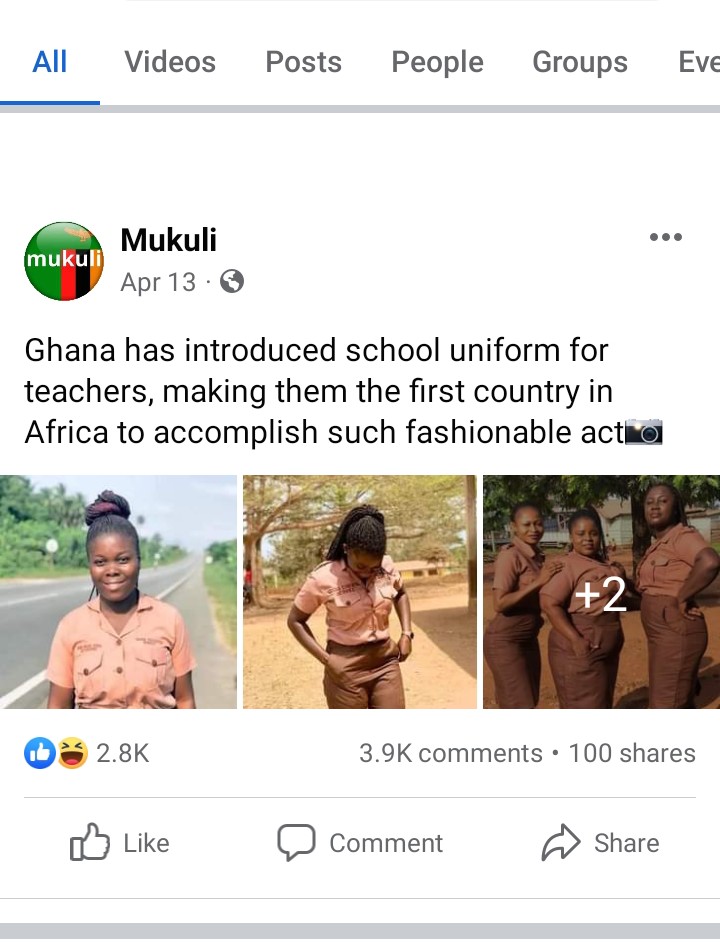
Claim: A Facebook user claims the Ghanian government has introduced uniforms for its school teachers.
The claim that the government of Ghana has introduced uniforms for its school teachers is false. The Public Relations Officer for the Ghana Ministry of Education and the Spokesperson, Ghana Ministry of Education, both confirmed that the information is false.
Full Text
For reasons such as equality, safety and sense of belonging, the concept of school uniform among primary and secondary schools in Africa has come to stay. Uniforms are the clothing students are required to wear at school. Schools often have specific styles and colours, “to identify students as attending a particular institution.”
Unlike students, school teachers in Africa are, however, rarely seen wearing school uniforms. Rather, they adopt corporate dresses as their dress code.
This claim surprisingly indicates that the Ghana government has implemented the wearing of school uniforms by teachers. The post was shared by this Facebook user. The post, accompanied by the post are pictures of some women and a man kitted in dull peach-coloured shirts and deep brown skirts and trousers, went viral and even resurfaced on Twitter. The chest pocket of the shirts reads ‘Ghana Education Service.’
The post, which has been widely shared and retweeted, has also caused controversial debates among users who saw the uniform as “unacceptable” and those who regarded it as ‘a welcomed development.’
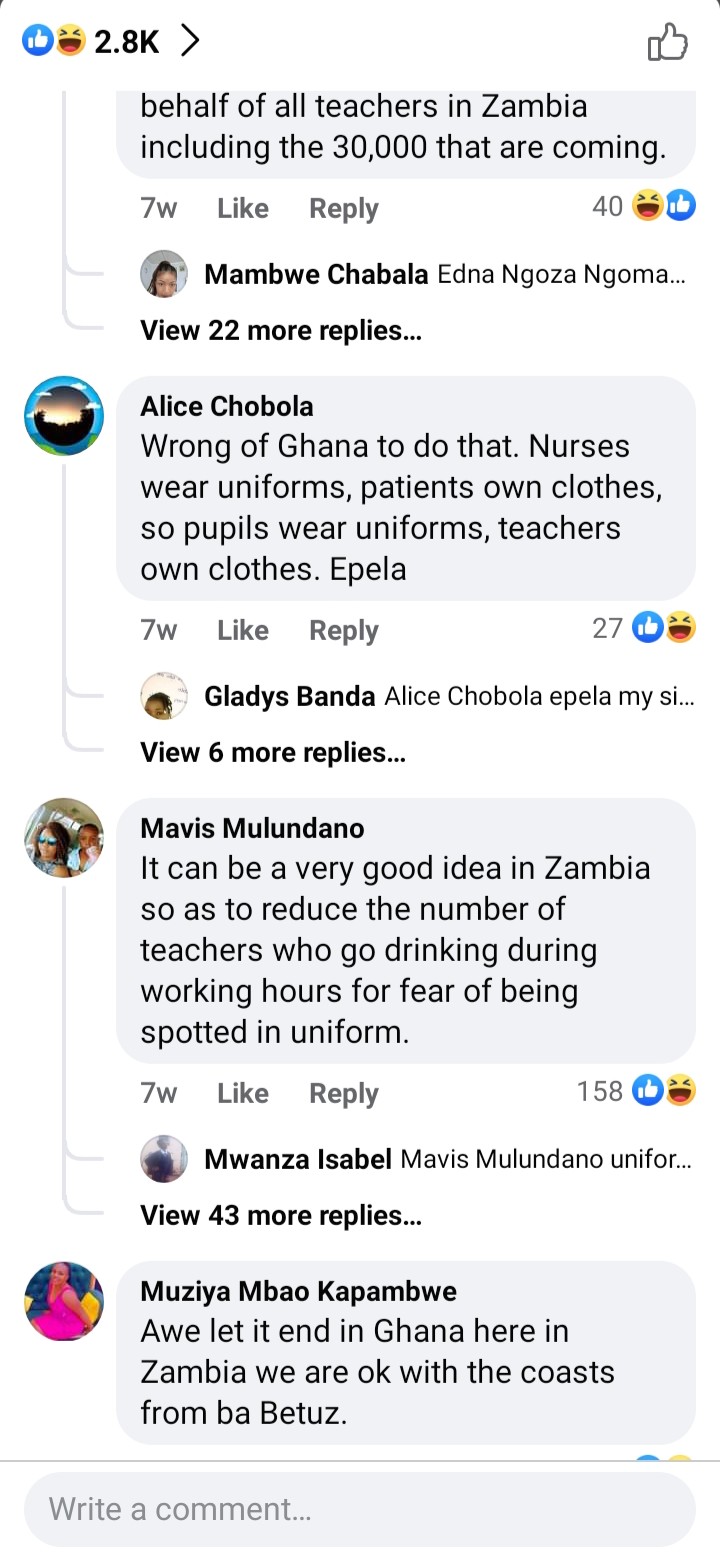
Reacting to the claim, Alice Chobola, a Facebook user, condemned the government’s act, saying it was not right for teachers to wear uniforms.
She wrote: “Wrong of Ghana to do that. Nurses wear uniforms, patients own clothes, so pupils wear uniforms, teachers own clothes, Epela.”
However, unlike Alice, Mavis Mulundano said introducing school uniforms to teachers will curb secret activities performed by them during school hours.
She wrote, “It can be a very good idea in Zambia so as to reduce the number of teachers who go drinking during working hours for fear of being spotted in uniform.”
One of the Facebook posts with over 2k likes, over 3k comments and 100 sharesA fragment of the many comments
It is due to this virality that DUBAWA decided to conduct a fact check.
Verification
DUBAWA first conducted a Google keyword search and discovered that the claim has also been published by this blog, this blog, and this blog. However, it was not reported by any credible news platform.
DUBAWA then contacted Cassandra Twum, the Public Relations Officer for Ghana Education Service. Bluntly but clearly, she discredited the claim, saying:
“Oh but this is an old fake story. Disregard! not true.”
Furthermore, DUBAWA also spoke with Kwasi Kwarteng, the Spokesperson of Ghana Ministry of Education who also debunked the news, saying in a WhatsApp chat:
“The Ghana Education Service has not approved of any uniform/attire for its teachers.”
Conclusion
The Public Relations Officer for Ghana Ministry of Education and the Spokesperson, Ghana Ministry of Education, have debunked the news. The circulating claim that the Ghana government asked its teachers to wear uniforms to work is, therefore, false.
WAEC says it is not collaborating with the Ghana education service for the upgrade of results.
Full Text
In anticipation of the 2021 West African Examination Council (WAEC) examinations conducted across West African countries such as Ghana, Nigeria, Sierra Leone and The Gambia and the subsequent release of the examination time table, a claim has surfaced on social media, particularly on Facebook groups about WAEC entering into collaboration with the Ghana Education Service (GES) to upgrade results.
“The accredited office of the West African Examination Council and Ghana Education service is still rendering its secure, safe and authentic Results upgrade and certificate generation services…assisting candidates gain admission to Tertiary institutions nationwide,assisting teacher trainees gain recruitment and creating links to civil service recruitment,” portions of the claim reads.
Dubawa contacted the attached WhatsApp number to find out how authentic this claim was. In a WhatsApp conversation with us, Mintah disclosed that this upgrade was a service that he has been providing for the past five years, adding that WAEC gave 300 slots for the upgrade of results.
He added that the objective of the upgrade of results is to help provide older candidates with better results to enable them access jobs within and outside Ghana and to further their education without any hindrances. The process, he indicated, is free but interested parties are required to purchase a form which costs ¢100.
Images: Screenshots of the chats
Dubawa then proceeded to contact the West African Examination Council (WAEC) through email to obtain the authenticity of this claim. The Examination body replied, saying it has no knowledge of such service and that it’s a scam.
Image: Screenshot of WAEC reply.
We again contacted Mintah Francis who is circulating the said claim and making attempts to justify its authenticity, informing him that such claim has been rendered as a scam by the WAEC.
He response was,
” We don’t need your ¢100 here.”
Image: Screenshot of the chat.
It’s worth noting that scams of this kind exist and students have been sacked from the various public institutions in the country over fake or falsified WAEC/SSCE results.
The West African Examination Council is not collaborating with the Ghana Education Service for the upgrade of results and its mandate does not include tampering with examination results in any way.
This report was produced under the Dubawa Student Fact-checking Project aimed at offering students in tertiary schools aspiring to take up roles in the profession the opportunity to acquire real-world experience through verification and fact-checking.
Claim: Ghana’s education minister, Matthew Opoku Prempeh, says Ghana has been ranked second in the latest Global Teacher Status Index
The Varkey Foundation which publishes the Global Teacher Status Index report measured teacher status using three different metrics. Ghana was 2nd in one, 5th in the other, and near-last in another.
Full text:
The Minister for Education, Matthew Opoku Prempeh says Ghana has been ranked 2nd in a new Global Teacher Status Index report. He made the claim while touting the Akufo-Addo government’s achievements in the area of education since it assumed office in 2017, at a recent Nation Building Dialogues event in Accra. [19:58 – 20:30 minutes]
“Interestingly, just two days ago, 22nd October [2020] there was a world ranking study that came out and Ghana was ranked second in the teacher survey. In the survey of 35 countries among 35,000 participants, the data gathered by the Global Teacher Status index group found out that for countries that respected teachers, did more for teachers, they improve their economies and others, Ghana was rated second after China,” the minister said at the event held on Thursday, October 29, 2020.
His claim has been published on various online news portals including Myjoyonline and EducationGhana.
We found that the Daily Guide newspaper in an online publication on October 22, 2020 also made the same claim.
But how true is this?
What is the Global Teacher Status Index
The Global Teacher Status Index is an in-depth opinion by Populus in 35 countries that explores the attitudes of people on different issues including fair salary for teachers, whether people think pupils respect teachers and how highly people rank their own education system.
The report is produced by Global education charity, the Varkey Foundation.
Regarding the Education Minister’s claim that Ghana ranked second to China in the Global Teacher Status Index released on 22nd October 2020, we confirmed from the Varkey Foundation’s website that it indeed published a report in October 2020 titled “Reading Between The Lines.” The foundation said the report builds on the data gathered in the 2018 report.
In that 2020 report, the status of teachers in the 35 countries surveyed was measured in three different ways.
1. Implicit Teacher Status
2. Explicit Teacher Status
3. Ranked Teacher Status
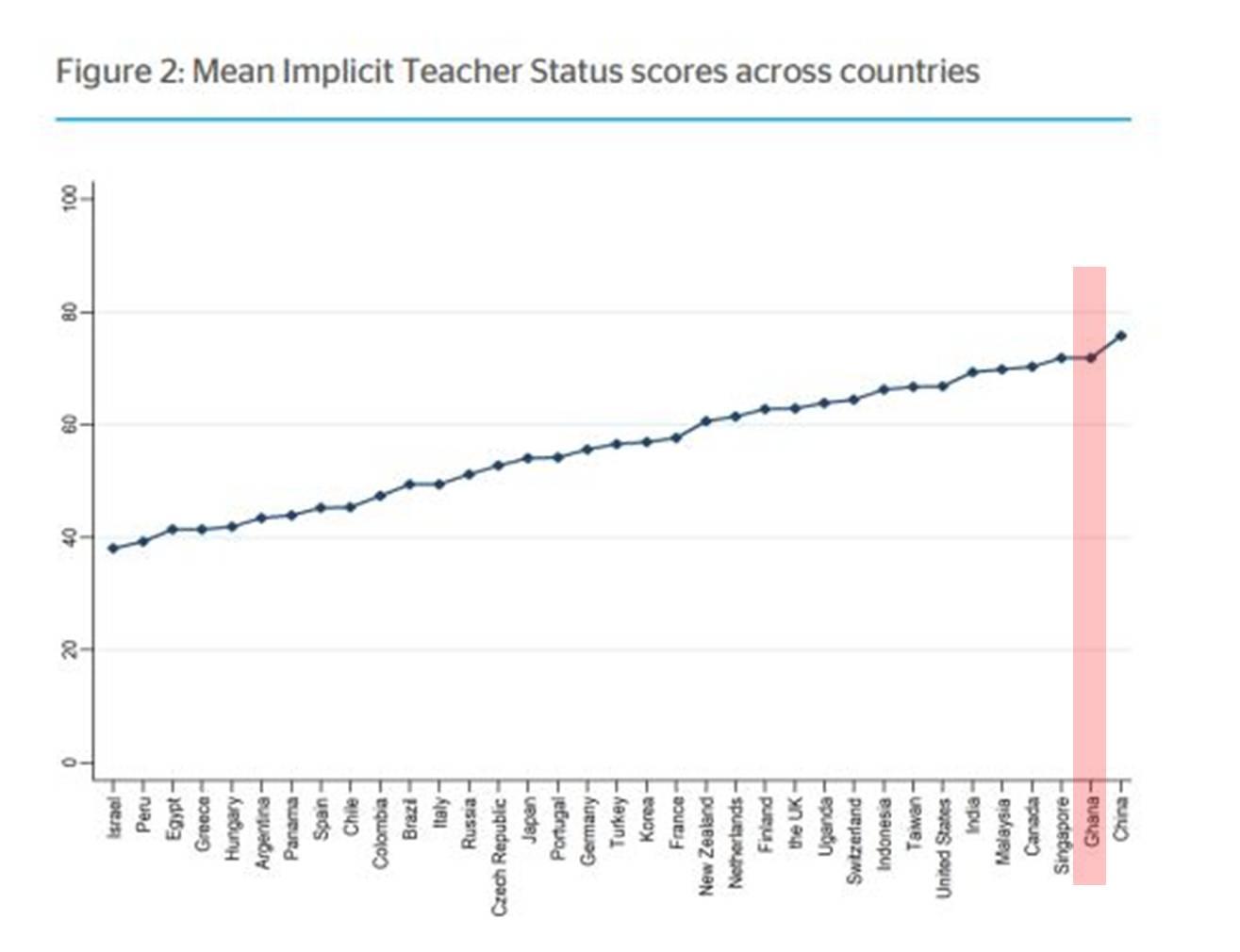
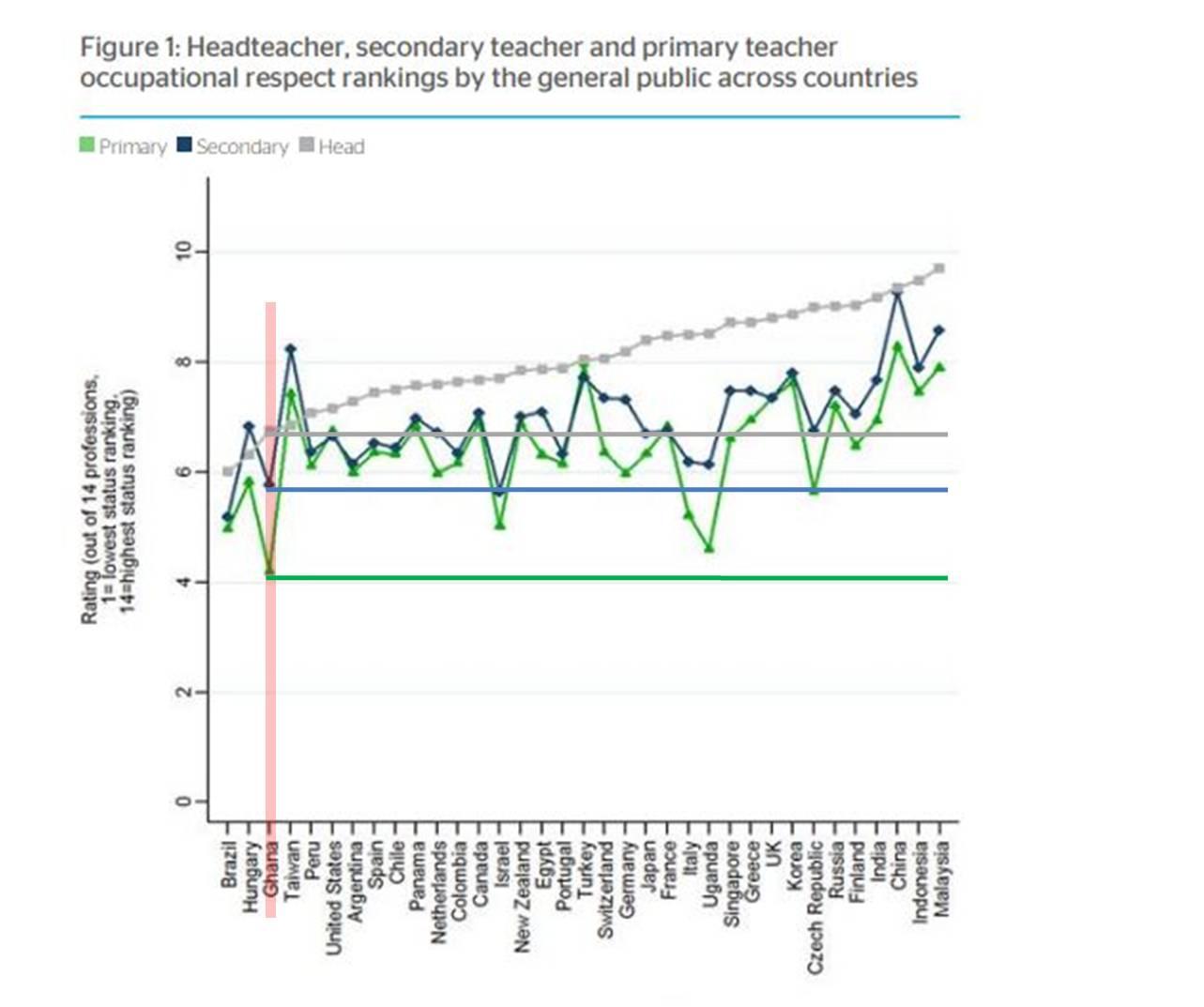
In the report, Ghana was ranked 2nd, 5th, and near last respectively on the Implicit Status, Explicit Status, and Ranked Teacher Status rankings.
Figure 1: Ghana was 2nd in the Implicit Teacher Status rankingFigure 2: Ghana was 5th in the Explicit Teacher Status rankingFigure 3: Ghana was near-last in the Ranked Teacher Status ranking
We see above that Ghana placed 2nd in only one of the three metrics used in the 2020 report the Education Minister referred to.
We reached out to the Varkey Foundation to seek answers to two issues:
1. The difference or relationship between the 2018 Global Teacher Status Index and the 2020 ‘Reading between the lines’ report.
2. Whether we can rely solely on the results of the Implicit Teacher Status ranking to determine Ghana’s position.
The Head of Advocacy and Analysis at the Varkey Foundation, Nicholas Piachaud, responded to our queries as follows:
“The two reports are both on teacher status and they’re both using the same data, but they’re measuring teacher status in different ways. In all, this research looks at four different ways to measure teacher status around the world:
1.The Global Teacher Status Index (2018 report): An index created by comparing a) how people perceive respect for teachers in their country against respect for other professions in their country, b) how perceived levels of respect for teachers differ from the nearest comparable professions in each country; and c) whether people in each country think that pupils in their country respect teachers.
Ghana ranks close to last in the Global Teacher Status Index (33 out of 35 countries for which we have data).
2.a. Implicit Teacher Status: (2020 report): A measure of teacher status based on people’s automatic reactions about teachers; that is what people seem to implicitly feel about them.
Ghana ranks second in the Implicit Teacher Status measure (2 out of 35 countries for which we have data.)
2. b.Explicit Teacher Status: (2020 report): A measure of teacher status based on what people explicitly say they think about teachers.
Ghana ranks fifth in the Explicit Teacher Status measure (5 out of the 35 countries for which we have data.)
2.c.Ranked Teacher Status: (2020 report): A measure of teacher status based on how people rank respect for primary, secondary and headteachers in their country against their respect for other professions in their country.
(Ghana ranks near last in the Ranked Teacher Status measure – our data show that people in Ghana think that primary, secondary and headteachers are significantly less respected than most other comparable professions in the country.)
The research seems to show that people in Ghana explicitly say and implicitly think very highly of teachers, but they believe that teachers are generally not as respected in the country as many other comparable professions.”
Conclusion
We find that “Reading between the lines,” the 2020 report on teacher status as reported by the Varkey Foundation measured teacher status in three different ways and Ghana was second in only in one of the three. Therefore, the claim is misleading as it clearly ignores Ghana’s position in the other two metrics used in the report.
The reporter, Jonas Nyabor, produced this fact-check under the auspices of the Dubawa 2020 Fellowship in partnership with Citinewsroom to facilitate the ethos of “truth” in journalism and to enhance media literacy in the country.