Featured

  • FALSE; President Akufo-Addo did not caution Ghanaians against a COVID-19 plan by Rockefeller Foundation

    President Akufo-Addo has, in an audiotape, warned Ghanaians of a Coronavirus plan reported in an article by the Rockefeller Foundation.

    The speaker in the audio is not President Akufo-Addo. Although a document published by the Rockefeller Foundation in May 2010 with a chapter titled ‘Lockstep’ was found, the chapter does not contain the exact content read by the speaker in the audio. 

    Full text

    The conspiracies surrounding COVID-19 do not seem to be tailing off, as a 14-minute audio purported to be from the President of Ghana, Akufo-Addo, warns Ghanaians to pay attention to an alleged extract from an article titled ‘Rockefeller Lockstep 2010’ on the Rockefeller website. 

    In the audio, the speaker’s main claim is on the Rockefeller Foundation’s detailing of a simulated global outbreak, the required steps involved, the various phases required, the overall timeline and the expected outcomes.

    Some of the plans and phases the speaker purports to be from the article include: 

    1.The creation of morbid viruses such as SARS, MERS and HIV in a laboratory to be stolen and smuggled to Wuhan, China as a pandemic.

    2. The Foundation’s plans to fund organisations such as WHO, CDC and the UN

    3. The creation and funding of a vaccination development plan, vaccination verification certification protocols, digital IDs to enforce the vaccination program after the mandatory rollout is enacted

    4. The control of a depopulation agenda 

    5. The establishment of public quarantine to destroy regions’ economy

    6. The creation of civil unrest, breakdown of supply chain to cause the start of mass food shortages, as well as weaken immune systems due to lack of interaction.

    The speaker further requested for the audio to be passed around to create awareness so that the document can be pulled down from the Rockefeller website.

    The audio circulating is accompanied by a message which reads:

    THIS VERY IMPORTANT SECRET AUDIOTAPE BY THE PRESIDENT OF GHANA MUST BE CIRCULATED TO THE ENTIRE HUMANITY FOR EXTREME AWARENESS OF THE CORONAVIRUS PLOT

    Verification

    The speaker in the audio

    It is evident that the voice of the speaker in the audio is not that of President Akufo-Addo. Yet, Dubawa further contacted the spokesperson for the President of Ghana, Eugene Arhin, who could not be reached yet. Additionally, Dubawa has contacted the Ministry of Information and awaiting a response.

    President Akufo-Addo has made no official announcements in any publication or on any platform concerning such a matter. Rather, he continues to publicly update Ghanaians on measures and efforts by the government to contain the spread of the virus.

    The content of Lockstep 2010

    Dubawa found a 54-page pdf document titled Scenarios for the Future of Technology and International Development – a report produced by the Rockefeller Foundation and the Global Business Network, published in May 2010.

    The document focuses on how technology can help in globalisation by using scenario planning to develop strategies to respond to each scenario over a period of years.

    On page 18 of the document, which contains that chapter on the ‘Lockstep’ as a Scenario Narrative, the document indicates the LockStep to be ‘a world of tighter top-down government control and authoritarian leadership with limited innovation and growing citizen pushback’. 

    It predicts and narrates a global pandemic expected in 2012, which would affect world economies and international mobility of persons. It is also expected to affect industries such as tourism and break global supply chains. Locally, the global pandemic is also expected to affect shops and buildings by keeping them empty of supplies for months. The chapter also predicts how the most pandemic-prepared and developed countries would be overwhelmed, as countries such as America would be unable to contain the spread whereas China would have a quick and effective enforcement of mandatory quarantine for its citizens. 

    The global pandemic is also predicted to result in mandatory wearing of face masks, body temperature checks at communal spaces, and states that Ghana’s government would have ambitious programmes to improve basic infrastructure and ‘ensure the availability of clean water for all her people’ which would lead to ‘a sharp decline in water-borne diseases’. 

    It stipulates that people would grow weary of so much top-down control and letting leaders and authorities make choices for them to the extent that there would be protests. It further predicts that developed countries would have innovations and technology whereas developing countries’ access to technology would remain limited.

    It finalises the import of this narrative and provides timelines for the occurrences from 2010 to 2030. 

    Photo source: Rockefeller Foundation document

    Although the Rockefeller 2010 Lockstep chapter Dubawa accessed contains simulations on a hypothesised global pandemic with indicated timelines with the purpose of using technology to enforce governmental control on citizens, the chapter does not reveal the exact claims made by the speaker in the audio, unless such claims are otherwise contained in another similar document. 

    It is, however, certain that the speaker is not the president of Ghana.

    Conclusion

    The claim that the president of Ghana has cautioned Ghanaians of a Coronavirus plan by the Rockefeller Foundation is false. President Akufo-Addo has made no official pronouncement or publication of such announcements to Ghanaians.

    Also, even though the Rockefeller Foundation document containing the 2010 Lockstep chapter simulates a global pandemic and predicts its global effects, the content is not the same as the claims the speaker makes in the viral audio. 

  • The facts about the Covid-19 app on Android and iOS mobile phones

    A Covid-19 tracker has been added in the settings section of every Android and iPhone 

    A Covid-19 Exposure Notifications feature has been jointly designed by Apple and Google for its mobile phone users. The feature is by itself not a tracker and is only functional when a corresponding Covid-19 tracking application is downloaded and when the Bluetooth on the device is enabled. The feature is built to assist government and health authorities with contact tracing as users are notified with anyone who was reported to have Covid-19.

    Full text

    It is expected that most people are wary of their privacy. That is why a viral WhatsApp message suggests a tone of caution, alerting Android and iOS mobile phone users of an inserted Covid-19 tracker in their phones found in the settings section. 

    The message reads:

    Attention

    COVID-19 sensor has been inserted into every phone. Apparently when everyone was having ‘phone disruptions’ earlier this week, they were adding COVID-19 Trackers to our phones!

    If you have an Android phone, go under Settings, then Google setting and it’s there. If you have an iPhone, go to settings, privacy, then health, It’s there but not yet functional.”

    Please check and confirm. 

    The message has also been shared on other platforms.

    Verification

    Dubawa followed the directives in the message and found a COVID-19 Exposure Notifications feature found in the Settings and Google Settings section for Android users, and in the Settings, Privacy and Health section for iPhone users.

    As the viral message indicated that the feature is not yet functional, the feature shows that it is turned off till the user’s Bluetooth is enabled. Additionally, there needs to be an installation or finishing of a participating app before the Covid-19 exposure notifications feature is turned on. 

    Further, as the message stated of a sensor and tracker, the feature indicates that the app installed ‘can notify you if you’ve been near someone who reported having COVID-19’ 

    An example from an Android phone shows in the photos below:

    Source of photos: Forbes 

    What is the Covid-19 Exposure Notifications?

    In April 2020, two technology companies Apple and Google announced a partnership of introducing a Bluetooth enabled technology that would assist governments and health authorities with contact tracing as a measure to reduce the spread of  Covid-19.

    Google explains that,

    “Exposure Notifications on your smartphone enables contact tracing apps to send you a notification if you’ve likely been exposed to Covid-19. Contact tracing apps will be developed by your local public health authority, not by Google or Apple”

    Apple further explains that this is “to enable a broader Bluetooth-based contact tracing platform by building this functionality into the underlying platforms.’’

    They added that “This is a more robust solution than an API and would allow more individuals to participate, if they choose to opt in, as well as enable interaction with a broader ecosystem of apps and government health authorities’’

    Both technology companies by detailing how the feature operates here and here, have also stated that this feature is built to protect users’ privacy and security. These include settings such as users’ control over whether or not they receive exposure notifications, the feature’s inability to track users’ location and the identity of users remaining unseen by Google, Apple and other users.

    Photo source: Forbes

    As explained by the tech companies, Covid-19 Exposure Notifications is not an application; however, it simply notifies phone users once the feature is turned on, and it is also only effective when a corresponding Covid-19 tracking application from the users’ government public health authority is installed. 

    Thus, for the Ghanaian context, for instance, the Covid-19 Exposure Notifications feature is built to be enabled by the Ghana Covid-19 Tracker app, once the app is downloaded.

    Dubawa spoke to the Regional Director of National Information Technology Agency (NITA), Richard Okyere-Fosu, who further clarified that this in-built Covid-19 Exposure Notifications feature on phones is totally different from the Ghana Covid-19 Tracker app launched by the Ministry of Communication in April 2020.

    ”This is different for the Covid-19 Tracker app. With our Covid-19 Tracker, you have to download it first,” Mr Okyere-Fosu stated. 

    Conclusion

    The viral message alerting Android and iPhone users of an inserted Covid-19 tracker is partly true. While it is true that a Covid-19 Exposure Notifications feature has been jointly designed by Apple and Google for its mobile phone users, the feature is by itself not a tracker. It is only functional by downloading a corresponding Covid-19 tracking application, as well as enabling Bluetooth on the smartphone. The feature is built to assist government and health authorities with contact tracing by notifying mobile phone users of anyone who was reported to have Covid-19.

  • What you Need to Know About Demolition of the Nigerian High Commission in Ghana

    Over the weekend, social media users in and out of Ghana were outraged over the news of the demolition of the Nigerian High Commission in Ghana, which according to the reports, happened on the night of Friday, June 19th. While some claimed that the High Commission itself had been demolished by armed men others said it was a building belonging to the Commission which had been pulled down

    1. The Building which was demolished

    Dubawa contacted the Nigerian High Commission which clarified that the demolished property was not the chancery but a building in the Commissioner’s Diplomatic Residence. 

    “It’s actually not the chancery. It’s actually one of our quarters, a building around the diplomatic residence…It is not the Embassy itself”, a staff of the Nigerian High Commission confirmed.

    Although both properties are located at Ridge in Accra, the Embassy is located behind the High Commissioner’s residence.

    2. Official Reactions from Nigeria

    Nigeria’s Minister of Foreign Affairs, Geoffrey Onyeama, through his official Twitter account, condemned the attack. 

    “We strongly condemn two outrageous criminal attacks in Accra, #Ghana, on a residential building in our diplomatic premises by unknown persons in which a bulldozer was used to demolish the building,” Mr Onyeama tweeted. “We are engaging the Ghanaian Government and demand urgent action to find the perpetrators and provide adequate protection for Nigerians and their property in Ghana…”

    3. Ghana apologises and says demolition “not a government-sanctioned activity” 

    According to a tweet from the Nigerian Presidency, President Akufo-Addo has, in a telephone call to President Muhammadu Buhari of Nigeria, apologised to the Nigerian government and indicated that the incident is under investigation. 

    The Ministry of Foreign Affairs, Ghana, had, a few hours after the news broke, apologised and denounced the attack which it says violates the Vienna Convention on Diplomatic Relations which states:

    “1. The premises of the mission shall be inviolable. The agents of the receiving State may not enter them, except with the consent of the head of the mission. 

    2. The receiving State is under a special duty to take all appropriate steps to protect the premises of the mission against any intrusion or damage and to prevent any disturbance of the peace of the mission or impairment of its dignity. 

    3. The premises of the mission, their furnishings and other property thereon and the means of transport of the mission shall be immune from search, requisition, attachment or execution.”

    According to a press release by the Ministry of Foreign Affairs, investigations are currently underway to bring out the facts of the matter and bring the culprits to book. The Ministry further assured the international community of Ghana’s commitment to ensuring the safety of members of the Diplomatic corps. 

    “The Ministry wishes to reassure the Diplomatic Community in Ghana and the Nigerian High Commission in particular, that Ghana remains a law-abiding country that upholds the principle of the rule of law, where due process is followed at all times. The government will, therefore, not relent in its primary obligation to guarantee the safety of Members of the Diplomatic Corp in Ghana” the Ministry said.

    Ghana’s Minister of Foreign Affairs and Regional Integration, Shirley Ayorkor Botchway, on a visit to the Commission on Monday, also said the incident was “not a government-sanctioned activity”.

    4. Controversies around ownership of the land

    The Paramount Chief of the Osu Traditional Area and the President of the Greater Accra Regional House of Chiefs, Nii Okwei Kinka Dowuona VI, has stated through a letter to Ghanaian Media houses, that the land on which the building was being put up on belongs to them, and therefore was being trespassed upon.

    “The said parcel of land and the entire Osu Mantse layout is not State Land but is a part of Osu Paramount Stool land and as such it is only the Stool that has the mandate to grant lease be it expired or otherwise,” the statement reads.

    “The said parcel of land is separate from that which is currently being occupied by the Nigerian High Commission,” it added.

    The statement further claims the structure was being put up by a Nigerian businessman with the help of the Nigerian High Commission for use as “an events center for commercial purposes and is not a block of flats as has been purported in the reportage.”

    Ms Botchway, however, indicated that even if ownership of the land is in dispute, it is expected that “the persons go to court because that is the normal way of dealing with such matters in this country.”

    The details that remain unclear presently is whether or not the portion of the High Commissioners Compound on which this structure was being erected constitutes the Commission’s land or the land owned by the Osu Stool. 

    The latter could constitute a breach of Article 41(3) of the Vienna Convention on Diplomatic Relations which states that, 

    “The premises of the mission must not be used in any manner incompatible with the functions of the mission as laid down in the present Convention or by other rules of general international law or by any special agreements in force between the sending and the receiving State.” 

    Same goes for Article 12 of the convention which also states that, 

    “The sending State may not, without the prior express consent of the receiving State, establish offices forming part of the mission in localities other than those in which the mission itself is established.”

  • Explaining the spike in Covid-19 recovery cases in Ghana

    As part of its routine update on the Covid-19 situation in Ghana, the Disease Surveillance Department of the Ghana Health Service and the Ministry of Health revealed that there had been a total of 10, 074 recovered cases, on 20 June 2020.

    The updated number of total recoveries indicated an increase of about 6,000 recoveries since the last update of 4,548 recovered cases the day before. This has consequently led to some Ghanaian social media users’ doubt in the sudden increase in recovery cases, as it is assumed to have happened overnight. While others have noted that the numbers are inconsistent with previous recovery rates, others have also requested for an explanation on the increase in recovered cases. 

    GHS announced an amended discharge policy before reporting the recovery cases

    What some Ghanaians may not have been privy to prior to the sudden spike in recovery cases is that an amended discharge policy was announced. 

    On 18 June 2020, two days before the ‘10,074 recovery cases’ was reported, the Director-General of Ghana Health Service, Dr Patrick Kuma-Aboagye, announced and explained the amended Discharge Policy for Covid-19 patients during a press briefing at the Ministry of Information. He later elaborated on the change in policy in some media interviews the same day.

    Dr Kuma-Aboagye stated that the new guidelines for discharging patients were in accordance with a revised policy from the World Health Organisation, and added that this policy of discharging patients was to take effect immediately. 

    The amended discharge policy explained

    At the press briefing, Dr Kuma-Aboagye stated new discharge protocols that had been agreed among some Ghana Health Service directors, stakeholders, and scientists indicating that resolution of symptoms, not tests, would be used in discharging patients. 

    He said that asymptomatic Covid-19 patients would be discharged 14 days after the initial positive test. By this, such patients who were mostly in isolation centres could be discharged and did not require any further tests to prove negative, as they were not showing symptoms.

    For symptomatic patients, he stated that they would be discharged three days after showing no symptoms, following 14 days after testing positive and responding to treatment. He further explained that for such patients who were mostly hospitalised and no longer pose any threat, they may now conduct their negative test at home and later go for a review as needed.

    According to Dr Kuma-Aboagye, even though some patients did not yet have their lab results in, the new guidelines permitted for a significant number of people to be discharged unless patients had other conditions.

    “We hope that will also allow us more time to focus on the new cases and be able to give more attention to those who are newly positive and then also create space in our facilities to be able to take care of new cases,” Dr Kuma-Aboagye said at the press briefing.

    An official at WHO Ghana also explained to Dubawa that using the new discharged criteria, patients no longer have to wait for long to be discharged in contrast to the previous criteria which necessitated patients to undergo two negative tests before they could be discharged.

    Are discharged patients considered recovered?

    Even though Dr Kuma-Aboagye had stated earlier that discharges were not the same as recoveries, yet following the new protocol, the Ghana Health Service is now counting discharges and recoveries together.

    “We do not intend to separate discharge and recovery”, Dr. Kuma-Aboagye  stated.

    In a press briefing on 23 June 2020, he explained that the recoveries are clinical recoveries which indicated that such patients are symptom-free and are unable to infect others, as a result, they were discharged and considered as recovered. 

    He stated further that all such persons should be received in society and not stigmatised. 

    Hence, the new protocol for discharging patients caused the spike in the number of recoveries while the gap between the announcement of the amended discharge protocol could have startled citizens about the sudden rise of patients leaving hospital after receiving full treatment, apart from staying in the hospital to take post-treatment testing. 

  • Is the claim of a pandemic every 100 years accurate?

    A viral social media photo purports that a pandemic has occurred every 100 years in 1720, 1820, 1920 and 2020.

    Although history records that disease outbreaks have happened during those periods, not all such outbreaks were actually pandemics and not all have occurred exactly in the years indicated. Furthermore, the occurrence of other pandemics within the period indicated demystifies the pattern of a pandemic only every 100 years. There is also no basis to prove such patterned occurrences.

    Full text

    Yet another theory surrounding the coronavirus pandemic is a claim that it is part of a pattern of pandemics every 100 years. A photo of an Instagram post indicates that a theory proposes the occurrence of pandemics every 100 years. The post further exemplifies a 1720 plague, an 1820 cholera outbreak, a 1920 Spanish flu and the 2020 coronavirus pandemic as proof of the theory.

    The photo, which appears to be an extract from a print publication on January 26, 2020, is captioned; “1720 Plague, 1820 Cholera Outbreak, 1920 Spanish Flu, 2020 Chinese Coronavirus- What’s happening?”

    It further reads; “There is a theory that every 100 years a pandemic happens. At first glance, nothing seems strange, but the accuracy with which these events take place is scary.”

    The photo has also been shared on Twitter and Facebook.

    Verification

    All Google Reverse image searches indicate that the photo is only associated with similar claims appearing on different platforms on the Internet. None of the searches shows the original source of the publication.

    However, all the outbreaks listed, and their corresponding years were verified.

    The case of the 1720 plague 

    The 1720 plague, also referred to as The Great Plague of Marseille, can not be considered a pandemic, contrary to what the post states. Both the World Health Organisation and the Centres for Disease Control define a pandemic as a worldwide spread of a disease usually affecting a large number of people. However, the 1720 plague, which lasted from1720 to 1723, occurred in the city of Marseille and did not affect people beyond France. 

    The plague is recorded to have been caused by fleas on plague-infected rodents from a docked ship in Marseille and killed an estimated number of 100,000 people in that city and surrounding provinces. 

    The case of the 1820 Cholera outbreak

    The Cholera outbreak first occurred in India in 1817 and lasted till 1824. The year 1820, therefore, is a period in which the outbreak lasted, not when it first occurred. However, 1820 is when it started becoming a pandemic, as it spread from India to affect and kill people in other parts of the world which makes the claim partly true.

    According to historical accounts, this first Cholera pandemic spread throughout India to modern-day Myanmar and Sri-Lanka in 1817, then in 1820, it spread to Thailand, Indonesia, Sri-Lanka and China. In 1821, it affected Europe, modern-day Turkey, Syria and South Russia. And in 1822, Japan was also affected. 

    The 1817 Cholera pandemic is recorded to be the first Cholera pandemic among seven Cholera pandemics that have occurred. 

    The case of the 1920 Spanish flu

    The claim of the 1920 Spanish flu shows inaccuracies in dates.

    The influenza occurred in 1918 and lasted till 1920. This contradicts the claim stating that the pandemic occurred in 1920; rather, it ended in 1920. The Centre for Disease Control indicates that the flu spread worldwide, thereby becoming a pandemic between 1918 and 1919. The flu spread from Europe, America and parts of Asia to other parts of the world.

    The flu, which was caused by an H1N1 virus is recorded to be the worst pandemic in recent history, affecting about one-third of the world’s population and killing an estimated 50 million people worldwide.

    The case of the 2020 ‘Chinese Coronavirus’

    The novel Coronavirus, Covid-19 was first reported in 2019 in China and was considered a pandemic in 2020 by the WHO, as it spread from China to affect and kill people around the world. 

    No correlation whatsoever

    Not only does the post inaccurately characterise the Plague as a pandemic, as well as show discrepancies in the dating of the occurrence of the Spanish flu, it also ignores other pandemics that have occurred before 1720 and within the 1720 -2020 year period. The occurrence of other pandemics consequently distorts the pattern of the 100-year occurrence of pandemics to show that pandemics have happened over the years in no specific pattern.

    Furthermore, some health experts have stated that although some viruses are seasonal, and some epidemics are also cyclical, the Covid-19, as a new virus, is unpredictable, and there is also no basis to prove that pandemics happen every 100 years.

    Conclusion

    The claim that a pandemic happens every 100 years is only partly true. Although all the outbreaks listed have occurred in history, the claim wrongly characterises the plague as a pandemic and inaccurately dates the Spanish flu pandemic. The claim also neglects other pandemics that have happened within the period indicated, which show that pandemics have happened over the years in non-cyclical order. Some health experts have also stated that there is no basis to prove the occurrence of pandemics every 100 years. 

  • Wrong photo used to portray Ghana Flag Designer, Theodosia Okoh

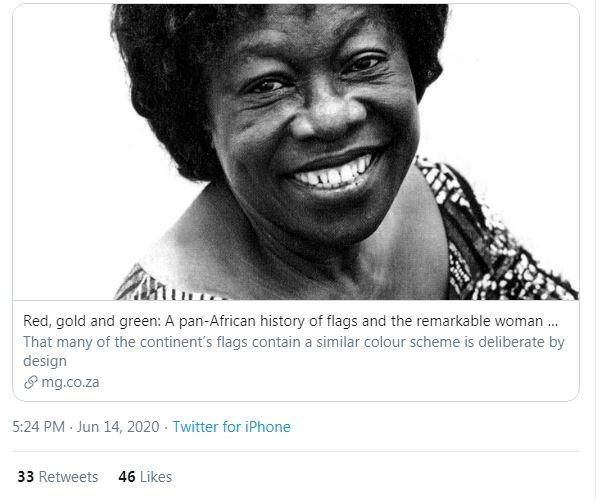
    A publication by the Mail & Guardian shows a woman purported to be Theodosia Okoh, the designer of the Ghana flag.

    The image used in the publication is not of Theodosia Okoh but rather of a Ghanaian scientist, Dr Leticia Eva Obeng, who, coincidentally happens to be her sister.  

    Full text

    A publication with headline “Red, gold and green: A pan-African history of flags and the remarkable woman who inspired it” comes with a black and white photograph of a woman portrayed to be the late stateswoman and designer of the Ghana Flag–Theodosia Okoh. 

    The article, which talks about the inspiring story of how Okoh designed Ghana’s national flag and how her contributions appear to be underplayed, was published on Saturday, June 13, 2020. 

    It has been shared multiple times and republished by other websites. 

    C:\Users\Jonas\Desktop\Fake.JPG
    Source: Twitter

    Verification

    Suspecting veracity of the image presented to be Theodosia Okoh, we used Google’s reverse image search tool to get details about the photo.  

    The results revealed that the image used in the publication is indeed not of Theodosia Okoh, the designer of the Ghana flag, but rather, of another Ghanaian, Dr Letitia Eva Obeng.

    Further briefs on Dr Obeng revealed that she is widely recognized as the “grandmother of female scientists in Ghana” and is the first Ghanaian woman to graduate with a bachelor’s degree in science, as well as the first to be awarded a doctorate in science from the Liverpool School of Tropical Medicine.

    She is currently 95 years old and launched her 381-page book titled ‘Anthology of a Lifetime’ in Accra in July 2019.

    A simple Google search of ‘Theodosia Okoh’ shows many different sizes of photos of a woman other than what was used in the news publication.  

    See the difference in the photos below:

    C:\Users\Jonas\Desktop\Dr. Obeng and Theodosia Okoh.jpg

    The photo on the left (Dr Leticia Obeng) is what was used in the news publication for Theodosia Okoh while the one on the right is the photograph of Theodosia Okoh. 

    While these two are very different people, it is important to mention that they are actually biological sisters born to the same mother (Madam Dora Asihene) and father (Very Reverend Emmanuel Victor Asihene, a former moderator of the Presbyterian Church of Ghana).

    Based on this mistaken identity, we conclude that a wrong image was used to represent Theodosia Okoh, a major cultural icon, in the news publication. 

  • How valid are apocalyptic interpretations about 2020?

    It has been five months plus into the year 2020 and the world is riddled with crises, such as locust invasions, protests against racial injustice, and an epidemic, that are unfolding amidst a global crisis.

    The global crisis, Covid-19 pandemic, has affected humans physically, mentally, emotionally, and spiritually. Millions of persons have been affected by the virus; minds have been exhausted from undesirable news stories; emotions have been elevated by fear, anger, grief, and uncertainty. And for those who are spiritually conscious, there has been an awakening of some sort.

    Particularly for a section of the Christian community, the awakening has been realized in various forms such as a call to repentance, a call to fasting, and a call to prayer. Although some have examined the source of, the reason for and response to the pandemic, others see the pandemic as a spiritual attack and the method to confront it as also spiritual. 

    It is, therefore, not surprising that members of spiritual sects of the Christian community, who consider themselves as spiritually aware,  view most life occurrences, if not all, with a spiritual lens

    It is in this vein that some people who identify with the Christian community, such as a Ghanaian Facebook user, have further attributed all the different crises that have happened and are happening to be signs of the end of the world. 

    In the Facebook user’s video post, the speaker is heard in an indigenous Ghanaian language, Twi. He narrates some incidents of invasions of locusts, hornets, and blackbirds that happened in different parts of the world and ‘diagnosed’ them to be an indication of God’s judgement on sin, and signs of the end of the world, thereby admonishing people to repent, referencing the Bible in 2 Chronicles 7:12.

    Other Significant Happenings that Shook the World

    Further, there are more highlights of news that have equally compelled a number of people to make apocalyptic claims of the year.

    January started with the news of a potential war outbreak between the USA and Iran, following the assassination of the Iranian General Qassim Suleimani. There was also news of intense wildfires in Australia owing to climate change which consequently killed people and destroyed homes and acres of arable land. Then, basketball icon, Kobe Bryant was reported dead with his daughter and nine other people in a helicopter crash. The month ended with the Brexit announcement, which is the day the UK left the European Union.

    February followed with an invasion of blackbirds in Kentucky in the U.S. The birds are reported to have darkened the sky before sunset, whitened the landscape with their poop while carrying diseases that could kill dogs and make human beings sick.

    In March, the novel coronavirus, Covid-19, intensified and was declared by the WHO as a pandemic, as the virus quickly spread beyond China, affecting and killing people all over the world. This necessitated several world leaders to put restrictions on the movement of citizens through lockdown and travel ban policies, ultimately having implications on world economies.

    In April, some countries in Eastern Africa, namely Ethiopia, Kenya, and Somalia were reported to have had an invasion of desert locusts. This invasion is reported to be a much more aggressive swarm of locusts since the last upsurge, and is currently destroying crops and threatening livelihoods in the sub-region.

    The month of May had, again, reports of locust invasion, this time, in India. This swarm locust had not invaded the country since the last 30 years and is also reported to be destroying croplands and affecting food supply in India. There were also reports of an invasion of murder hornets in the US, identified to have a negative impact on the environment and public health. 

    Then, there was news of the murder of an African-American man, George Floyd by a white police officer in Minneapolis, on May 25. This has caused ongoing protests across the country, as well as in other parts of the world, in a quest to fight injustice and systemic racism against black people.

    On the first day of June, DR Congo reported a new outbreak of Ebola in the country. The WHO has expressed concern as the outbreak has already claimed four lives in the western part of the country. 

    Pakistan is also reported to be invaded by locusts which are threatening the livelihood of people and food security. 

    For some, it seems to be getting worse by the day with an overwhelming number of unpleasant news. A study conducted by LifeWay Research in Nashville indicates that nine out of 10 pastors see evidence of end times in the current happenings around the world. 

    In view of this, best-selling author, Joel Rosenberg has said that;

    “For too long many pastors have shied away from teaching on birth pains and events leading up to the second coming, but the current pandemic demonstrates the need for solid, non-sensational preaching done in a biblical manner.”

    What does the Bible teach on end times?

    It is worth noting that, for the Christian community, the Bible is upheld as the source of all spiritual truths. Therefore, it is imperative to understand what the Bible teaches concerning signs of the end of the world and how to interpret them. 

    In the Bible, Jesus Christ, the source of the Christian faith, was asked by His disciples to indicate the signs of the world (Matthew 24:3). He mentioned that rumours of war, famines, pestilences and earthquakes in different places, offences, betrayals, hatred for each other, deception, lawlessness are truly some of the occurrences which must come to pass. Yet he encouraged  his followers not to be troubled by them because it is not yet the end. He added that all these are only the beginning of sorrows (Matthew 24:4-13). He revealed that the end will come when the Gospel of the Kingdom has been preached to everyone in every nation (Matthew 24:14).

    Are these crises an indication of God’s judgment and a need to repent?

    Barry Bennet, a Bible teacher and Missionary, shared his views on some of the current happenings, judgment, repentance and the end-time.

    “It is concerning how many Christians want to jump to the ‘day of wrath’ (Romans 2:5) and assume that God is behind a virus. Just because plagues and viruses are predicted in Scripture does not mean they are from God, nor does it mean that we are at the end of human time. Jesus called such things ‘the beginning of sorrows’. The gospel is not about afflicting humanity with judgments and sicknesses. God is not judging regions and nations. He told us to go into all the world and preach the Good News. He is not trying to kill everyone before we get there,” Barret stated

    He further explained that, contrary to what some Christians claim, plagues, viruses and other calamities are not an indication of God’s judgment of the world in order to bring people to repentance. He emphasised that God is good and instead, it is His goodness that leads people to repentance, referencing the Bible in Romans 2:4.

    “The Father is judging no one. The Son came to save the world, not judge it. The Word will judge those who reject Jesus, in the last day, not before. These truths are ignored by many who run to the Old Testament or Job for their understanding of God. In the rush to attribute plagues to God, they hurdle over Jesus and the New Covenant”, as he quoted John 5:22 and John 12:47&48,” he added.

    Furthermore, Barry emphasised that God is reconciling the world to Himself in Christ and not counting the sins of people against them, quoting 2 Corinthians 5:19

    “God has sent His church into all the world to proclaim the Good News of reconciliation. It would make no sense for God to bring destruction to the very people to whom we are sent with the gospel,” he concluded.

    The Gospel of God’s salvation and reconciliation is the very message Jesus stated in Matthew 24:14  would be preached to everyone in the world before the end itself comes.

    What Do You Think?

    Is 2020, for you, the beginning of the end? Do you believe your position is valid despite biblical positions on this matter?   

  • FACT-CHECK: Was a tribute read on Ghana’s behalf at George Floyd’s funeral?

    A tribute was read on behalf of Ghana and President Akufo-Addo at George Floyd’s funeral in the US.

    No tribute was read on either Ghana or President Nana Akufo-Addo’s behalf at the funeral service of George Floyd in the US. However, the country and its president were acknowledged for the solidarity shown to the family of Floyd.

    Full text

    Some social media posts shared by some influential persons claim that a tribute was read on behalf of Ghana and on the personal behalf of President Nana Akufo-Addo at the funeral service of African-American man, George Floyd, that was held at the Fountain of Praise Church in Houston, Texas on Tuesday, June 9, 2020.

    One of the posts reads: “Tribute read on behalf of @nakufoaddo and Ghana at the funeral of #georgefloyd.” Another read, “Tribute read on behalf of Ghana at the ongoing funeral for #georgefloyd.”

    The posts, accompanied by a one-minute-long video clip from the funeral, have reached thousands of social media users already. 

    Verification

    To verify the claim, we obtained a full video clip of the funeral service as streamed on Facebook by Yahoo News and reviewed the part that mentioned Ghana and President Nana Akufo-Addo. 

    At the one hour eight-minute mark, Ivy McGregor, Director for Social Responsibility for Parkwood Entertainment, was invited to deliver “resolutions”. 

    She read resolutions from Fountain of Praise Church, Greater St. Matthew Baptist Church, and the 1993 Class of Jack Yates Senior High School. 

    At 1 hour 14 minutes, she mentioned Ghana and President Nana Akufo-Addo. We have transcribed all she said about Ghana and President Nana Akufo-Addo below.

    [At 1:14:00 to 1:15:00]

    Ivy McGregor: “The family of George Floyd will like to acknowledge the message of solidarity, resolution and virtual tribute from His Excellency Nana Akufo-Addo, the President of Ghana. Yesterday, during the memorial, a video produced by the people of Ghana was broadcast for thousands of mourners as they paid their final respects to Mr Floyd. The family is honoured by President Akufo-Addo’s decision to have Mr Floyd’s name permanently mounted on the historic Sankofa wall at the Diaspora African Forum in the W.E.B Dubois centre in Africa.

    They are grateful that the country of Ghana stands with the Floyd family and the struggle of all families to change the status quo of racism and prejudice. The family is deeply moved by the generous act of the Ghanaian government to solidify George Floyd’s legacy.”

    McGregor subsequently acknowledged several individuals and institutions who had also expressed their solidarity with George Floyd. 

    To give a better context, we have defined the two keywords in this fact-check; Tribute and Resolution below: 

    Tribute: A tribute is a sign of respect or admiration, an award to honour a person’s accomplishments (according to Vocabulary.com).

    Resolution: A funeral resolution is a formal acknowledgement of the relationship between the deceased and a church community. It is delivered at a funeral to honour someone who has died by elaborating on his spiritual qualities and good works (according to dying.lovetoknow.com).

    Based on the above, it is clear that Ivy McGregor did not read a tribute on behalf of Ghana or on behalf of President Nana Akufo-Addo. She read three resolutions from different groups and only acknowledged Ghana and President Akufo-Addo for the solidarity for George Floyd and his family.

    Based on these facts, we conclude that the claim is false.  

  • Who lays claim to the Tema Motorway Interchange?

    The vehicular traffic situation in parts of Accra, owing to poor road infrastructure across the capital, has been a major and topical issue for years. It is unsurprising therefore that news about the construction or renovation of any road network in the country will be a subject of interest. One of such roads that sparked discussion recently is the Tema Motorway Roundabout. 

    Why has this roundabout been in the news?

    On Friday, June 5, 2020, President Akufo-Addo commissioned the roundabout although it had been opened to traffic since Saturday 16 May 2020. Subsequently, there has been some controversy about the rights of claim to the project. 

    The National Democratic Congress (NDC) has called on the ruling government to give credit to former President John Mahama for the project. They argue that the former president had cut sod for the construction of the road during his tenure, a formality they claim was repeated by the Vice President, Mahmoud Bawumia.

    The evidence adduced for this comes from an article by ghanapolitics.com. That, however, was not about the Motorway Roundabout project but rather a flyover project which was to link Spintex road to East Legon. They are two different projects.

    Social media users have also not been left out of the discussion. A post on Facebook, which has since been removed, suggested that President Akufo-Addo did not have the right to commission a project undertaken by his predecessor. According to the post, former President John Mahama is the person responsible for the project’s realization and should, therefore, be the one to commission it. The post was met with a lot of backlash by users of the platform and members of the group on which it was posted, owing mainly to the nature of the language used in the post.

    A Little Background of the Motorway Roundabout and the Project

    The Tema Motorway Roundabout is a highly used point for traffic from Accra, Tema and environs. The intersection used to be prone to severe traffic congestion, especially during rush hour owing to heavy use of the intersection. In response to several complaints by road users, the Government of Ghana requested the assistance of the Japanese Government to improve the situation at the interchange. 

    The request was to cover a two-phase construction of flyovers to improve traffic flow at the intersection. A preparatory survey on the project was entrusted to the Japan International Cooperation Agency (JICA) and was scheduled to take place from March 2015 to March 2017.

    The period stated for the implementation of the project was estimated to be eight months for detailed engineering design and 36 months for construction work.

    Some Details on the Project: Who Did What?

    The Government of Ghana, led by then-President, John Mahama in 2013 requested the grant from the Japanese Government to implement the Tema Motorway Interchange project.

    The grant signed was to cover two programmes:

    “(1) The Programme for Improvement of Ghanaian International Corridors (6,259 million yen)  

    (2) The Programme for Poverty Reduction Strategy (Health Sector) (200 million yen)”.  

    The first programme was to feature the building of an underpass at the “Tema Motorway Roundabout and conduct detailed design improvements for the rehabilitation of National Trunk Road N8 in the Central Region”. This is in the bid to ensure safe, efficient “road transportation and contribute to the efficient flow of goods between international corridors (the Lagos-Abidjan Highway and the Eastern Corridor of Ghana).”

    The project was mentioned in both the 2016 Budget Statement and Economic Policy of Ghana, and the 2016 State of the Nation Address delivered by the Finance Minister Seth Terkper and John Mahama, President of the Republic of Ghana at the time, respectively. The Budget Statement stated that discussions on the Accra-Tema Motorway project design concept and the draft agreement were ongoing with detailed feasibility studies and designs to commence in 2016 while the State of the Nation Address noted that,

     “Preparatory works for the redevelopment of the Accra-Tema Motorway into a six-lane road with 4 interchanges at Adjei Kojo, Abattoir, Teshie Link, and Tema Roundabout will commence soon”.

    John Mahama added that the project was ongoing in his State of the Nation Address, as seen on the Official Twitter account for @NDCGH when in actual fact it did not commence until 2018.

    According to a press release on the website of the Japan International Cooperation Agency (JICA), the contract for the grant was signed with the Government of Ghana to provide grant aid of up to the sum of 6,259 million yen for the execution of two programmes in March 2017. JICA’s role here was to provide the road infrastructure to support Ghana’s efforts to enhance transportation capacity with the goal of improving the flow of goods between international corridors with the execution of the project by Messrs Shimizu Dai-Nippon, a Japanese construction firm.

    Vice president Mahamadu Bawumia cut sod for the commencement of construction works on the Tema Motorway Roundabout in July 2018.

    President Akufo-Addo commissioned phase one of the Tema Motorway interchange on Friday, June 5, 2020, with a pledge to commence phase two of the project in the fourth quarter of  2020.

    Conclusion

    It is fair to say that both administrations played a part in the realization of the motorway roundabout expansion project, from conceptualization, initial groundworks to execution. The John Mahama-led administration started the ground-works for the Tema Motorway Roundabout project. However, the signing of the contract securing the grant and its execution was carried out by the current government led by Akufo-Addo. And contrary to the Facebook post, as the head of the present government, President Akufo-Addo is in order to commission the project.

  • New Ebola cases: True or False?

    A Twitter user says “It’s all a lie; there is no case of Ebola.”

    Completely false; there is a new outbreak of Ebola in the Democratic Republic of Congo (DRC) even as the country still fights a previous outbreak. 

    Full text

    A Twitter user claims that there is no case of Ebola.

    “ WE JUST SCANNED ALL NECESSARY FILES AND CONFIRMED THAT THERE IS NO CASE OF #EBOLA, IT’S ALL A LIE. WE WILL KEEP EXPOSING THESE LIARS”.

    Image source: Twitter.com

    The tweet has been retweeted over 1000 times and has garnered over 9000 likes since it was posted on June 1, 2020.

    Verification

    A WHO news release on June 1, 2020, says that the Government of the Democratic Republic of Congo had announced the outbreak of a new Ebola virus in the northwestern part of DRC, specifically in the Wangata health zone, Mbandaka and in the Equateur province. This will be the 11th outbreak of the Ebola virus in the country since its discovery in 1976.

    The official Twitter account for the World Health Organization (WHO) in DR Congo reported that the agency is holding meetings to work out modalities on how to handle the case. The tweet suggests that training of local vaccinators would commence on Friday to help mitigate the crisis. 

    DRC was already battling an Ebola virus outbreak which began in 2018. WHO says that outbreak is now in its final phase, in the eastern part of the country. The virus has claimed over 2243 lives, as of May 25, 2020.  This outbreak was the 10th outbreak in North Kivu and Ituri provinces of the DRC.

    According to a news release, the Ministry of Health on May 14 began a 42-day countdown to declare the end of the outbreak(for a country to be declared Ebola-free, there needs to be a 42-day no new case report).

    Not only is there a new wave of Ebola virus outbreak in a different part of the DRC but also a host of other health issues as well. Alongside the new outbreak, the country is currently dealing with the Covid-19 pandemic, an outbreak of what the WHO calls “the world’s measles outbreak”, mpox, poliomyelitis and cholera. 

     “It’s happening at a challenging time, but WHO has worked over two years with health authorities, Africa CDC, and other partners to strengthen national capacity to respond to outbreaks,says Dr Matshidiso Moeti, WHO Regional Director for Africa.

    The Account behind the Claim

    The account which tweeted the false claim, as noted by a few comments under the tweet, is a ‘parody account’ (fake account) which was created in April. Strangely, it has a lot of followers, 5190, but follows no one. 

    The bio of the account, “We are Anonymous, We are legion , We do not forgive , we do not forget , expect us , PARODY ACCOUNT”, which conforms with Twitter policy for parody accounts to indicate with words such as ‘parody’, ‘fake’, ‘fan’ as a giveaway that it is not a trustworthy account and source of information. 

    In addition, since its creation, the account has tweeted six times with three of them claiming to have evidence of the source of wrong deeds. The other tweets are duplicated – another telltale characteristic of parody accounts.

    A bit about Ebola

    The Ebola virus was first identified in 1976 in Central Africa with the first outbreak recorded in DRC in a village near the Ebola River. The second outbreak occurred in South Sudan. The virus later hit West Africa around 2014-2019, spreading rapidly to become a global pandemic within months of the outbreak. The Ebola outbreak was a global health scare with high fatalities in countries like Sierra Leone, Liberia, Guinea, and DRC. 

    In West Africa, the Ebola virus was first reported in 2014, recording 11,315 deaths by January 2016. This figure, according to the WHO,  is just an estimate due to difficulty in collecting data in the country. 

    Conclusion 

    Contrary to the claim, the Democratic Republic of Congo (DRC) is facing its newest and 11th wave of Ebola outbreak. This was announced by the government of the DRC on June 1 this year.

Back to top button