Featured

  • These are the facts about FDA’s recall of dietary supplement, COA FS

    Popular drug which was alleged to cure coronavirus, COA FS, has been recalled by the Food and Drugs Authority – news websites

    True, the FDA issued a release on April 17, 2020, notifying the public that the drug has been recalled over contamination.

    Full Text

    COA FS is a locally manufactured drug in Ghana, which serves as a dietary supplement to support the Human Immune System to help fight a variety of diseases.

    The drug was approved by the Food and Drugs Board as an immune booster for general well-being and was officially launched by its manufacturers, the Centre of Awareness Global Peace Mission, on June 11, 2019.  

    Although a number of Ghanaians have attested to the drug’s efficacy after usage, the drug gained its utmost prominence among Ghanaians last month when it was alleged to be a cure for the novel COVID-19. 

    It is on this premise that Dubawa took to verifying developing claims on the drug. 

    Dubawa found that Professor Samuel Ato Duncan, the executive president of the centre, had suggested to the government and research institutions globally to further research the drug to determine its effectiveness against COVID-19 on the basis of its immune-boosting potential.  

    Thereafter, stories emerged revealing that Ghana’s leading research institution, the Noguchi Memorial Institute, had responded to this suggestion by the manufacturers of the drug, adding that ‘clinical trials were ongoing on the drug’ to properly test and assess it. This was a process that was ongoing at the Institute, the Food and Drugs Authority, and the Centre for Plant Medicine.

    Yet, some news sites had headlines which claimed the Institute had approved the drug to fight coronavirus. 

    Dubawa further found that Noguchi Memorial Institute and the Food and Drugs Authority had both refuted the claim that the drug had been approved as a coronavirus cure.

    Subsequent to this, a news report flagged to fact-checkers by Facebook as part of its Third-Party Fact-Checking Partnership claims the popular immune booster, COA FS, has been recalled by the Food and Drugs Authority (FDA).

    Verification

    Dubawa found that the Food and Drugs Authority (FDA)  issued a press release on April 17, 2020, notifying the public of a recall of COA FS as a result of laboratory analysis of samples of the drug which indicated excessive microbial, mold, yeast and E. Coli contamination.

    The FDA indicated in the release that the contamination poses serious health risks such as abdominal pain, nausea and vomiting to consumers and that it can also lead to kidney failure and weakened immune systems. 

    Dubawa also spoke to the Head of Communication at Food and Drugs Authority, James Lartey, who confirmed the information. He stated that the contamination is subsequent to the approval of the drug by the FDA, although it appears it has been there for some time. 

    Mr Lartey emphasized that the drug itself is a good product and that it is just unfortunate that samples on the market have been contaminated. 

    He further stated that the recall does not affect the registration of the COA FS drug by the FDA in any way.

    The FDA, in interviews with the media, has defended its claims and explained how it arrived at the conclusion that the drug is contaminated.

    Manufacturers Contest FDA’s Claims

    The manufacturers of COA FS are however contesting FDA’s claim. In a press statement on April 21, they stated that results of microbial tests conducted on their product by the microbiology department of the Cape Coast Teaching Hospital do not support the FDA’s claims of contaminations. They added that similar tests are being conducted in other independent laboratories.

    Conclusion

    The COA FS drug, an immune booster, which has recently gained popularity among Ghanaians as a potential cure for Coronavirus, has been recalled by the FDA, following laboratory results which indicated contamination of samples of the drug. The Head of Communication at the FDA, Mr Lartey, has stated that the recalling of the contaminated drugs does not, however, affect the registration of the drug under the FDA.

  • How Pictures of Food Distribution Taken Out of Context Were Used to Ridicule Ghana

    In their bid to assess how well Ghana fared in the distribution of food to its citizens during the coronavirus-imposed lockdown, some social media users deployed genuine photographs taken out of context. They then concluded that Ghana did poorly than Rwanda, Niger and Nigeria.  

    The photos have been taken out of context. The one purported to have been from Rwanda was originally taken in The Gambia and is a photo of food distributed during Ramadan. The other sets of images also are scenes from Senegal and not Niger or Nigeria as claimed by social media users.

    FULL TEXT 

    Restrictions on movements were imposed in Ghana on March 31, 2020, to help mitigate the spread of the coronavirus pandemic in the country. The government, in its bid to support the less privileged in the affected communities, began a daily distribution of cooked and packed food. 

    Following the commencement of the exercise, some of those who received the daily meals complained of unfair and haphazard distribution of the food packs. This resulted in the comparison of relief items being shared to the needy in other countries to what is being done here in Ghana, with the conclusion that Ghana’s efforts are not “good” enough. 

    Following this report, images started being circulated on Facebook by individuals about food being distributed in various countries during the coronavirus-imposed lockdown.

    One of these images is claimed to be of Rwanda’s relief items, ready for distribution to those in need and packed in neat stacks. The picture was accompanied by the words: “This is what Paul Kagame of Rwanda presented to each family before the partial lockdown. Visionary leader.” 

    This post alone has generated 1502 shares and over 139 likes.  

    Source: Facebook.com

    Another set of images which have gone viral has been shared by other Facebook users with different captions. Whereas some users claim that the images were of food distributed by the government of Niger, others said the same images were about Nigeria. The posts convey the message that while its contemporaries are providing significant support to their citizens during the lockdown, the government of Ghana has been remiss in doing the same. 

    Source: Facebook.com
    Source: Facebook.com

    VERIFICATION

    Dubawa found that all the images are original photos taken out of context.

    A reverse image search conducted on the purported  Rwanda relief items revealed that the picture is actually of food distribution to the needy in the Gambia and not in Rwanda. The picture had been in existence even before the outbreak of the COVID-19, weeks before declarations of lockdowns in sub-Saharan Africa. 

    The items in the picture were distributed in the month of Ramadan by Iman Jaiteh Charitable Foundation to help the needy in villages, schools and orphans in 2019 as seen in this feature here

    Niger or Nigeria?

    The other sets of photos are neither from Niger nor from Nigeria. 

    Our search revealed that the lead person in the photo is Macky Sall, President of the Republic of Senegal. According to our findings, the bags of rice in the photo are of the first batch of emergency food aid for Senegal during the COVID-19 pandemic period. The photo and other related images were posted on the official verified twitter page of the Senegalese President on April 11th 2020

    Other posts related to the first tweet revealed a video showing the bags being rounded up with the caption “Together and united to face the socio-economic consequences of the pandemic #COVID19sn,” proving the affiliation of the photos to Senegal and not Niger or Nigeria.

    I received the first batch of food today as part of the emergency food aid. It is also an opportunity to salute the responsible behaviour of the Senegalese in the face of the pandemic. Compliance with the measures to support Gvmt’s efforts in the fight against #covid19,” President Macky Sall said in the twitter post.

    The news of that exercise was carried by the Senegalese media as seen here.

    Conclusion

    Governments are tackling the effects of COVID-19 pandemic in different ways. Some are providing cooked food for their citizens, some are giving cash to citizens while others are distributing uncooked food items. This is based on their individual ability and plans put in place by the various countries. It is important to note that false claims pertaining to which country is doing better than the others should be avoided, to prevent the incitement of anger and possibly violence.

  • Is Sobolo the magic cure for coronavirus?

    Let’s use traditional medicine to cure COVID-19 because China used just ‘SOBOLO’ to cure theirs.

    The claim is inaccurate. The hibiscus flower has not been proven or approved as a singular cure for the coronavirus and China has not ‘cured’ the virus by using the plant. The articles cited in the viral video did not name hibiscus (sobolo) as a coronavirus cure.

    Full Text

    A drink or tea made from hibiscus flower, known in Ghana as sobolo and in Nigeria as sobo/zobo, according to a viral video, has been used by China to cure the novel coronavirus, Covid-19. 

    The video, which we also found on One Ghana TV via Facebook showed the Executive Director for Soul Health and Wellness Center, Nana Okogyedom Ntim-Barimah, popularly known as Oheneba, in an interview with Kofi Adomah Nwanwani of Kofi TV

    The video was captioned “Lets use traditional medicine to cure COVID-19, because China used just ‘SOBOLO’ to cure theirs.”

    In the interview, Nana Ntim-Barimah claimed the Chinese used ‘sobolo’ to cure the COVID-19 and called on Ghanaians to do the same.  

    “These people are deceiving us. They are deceiving us seriously because they have made up their minds to use us as their market…Do you know sobolo? It is the hibiscus flower that is called Sobolo. The Chinese are using it to treat coronavirus and we are sitting here waiting for WHO to say a medicine has been found. May God have mercy on Africans,” Nana Ntim-Berimah said.

    The video has been shared over 8500 times on One Ghana TV alone and has 104,475 views on YouTube.

    In the video, Nana Ntim-Berimah refers to two articles which he suggests have information on the use of the flower as a cure for the coronavirus in China. Dubawa checked this claim.

    Verification

    There is widespread use of Traditional Chinese Medicine (TCM) by China to treat Covid-19.  Information available indicates that TCMs are highly valued by the Chinese government and have been recommended by its health ministry to be used together with conventional medicine in the treatment of Covid-19. 

    On 17 February, the National Health Commission of China (NHC) announced that 85.20% of the 60,107 confirmed cases at the time had been treated with TCM.

    A YouTube live news post by CGTN also showed how Chinese frontline doctors in China are using TCM to fight the coronavirus pandemic.  According to this video, TCM has proven to be effective in the treatment of Covid-19 cases in China and has also been found effective when complemented with western medicine. The video also states that 90.6% of COVID-19 patients have been given TCM treatment in Hubei. 

    Sequel to this, advocates of traditional medicines and herbs have called on the government of Ghana to follow the Chinese example and consider using some traditional medicines in the treatment of patients.

    Delving into the Claim

    Two articles were mentioned and referred to by Nana Ntim-Berimah in the video which he credits for the information on hibiscus as effective cure for coronavirus in Ghana, as it has been in the case of China.

    The first one, “Traditional Chinese Medicine in the Treatment of Patients Infected with 2019-New Coronavirus (SARS-CoV-2): A Review and Perspective” published in the International Journal of Biological Sciences discusses the beneficial effects of traditional Chinese medicine (TCM) use in the treatment of the 2019-nCov as, according to the study, more than 85% of infected people in China are being treated with TCM.  

    Dubawa found that the article does not mention that the hibiscus flower has been used for the treatment of Covid-19 in China. In fact, hibiscus is not mentioned in the article at all.

    The article does, however, note that some TCMs have been used in treating Covid-19 patients in a protocol that involves clinical trials to ascertain their effectiveness.

    What is important to note here is that these TCMs are composites of various herbs and tackle various symptoms which may be related to covid-19. For instance, the Yu Ping Feng San TCM formula contains Astragali radix (Astragalus root), Astragalus membranaceus( Astragalus flower), Atractylodes macrocephala, and Saposhnikoviae Radix which helps in protecting against external pathogens and have antiviral, anti-inflammatory and immunoregulatory effects.  

    Furthermore, different TCMs are stated to be used for different conditions. For instance, for fatigue and fever, TCM recommended by the 6Th edition Guidelines of Diagnosis and Treatment for COVID-19 is Lian Hua Qing Wen Capsule, Shu Feng Jie Du Capsule, and Jin Hua Qing Gan Capsule. This differs from Shen Fu Injection which could inhibit the inflammation of the lungs. 

    No singular herb or medication was identified to cure Covid-19.

    The article cautions that most of the clinical studies to test the efficacy of TCMs are poorly designed and that the results could lead to potential biases in evaluating the effectiveness of TCM treatment. It further states that herbs used in TCM may mimic, or magnify, or counter the effects of conventional medicines, therefore calling for further evaluation of the safety of TCM. 

    The second article, High antiviral effects of hibiscus tea extract on the H5 subtypes of low and highly pathogenic avian influenza viruses, was published in May 2016 and has nothing to do with the novel coronavirus. The study was conducted by a group of scientists in Japan, Vietnam and Thailand. 

    In fact, the article talks of the H5N1 highly pathogenic avian influenza virus (HPAIV) and how some selected tea extracts, including the hibiscus tea, had effects on the H5N1 HPAIV. 

    The abstract of the article also shows that Nana Ntim-Barimah left out the part that said the herbs were screened against the H5N1 HPAIV in vitro.  

    According to information from the CDC, the H5N1 HPAIV is a virus that mainly occurs in birds and was first detected in humans in 1997 during a poultry outbreak in Hong Kong. Symptoms of H5N1 in humans may include fever (often high fever, > 38°C) and malaise, cough, sore throat, and muscle aches. Other early symptoms may also include abdominal pain, chest pain and diarrhea. They further state that the infection may progress quickly to severe respiratory illness (for example, difficulty in breathing or shortness of breath, pneumonia, Acute Respiratory Distress Syndrome) and neurologic changes (altered mental status or seizures).

    Although symptoms of the H5N1 virus are similar to the novel coronavirus, they are not the same virus. Furthermore, the study was not conducted on the novel coronavirus, thus making the reference to coronavirus as proof of its efficacy in curing covid-19 baseless.

    Upon further attention to the video, some disparities are noticed. For instance, Nana Ntim-Berimah speaks about boosting the immune system as a way to fight the virus.  This, he links to the use of the hibiscus tea, brewed together with other spices like cloves and ginger among others. In this regard, it seems he is lending credence to the importance of a strong immune system in fighting the coronavirus. This does not point directly and solely to “sobolo” as a cure to coronavirus.

    Dubawa’s efforts to contact Nana Ntim-Berimah for comments have been unsuccessful till now. We will, however, update this article when we eventually get through to him.

    Could the hibiscus tea be the Covid-19 Cure?

    Dubawa found that although hibiscus tea was not explicitly mentioned in the first article referred to by Nana Ntim-Berimah as a Covid-19 cure, it may be useful in treating viral infections as seen in the second article. 

    Based on the similarities between the symptoms of the two pathogens, correlations can be established on the strength of another study conducted. According to this study, the hibiscus extract (Hibiscus L. Sabdariffa) inhibited viral replication and the expression of viral antigens and genes. The hibiscus tea showed the most notable antiviral effects against both H5 HPAIV and Low pathogenic avian influenza virus (LPAIV). The plant is therefore recommended as a potent anti-influenza drug. 

    Conclusion

    No specific treatment has been identified as cure for COVID-19. Indeed, alternative medicine is being used by countries like China in their fight against the virus and may be a useful venture for other countries to follow. According to information from China, TCM is proving successful in COVID-19 treatment. However, these TCMs are being subjected to clinical trials and outcomes are being awaited.

    Furthermore, WHO, the organisation at the forefront of information regarding the pandemic, has not recommended any specific medicines to treat or cure COVID-19. 

  • Ghana Has NOT Recorded 100 per cent Coronavirus Recovery Rate!

    Ghana Health Service announces 100 per cent Covid-19 recovery rate – adepanews.com

    The Ghana Health Service says it has NOT reported a 100 per cent recovery rate among confirmed cases of coronavirus in Ghana.

    Full Text

    Worldwide, the coronavirus pandemic has hit very hard. According to World Health Organisation data, the global cases confirmed so far are 1 282 931 with 72 774 confirmed deaths.

    On March 28, 2020, adepanews.com reported that the Ghana Health Service announced a 100 per cent recovery rate among patients that were infected by the disease in the country.

    With the headline “COVID-19: Ghana health Service announces 100% recovery rate”, the report indicated that the Ghana Health Service had announced that “the recovering rate of the infected persons has doubled and its now mentioned 100% increase.”

    Dubawa checked and found the claim made by the news outlet to be false.

    Verification

    To ascertain the truth behind the claim on the recovery rate of infected persons in Ghana, Dubawa spoke to the Public Relations Officer (PRO) of the Ghana Health Service,  Jacob Andoh. 

    According to Mr Andoh, the news is false as no such information was ever released by the Ghana Health Service. 

    “Any figure that comes out and cannot be found on our website is false. Please disregard it. We entreat everybody to cross-check any data or information from our website,” Mr Andoh said.

    Further checks on the Ghana Health service website revealed that no such statement of Ghana recording a 100 per cent recovery rate has been made concerning the COVID-19 pandemic in Ghana.  

    As of March 28, 2020, when adepanews.com reported the claim, information available on the Ghana Health Service Covid19 dedicated website indicated that a total of 141 cases had been confirmed nationwide. The website further stated that two people had recovered and had been discharged, while 14 were being managed at home. At the time, four deaths had been recorded. Additionally, 87 were reported to be responding well to treatment and two were in critical condition. 

    Current Covid-19 Situation In Ghana

    According to Ghana Health Service, Ghana currently has a total of 287 confirmed cases as of April 7, 2020.  Of the total number recorded, three have fully recovered, 49 have been discharged and are undergoing home management. A total of 228 have been reported to be well and responding to treatment while two are moderately ill. Five deaths have been reported in the country so far, all having been identified to have had underlying chronic medical conditions prior to COVID-19 infection.

    Conclusion

    The Ghana Health Service did not say the recovery rate of Ghanaians with confirmed cases of coronavirus is 100 per cent. The information published by adepanews,com is, therefore, false. 

  • No, Barack Obama Never Asked Africans to Reject Vaccines!

    Obama warns Africans against vaccines from America and Europe – Instagram user

    Mr Obama’s office says the former president has not made any statements on coronavirus vaccines. Also, there is no factual evidence of former US President Obama cautioning Africans to resist the testing of vaccines. Aside from viral social media messages, no reputable media outlet, both international and national, have reported the claim. 

    Full text:

    COVID-19, like other pandemics, has fueled a number of conspiracy theories concerning its cause, treatment and a lot more. One of such theories is a message going viral on WhatsApp linked to an Instagram post that states that former US president, Barack Obama, is ‘asking Africans not to accept the vaccines that will come from America and Europe’. The post, which has a photo of Obama in tears, continues with an alleged warning from Obama which reads: 

    “I’ll be an accomplice if I don’t denounce this evil act white people want to do to Africans, first of all I was born in America but I’m African blood, I’m not going to allow white people to kill Africans with their toxic vaccines, I ask Africans to be smart, and to ensure that coronavirus vaccines do not enter African territories, there is a Machiavellian plan they invent, saying we come to help Africans, or that they will come to kill you, I will let the message be shared everywhere, to awaken African minds so that the vaccines do not arrive in Africa” 

    Verification

    Dubawa followed the WhatsApp link to Instagram. Instagram showed that the post was made three days ago, but has been edited 12 hours ago (as at 9.05pm GMT on 3 April 2020) with a new caption in French that reads “Moi Joel Wembo je serai comme @barackobama, je le crois’ which translates as “I, Joel Wembo, I will be like Barack Obama, I believe it’’. 

    However, all 1,783 user comments generated by the post are reactions to the initial caption and message circulating on WhatsApp. Although some of the comments reacted with belief in the claim, most dismissed it as fake news, while others indicated that the claim cannot be found anywhere on the Internet.

    The coronavirus vaccine debates…

    Dubawa further traced the widespread public discourse on the arrival of COVID-19 vaccines in Africa, which has incited a lot of dissatisfaction and resistance from some Internet users. We found that the discourse originated from a recent suggestion of the testing of a potential COVID-19 vaccine (BCG tuberculosis vaccine) in Africa to prove its efficacy, by two French doctors.

    The video shows the two doctors Jean-Paul Mira, Head of Resuscitation Department at Cochin Hospital and Camille Locht, Head of Research at Inserm Health Research Group (IHRG), in a debate on TV Channel LCI. In the video, Africa was suggested to parallel the studies to be conducted in other countries, since Africans were highly exposed to the virus under the circumstances with ‘no masks, no treatments and no resuscitations’ to protect themselves from the virus. 

    According to a BBC publication on 3 April 2020, IHRG has clarified in a statement that the suggestion of testing the vaccine in Africa has been misinterpreted, given that already, clinical trials for the efficacy of the BCG vaccine is about to be launched in Europe and Australia. This is corroborated by information on the IHRG website which indicates that researchers have already launched clinical trials in the Netherlands and Australia.

    IHRG, however, added that Africa must be part of the research regarding the coronavirus “because the pandemic is global.”

    Did Obama caution Africans against vaccines?

    Mr Obama’s office said the statement is not from the former president. 

    “President Obama did not say this – and hasn’t made any statements about coronavirus vaccines. There isn’t a coronavirus vaccine yet, of course, and regardless, he is pro-vaccination,” said Ms Katie Hill from Mr Obama’s office.

    Additionally, considering the newsworthiness of the claim, one would expect that international media would carry the story had Mr Obama waded into the discussion on vaccines. However, no international mainstream news portals, including the CNN and the BBC, have. Ghanaian mainstream media have also not mentioned anything on the claim attributed to Obama. 

    To further verify, Dubawa searched Mr Obama’s verified social media handles on Facebook, Twitter and Instagram and found no remarks from the former US President on vaccines. His last posts on Facebook and Twitter on 1 April 2020 were to implore Americans to fill out forms on Census Day. His last post on Instagram, on 28 March 2020, was a tribute to the late Reverend Joseph Lowery.  

    Dubawa has therefore determined that there is no factual evidence that former President Obama ever counselled Africans to resist purported testing of vaccines from Europe and America, as reported in an Instagram Post.

    Conclusion

    There is no factual evidence that Mr Obama ever cautioned Africans to resist being used for testing any vaccines. The viral post attributed to the former American president is false.

  • President Trump Has Not Announced A New Vaccine!

    America’s President, Donald Trump, has announced a vaccine for COVID-19 – Facebook User

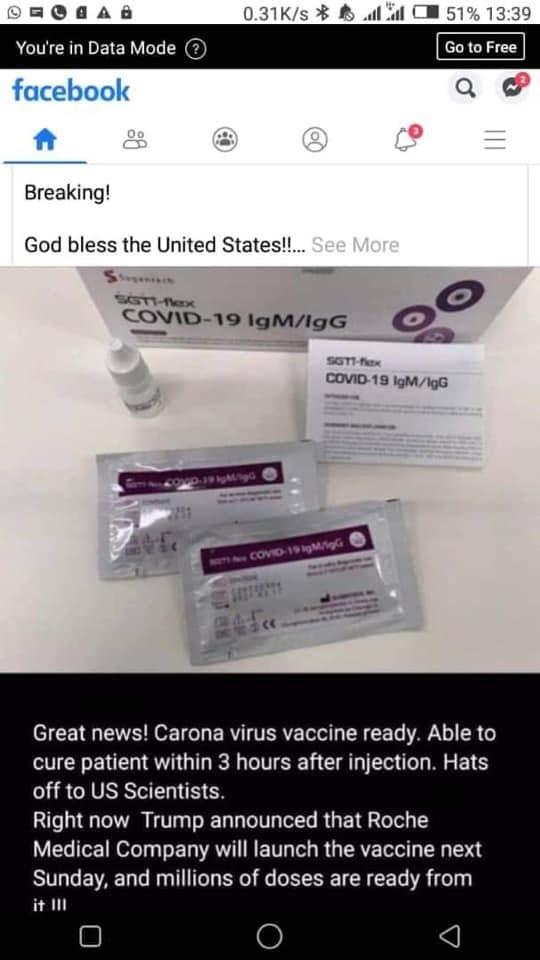
    The President of America, Donald Trump, has not announced the launch of a covid-19 vaccine. The photo attached to the text is not a vaccine, but a COVID-19 test kit manufactured by Sugentech in South Korea. There is no known vaccine yet for the COVID-19 virus.

    Full text: 

    The novel Coronavirus, COVID-19, has necessitated the search for a vaccine by scientists all over the world. In the meantime, there has been a myriad of information circulating, asserting the discovery of vaccines for the virus. Among them is a Facebook post on 25 March 2020, which stated that scientists in America had discovered a vaccine that was able to ‘cure’ a coronavirus patient within 3 hours after injection.

    The post generated 38 interactions, 22 comments and 54 shares. While some user comments showed an appreciation for the discovery, other user comments interrogated how a vaccine ‘cures’ the virus instead of preventing the virus. 

    The post read: 

    Good News from President Trump of America*
    A COVID-19 Vaccine made by America now ready. Able to cure a corona virus patient within 3 hours after injection.
    Kudos to USA Scientists.
    Right now president Trump has announced that Roche Medical Company will launch the vaccine next Sunday, and millions of doses are ready for distribution to other part of the world.
    Congratulations to the world over this success news…

    The post also included the photo below:

    C:\Users\Maxine Gloria\Downloads\90595118_2794545770663278_6828803954017566720_n.jpg

    Verification: 

    Dubawa ran a Google reverse image search on the photo. We found that photo purported to be a vaccine is a COVID-19 test kit with a full name ‘SGTI-flex COVID-19 IgM/IgG’. Additionally, the search showed that contrary to the claim, the COVID-19 IgM/IgG test kit is not a product of Roche Diagnostics. The test kit was manufactured by Sugentech Inc., a company in South Korea that develops in-vitro diagnostic systems and products based on BT-IT-NT convergence technology. 

    Verifying from Sugentech’s website, Dubawa found the description of the COVID-19 IgM/IgG as “a kit for the qualitative test of COVID-19 antibody by immunochromatography’’. The website further advised that “as there is no medicine or vaccine, the best way to combat this infection is isolation”. 

    Did President Trump Announce A New Vaccine?

    Dubawa also investigated the claim that President Trump has announced that Roche Diagnostics was to launch the ‘vaccine’ on Sunday and that millions of doses were ready to be distributed to other parts of the world.

    The claim was traced to be associated with a viral video of the CEO of Roche Diagnostics, Matt Sause. In the video, Mr Sause was seen showing appreciation for the approval of new tests kits for the virus. Dubawa found that the video is an extract from an hour-long news conference held by President Trump at the White House on 13 March 2020.

    In his address, President Trump commended Roche Diagnostics for their work, as they had been given an unusually quick approval by the Food and Drug Administration (FDA) for new tests for the virus, and not for vaccines as purported. 

    “We, therefore, expect up to half a million additional tests available early next week. We’ll be announcing location probably on Sunday night,” President Trump said at the press conference (06:40 -7:26 of the video).

    The World Health Organisation has stated that there is no known vaccine for COVID-19 yet. However, possible vaccines are still under investigation.

    During the verification process, Dubawa also identified that the claim has popped up in other parts of the world and has been debunked by fact-checkers.  

    Conclusion

    The President of America, Donald Trump has not announced the launch of a vaccine. He announced the availability of new tests by Roche Diagnostics. Furthermore, the photo attached to the text is not a vaccine. It is a picture of a test kit for COVID-19 manufactured by Sugentech in South Korea. There is no known vaccine yet for the COVID-19 virus.

  • Is MTN Ghana Giving Free Data to Subscribers in Lockdown Areas?

    MTN to give free internet data to people living in lockdown areas – thebbcghana.com

    MTN Ghana is not giving free internet data to its subscribers in the locked-down communities. The message based on which the story was written is from MTN Nigeria and meant for subscribers in that country.

    Full Text:

    An article by thebbcghana.com says that one of Ghana’s leading telecommunication companies, MTN, is giving out free internet data to its subscribers living in areas affected by the lockdown. The areas are Accra, Tema and Kumasi.

    This move, according to the story, is to keep MTN subscribers in the areas updated on the latest happenings concerning the coronavirus pandemic.

    “In the same bid to keep its subscribers abreast of the latest update on the spread of the virus with in the country, MTN Ghana is offering its customers free internet data to help them get daily information about the global pandemic,” it said.

    “….this MTN free internet data is a welcome development as this will allow especially people living in the lockdown areas ( Accra, Kumasi, and Tema.) to know more about the prevention of the virus,” it continues.

    Ghana’s President, Nana Addo Dankwa Akufo-Addo last week announced a two-week restriction on movement in some parts of the country. It took effect 1 a.m. yesterday March 30th. He said a lockdown has become necessary to help curb the spread of coronavirus and also to fast-track contact tracing.

    Verification:

    Dubawa spoke to Efua Falconer, Corporate Communications Manager at MTN Ghana. She told Dubawa that the information is untrue.

    “It’s fake news”, Efua Falconer said. 

    Additional checks were conducted on MTN Ghana’s website and verified twitter page. Unsurprisingly, we found no mention of free internet data to subscribers in the said communities or any part of the country on either platform.

    Message from MTN Nigeria to Nigeria Customers

    Further research conducted by Dubawa found that the news portal misrepresented information from MTN Nigeria.

    On March 26, 2020, MTN Nigeria through their Twitter page announced that its subscribers can access information about the coronavirus pandemic on the network without data.

    Source: Twitter (MTN Nigeria)

    As seen in the image above, the post is specific to MTN Nigeria to its subscribers in Nigeria. The tweet contains a link that leads to a page on the MTN Nigeria website. On the website, three hyperlinks are shared: the World Health Organisation, the Nigerian NCDC and the Federal Ministry of Health websites. These websites are the information portals that MTN Nigeria has allowed data-free access to. Also on the page are five (5) tips for coronavirus prevention.

    Conclusion:

    MTN Ghana is not giving free internet data to subscribers in the locked-down communities in Ghana. It is rather MTN-Nigeria that is allowing free access to information on specific websites for its subscribers in Nigeria.

  • Did President John Mahama say he will not donate towards the Covid-19 fight?

    President Mahama says he will not donate his money to support Covid-19 fight – Facebook post.

    Former President John Dramani Mahama has NOT said he will not donate towards the fight against coronavirus. On the contrary, he has already made donations to the Greater Accra Regional Hospital (GARH) to help fight COVID-19. 

    Full Text:

    A Facebook post flagged to fact-checkers by Facebook claims Former President John Dramani Mahama has said he will not donate his money towards the fight against Covid-19. The post was accompanied by a picture of the Former President having a meal – jollof rice- at a dining table. 

    “I will not donate money meant for my future campaigns to support convid 19..there was no virus in my time so why must I donate my money to nana addo….mahama says,” the post reads.

    It has generated 41 shares, 57 likes and over 19 comments. Views shared on the post were varied with some proclaiming disdain at the former president while others say it is untrue. They say it is just concocted to discredit the former president.

    Verification:

    Dubawa spoke to Mr Stan Xoese Dogbe, an aide to Former President John Dramani Mahama, to ascertain the truth behind this post. Mr Dogbe said the claim is untrue.

    “That’s a false post attributed to John Mahama. Mahama has already made a donation to the Ridge Hospital in Accra. His Parliamentary candidates and MP’s are all over the country and are supporting mitigation efforts in their communities and constituencies. And he will continue to support, himself, many other institutions are working to fight COVID-19,” Mr Dogbe said.

    Various media houses and news portals have reported on the donations made by the former president to the Greater Accra Regional Hospital. See here and here.

    Coronavirus: John Mahama donates PPEs to Ridge Hospital health workers
    John Mahama presenting his donation

    The items presented by Mr Mahama included 100 full sets of Personal Protective Equipment (PPEs), 100 gumboots, 120 doctors’ scrubs, 50 patient gowns, 30 theatre gowns and 400 packs of bottled drinking water.


  • Ghana has not recorded 1,500 Coronavirus cases

    Ghana has recorded 1,500 cases of coronavirus” – Facebook post

    Ghana has not recorded 1,500 coronavirus cases. A total of 137 cases had been confirmed as at the time the claim was made – March 27, 2020. The country currently has 152 confirmed cases of coronavirus.

    Full text

    A Facebook post on 27th March 2020 at 11:31 am GMT, claimed Ghana had recorded over 1000 coronavirus cases. It has generated 300 comments, 21 shares and 306 interactions.

    “Breaking News. Ghana has recorded 1,500 cases of coronavirus,”

    the post reads.

    Although some comments blamed the incumbent government for the sudden rise of the cases, most of them showed disbelief. Some users asked for the source of information while others outrightly dismissed it as fake news. 

    The post was flagged to Dubawa as part of its Third Party Fact-checking partnership with Facebook.

    Verification

    Our verification started at the Ghana Health Service dedicated website for information on the coronavirus. According to the Ministry of Information, the  website is the only accredited website dedicated to the update of coronavirus in Ghana. It is also the official source of information and data on coronavirus in Ghana. 

    Contrary to the claim, Dubawa found that Ghana’s confirmed coronavirus cases have so far not exceeded three digits. As of the time this fact-check was being written, a total of 152 cases have been reported.

    On 27th March 2020, when the claim was made, there were two updates on the website. The first, at 9.15 am GMT, revealed that the country had recorded 136 confirmed cases – 58 from routine surveillance and 78 from travellers who have been mandatorily quarantined. The second update was at 7 pm GMT. It showed a total of 137 confirmed cases. Of the number, 59 were from routine surveillance and 78, travellers who have been mandatorily quarantined.

    This was confirmed by the John Hopkins University and Medicine which has been monitoring and updating coronavirus figures across the world – it also reported 137 cases on March 27, 2020.

    Conclusion

    Ghana has not recorded 1,500 COVID-19 cases. A total of 137 cases were confirmed on March 27, when the claim was made. There are currently 152 confirmed cases as at 30 March 2020, 8.30 am GMT.

  • Parts of Ghana To Be “Locked Down”

    The government of Ghana has imposed restrictions on movement in some major parts of the country for two weeks effective 1 a.m. Monday, 31 March 2020.

    Addressing the nation Friday evening, President Nana Addo Dankwa Akufo-Addo said stricter measures needed to be implemented to help curb the spread of coronavirus.

    “However, prevailing circumstances mean stricter measures need to be put in place to stop the spread of the virus in-country in Accra, Tema, Kasoa and Kumasi which have been identified by the Ghana Health Service as the “hotspots” of the infections,” he said.

    The President’s decision is backed by the new Imposition of Restrictions Act, 2020 (Act 1012) passed by Parliament last week despite opposition from the main opposition political party, the National Democratic Congress. The bill gives legal backings to the president’s directives as the country deals with the spread coronavirus in the country. 

    “Effective 1 am Monday 30th March, some 48 hours from now, I have imposed, pursuant to the powers granted the President of the Republic, under the Imposition of Restrictions Act, 2020 (Act 1012), restrictions on the movement of persons in the Greater Accra Metropolitan Area ( GAMA, which includes Awutu Senya East) and the Greater Kumasi Metropolitan Area and contiguous districts, for a period of two weeks, subject to review,” he said.  

    Essential service providers are exempted from the lockdown. This includes members of the Executive, Legislature and Judiciary, journalists, members of the security service assigned lawful duties, producers, distributors and marketers of food and beverages and fuel station staff.

    President Akufo-Addo also announced a COVID-19 Fund to receive contributions and donations to assist the poor and needy. He said he is donating his April, May and June salaries to the fund as seed capital.

    “I am announcing tonight the establishment of a COVID-19 Fund, to be managed by an independent board of trustees, and chaired by former Chief Justice, Sophia Akuffo, to receive contributions and donations from the public to assist in the welfare of the needy and the vulnerable. I have directed the Controller and Accountant General to pay my next three months’ salary, that is April, May and June, into this Fund,” he said.

    The country as of March 27 has recorded 137 cases of Covid-19. The majority of cases, 78, are travellers who have been mandatorily quarantined and tested following a directive by the president last week. A total of four deaths and two recoveries have so far been recorded. 

    Calls for a Lock Down

    Calls for a lockdown of the country, especially the epicentres of the disease, Accra and Kumasi, have been deafening following an exponential increase in the number of confirmed cases on Tuesday, March 24. The number of confirmed cases jumped from 27 to 53.

    The Ghana Health Service (GHS) at the time indicated the increase was as a result of tests performed on travellers who had been mandatorily quarantined following a directive by the President.

    “The sudden spike in case incidence is as a result of the mandatory quarantine and compulsory testing for all travellers entering Ghana, as directed by the president,” information on the GHS Covid-19 dedicated website explained.

    The Ghana Medical Association (GMA) lent its voice to the calls on Wednesday noting that a restriction on movement is in the country’s best interest.

    “The Lockdown though not a comfortable decision for leadership and citizens alike is a proven option backed by science and along with the other measures will ultimately be in our best interest,” the GMA said in a press statement.

    The Minister of Information, Kojo Oppong Nkrumah, had said the government was considering all available options.

    “All options are on the table. Government continues to receive advice which is subjected to analysis by experts. The decision to lockdown is not one that is taken lightly or because we’ve seen other persons doing it. Experts continue to provide advice to decision-makers,” he said at a Press Briefing on Tuesday.

Back to top button