An NDC activist claims President Akufo-Addo took Former President Rawlings to court to challenge his Ghanaian nationalityin 1992
The case challenging Rawlings’ nationality in 1992 was brought against him by politician John Bilson. The lawyer for John Bilson was Mr Obeng Manu. There is no evidence that Nana Akufo-Addo is linked to the case.
Full text:
An activist of the National Democratic Congress (NDC), Dzifa Gunu in a Facebook post on Facebook on Saturday, November 14, 2020, indicated that Ghana’s president, Nana Akufo-Addo in the year 1992, dragged the late former President Jerry John Rawlings to court to challenge his Ghanaian nationality.
“In 1992 Akufo-Addo took JJ to court saying that he (JJ) was not Ghanaian. J J suffered,” the post reads.
The lawsuit brought against Jerry John Rawlings to challenge his nationality in 1992 was a major issue in Ghana’s recent history receiving both local and international coverage. The Independent in the UK, on Friday 9 October 1992 reported the news. The publication named one John Bilson as the man that challenged Rawlings’ nationality.
The book described Dr Bilson as the leader of a political party, the Third Force Party, which contested and lost in the 1979 elections.
The news report says that he initiated the process in an attempt to stop Rawlings from contesting in the 1992 elections; Ghana’s first democratic elections in the Fourth Republic.
Judy.legal, a website that has archived several court records in Ghana online has a copy of the judgement on the case.
The case is titled; BILSON V. RAWLINGS AND ANOTHER (1992) JELR 69624 (HC).
Case details:
Jerry John Rawlings – First defendant
Interim National Electoral Commission – Second defendant
Dr John Bilson – Plaintiff
Dr John Bilson wanted the court;
1). “To restrain the first defendant-respondent herein from holding himself out and/or campaigning on any platform or at any public forum as presidential candidate of the National Democratic Congress (NDC) in any part of Ghana pending the hearing and final determination of the suit.
(2). To restrain the second defendant-respondent from including the name and particulars of the first defendant-respondent in the performance of its functions in relation to the conduct and supervision of the 3 November 1992 presidential election.”
Dr John Bilson’s position was that Rawlings, at the age of 21 years, was of dual nationality. He said Rawlings owed allegiance to the Republic of Ghana and the United Kingdom but had not renounced his UK citizenship, thus remaining a non-Ghanaian based on sections 1 and 8 of the Ghana Nationality Act, 1971 (Act 361).
He said by virtue of this, Rawlings did not qualify to contest in the elections.
But the court presided over by Justice Essilfie Bondzie among other things noted in his judgement that:
“The plaintiff has failed to provide in his pleadings particulars from which this court can infer that the first defendant is also a citizen of the United Kingdom. In the present condition of the plaintiff’s pleadings therefore, I hold that the plaintiff’s assertion that the first defendant held dual nationality at the age of 21 is purely speculative.
I take a judicial notice of the fact that until September 1992 the first defendant was a member of the Ghana Armed Forces. Also as head of state he is the commander-in-chief of the Ghana Armed Forces. He had been a member of two governments of the Republic of Ghana. Currently, he is the head of state of Ghana. It is therefore to be expected that in these capacities he had on several occasions sworn allegiance to the Republic of Ghana. So that even if on attaining the age of 21 then he had dual citizenship (which is not admitted) the irresistible inference which this court draws from the oaths of allegiance he took on these several occasions, is that the first defendant does not owe allegiance to any foreign government. This must be so especially as he is still the head of state and a member of the Government of the Republic of Ghana.”
Rawlings was consequently cleared to contest in the polls which he won with 58.3%.
Per the document, the counsels in the case were:
Obeng Manu – Lawyer for John Bilson
Joe Reindorf – Lawyer for Jerry John Rawlings
Martin Amidu (Deputy Attorney General), Afrifa Gyasi (Principal State Attorney) – Lawyers for INEC
Was Akufo-Addo connected to the case?
President Akufo-Addo was not mentioned in the official record as being either the plaintiff or counsel for any of the parties involved.
While it is possible that there may have been supporting counsels, there is no record of President Akufo-Addo being one.
Records show that by 1992 when the case was filed in court, Nana Akufo-Addo had already established his own law firm, Akufo-Addo, Prempeh & Co.
Conclusion:
There is no evidence that President Akufo-Addo in 1992 took former President Rawlings to court to challenge his Ghanaian nationality. There is also no evidence that he served as counsel to any of the parties in the case.
The reporter, Jonas Nyabor, produced this fact-check under the auspices of the Dubawa 2020 Fellowship in partnership with Citinewsroom to facilitate the ethos of “truth” in journalism and to enhance media literacy in the country.
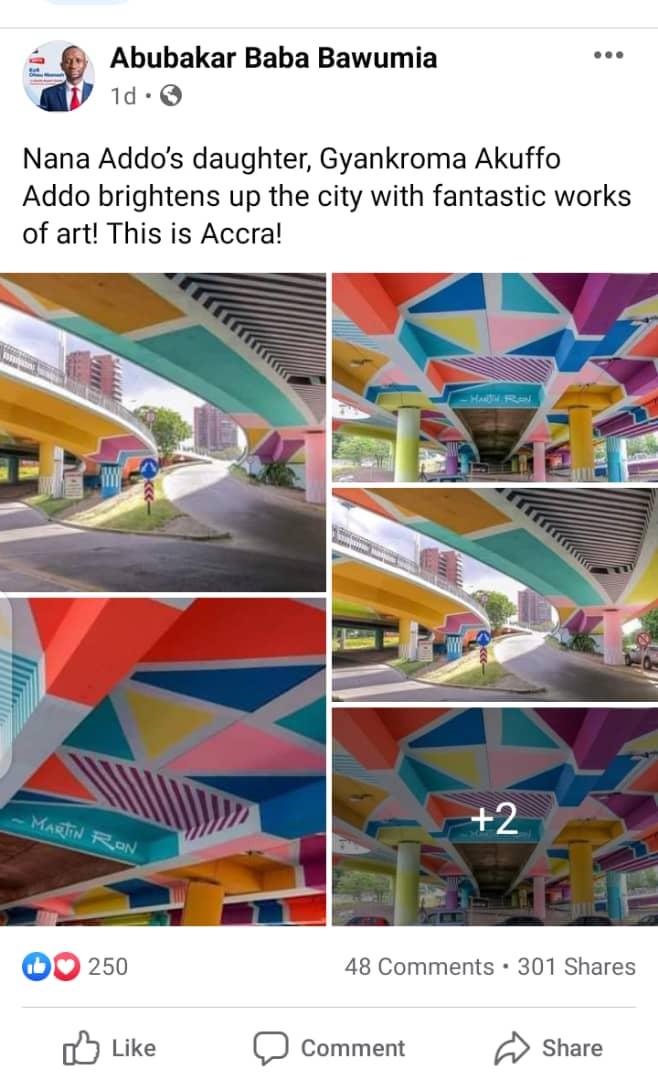
A Facebook user shared photos of murals he claimed are in Accra and attributed them to President Akufo-Addo’s daughter, Gyankroma Akufo-Addo in Accra, Ghana.
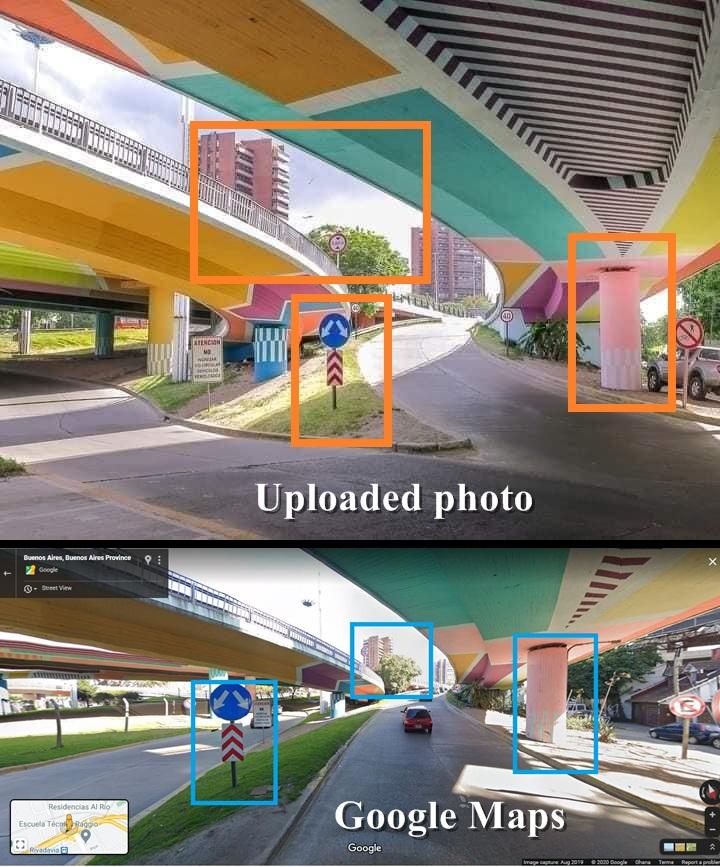
The murals are not from Accra, Ghana but Argentina. They were painted by an Argentine artist, Martin Ron
Full text
A Facebook user, posting with username Abubakar Baba Bawumia, on Thursday, November 12, 2020, uploaded photos of colourful paintings at an interchange.
He attributed the designs to President Akufo-Addo’s daughter, Gyankroma Akufo-Addo, and said the paintings were done in Accra.
“Nana Addo’s daughter, Gyankroma Akuffo Addo brightens up the city with fantastic works of art! This is Accra!,” the post caption reads.
Earlier this year, she, under the auspices of the Council facilitated the ‘Arts for All’ project which saw interchanges within Accra decorated with beautiful paintings.
Verification
A Google reverse image search matched the photos to ones shared on September 3, 2020, by an Argentine muralist, Ron Martin.
Additionally, a website for finding businesses and local places identified the painting as one done by Ron Martin.
In fact, some of the photos, such as this had his name, “Martin Ron” written on them.
Using local clues in Martin Ron’s post, we were able to find the exact location of his painting in Argentina on Google Maps. It is at Av. del Libertador – Vicente López, Provincia de Buenos Aires, Argentina.
Abundant evidence available shows that the photos shared by the Facebook user are not from Accra as he claims but rather Argentina. Also, the paintings are not in any way related to President Akufo-Addo’s daughter, Gyankroma. They are the works of 39-year-old Argentine street artist, Martin Ron.
This research is a qualitative study that seeks to identify the dominant approaches used by journalists and organisations in fact checking and the challenges that confront fact-checkers in the process. The findings of the study show that for journalists, fact checking involves an interwoven processing of information before it is published for public consumption. Organisations that are solely into fact checking as their core function often fact-check claims already published and are extracted from media platforms.
Despite the term fact-checking, often used casually to connote a thorough scrutiny of information, the study found that the journalist’s type of scrutiny as espoused by extant literature is designated as verification rather than fact-checking. However, fact-checking is fast emerging as a new genre in professional journalism.
The study also found that fact checkers and fact checking organisations encounter a number of challenges, including lack of access to information, perceived political victimization, lack of publicly available records, lack of public understanding of fact checking and lack of funding.
Information disorder has gained global attention with its concomitant effect of derailing confidence and whittling away the trust of media audiences in the credibility and reliability of information shared on media platforms. This development has given rise to a number of measures being taken by state and para-state organizations and the media, in a concerted effort, to find a solution to spiking of information disorder in the public space. Information verification in the form of fact-checking has become the antidote being deployed to prevent the rapid spread and potential impact of misinformation in the thriving information ecosystem.
According to Tedros Adhanom Ghebreyesus, Director-General of the World Health Organization (WHO), the world is not just fighting a pandemic, rather, ‘’we are fighting an infodemic,” (United Nations Department of Global Communications, 2020). The statement goes to support extant literature that asserts that misinformation and other variables in the constellation of information disorder has become widespread, affecting almost every sector of social life. According to Nemr & Gangware (2019), a growing number of States, in the pursuit of geopolitical ends, are leveraging digital tools and social media networks to spread narratives, distortions, and falsehoods to shape public perceptions which can undermine trust in the matter or topic at hand. The study posits that on average, a false story reaches 1,500 people six times more quickly than a factual story and stories about politics are the most likely to go viral.
The global surge in fact-checking projects and fact-checking institutions aimed at countering the spread of misinformation is an ongoing process. According to Stencel & Luther (2020), the global total of fact-checking institutions more than doubled from 2016 to now and the number outside the U.S. increased two and a half times — from 97 to 246. Their report asserts that the number of fact-checking institutions in South America alone doubled while the counts for Africa and Asia more than tripled. Chronicling the rise of fact-checking activities in Europe, Graves & Cherubini (2016) posit that fact-checking sites in Europe continue to see growth with focus on political claims being fact-checked on a daily basis. The study further asserts that fact-checking sites can be found everywhere on the continent today, and as a genre, fact-checking has become sufficiently well-established that many news outlets without dedicated teams offer it on an ad hoc basis, especially during major political campaigns.
Graves & Cherubini (2016) categorize fact-checkers into three main groups – reporters, reformers, and experts. The differentiation in categorization is based on the method adopted in fact-checking claims and the mission that drives the effort allocated to fact-checking. Reporters are more concerned with providing information to citizens and often are found in the traditional newsrooms as professional journalists; and reformers do focus on promoting institutional development or change in politics and/or the news media. The third group of fact-checkers include organisations which have cultivated a role as independent experts, along the lines of a think tank devoted to extension of knowledge in the field.
Fact-checking is not a new phenomenon in Ghana and the spiraling rise of the practice is occasioned by the infiltration of fake news and misinformation into public discourse and on media platforms. A report by the DW Akademie (2019) on the status of information shared on media platforms suggests that the media landscape is witnessing a situation where users of new media platforms, such as on twitter and facebook, now determine the agenda for public discussion as against the traditional form where reporters and established news organisations set the agenda for public discourse. The report further suggests that because of lack of scrutiny on the part of users before sharing information on easy-to-go media platforms, it has given rise to the spread of misleading information. The report explains that such development is degrading the beauty of journalism with little or no attention given to fact checking.
A study by Graves (2013) asserts that fact-checking is not cast in the mode of traditional journalism though the practice is often interwoven with proofreading of information mainly to correct errors, change a language or expunge non-factual information. “Fact-checking aims to expunge error and falsehood, not to call attention to it. The response to a misleading claim is either to fix it, or to cut it.” The study explains further that fact-checking is a reform movement that seeks to publicize errors or false claims made by public officials and political actors. Unlike traditional journalism, fact checkers dedicate their publications to setting the record straight on a factual misrepresentation by either debunking a claim or authenticating the veracity of it.
According to Cazalens et al (2018), originally, fact checking designated the correct checking of all facts in news articles before they are published. This practice however is the core of journalistic work in almost all newsrooms. The study posits that over time, fact-checking as a term refers to the analyses of claims a posteriori, after a certain article (or tweet, or speech etc.) is published. The report explains that fact checking is performed by NGOs who usually maintaining active, high-profile websites, such as FactCheck or PolitiFact in the US and FullFact in the UK by specialists within established news organizations, such as the Fact Checker of the Washington Post2 in the US, the Décodeurs3 with Le Monde and Désintox4 within Libération in France.
Premised on the assertion by Graves & Cherubini (2016) and Cazalens et al (2018) that fact-checking could be undertaken either a priori, where the activity involves checking the correctness of all facts in news articles before they are published, or a posteriori, after a certain article has been published which involves:
Extracting claims from some discourse,
Searching for the facts the claims are based on,
Assessing the accuracy of the claim with regards to those backing facts, and
Providing perspective to claims for which there is no straightforward settlement,
this study thus seeks to:
Identify the dominant group(s) of fact-checker(s) in Ghana
Determine the fact-checking approach used by the identified group
Assess the challenges fact-checkers encounter in the scheme of their work
Determining the Factsand Fact Checking
In determining the factual accuracy of a news article, a comment by a public official or a trending statement by a political figure, fact checking has become the ‘golden tool’ for winnowing fact from falsehood. A study by Graves, Nyhan & Reifler (2016) posit that fact checking enables journalists to interrogate the basis of primary information. Thus, fact checking has become the new paradigm in professional journalism for interrogating statements and comments published in the public space of discourse.
According to Mantzarlis (2018) The term “fact-checking” can mean two different things in journalism.
‘’Traditionally, fact-checkers were employed by newsrooms to proofread and verify factual claims made by reporters in their articles. This genre of fact-checking evaluates the solidity of the reporting, double-checks facts and figures, and serves as an overall round of quality control for a news outlet’s content before publication’’.
Fact checking today has taken a new paradigm where the focus is on “ex post”. “This type of fact-checking seeks to make politicians and other public figures accountable for the truthfulness of their statements. Fact-checkers in this line of work seek primary and reputable sources that can confirm or negate claims made to the public. “Ex post” fact-checking concentrates primarily (but not exclusively) on political ads, campaign speeches and party manifestos”.
Methodology
This study predominantly uses in-depth interviews to gain a deeper understanding of approaches adopted by fact checkers in fact checking claims and challenges fact checkers encounter when doing fact checking in Ghana.
Two journalists each from radio, television, newspaper and online media were selected for the study. To ensure balance in the views expressed by the respondents, a male and a female each was selected from the four dominant media genres in Ghana – radio, television, newspaper and online. The gender of the journalists, however, was not germane to the study and was not factored in analysis. An interview guide was designed by the researcher to elicit responses from the respondents on sources they get information to fact check and also to identify the dominant challenges fact checkers encounter in their work.
According to Cazalens et al (2018), some established media organisations have a special desk for fact checking in their newsrooms with persons, often journalists, assigned and solely dedicated to the work of fact checking. Four of such media organisations were identified by the researcher and an in-depth interview with the focal persons was conducted to get an understanding of approaches as well as challenges they encounter as fact checkers.
To further understand specific approaches and challenges of fact checking as practiced in Ghana, work of two key organizations doing fact checking were also analysed and focal persons in the organisations were interviewed to understand the practice of fact-checking in Ghana. According to the Duke Reporters Lab, Dubawa Ghana and Ghana Facts are the only two organisations in Ghana that are dedicated to fact checking as a core institutional work and they will be part of organisations that receive attention in the study.
In all, eight (8) journalists from selected media organisations with the various genres of the media spectrum, 4 expert fact checkers with media organisations publicly known for conducting fact checking and two (2) organisations whose core mandate is fact checking were selected for the study.
Findings and Discussion
The findings of this study is based on responses from the in-depth interviews conducted and the questionnaires. The responses address key issues of approach adopted by fact checkers in determining whether an issue is factually accurate or fake, and the challenges they encounter while fact checking claims within the Ghanaian context.
Prevalence of Misinformation
Views expressed by the respondents suggest strongly the prevalence of misinformation in the information ecosystem in Ghana. Answering a question of whether misinformation is prevalent in the information ecosystem, an expert fact checker working with one of the selected media organisations in Ghana, herein called respondent 1, explained that truth is now competing with falsehood and other misleading information on media platforms.
‘The media is inundated with a lot of misinformation about everything. Sometimes, if you are not critical, you may be misled into believing false news as true.’
Corroborating his claim, respondent 2 who also works as an expert fact checker with a selected media organisation intimated that ‘misinformation is there in the media and in the public and it is widespread’.
The views expressed by respondents on the prevalence of misinformation in the public space reaffirms the position by the Director General of the WHO to the effect that the world today is battling with infodemic – a preponderance of misleading information in the public space. In a recent statement released by the WHO, the body bemoaned the havoc misleading information is causing especially in an effort to fight the spread of the coronavirus pandemic. The WHO statement asserts that the technology we rely on to keep connected and informed at the same time enables and amplifies an infodemic that continues to undermine the global response and jeopardize measures to control the pandemic (WHO, 2020).
A study by Fullfacts (2020) supports the assertion that indeed misinformation is a common phenomenon in public discourse. The study posits that more than half of UK citizens agree that they have spotted news which they thought was inaccurate, exaggerated, or false. In Argentina, a third of respondents surveyed among Buenos Aires residents believed that the majority of news content shared on social media was false, while in Nigeria and South Africa approximately half of users thought they had spotted inaccuracies often.
Sources of Misinformation
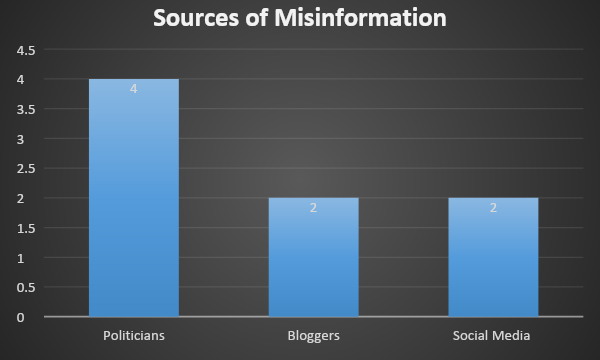
The researcher sought to know the common sources from which misinformation emanates. Eight respondents who responded to the questionnaire shared their views on this. Politicians and political actors were the most cited for often initiating misleading information in public discourse. The graph below illustrates the responses by the 8 respondents.
Source: Researcher’s construct
Respondent 5 and 6 who were interviewed on the subject both agreed that though misinformation is spread across all divides of our social set up, politicians have become noted for peddling misinformation in public discourse. respondent 4 particularly mentions that ‘especially during political seasons, politicians make all manner of claims and it is thrown out there into public discussions. Sometimes it is even close to impossible to fact check such claims’. Respondent 6 also notes that during political seasons there is preponderance of misleading statements in the public domain and often, such statements are perpetrated by politicians.
The assertions by the respondents confirm the study by Graves & Cherubini (2016) that posit that the majority of misinformation that have wriggled itself into public discourse are statements and claims that can be attributed to politicians and political actors. A study by Brennen et al (2020) found that politicians are one of the sources of misinformation and often their statements have 69% engagement online as against sources from ordinary people.
Dominant Groups of Fact Checkers in Ghana
The findings of the study show that eight of the respondents interviewed are journalists whose work involves verification and scrutiny of information before being shared with the public for consumption. Four expert fact checkers sampled for this study are also journalists who are assigned a fact checking desk in their respective media organisations. According to Cazalens et al (2018), journalists belong to a group of fact checkers called reporters, whose role involves verifying information before going public with it for audiences’ consumption. Thus, the process of verification, which involves cross checking facts to determine whether information is accurate or not, is aimed at presenting factually accurate information to the general public and engenders informed public discourse on varying issues.
The other group identified by the study is made up of organisations whose work mandate is sloley dedicated to fact checking. Cazalens et al notes that organisations dedicated to fact checking belong to a group called reformers. Their study posits that reformers often operate as non-governmental organisations and their scheme of work often involves verifying claims already in the public domain. As observed by Duke Foundation Lab, Dubawa Ghana and Ghana Fact are the only two organisations that belong to the second group of fact checking organisations in Ghana.
Approaches to Fact Checking In Ghana
It is evident from the study that before journalists publish their final work, they do some form of scrutiny of their facts as part of their reporting techniques. However, this scrutiny is done prior to the publication of their stories in the media. Mantzarlis (2015) contends that the type of scrutiny undertaken by journalists should be designated as verification instead of fact checking. He argues that,
Verification and fact -checking are two separate but closely tied journalistic practices. ……. verification is a process that evaluates the veracity of a story before it becomes ‘the news’; fact-checking is a process that occurs post publication and compares an explicit claim made publicly against trusted sources of facts. In this sense, verification concentrates on the reliability of the origin of a claim, while fact-checking addresses the claim’s logic, coherence and context.
According to Cazalens et al (2018), unlike reformers who often do an a posteriori fact checking – fact check claims after publication and circulation in media and public spaces – the journalists’ work involves a verification before publication of whatever information they intend to share with the public.
Respondent 6 in an interview explains that as an organisation involved in fact checking, they do a lot of surveillance on all media platforms to get claims to fact check. ‘We scan the internet a lot in search of statements made by public figures and political actors. Beyond that, we listen to political programmes on air and also follow the politicians whenever they are making speeches at public forums and other places.
The assertion by respondent 6 was corroborated by respondent 1 who works on a fact checking desk with a media organisation and states that ‘as a journalist I verify my information before publishing it but when performing my role as a designated fact checker at my desk, my work involves looking at information that are already in the public domain and not one yet to make the news’.
Thus for journalists, ‘fact checking’ is done a priori – verification is done before information is published in the media. This type of verification according to Graves (2013) is often interwoven in proofreading of information mainly to correct errors, change a language or expunge non-factual information. Fact checking done by reformers, on the other hand, is done a posteriori – verification done after information is published in the public space. This involves publicizing the truth or the falsity of a claim fact checked.
Challenges of Fact Checking
Access to information and data
Access to data was majorly cited as the challenge that confronted fact-checking within the Ghanaian context. According to the respondents, public institutions are either unwilling to share available information when contacted or in instances where one makes the effort to do a personal search, the data is simply not available in the public domain.
Respondent 2 in highlighting the challenges that confront fact checkers in the country noted that ‘when politicians and public officials make a statement and find itself in public discourse and it calls for scrutiny, no government institution is ready to give you a document in order to substantiate claims or otherwise. In the event, most claims go without being fact-checked because there is no available data for the fact-checker to verify claims’.
Participant 4 in a similar response, mentioned that ‘either people are not willing to share information with you or they feel it will affect their position or they consider a disclosure of an information being requested for may hurt their organisation and they may suffer some consequences from their employers’
In 2019, the Right to Information Law was passed in Ghana. Among other things, the provisions in the law allows citizens to access a certain category of information in order to hold the government accountable. The law states among other things that:
A person has the right to information, subject to the provisions of this Act;
The right may be exercised through an application made in accordance with section 18; and
A person may apply for information without giving a reason for the application.
While the law allows citizens to request for information, it also expects the government to provide the information as requested without impediments. ‘The government shall make available to the public, general information on governance without an application from a specific person’ (Ghana Business News, 2019).
It is instructive that while the law gives citizens the right to access information with all the privileges that goes with the rights, fact checkers continue to have challenges accessing information from key government institutions. However, as respondent 4 noted, most government officials are unwilling to give out information because they think it may hurt their organisation or they may suffer some consequences from their employers’
Political victimization
As political actors make statements in the public domain, getting access to publicly available information to verify claims made on campaign platforms or in other political programmes often proves challenging. Fact checkers who make the effort to contact government agencies to seek information from such agencies face a similar challenge of not getting access to data or an authority who could speak to the issue. Often, the reluctance as noted by respondent 3 in this study is because of a certain cloud of political victimization that awaits persons who share information that contradicts one made by government officials.
‘Some officials who sometimes you want to interview to get information on an issue that is already in the public space are simply unwilling to comment and will always frustrate your effort to get what you want. Some are just not willing because they feel they may be victimized once they give answers to what you are seeking to get’
Lack of proper record keeping
The study found that proper record keeping that facilitates access to referencing is often a challenge that confronts fact-checkers and fact-checking organisations. As observed by respondent 5 in an interview conducted for the study, she indicated that ‘ lack of proper record keeping is often a challenge and even when there is a claim that one can fact check, the lack of publicly available records makes one abandon the claim which otherwise is a fact checkable claim’.
Victimization
‘There is a lot of victimization, name calling and tagging when you are involved in fact checking in this terrain. If you fact check a claim and it is in favour of the ruling government, the opposition accuses you of being a member or an affiliate of the party in power. When you, on the other hand, do your fact check that confirms as true what an opposition member has said as against what the government is claiming, supporters of the government see you as being in bed with the opposition. This makes it very difficult for our work sometimes and it affects us when you are genuinely doing your work and a political tag is placed on you’.
This concern expressed by respondent 3 again highlights how efforts are often made to discredit the work of the fact checker while they carry out their duties of verifying the truth or the falsity of an information.
Lack of Public Understanding
According to respondent 3 and respondent 4, the lack of public understanding of the whole fact checking exercise is a contributing factor to why sometimes some persons will want to discredit their work. ‘Respondent 3 notes that ‘sometimes people question you about how you came by your verdict and why you have to fact check one claim and leave others. Though I spend time to explain, it appears it has still not gotten down well with people and every time we publish a work, people still have issues with our verdicts’.
Respondent 4 shares similar concerns and intimates that ‘sometimes people’s political leanings make it difficult for them to accept a verdict that does not go in their favour. They see it as a contest and are ready to pounce on you for saying something that tarnishes the reputation of the party they hold their allegiance to’.
Funding
Funding of fact checking activities as observed by respondent 5 is sometimes a challenge. She mentions that ‘it is for that reason you hardly see organisations operating as fact checking organisations throughout the year. Though funding should not stop one from doing a follow up to a story to cross check facts and publish the truth or otherwise found, sometimes the exercise calls for financial commitments that make it even more challenging to be consistent with the frequency of fact checks one does’.
Responding to the question of whether funding is a challenge to fact checking in Ghana, respondent 5 also indicated that ‘generally funding a fact-checking project is challenging and it comes always as a hurdle that must be surmounted to get the work going as part of commitment to ensure appropriateness of information in the public space’
Conclusion
The findings of the study on the approach fact checkers adopt in conducting a verification activity to affirm or debunk a claim shows that political actors are the major sources misinformation emanates from.
The study found that reporters, often journalists, whose routine work comes with cross checking facts before sharing the information in the public domain for audiences’ consumption form one group of fact checkers in Ghana. Their fact checking often is a priori, thus the fact checking is done prior to the publication of a news item for public consumption. The other group of fact checkers are the reformers who do fact checking after a claim has already been publicized. Their form of fact checking called a posteriori is done after a speech, a tweet or statement is already made and circulating in public spaces.
On the challenges of fact checking in Ghana, the study found that access to information, perceived political victimization, lack of publicly available records, lack of public understanding of fact checking and lack of funding are challenges that confront the work of fact checkers in Ghana.
Recommendations
Based on the findings of the study, the researcher makes the following recommendations:
Fact-checking organisations must continuously engage the public to educate them on the importance of fact checking and its impact in public discourse;
Government agencies and institutions, as enjoined by law, must share information requested of them by persons and organisations who may need them without impediments.
Good record keeping must be prioritised by the media for effective referencing to enrich their publications. Government agencies must equally leverage new technologies in storing relevant information for easy access by the general public.
Since fact checking is gradually becoming a new genre in journalism, media outlets must activate their educative role in engaging the public on the core functions of fact checkers. This could immune fact checkers from the frequent victimisation they are subjected to.
With the beneficial impact of fact checking in sanitising public discourse, the donor community must offer support to fact checking organisations as part of efforts in building a nation that engages in progressive and development-oriented public discourse.
References
Mantzarlis, A., (2018). Module 5, Fact-Checking 101. Retrieved from
Ghana’s former president, Jerry John Rawlings, has died at age 73.
The former president died on Thursday, November 12, 2020, at the Korle-Bu Teaching Hospital in Accra.
Rawlings, a flight lieutenant of the Ghana Air Force, came into public limelight after leading an unsuccessful coup attempt in May 1979.
A month later on June 4, 1979, Rawlings and other junior officers overthrew the military government of the day.
He formed the Armed Forces Revolutionary Council (AFRC) to rule Ghana for a few months before handing over power to Dr Hilla Limann on 24 September 1979.
On December 31, 1981, he ousted Hilla Limann and created the Provisional National Defence Council (PNDC) which led the country until 1992.
He resigned from the military and created the National Democratic Congress (NDC) on whose ticket he contested in Ghana’s first democratic elections of the fourth republic in December 1992.
He won that election with 58.3% of valid votes cast.
He was re-elected in the 1996 elections and served until 2000 when his second four-year term came to an end.
Ghana’s education minister, Matthew Opoku Prempeh, says Ghana has been ranked second in the latest Global Teacher Status Index
The Varkey Foundation which publishes the Global Teacher Status Index report measured teacher status using three different metrics. Ghana was 2nd in one, 5th in the other, and near-last in another.
Full text
The Minister for Education, Matthew Opoku Prempeh says Ghana has been ranked 2nd in a new Global Teacher Status Index report. He made the claim while touting the Akufo-Addo government’s achievements in the area of education since it assumed office in 2017, at a recent Nation Building Dialogues event in Accra. [19:58 – 20:30 minutes]
“Interestingly, just two days ago, 22nd October [2020] there was a world ranking study that came out and Ghana was ranked second in the teacher survey. In the survey of 35 countries among 35,000 participants, the data gathered by the Global Teacher Status index group found out that for countries that respected teachers, did more for teachers, they improve their economies and others, Ghana was rated second after China,” the minister said at the event held on Thursday, October 29, 2020.
His claim has been published on various online news portals including Myjoyonline and EducationGhana.
We found that the Daily Guide newspaper in an online publication on October 22, 2020, also made the same claim.
But how true is this?
What is the Global Teacher Status Index
The Global Teacher Status Index is an in-depth opinion by Populus in 35 countries that explores the attitudes of people on different issues including fair salary for teachers, whether people think pupils respect teachers and how highly people rank their own education system.
The report is produced by Global education charity, the Varkey Foundation.
Regarding the Education Minister’s claim that Ghana ranked second to China in the Global Teacher Status Index released on 22nd October 2020, we confirmed from the Varkey Foundation’s website that it indeed published a report in October 2020 titled “Reading Between The Lines.” The foundation said the report builds on the data gathered in the 2018 report.
In that 2020 report, the status of teachers in the 35 countries surveyed was measured in three different ways.
1. Implicit Teacher Status
2. Explicit Teacher Status
3. Ranked Teacher Status
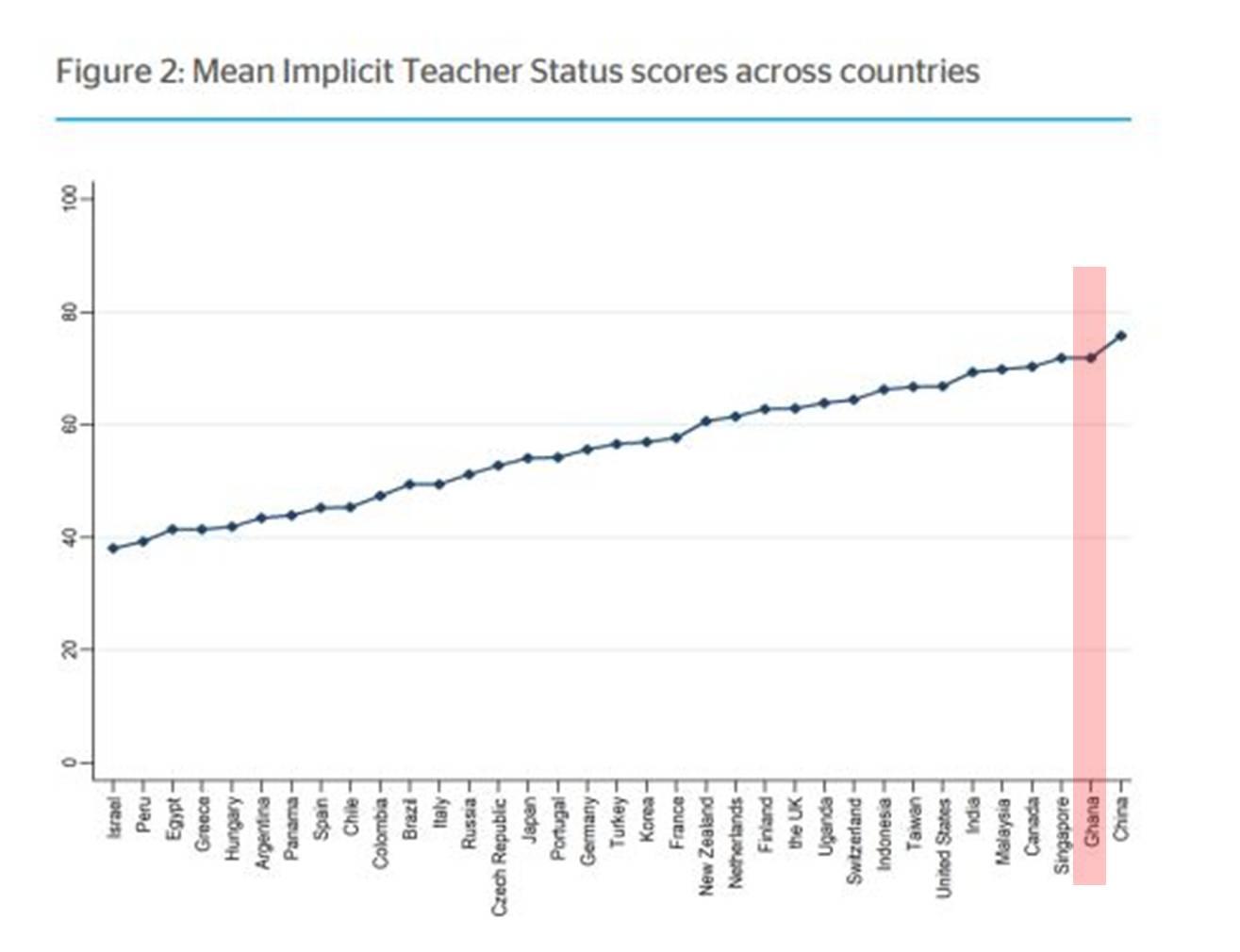
In the report, Ghana was ranked 2nd, 5th, and near last respectively on the Implicit Status, Explicit Status, and Ranked Teacher Status rankings.
Figure 1: Ghana was 2nd in the Implicit Teacher Status rankingFigure 2: Ghana was 5th in the Explicit Teacher Status rankingFigure 3: Ghana was near-last in the Ranked Teacher Status ranking
We see above that Ghana placed 2nd in only one of the three metrics used in the 2020 report the Education Minister referred to.
We reached out to the Varkey Foundation to seek answers to two issues:
1. The difference or relationship between the 2018 Global Teacher Status Index and the 2020 ‘Reading between the lines’ report.
2. Whether we can rely solely on the results of the Implicit Teacher Status ranking to determine Ghana’s position.
The Head of Advocacy and Analysis at the Varkey Foundation, Nicholas Piachaud, responded to our queries as follows:
“The two reports are both on teacher status and they’re both using the same data, but they’re measuring teacher status in different ways. In all, this research looks at four different ways to measure teacher status around the world:
1.The Global Teacher Status Index (2018 report): An index created by comparing a) how people perceive respect for teachers in their country against respect for other professions in their country, b) how perceived levels of respect for teachers differ from the nearest comparable professions in each country; and c) whether people in each country think that pupils in their country respect teachers.
Ghana ranks close to last in the Global Teacher Status Index (33 out of 35 countries for which we have data).
2.a. Implicit Teacher Status: (2020 report): A measure of teacher status based on people’s automatic reactions about teachers; that is what people seem to implicitly feel about them.
Ghana ranks second in the Implicit Teacher Status measure (2 out of 35 countries for which we have data)
2. b.Explicit Teacher Status: (2020 report): A measure of teacher status based on what people explicitly say they think about teachers.
Ghana ranks fifth in the Explicit Teacher Status measure (5 out of the 35 countries for which we have data.)
2.c.Ranked Teacher Status: (2020 report): A measure of teacher status based on how people rank respect for primary, secondary and headteachers in their country against their respect for other professions in their country.
(Ghana ranks near last in the Ranked Teacher Status measure – our data show that people in Ghana think that primary, secondary and headteachers are significantly less respected than most other comparable professions in the country.)
The research seems to show that people in Ghana explicitly say and implicitly think very highly of teachers, but they believe that teachers are generally not as respected in the country as many other comparable professions.”
Conclusion
We find that “Reading between the lines,” the 2020 report on teacher status as reported by the Varkey Foundation measured teacher status in three different ways and Ghana was second in only in one of the three. Therefore, the claim is misleading as it clearly ignores Ghana’s position in the other two metrics used in the report.
The reporter, Jonas Nyabor, produced this fact-check under the auspices of the Dubawa 2020 Fellowship in partnership with Citinewsroom to facilitate the ethos of “truth” in journalism and to enhance media literacy in the country.
Dubawa, on Friday 6 November 2020, held a virtual fact-checking training for members of the Communications and Corporate Affairs Department of the National Commission for Civic Education (NCCE) as part of the two parties’ partnership in public sensitisation engagements against misinformation and disinformation.
The Dubawa-NCCE partnership which started during the thick of the Covid-19 pandemic was primarily designed to ensure that the Ghanaian community received accurate information on the pandemic. The focus of the partnership has since been extended to cover Ghana’s elections.
Speaking on behalf of the NCCE Chairperson, Director of Communications and Corporate Affairs, Mrs Joyce Afutu, said the training was timely, coming at the time the nation heads to the polls soon.
“I must say the training has been insightful and as a civic education institution, the information gleaned from these sessions, will enhance our online communication engagements and also our grassroots sensitization activities, as fact-checking can not be overemphasized with respect to this age of people just filling the airwaves with all manner of information,” Mrs Afutu said.
Caroline Anipah, Programme Officer and Editor Dubawa (Ghana), extended her appreciation to the Commission for its willingness to work with Dubawa on this important national project:
“As a fact-checking organisation with the mandate to amplify truth and ensure citizens have access to accurate information for decision making, we are aware that we are unable to tackle the threat of dis- and misinformation alone. This is why we have collaborated with the NCCE, the agency with a mandate to educate Ghanaians on civic matters and also with direct contact with citizens. We believe an engagement with the Commission will be one way of effectively addressing the threat of ‘fake news.”
Anipah added, “We hope that knowledge and skills gained here will be passed on to citizens.”
The training was facilitated by Editor of Dubawa Nigeria, Kemi Busari, and Deputy Programme Director, Premium Times Centre for Investigative Journalism, Adedeji Adekunle, who equipped the NCCE staff with basic tips on identifying and combating fake news online through fact-checking.
The NCCE is an independent, non-partisan government organisation, with the mandate of promoting and sustaining democracy by educating Ghanaians on civic matters.
It is anticipated that trained staff members of the Commission will spread the knowledge gained from the training to colleagues who will in turn pass insights from the training to citizens to facilitate their efforts to identify election-related misinformation.
A Facebook page, NDC Tv, shared an image of a badly constructed road, seeking to ridicule the government’s “year of roads” mantra.
From a Google reverse image search conducted, the image depicted in the post is a road in South Africa and not Ghana.
Full Text
The Minister for Finance and Economic Planning, Ken Ofori-Atta in November 2019, declared 2020 as the “year of roads”.
Mr Ofori-Atta, who said this during the 2020 budget presentation in parliament, explained that the government was going to prioritise the road sector and improve road infrastructure in the country.
The president, Nana Addo Dankwa Akufo-Addo, reiterated the promise in December 2019, stressing that the government intended to embark on aggressive road development throughout the country.
The National Democratic Congress (NDC) expressed reservations about the promise, describing it as a ploy to deceive Ghanaians ahead of the 2020 general elections.
A Deputy Director of Research for the NDC, Kale Caesar, said on Power 97.9 FM that there was no way the government could redeem that promise.
Subsequently, a picture circulating on social media shows a poorly constructed tarred road being peeled off. The picture shows a man removing the asphalt with his bare hands.
One of the platforms on which the picture was shared was NDC Tv which sought to portray the picture as a road that was constructed in Ghana.
The post encouraged Ghanaian electorates to vote out Nana Akuffo-Addo and his government in the upcoming elections.
“Year of roads indeed. Let’s vote out Akuffo Addo and his gov of deceit. Vote2,” the post read.
The post generated a lot of reactions, comments and shares.
Verification
To verify the claim, Dubawa conducted a google reverse image search to confirm the source of the image. The reverse Google image search revealed that the image was first posted on Twitter by chief Erican with the Twitter handle @ericanSA on the morning of Saturday, November 7, 2020. The write-up that accompanied the picture was “This is the newly unveiled Road in Zeerust in North West. Won’t be surprised in Hundreds of millions of rands were spent here.”
The image was subsequently shared on Twitter and Facebook by this, this, this, among others.
Further search shows that Zeerust is a town in the North West Province of South Africa.
All the posts, except the one posted on NDC Tv, indicated that the road was constructed in South Africa. Therefore, the claim is false and misleading.
The reporter produced this fact-check under the auspices of the Dubawa 2020 Fellowship in partnership with The Finder Newspaper to facilitate the ethos of “truth” in journalism and to enhance media literacy in the country.
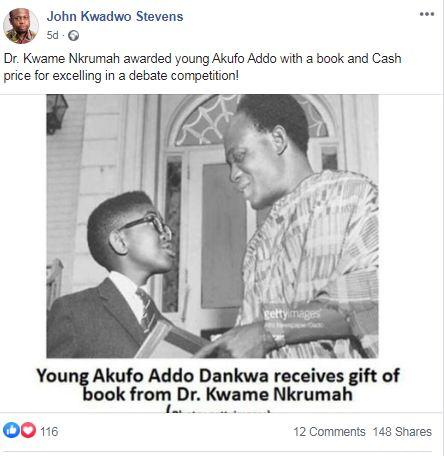
Social media user shares evidence of Kwame Nkrumah awarding Nana Akufo-Addo with book and cash prizes after debate competition decades ago.
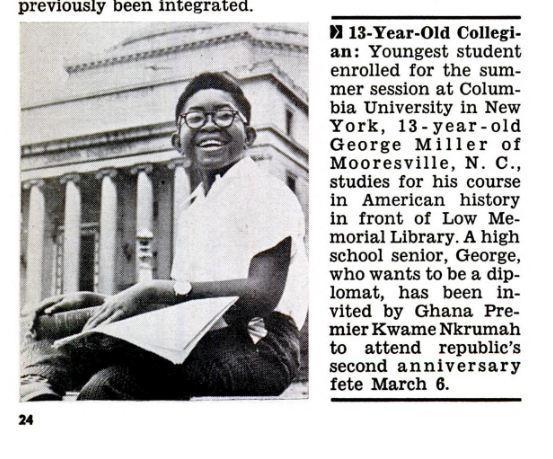
The young boy pictured with Nkrumah is 13-year-old George Miller who was at the time, the youngest student enrolled for the summer session at Columbia University.
Full text
An old photo purportedly showing Ghana’s first president, Kwame Nkrumah and incumbent president, Nana Akufo-Addo, together from many years ago is once again going viral on social media.
A Facebook user, John Kwadwo Stevens, recently shared the photo with the caption, “Dr. Kwame Nkrumah awarded young Akufo Addo with a book and Cash prize for excelling in a debate competition!”
It has since been shared more than 140 times.
The last time this photo went viral was in 2016 when President Akufo-Addo was campaigning to be president. A number of comments at the time flagged the photo as false even though it still continues to be believed by many to be the photograph of Nana Akufo-Addo in the photo.
Verification
Given that the photo’s purchasing license is owned by GettyImages, we accessed the photo on GettyImages’website to get further details.
Per the caption on the photo, the photo was taken at Moorseville, North Carolina in the US in 1960.
Beyond that detail, Getty Images did not state the identity of the little boy.
“Former president of Ghana Kwame Nkrumah and child, Moorseville, North Carolina, 1960,” the photo’s caption on the website has stated.
Nana Akufo-Addo, born in 1944, was 16 years old in 1960 and according to many biographies, was in Lancing College in the UK around that time.
A photo shared by the school and published on some Ghanaian news portals in 2018 including My News GH shows Akufo-Addo as a student there in 1960.
With the photos taken in the US while Nana Akufo-Addo was schooling in the UK, it was unlikely that he was the one in the photo.
After a series of advanced Google searches based on keywords from the caption shared by GettyImages, we found more information on the said young boy in the August 21, 1958 issue of Jet magazine hosted on Google Books.
Page 24 of the magazine captures the story of a young boy who was scheduled to meet Kwame Nkrumah.
The boy was named as 13-year-old George Miller who was the “youngest student enrolled in summer school at Columbia University in New York.”
He was “invited by Ghana’s Premier, Kwame Nkrumah, to attend the republic’s second-anniversary fete March 6.”
The photo accompanying the publication had some remarkable resemblance with the youngster who featured with Kwame Nkrumah in the iconic photo.
These include the glasses and his ears. Considering both images, it is very convincing that that youngster in the photo with Kwame Nkrumah was George Miller and not President Nana Akufo-Addo.
Besides this point, George Miller was from the same town in which the photo with Kwame Nkrumah was taken–Moorseville, North Carolina.
Conclusion
Based on the evidence presented above, we conclude that the boy who featured in the photo with Kwame Nkrumah was not Nana Akufo-Addo but very likely to be that of 13-year-old George Miller of Moorseville, North Carolina.
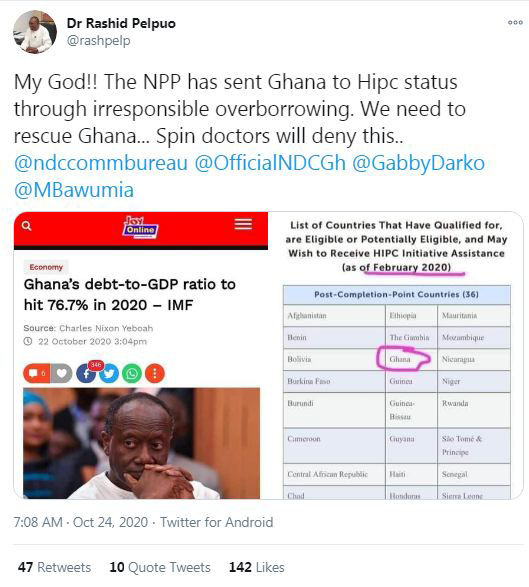
Social media users claim the Akufo-Addo government has led Ghana into the group of Heavily Indebted Poor Countries (HIPC).
Ghana’s listing on the World Bank website as a Heavily Indebted Poor Country (HIPC) dates back to 2002 and has remained so to date. Ghana completed the HIPC process in 2004 and according to the IMF, cannot reapply to the initiative.
Full text
Several members of the opposition National Democratic Congress (NDC) have made social media posts to the effect that the New Patriotic Party (NPP) government, led by President Akufo-Addo, has led Ghana into the being recognized as a Heavily Indebted Poor Country (HIPC).
Former President John Mahama reiterated the claim on Monday, October 26, 2020, while engaging some professionals ahead of the December 7 elections at the La Palm Royal Beach Hotelsaying, “Ghana is back to HIPC status under Nana Akufo-Addo and Ken Ofori-Atta administration.”
One of the viral tweets making the claim is a tweet by the Member of Parliament for Wa Central and former Minister for Youth and Sports, Rashid Pelpuo.
“My God!! The NPP has sent Ghana to HIPC status through irresponsible overborrowing. We need to rescue Ghana… Spin doctors will deny this..,” his tweet reads.
What is HIPC?
According to a factsheet by the International Monetary Fund (IMF), Heavily Indebted Poor Country (HIPC) is a debt relief initiative launched in 1996 by the IMF and World Bank, with the aim of ensuring that no poor country faces a debt burden it cannot manage.
The initiative reduces the debt of countries that meet the strict criteria for such classification.
1.Face sustainable debt situation after the full application of the traditional debt relief mechanisms (such as the application of Naples terms under the Paris Club agreement).
2. Be eligible for highly concessional assistance from the International Development Association (IDA) and for the IMF’s Poverty Reduction and Growth Trust (PGRT).
3. Have established a track record of reform and sound policies through IMF and World Bank-supported programs.
4 Establish a track record of reform and develop a Poverty Reduction Strategy Paper (PRSP) that involves civil society participation.
Ghana’s history with HIPC
Ghana has a known history with HIPC. In 2002 during the John Agyekum Kufuor led NPP administration, Ghana was listed as a HIPC and subsequently benefited from a comprehensive debt reduction package from the World Bank and the IMF.
The IMF announced in 2002 in a press release that Ghana was due to get $3.7 billion in debt relief through the HIPC initiative.
Being classified as a heavily indebted poor country to most opposition parties in Ghana is an indication of mismanagement of the local economy and extreme levels of government borrowing.
This may explain the virality of the recent claims but how true it is in the first place that the Akufo-Addo government has led Ghana into HIPC.
Verification
The World Bank’s data portal which is referenced in the claim lists 39 countries including Ghana as Heavily Indebted Poor Countries (HIPC).
But is this enough to prove that the Akufo-Addo government has led Ghana into HIPC?
Following an email we sent to the IMF with regards to the claim, a Senior Communications Officer, Gediminas Vilkas responded that Ghana has not made any new application to the HIPC initiative and indeed “cannot apply again” since it has already completed the process.
Further, through the Wayback machine which helps to track changes on websites by archiving its pages, we found that Ghana, even as at August 11, 2016, was listed on the World Bank’s data portal as being amongst HIPCs.
In the December 2014 update of the IMF on HIPC (Page 6), Ghana remained among the list of HIPCs when the NDC led by John Mahama was in power.
The World Bank’s most recent update, which was in August 2019 again included Ghana among the list of highly indebted poor countries and as recent as the IMF’s March 25, 2020 fact sheet, Ghana was still a part of the HIPC initiative.
It is important to note that the World Bank and IMF have in all their other reports on the initiative mentioned Ghana among the 39 countries identified as beneficiaries from the HIPC initiatives.
Chad is the latest country to have completed the initiative, in 2015, but it still remains in the list.
In other reports, Ghana is said to have its debts at high levels but there is no formal indication that the debts are at an unsustainable level after the full application of the traditional debt relief mechanisms required in addition to the other requirements for the HIPC initiative.
Conclusion
Although Ghana is duly captured on the World Bank’s data portal amongst HIPCs, that does not prove that the country has opted again to go into the HIPC initiative, in fact, that is impossible. Ghana and the other 38 countries that have gone through (including those still in the process of) the HIPC initiative have consistently featured on the World Bank data portal as HIPCs.
Ghana has featured since 2002 when it joined the program under former President Kufuor through the period of President Atta-Mills, President Mahama and now President Akufo-Addo.
…….
The reporter, Jonas Nyabor, produced this fact-check under the auspices of the Dubawa 2020 Fellowship in partnership with Citinewsroom to facilitate the ethos of “truth” in journalism and to enhance media literacy in the country.
Claim: an audio recording circulating on social media has as content a claim that the Serious Fraud Office (SFO) in Britain is investigating a suspected money laundering case involving Ghanaian government officials who were arrested with a cash amount of 26 million pound sterling at the Heathrow Airport.
The British Authorities at Heathrow have intercepted a cash amount of 26million pound sterling in suitcases flown into the country by private jet for the key government official in President Nana Akufo-Addo’s government on board the private jet.
The Serious Fraud Office (SFO) of Britain are currently investigating the suspected money laundering and have requested documents in respect of the money from Ghanaian government.
This is coming just within days when the Belgium European giant Bank – The ING Bank gave notice to the Ghana Embassy in Belgium – that all its accounts with the bank will be closed over money laundering and other fraudulent activities.
According to sources with the financial crime division of the investigative body and close to the ongoing investigation, it seems members of the government led by President Nana Akuffo-Addo are siphoning tax payers’ money into private foreign accounts ahead of the upcoming Ghanaian elections.
In a related development, the European Union has black listed Ghana over laundering and financial fraud issues.
Some social media users affiliated to the government discounted the claim, citing an online story on www.gov.uk as the source of the “fake claim.” The story reports of a Yorkshire woman who was arrested on October 3 and charged with money laundering after almost £2 million was seized at the Heathrow Airport.
The Ministry of Information has denied the involvement of any government official in any money laundering issue.
The Minister of Information, Kojo Oppong Nkrumah, accused the National Democratic Congress (NDC) of being behind the matter.
“No government official has been arrested in the UK. It is a total fabrication and we are clear in our minds that it is a fabrication by the NDC and it is part of their strategy for these last eight weeks where they will be churning out a lot of fabrication, lies and fake audio tapes,” the minister asserted in an interview on Takoradi based Sky Power FM.
The National Cyber Security Centre also issued a statement and described the audio in circulation as computer-generated.
“Forensic analysis by the National Cyber Security Centre reveals the audio was computer-generated using available technologies for fictitious audio-visual creation and manipulation. The Centre is working with the Police CID and other security agencies to identify the sources of this and other false materials being generated and bring them to book,” the statement read in part.
The European Union (EU), through its head of delegation to Ghana, Ambassador Diana Acconcia has also responded to the allegations of money laundering, indicating that there is no evidence of money laundering in Ghana.
The EU, in May 2020 blacklisted Ghana over money laundering issues, but Ambassador Acconcia said the action was because Ghana had failed to put checks in place to forestall money laundering.
Reacting to the ING bank’s directive to close the Ghana Embassy’s accounts in Belgium, she said the bank took a business decision and was not directed by the EU to do so.
Verification
To verify the claim, Dubawa contacted the press office of the SFO in Britain to find out whether or not the claim made in the audio about the SFO investigation and the interception of the cash amount of £26 million was true.
In a reply to our request made via email, the SFO neither denied nor confirmed the claim.
“I’m afraid we can neither confirm nor deny the accuracy of this report,” the SFO wrote in the reply.
To further verify, Dubawa consulted flight results published by Flight Aware, a digital aviation company that operates flight tracking and data platforms.
A review of the schedule for days between 2nd and 12th October showed no results of any private flight leaving Ghana within the period.
Conclusion
Based on the inability of the SFO to confirm or deny the accuracy of the report, we conclude that there is insufficient evidence to pass a verdict on the claim.