Claim: A video on Twitter depicts Akufo-Addo as saying his tribal agenda is to disenfranchise people in the far north of Volta.
False. The video clip was taken out of context to share a false narrative. It is originally a video of Akufo-Addo’s zoom meeting video published in July 2020 where he was heard advising his team to focus on records, competencies, abilities and achievements and outputs and not on gender and tribal agenda.
Full text:
A Twitter user has shared a video today, which has Akufo-Addo seen stating that “we have some tribal agenda to disenfranchise people in the far north in the Volta’’
The video also has multiple stamps of caution attached to the video frames reading: “REVEALED, Akufo Addo caught on camera listen closely” and “STOP AKUFO-ADDO, STOP THE DICTATORSHIP!”.
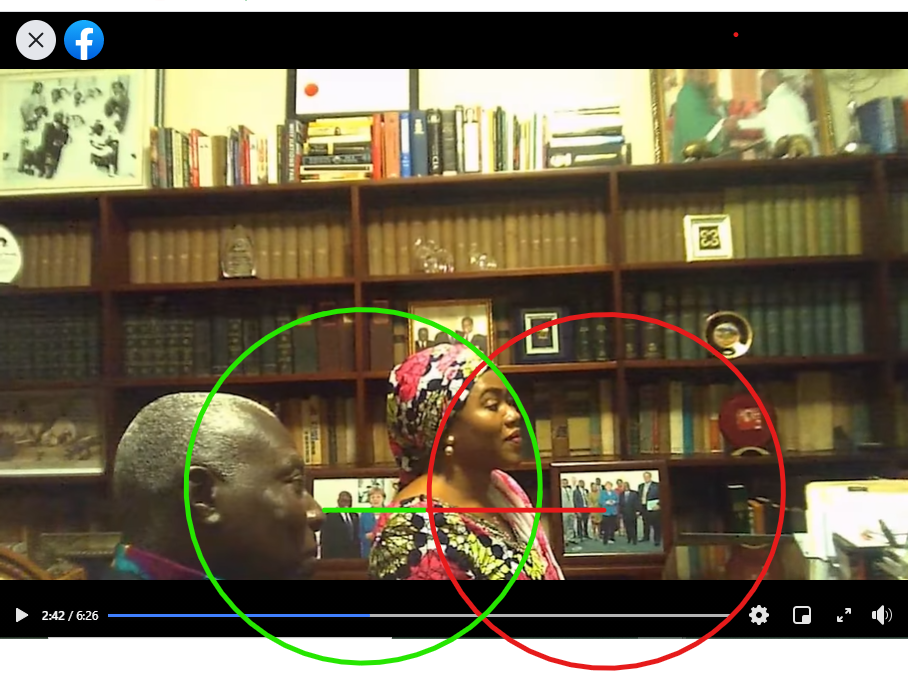
Dubawa subjected the acclaimed 27 second video on Twitter to analytical scrutiny and found the video to be taken out of context. Results of the video frames examined on Yandex reverse image search revealed that the claimant’s video was taken from President Akufo’s Zoom meeting held with members of his campaign communication team where his comments were stylized and twisted to miscommunicate his true claims.
A screenshot from the actual video where the claimant took the claim from – President Akufo-Addo holding a meeting with his campaign communication team
Context of video clip
The Zoom meeting took place on 13th July 2020 while Ghana was still under lockdown and the crux of the meeting was to lay a strategic plan towards the December presidential polls in Ghana; alongside campaign strategy for the NPP and Akufo-Addo. The actual video which was shared on YouTube on 13 July 2020 by NET 2 TV, showed Akufo-Addo discussing the need for his communication team to focus on the Unity of Ghana and the achievements of his tenure; and not focus on sentiments such as tribe, religion, and gender as a basis for voting.
It was along the line of this theme that the claimant cut some part of Akufo-Addo’s words to purport the claim in question.
The actual context of Akufo-Addo statement’s captured reads below:
“whether you are Muslim or Christian I am strongly a Christian and am part of the big Christian majority in Ghana but it shouldn’t be part of our discourse, and clearly, gender should not be also part of our discourse. We are looking at all kinds of records and competencies. So it should be possible in discussing these statements before the Ghanian people to be a discourse about: competencies, abilities, records, achievements, output. So I think that is something I would like us to stress so much, not some tribal agenda that we want to disenfranchise the people in the far north in the Volta. I don’t understand where that is coming from. It is deliberate and artificial; any candidate of valor knows that it is artificial and it’s being done for a very short time political game. I am not sure if that’s a legitimate way of advancing a political agenda. Certainly, it is not the one that would love to promote”.
Also, it is obvious that the actual video is not a leaked one, contrary to what the claimant cautioned on the short clip to push the narrative. The original video has been made available to the public since July 2020.
Conclusion
The claim that Akufo-Addo is seen and heard stating that ‘’we have some tribal agenda to disenfranchise people in the far north in the Volta’’ is false.
The claimant’s video shared on Twitter was cut from a zoom meeting Akufo Addo had with his campaign communication team in July 2020, where he was heard advising his team to focus on records, competencies, abilities and achievements and outputs and not on gender and tribal agenda. The claimant stylized Akufo-Addo’s statement in mid-sentence from its actual context to achieve an entirely different narrative.
Akufo Addo’s picture is missing on ballot papers at Awutu Twimi polling station in the Central Region and the Alhaji Salam Grinding Mill polling station in the Bawku Central Constituency.
The CODEO Constituency Supervisor present at the polling station has confirmed that a voter noticed it, reported it to an NPP agent and an alarm was raised. The Electoral Commission has also confirmed it in a press statement.
Full text:
A claim circulating on WhatsApp is stating that there are ballot papers at the Awutu Twimi polling station in the Central Region which do not have the picture of NPP presidential candidate, Akufo-Addo on them. Videos circulating on Twitter also show this claim
It reads below:
Verification:
Dubawa verified from the CODEO Constituency Supervisor (CS) officer stationed at the Awutu Senya West, Awutu Twinmi polling station where the incident is reported to have happened, and it was confirmed to be true.
The CODEO CS stated that a voter detected the missing picture of Akufo-Addo on the ballot paper, and reported it to an NPP agent who consequently raised the alarm.
Upper East region incident
A similar claim was made in the Upper East region.
Verdict: True. The presidential ballot paper was issued to a voter at the Alhaji Salam Grinding Mill polling centre in Bawku Central constituency without the image of candidate Akufo-Addo.
Verification
Citi News’s Upper East Regional Correspondent confirmed that the incident occured at the Alhaji Salam Grinding Mill polling center in the West Natinga electoral area of the Bawku Central constituency.
He reported that, “It is not a rumour. This happened.”
“It happened at the Alhaji Salam Grinding Mill polling station in the West Natinga Electoral area of the Bawku Central constituency… The first person voted with part of that ballot paper being torn. The same repeated the second time and it caught the attention of the party agent of the NPP and he moved to rectify it. They recalled that ballot and issued a new ballot to the voter. The regional directorate of the NPP tells me that they have made a complaint to the EC but the matter, for now, has been resolved,” he said in a live interview on Citi TV.
Based on the ballot paper serial number, we confirmed from the Electoral Commission’s master sheet for polling stations that the ballot paper in the photo was indeed for the Bawku Central constituency.
Both incidents have been confirmed in a press statement by the Electoral Commission which says it will deal with the officers who tampered with the ballot papers.
The claim that there is a missing picture of Akufo-Addo on ballot papers at Awutu Twimi and Alhaji Salam grinding mill polling station is true. CODEO officers and Citi FM respondents present on site have confirmed it, and the incident has been reported. The Electoral Commission has also confirmed both incidents in a press statement and has promised to deal with the officers who tampered with the ballot papers.
Social media users share viral video claiming NPP’s Ashanti Regional Chairman has been arrested by police for possession of thumb-printed ballot papers.
The video accompanying the claim was of a 2016 incident where some persons were arrested at a hotel in the Ashanti Region for possessing ballot papers.
Full text
Series of messages received via WhatsApp say the governing New Patriotic Party’s Ashanti Regional Chairman, Bernard Antwi Boasiako, popularly known as Chairman Wontumi has been arrested.
The message is accompanied by a 1.16 minutes video with a caption suggesting that Boasiako was arrested because he was found with thumb-printed ballot papers.
“NPP caught with Thump Printed Ballot Papers in a Private Residence… Chairman wontumi caught with ballot papers,” the caption reads.
It is an offence to possess a ballot paper or any other election material without due authorization, according to Ghana’s electoral laws.
Verification
Listening to commentary by a man who recorded the video, we followed his lead on the location of the said incident as Madison Lodge, TUC in the Ashanti Region.
A simple Google search showed, among other things, a news item by Graphic.com.gh on the retrieval of thumb-printed ballot papers from a hotel room at the same location mentioned by the commentator.
Citifmonline.com also published a related story on December 5, 2020, the same day Graphic.com.gh did its publication.
According to both stories, some individuals were arrested by Police at the hotel and the NPP’s Chairman Wontumi gave the police the tip-off.
Through a series of searches on Facebook as well, we found many copies of the 1.16-minute videos published four years ago such as is seen here and here.
While the evidence above by themselves sufficiently show that the video in question is an old video, a statement signed by Andy Owusu, Special Aide to Chairman Wontumi said has also debunked the claim.
“Chairman Wontumi has not been arrested neither has he engaged in any printing of ballot papers as being speculated. The fact of the matter is that the said incident being shared on social media by known members of the opposition National Democratic Congress happened in 2016,” Andy Owusu noted in the statement.
Conclusion
The claim that Chairman Wontumi has been arrested with thumb-printed ballot papers is false and the accompanying video is an old clip from a 2016 incident being re-circulated on social media as a recent happening.
Akufo-Addo was caught on video accepting a bribe in 2017 in his capacity as President
Forensic analysis on the viral video shows it to be doctored while a much clearer and full version of the video found reveals the context of the video to be an occasion of a donation of GHS 40,000 and 1000 t-shirts of Akufo-Addo and Bawumia by one Hajia Fawzia given to support Akufo-Addo ahead of the 2016 elections.
Full text
A video circulating which has also been turned into a GIF by some social media users is purporting that President Akufo-Addo was caught on video receiving a bribe. This has been discussed extensively on mainstream media and social media by the opposition party NDC with the narrative purporting that Akufo-Addo took a USD40,000 bribe in 2017 in his capacity as president, in order not to sack Alhaji Abbas who is the director of Urban Roads.
A situational description of the scenes in both the viral video and the supposed original video was given and a translation of some of the conversations heard was made from the local Ghanaian dialect (Twi) utterances to English, to establish the context of the video. It was found that the part conveniently cut to suit the claim that Akufo-Addo was receiving the bribe (4;47-4:56), was a moment Akufo-Addo hesitated as he was writing down the name of the donor (Hajia Fawia), who offered a sum of money (GHS 40,000) and 1,000 T-shirts of Akufo-Addo and Bawumia inscribed with ‘Arise for Change 2016’, which was captured in the second supposed original video. It was also stated a number of times by the donor, and the men who accompanied her that it was her little way of helping Akufo-Addo and a show of her support to him.
Both the viral video and supposed original video start with two women sitting in a sitting room; one on the left is in glasses and scrolling through her phone and the other on the right (who later introduces herself in the video as Hajia Fawzia to Akufo-Addo) had bowed her head before, raises it later to hold a conversation with the person behind the camera documenting the scene (who later introduces himself as Yakubu in the video to Akufo-Addo).
Transcript of conversation
Hajia Fawzia: (mutters some words)
Yakubu: Eh? Aaah
Hajia Fawzia: (keeps muttering and points to herself)
Yakubu: (Giggles) So much
Some men are also seen and heard on the porch overlooking the sitting room, having a conversation.
A woman appears at the entrance of what is later identified to be an office and is heard greeting good morning in the background as one of the men from the porch in a black suit also appears and walks with Hajia Fawzia and person recording the video, Yakubu, into an office where Akufo-Addo is seen sitting at a desk and welcomes them.
In the office
(In the background) I am getting married and I said I’m coming to introduce you…
Akufo-Addo: You’re lucky
There is laughter, and Hajia Fawzia and the man in black suit sit opposite Akufo-Addo and the man is heard introducing the intent of the visit.
Akufo-Addo: And this morning?
Man in black suit: This morning is fine. It is this queen who went to see Aunty Ama…
Akufo Addo: Ama Busia?
Man in black suit: Yes, that she has some t-shirts and some little help that she wants to bring to you. But Aunty Ama said if she attempts to dress up and come here… but she knew I was coming here so… Her husband is the director of urban roads
Akufo-Addo: Oh, Transport Ministry?
Man in black suit: Yes, they are under Ministry of Transport
Akufo-Addo: Now they say they are called Highways
Man in black suit: That’s right. I think issues about civil servants are hard to discuss
(man and Akufo-Addo laugh)
Hajia Fawzia: We have been sending it, but we have realised that it doesn’t come
Akufo-Addo: Oh, I see. Okay…
Hajia Fawzia : We are meeting the wrong people
Man in black suit: So this morning, my first business is that I brought her to greet you so that whatever she has to say…
Akufo-Addo: Okay okay
Man in black suit: I think the t-shirts are in the car (motions for Hajia to speak)
Hajia Fawzia: I am so excited, I don’t even know what to say… Please this brother of mine brought me so I will let him do the talking
Another man who does not appear in the video but seems to be the one still behind the camera, later identified as Yakubu, is heard further introducing the purpose of the visit.
Yakubu: Yah, Nana, I think some time ago, Lt. Colonel Damoah met at Mama Busia’s house where I showed you some videos of how military people are trained,
Akufo-Addo: Yes, yes, yes (Akufo Addo nods in confirmation)
Yakubu: Ahaaa, since then I think the workload has been a lot so… they usually bring me a report of how they help and all, and I said no let’s go to Mama to inform her so that whatever they would like to do… maybe there are some proposals before you and some little items that they can also use to help out… so this is the little help we can also offer to help you. So this morning as we came, she said she has in her hands 40, 000 in addition to the T-shirts so that later, any help that there will be, we can communicate it….
The man in black suit stands to offer a parcel in a brown envelope to Akufo-Addo, who was busily noting down something on paper and did not appear to notice the gesture. He later lifts his head to notice and exclaims ‘oh’, receives it and continues to write.
Akufo-Addo: Please I need to have a name….
Hajia Fawzia : Hajia Fawzia
Akufo-Addo: Fawzia? I…A?
Hajia Fawzia: F- A- W- Z- I – A
Akufo-Addo: (Stops writing) Oh fantastic. And t-shirts?
Yakubu: Yes, a 1000 t-shirts
Akufo-Addo resumes writing
Man in black suit gives a proverb about the importance of the t-shirt and mentions his travel plans to Kumasi the next day and his intent to take some of the t-shirts
Akufo-Addo: So you will take it to them?
Man in black: Yes
Hajia Fawzia: The T-shirts, we had even already given some out, just that we hadn’t met the right people
Akufo-Addo: Is it of just me? Or me and him, the t-shirt…
Hajia Fawzia, Man in black suit and Yakubu chorus: Yes, of you and Bawumia
Yakubu: Or should I go and bring samples so you see?
Hajia Fawzia nods and motions for Yakubu to bring the samples, who leaves the scene.
The second supposed original 7 minute 15 second video continues with Yakubu, the man behind the camera, going outside into a car to get the-shirts. He later enters the office and Akufo-Addo comments that it looks really good and that the samples brought in should be left with him. Yakuba is seen handing a sample of the T-shirt with the inscription ‘Arise for Change 2016’ to the man in a black suit. There is some laughter while Yakubu also compliments the quality and texture of the t-shirt, and Hajia Fawzia reveals the location of the printing press.
Shortly after, Akufo-Addo thanks them for coming and Hajia Fawzia asks for a photo.
Akufo-Addo is heard asking for the name of the man behind the camera and he is heard mentioning Yakubu. There is more laughter after the photo is taken and Hajia Fawzia promises another visit, and they leave the office.
The Salis Video
The conversation in this video, also with an accompanying narrative suggesting that the President was Caught accepting a bribe on 30th of May 2017 to halt the dismissal of the Director of Urban Roads Alhaji Dr Tanko, is similar to that of the two earlier discussed with some very obvious manipulation. This one, however, came with a voice-over narrating to viewers the place and purpose of the meeting, and the sequence of events in the video.
Unlike the previously discussed videos, this one does not start with the two women. It starts with the gentleman in the black suit, identified by the narrator as Ambassador Adeji-Bawuah, in the middle of a sentence “…Her husband is the director of urban roads…”
Akufo-Addo: Oh, Transport Ministry?
Man in black suit: Yes, they are under Ministry of Transport
Akufo-Addo: Now they say they are called Highways
Man in black suit: That’s right. I think issues about civil servants are hard to discuss… man and Akufo-Addo laugh)
woman : We have been sending it, but we have realised that it doesn’t come
Akufo-Addo: Oh, I see. Okay…
This is followed by the voice of the narrator which tells viewers the meeting happened in the private residence of the President, Nima, and that the individuals had visited him to ‘plead clemency’ for the Director of Urban Roads.
The conversation continues in the same line as the two earlier transcribed videos until the woman asks her ‘brother’ who had led her to Akufo-Addo to brief him on the purpose of the meeting.
Invisible man: Yah, Nana, I think some time ago, Lt. Colonel Damoah met at Mama Busia’s house where I showed you some videos of how military people are trained…
Akufo-Addo: Yes, yes, yes (Akufo-Addo nods in confirmation)
The voice of the speaker (referred to here as invisible man as he cannot be seen in the video suddenly changes – so does the narrative in comparison with the earlier videos).
Invisible man: So your excellency, this morning we did not come with bad news, we are here because of Alhaji Abass’s issues. People are disturbing him – that he should be removed from office because he has been engaging in politics. But he has denied engaging in politics in office. He is a civil servant. He has never committed any offence there too but people just hate him and they say they will sack him from there. So he says we should come and plead with you on his behalf and to tell you the truth. He is on his knees pleading. The hatred they have for him, it will not be well if you don’t step in.
This is again followed by a narration to the effect a brown envelope containing an amount of $40,000 was then handed over to Akufo-Addo by the man on behalf of the Director of Urban Roads.
Invisible man: People claim they said he should give some money to them. He also says he does not have any money on him. All he can do is this $40,000 – we should bring it to you and that he is on his knees. He will not disgrace you if you give the position to him.
The narrator comes in again that Akufo-Addo asks for a name to which the woman gives the name FAWZIA.
Analysis of the videos
Dubawa ran a forensic search on the acclaimed video making rounds on social media with the ‘JT’ inscription and found it to be manipulated, whereas evidence from the supposed original video proves it to be otherwise.
The resolution of the video frames in the acclaimed video was deliberately altered to increase the noise on the video quality. Noise is a grainy veil in a photograph or video, obscuring details and making the contents appear significantly worse. Sometimes, photos or videos can be so noisy that they are essentially unusable.
However, in this case, the noise was implanted in the video to target more specifically the faces of the persons and the atmosphere of the events that went through the video. Clarity gives people a better understanding of the context and facial expressions of the persons involved. Thus in the video making rounds on social media, the noise was purposely increased to blur the atmosphere and to somehow give the unsuspecting viewer a general perception of the narrative the doctored video intends to share. That is, Akufo-Addo receiving bribes.
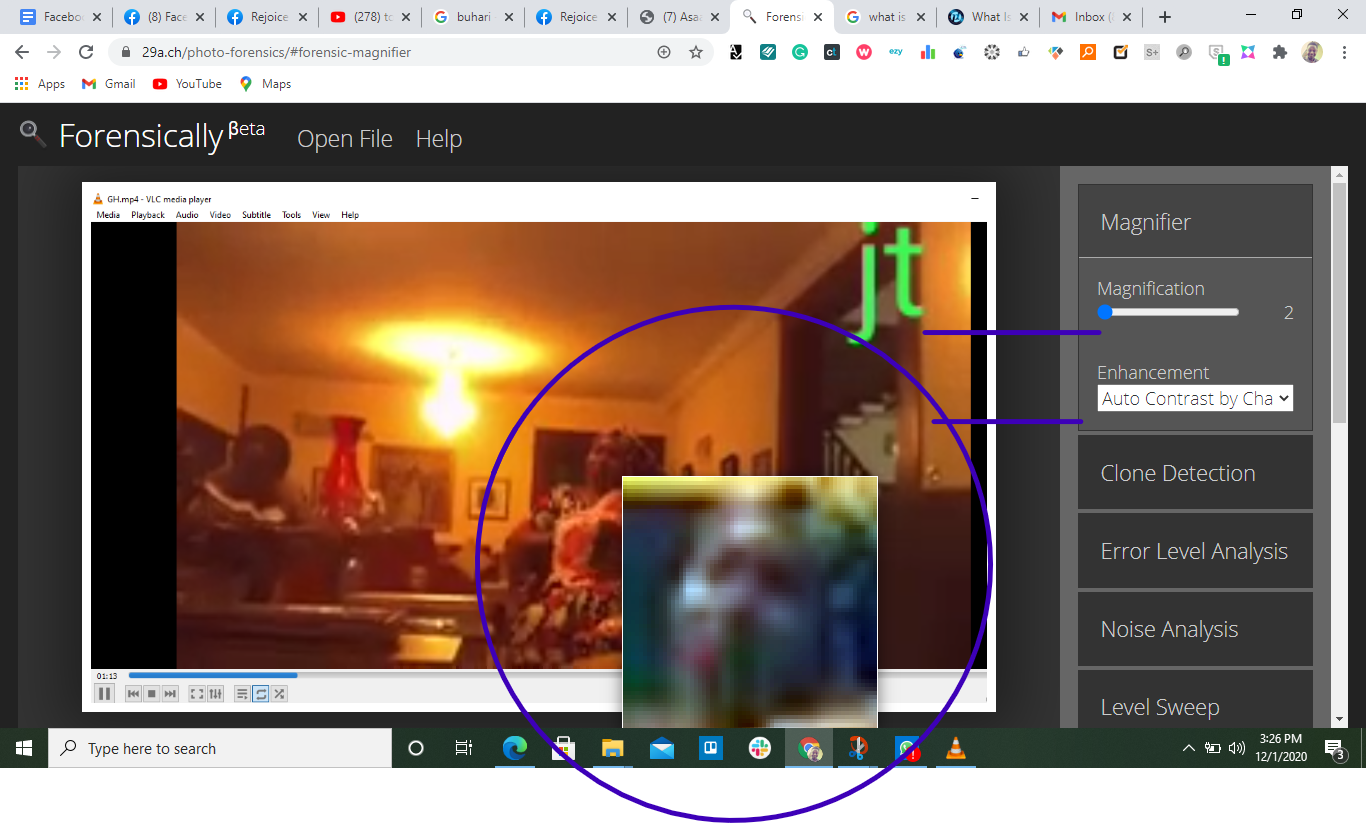
An analysis of the supposed doctored video using an open-source tool, Forensically, demonstrates the prior stated points.
Image 1: From the doctored video
In image 1 at the Magnification level 2 the face of the woman in the video cannot be seen clearly because of the noise infused. Facial expressions are important in such videos because it gives the viewer a general background of context. Here; it was intentionally blurred.
Image 2: From the supposed original video
At the same magnification level as image 1, image 2, taken from the original video shows a clearer face of the woman. This implies the absence of noise in Image 2 that was present in Image 1 (which was taken from the supposed doctored video.)
Also, videos that are deliberately doctored to be noisy are usually shared to capitalize on the viewers existing perception to believe a narrative without noticing the details, like actual conversation in such videos. For the audio, it was deliberately unaltered in the doctored video, since most of the communication was a dialectical Interswitch. Most Ghanaians may understand the actual context of the video in line with the language spoken, but others, especially those who don’t understand the local dialect, will be easily misled and will have to base their judgment on a noisy presented video that neither showed detailed facial expressions or a fairer atmosphere of the context.
Image 3: from the doctored video
Image 3, taken from the doctored video is analyzed on noise amplitude %100 and on the opacity level of %60, the results show a poor image quality as not even the pattern of the woman’s face is seen in the magnifier (the dark square).
Image 4:from the supposed original video clip
Image 4, taken from the original video clip and analyzed on the same noise amplitude of %100 and the opacity of %60 as of image 3. The result shows a converse outcome, while image 4 shows a pattern of the woman’s image 3 was completely blurred (noise).
Even though the timeline to the metadata of the doctored video could not be traced, shreds of evidence recovered using the forensically image magnifier showed the video was taken around 2016 before the presidential elections. This evidence is depicted below in image 5.
Image 5: from the supposed original video
Image 5, on the left, extracted at exactly 2:24 timing of the supposed original video depicts the T-shirt presented to Akufo-Addo with the inscription ‘Arise for Change 2016’ in his office. This inscription was part of his campaign signature in 2016 as seen in the other image on the right. This implies that the video was taken in 2016 before the elections. It also syncs with the dialogue (audio) suggesting that the T-shirts were presented for the Akufo-Addo 2016 campaign.
In further contentions that appeared on Twitter, some users have maintained that Akufo-Addo ‘took that bribe’ when he was President by juxtaposing a photo of Akufo-Addo with the former German Chancellor, Dr Angela Merkel seen in his office as shown in the video, to a news report by Ghana Broadcasting Corporation (GBC). The first picture was from an updated news version on Ghana Broadcasting Corporation dated 2017; while the second picture was captured from the video in question. The user placed the photos to prove that Akufo-Addo was already President when the acclaimed video was made. However, the facts Dubawa uncovered disproves this claim.
Image: 6 Twitter disputant
First, the image the user shared was from anupdated version of a report on Ghana Broadcasting Web. Dubawa traced the actual report and confirmed it to be an updated news report that narrates Akufo- Addo’s visit to Europe in 2015 before he became president. The report was about his 2015 visit to Europe when he met with Angela Merkel, the then German Chancellor.
Image 7: From the original report on Ghana Broadcasting Corporation(GBC)
The above screenshots are from the 2015 report by the Ghana News Agency (GNA), that the user alleges to have occurred in 2017 while Akufo-Addo was President. The report introduced Akufo-Addo as the 2016 Presidential Candidate of the NPP on a 16-day Europe tour.
Furthermore, a TinEye Reverse Image and a Google Reverse Image search show that the photo of Akufo Addo and Angela Merkel being debated, first appeared online in 2012 during Akufo-Addo’s meeting with the former German Chancellor when Akufo-Addo was a 2012 presidential candidate. Other searches show that the photo was only used again in the GNA 2015 report during his visit again to Angela Merkel as a 2016 presidential candidate.
Image 8: taken from Akufo-Addo’s twitter handle posted in 2012
Post shows the original photo taken with a group during Akufo-Addo’s visit to German Chancellor in 2012
Image 9: from the supposed original video
The group photo taken in 2012 is also seen in the video next to the photo of Akufo-Addo and Angela Merkel
Image 10: From the original video
The narrative with the doctored video claims the footage was covered sometime in 2017 when Akufo-Addo was already President. The first image on the left was taken in Akufo-Addo’s office before presidency. It was captured moments after John Dramani Mahama, the former President of Ghana rang him to concede defeat. The news that presented the picture was captured on December 11, 2016. The second image captured at exactly 4:56 of the viral video timing also showed that the proceedings took place in the same office he was in before his presidency.
Hajia Fawzia, the woman who appeared in the video at Akufo Addo’s office has attested in a recent interview that the event took place before the election in 2016 where she donated GHS 40,000 and 1,000 T-shirts to Akufo-Addo, who was then a presidential candidate. She further explained that it was not a bribe but a campaign donation out of goodwill.
Conclusion
The viral video purporting that Pres Akufo-Addo was caught taking a USD40,000 bribe in 2017 in his capacity as president, in order not to sack Alhaji Abbas who is the director of Urban Roads is false.
Pieces of evidence reveal that the video in circulation is dated in 2016, it was doctored and does not reveal a bribe scandal. The original video reveals that it was a visit to Akufo-Addo by Hajia Fawzia, whose husband was indeed introduced as the director of Urban Roads. She was accompanied by two men on the visit to offer a sum of GHS 40,000 and 1,000 T-shirts with an inscription ‘Time for Change 2016’ as a gesture to help and support Akufo-Addo’s campaigns.
Also, in the video, Akufo-Addo does not prove to be the sitting President at the time, as he attributes the renaming of the Transport ministry to another government, and he is referred to as Nana, with no titles. This is further corroborated with shreds from the video that prove that he was not the sitting president at the time.
Claim: Akufo-Addo is set to deliver five airplanes to the Aviation Ministry to bring Ghana airways back to life.
False. Both the Ministry of Aviation and the Ghana Civil Aviation Authority have debunked claims of the President delivering airplanes to the Ministry on 29 November, 2020.
The Public Relations Officer for the Ministry of Aviation, Madeleine Insaidoo, debunked the claims with a statement signed by the Minister for Aviation, Joseph Kofi Adda, asking the general public to disregard the claims.
‘This is certainly not true as no agreement has been signed yet with the strategic partner so far identified. This would have to get the consent of Cabinet and Parliament,” the statement reads.
The minister added that,
“It is indeed true that when Cabinet and Parliament finally do respectfully approve and ratify the Partnership Agreement, the new Flag Carrier will commence operations with at least five aircraft. However, we wish to state that the President is not yet delivering the aircraft as those processes have been concluded.’’
Source: Ministry of Aviation
Additionally, Dubawa contacted the Ghana Civil Aviation Authority (GCAA), and the Corporate Communications Manager for GCAA, Eric Amaning, also debunked the claims.
“No, it is not true. To the best of my knowledge, we have not received anything. Those stories are false, they are fake news,’’ Amaning said.
Furthermore, neither the presidency nor any mainstream media has reported on the story or event purported to have been held on Sunday 29 November, 2020.
Conclusion:
The posts circulating on social media claiming that Akufo-Addo was set to deliver five airplanes to the Ministry of Aviation on Sunday 29 November, 2020 is false. The PRO for the Ministry of Aviation, Madeleine Insaidoo, and the Corporate Communications Manager for GCAA, Eric Amaning, have both debunked the claims.
The Minister of Aviation, Joseph Kofi Adda, has also explained in a statement that the processes for the delivery of the airplanes have not been concluded yet, and have asked the public to disregard the claims.
Several Facebook posts claim the UK’s Guardian newspaper featured former president, John Mahama, on its front page in a report on the Airbus scandal.
The Guardian Newspaper has denied featuring John Mahama on its front page as claimed in the viral image saying “the screenshot and headline you share is not a published Guardian front page or news article”. The supposed photo of the newspaper’s front page is doctored.
Full text
Many Facebook posts including this and this claim that Ghana’s former president, John Mahama, has been featured on the front page of the UK’s Guardian Newspaper in a report the newspaper did on the Airbus scandal on Tuesday, November November 24, 2020.
The claim is based on a photo that shows John Mahama and his brother Samuel Mahama on what is claimed to be the newspaper’s front page with the headline, ” Airbus scandal: UK Authorities question Samuel Mahama, John Mahama next.”
About the Airbus scandal
On January 31, 2020, Ghana was cited as one of five countries in which global aerospace group, Airbus SE, allegedly bribed or promised payments to senior officials in exchange for business favours between 2009 and 2015, according to the UK’s Serious Fraud Office (SFO).
This led to a record £3 billion in settlement by Airbus with France, the United Kingdom, and the United States to avoid corporate criminal charges.
Martin Amidu, the former Special Prosecutor before he resigned from office, stated in a report that John Mahama was the government official who was code-named ‘Government Official 1’ in the UK SFO’s report.
Mahama was not indicted in the report.
Verification
The Guardian Newspaper uploads photos of its front page and publishes its major news reports daily on its website; Guardian.co.uk.
Based on the date on the viral image, Tuesday, November 24, 2020, we visited the Guardian UK’s website in search of that day’s reports.
For the Tuesday, November 24, 2020 edition of the newspaper published online, the headline story was titled, “UK vaccine ‘brings world step closer to ending Covid.”
An image of the front page on the website was completely different from what is claimed in the viral posts.
Through a series of Google searches, we found that other reports on the front page of the viral posts were sourced from different articles.
The button right article on the viral post was also sourced from this article published on the Guardian UK’s website.
The article title located on top of the “Guardian” logo was also sourced from this article published on the November 24, 2020, edition of the Guardian newspaper.
The press office of the Guardian newspaper in response to an email we sent saying, “the screenshot and headline you share is not a published Guardian front page or news article,” adding a screenshot of a photo of the front page of the newspaper which corresponds with this we uploaded earlier.
Conclusion
The viral post claiming that the UK’s Guardian Newspaper featured John Mahama on its front page issue of Tuesday, November 14, 2020, in a news report on the Airbus bribery scandal is false. The image was doctored to create a false impression.
The reporter, Jonas Nyabor, produced this fact-check under the auspices of the Dubawa 2020 Fellowship in partnership with Citinewsroom to facilitate the ethos of “truth” in journalism and to enhance media literacy in the country.
Ghana’s Vice President, Dr Mahamudu Bawumia on Monday, November 23, 2020, commissioned the Tolon district hospital in the Northern Region.
He said the facility is one of the six medical facilities which began three (3) years ago.
The other facilities are the 80-bed Hospital at Somanya in the Eastern Region; 80-bed District Hospital at Buipe in the Savannah Region; 60-bed Hospital at Wheta in the Volta Region; 60- bed Hospital at Sawla in the Savannah Region and a 30-bed Polyclinic at Bamboi in the Savannah Region.
In addressing the gathering at the ceremony, he remarked that the commissioning of the project proves wrong persons who claim the New Patriotic Party (NPP) government has not built a single health facility since it came to power in January 2017.
“Today’s event is a testament to the fact that truth crawls but will always triumph over falsehood…All of these facilities are practically complete and will be inaugurated one after the other by the close of the year, 2020,” Dr Bawumia said at the event.
His claim is, however, disputed by the opposition National Democratic Congress (NDC) which contends that the project is a legacy left behind by the John Mahama NDC administration.
A former Communications Minister, Felix Kwakye Ofosu in a Facebook post said the Akufo-Addo government knows nothing about the project.
“The Tolon District Hospital is yet another legacy of President Mahama. He found money for it in April 2016 and the contract for it and four others, as well as a Polyclinic at Bole, was awarded and signed with Vamed in September 2016. Akufo-Addo knows nothing about it and nothing about it knows Akufo-Addo,” Kwakye Ofosu’s post read.
There is, therefore, divided opinion on social media over who should be credited for the project.
What are the facts about the project and who can lay claim to it?
Based on the background information that the Tolon District Hospital and the five other health facilities were externally funded, we checked the Parliament of Ghana’s archive of agreements and memoranda and found that the agreement for funding and construction of the facilities was submitted to parliament in March 2016 when the NDC’s John Mahama was still in office.
According to the document, President Mahama gave executive approval to the credit agreement a day before it was sent to Parliament.
Per the document, a total amount of €89.9 million was sought from the Raiffeisen Bank International of Austria for the design, construction, equipping and furnishing of five new district hospitals at Somanya, Buipe, Sawla, Wheta, Tolon, and one Polyclinic at Bamboi.
The Ministry of Health in a press release on September 7, 2016, indicated that an agreement had been signed with Vamed Engineering group as the contractor to execute the project.
According to many news reports such as one on Myjoyonline and GBC Ghana, John Mahama, on January 1, 2017, days before officially handing over power to the NPP’s Nana Akufo-Addo, held a ceremony in Wheta in the Volta Region to symbolically cut sod for all the five district hospital projects.
At the function, he said funding had been approved and he was hopeful that the incoming government will continue with the projects.
In his last State of the Nation Address on January 5, 2020, John Mahama restated the fact that he had cut sod for the projects to start.
In the 2017 budget statement [Page 113] read by the new government’s finance Minister, Ken Ofori Atta on March 2, 2017, the NPP government said it will continue the work that had started for the five district hospitals including the Tolon district hospital as well as the Polyclinic in Bamboi.
Despite the development, media reports from Daily Guide and Citi FM indicate that President Akufo-Addo in July 2018 again cut sod for the construction of the Tolon district hospital while on a 3-day tour of the Northern Region.
A photo from the ceremony used by Daily Guide shows that at the time, blockwork was yet to commence, although the site had been prepared.
In the 2019 budget statement [Page 175] item 899, the Minister for Finance said, “In 2019, the following projects will continue: completion and equipping of Bekwai district hospital; four district hospital projects at Sawla, Tolon, Somanya, Buipe and a polyclinic at Bamboi; construction of Axim hospital; and rehabilitation of Effia-Nkwanta emergency, maternity and children’s block.”
Again in the 2020 budget statement [Page 185] item 1033, the Finance Minister, Ken Ofori Atta said, the construction of 5 District Hospitals in Sawla, Tolon, Somanya, Buipe and Wheta and a Polyclinic in Bamboi will continue.
The contractors, VAMED Engineering GmbH on their website listed the Tolon District Hospital project contract’s execution as spanning from 2016 to 2020.
Conclusion:
Evidence shows that the John Mahama administration started work on the Tolon District Hospital project by getting parliamentary approval for its funding agreement, signing the agreement with the contractor and cutting sod for the commencement of construction.
The Akufo-Addo administration also cut sod for the project and blockwork (actual construction) was undertaken during this administration.
Both leaders, therefore, played a role in the construction of the Tolon District Hospital.
Unlike the gooey chocolate cookies we devour and salivate over, internet cookies are inedible (lol).
Personally, nothing puts me off than visiting an online site and being asked to accept cookies. I always scream, what are these things called cookies and why must I accept them if I cannot eat them? And what’s worse, some sites will not allow you to view content on their page without accepting them by obstructing the page.
What are internet cookies?
According to Kaspersky, cookies are text files with pieces of data that are used to identify your computer when you use a computer network. Some have also described it as pieces of information stored as text strings on a machine like a computer.
How do you receive cookies and how are they stored? A web server sends users a cookie which is then stored by the browser.
Internet cookies can be either direct or indirect. Direct cookies are created by the site you are visiting while indirect ones are created by sites other than the one you are visiting.
What is the point of having cookies?: The good
Eases promotion
Cookies are designed to bring ease to the web user. What it does is that it saves certain details like usernames and passwords so that when you log in later, it can use those details to make things easier. In other words, cookies act like a purse which stores information and hands it out to you whenever you need it. This information is uniquely labeled for the user and their computer.
Cookies are meant to be used for managing sessions, personalizing user sessions, and tracking.
Managing sessions
Cookies allow websites to recognize a user and to recall their individual login information and their preferences. These preferences can be song choices, politics, interests, etc. Much like when you go to YouTube a few times and search for nursery rhymes for kids and the next time you log into Youtube, your search engine automatically assumes that that is why you are back and floods your interface with many varieties of nursery rhymes for kids.
Personalization of user sessions
Ever caught yourself being shown some ads just because you checked a website earlier? Yeah, cookies do that. Advertising can be customised for users using cookies with the hope that they may be something that may be of interest to you or that you might enjoy.
For tracking
If you love online shopping as I do, then this is for you. Shopping sites use internet cookies to track items you previously view or purchase. This allows the site to suggest other items that you may like based on previous buys or views. These cookies also keep items in shopping carts while you and I continue shopping, otherwise, the cart would reset to zero once another item is clicked.
The not so good (Risks associated with internet cookies)
Although internet cookies are naturally safe and helpful to the internet user, and because they cannot transfer malware or viruses to your device we readily accept them but the truth is, cookies can be potentially dangerous.
First, some viruses and malware can be disguised as cookies. An example of this is the “zombie cookies” which can recreate itself even after being deleted. These are what I have come to call the resurrecting cookies (lol). No matter how many times you delete them, they keep coming back, thus the term “zombie cookies”. Once you accept these types of cookies, there is almost no getting away from them. They can be used by web analytic companies to track your browsing history and a website can ban you from using their site by using these cookies.
Third-party tracking cookies can also make it easy for parties you cannot identify to keep watch on you. This can happen when you login to your activities online, like logging into your AliExpress account. Your login details can be saved for easy access on your next visit but, and this is a big but, since your activities are monitored, you have ads popping in based on items you have either looked at or searched for. These ads carry cookies. These are termed third-party cookies and these can be troublesome cookies because they are not generated by the website you are on but other sites that are linked to ads on the site you are on. Tricky? No. As you know, most websites advertise. This can be seen in strips, pop-ups or many other forms. These ads may not necessarily be content from the site you are on but other products, sites etc. Now, some of these ads have cookies attached to them which you have no knowledge of and these cookies can be automatically uploaded onto your device. What is disturbing is that you do not need to click on the ads for this to happen.
Further, in the hands of hackers, cookies can be used to hijack user sessions. Here, the hijacker pretends to be the user and performs actions that only the user has permission to perform. For shoppers like me, this is frightening. Why? Imagine someone posing as you and shopping with your details. Or having your content deleted or malicious content being posted in your name? An example can be the recent Twitter account hijack which had accounts of Bills Gates and other famous people taken over. These are all ways your sessions can be hijacked using cookies. And that is why you will find some applications have taken to logging users out after each session or have constant reminders sent to users to always log out of sessions.
Fourthly, cookies are actually stored on your device! As many times as you visit sites, as many of the cookies from those sites and associate sites get stored onto your hard drive. If space is a major issue for you, this is a nightmare. And if you end up having zombie cookies, you are in for some stress.
Cookies and Internet privacy in Ghana
In Ghana, privacy and personal data is directly protected under the Data Protection Act, 2012. The act establishes the Data Protection Commission (DPC) which is under the Ministry of Communications. The commission’s role, which is to oversee the regulation of the process by which personal information is acquired, kept, used or disclosed by data controllers and data processors, is also established under the Act.
Overall, the 1992 Constitution provides for the protection of fundamental human rights and freedoms, of which privacy is one. Cookies are a potential threat to that right.
Although cookies are not specifically mentioned in the Data Protection Act, there is the prohibition to purchase, obtain or disclose personal data as found in clause 88 of the Act.
The DPC is yet to take any enforcement action against organisations in respect to the violation of cookie restrictions. This makes it even more important for individuals to take the necessary steps to protect themselves from the possible threats of accepting cookies.
What to do as an internet user
Baseline, BE CAREFUL.
Also, you can protect yourself by deleting/clearing or managing cookies on your devices. To do so, follow the steps indicated in any of the suitable links below:
You can also modify your browser settings in your device’s privacy settings, Use Add-ons, personal moderation, and protect yourself with available and good quality antivirus software.
Conclusion
Although internet cookies are designed to offer ease of use to internet users, they can be potential threats in the hand of the wrong people. Privacy is expensive and ensuring that you manage your cookies takes you one step closer to ensuring your privacy is protected.
Claim:A video circulating on social media purportedly shows how former president, Jerry John Rawlings, flew a plane under the Adomi bridge.
False. The video in circulation is not from Ghana. It was from a performance by an aerobatic pilot, Jurgis Kairys in Kaunas, Lithuania in 2000.
Full text
One of the very intriguing stories many people have been told about the life and times of former President Jerry John Rawlings, who died on Thursday, November 12, 2020, is about how as a Flight Lieutenant of the Ghana Armed Forces, he supposedly flew a plane in a spectacular way under the Adomi bridge in the Eastern Region.
The veracity of the story is doubted by some people with a former Chief of Air Staff, Air Commodore Kwame Korankye Pumpuni (Rtd) saying in a radio interview in January 2020 that the story was false and that Rawlings never did such a thing.
On Monday, November 16, 2020 we noticed the circulation of a video on social media that was meant to buttress the point that Rawlings indeed flew a plane under the Adomi bridge.
The 28-second video shows a plane flying under a bridge and then making a number of flips in the air.
But is it really the late former president flying the aircraft in the video?
Verification
Using the InVID toolkit, we extracted keyframes for the video for further analysis.
In one of the frames, an artboard displayed on the handrail of the bridge had the inscription “rytas” written on it.
Following up with the inscription and other relevant keywords in an advanced Google search, we found related images such as this on Reddit which was shared on May 31, 2019.
It was captioned: “Jurgis Kairys performing inverted flight under bridge 2000.SEP.02”
However, a side by side comparison of the two photos showed a number of similarities.
Both photos appear that they are from the same scene shot from different angles.
The photo has also been shared on various websites including here and here.
All the publications named one J. Kairys as the pilot behind that flight.
This report by Lithuanian news website, 8diena, commented on the photo as follows:
“Many Lithuanians still remember the 2000s, when J. Kairys performed an unprecedented acrobatic trick with his Su-26 – the pilot flew under the pedestrian bridge in Kaunas, turning the plane up in wheels.”
Through a specific Google search on the pilot and his flight achievements in 2000, we found a YouTube video that names Jurgis Kairys as the pilot. The video matches the viral one claimed to be Flt. Lt. Jerry John Rawlings flying under the Adomi bridge.
Jurgis Kairys on his personal website stated that flight under the bridge in Lithuania among his achievements in the year 2000.
Conclusion
The evidence gathered indicates that the viral video shared on social media claiming to be a flight under Adomi bridge by President Jerry John Rawlings is false.
The reporter, Jonas Nyabor, produced this fact-check under the auspices of the Dubawa 2020 Fellowship in partnership with Citinewsroom to facilitate the ethos of “truth” in journalism and to enhance media literacy in the country.
Claim: Flagbearer of the Ghana Union Movement, Reverend Christian Kwabena Andrew, claims 99% of youth in Ghana are unemployed
Though Reverend Andrew did not provide any basis for his claim, available data from the Ghana Living Standard Survey prove that the youth unemployment rate is not 99% as claimed by Reverend Andrew.
Full Text
Youth unemployment is one of the areas that have dominated political parties’ policy plans over the years. Efforts over the years have led to the establishment of youth employment programs to offer temporary and permanent jobs to the youth.
In the run-up to the 2020 general elections, political parties in the country have made provision for solving youth unemployment.
In an interview on GhOne TV, the flagbearer of the Ghana Union Movement, Reverend Christian Kwabena Andrew, claimed that only 1% of the youths in Ghana are employed. He said about 99% of Ghanaian youths are unemployed.
Below is the transcript of the interview Reverend Andrew granted Serwaa Amihere on GhOne TV on October 12, 2020: 4:40 – 6:25
Serwaa Amihere: how many unemployed people do we have in the country now (young people)?
Reverend Andrew: about 99%
Serwaa Amihere: about 99% of young people are unemployed?
Reverend Andrew: yes, they don’t have work to do
Serwaa Amihere: where did you get the figure from?
Reverend Andrew: I’m familiar with these things. I’m in the country, I’m aware. They are on the streets. Go to the streets now.
Serwaa Amihere: where did you get the figure from?
Reverend Andrew: I shouldn’t wait to listen to somebody to give me a figure while I’m aware. I’m in the country. It is not somebody who is going to sit down and tell me that I’ve calculated, I’ve got this, I’ve got these numbers that you should use it. My own experience in this country, I’m aware of the things that go on. Go to the streets.
Serwaa Amihere: that 99% of young people in this country are jobless?
Reverend Andrew: yeah
Serwaa Amihere: so, the 1% what do they do?
Reverend Andrew: like the job that you people are doing now. The scanty money that you have been receiving.
Serwaa Amihere: it’s not scanty
Reverend Andrew: let me come in here. If you have the privilege to get another company, you spend two hours here, you can go out and work for another company to get something in addition to whatever you are receiving here. You can’t waste all your hours in the day. When you come for this programme as you are sitting down with this very gentleman, after this very programme, at least if you have a company somewhere, you can even spend more than an hour or two to get something in addition to what you received. So, I think it is better we create more jobs. We cannot depend on individuals to give us a job. When we keep on doing that too, they are rather going to cheat our own people and make our people poor because the salary that they are going to give to them, they are just small money that they will pay them and nobody can do anything to them because it’s their own company.
We contacted Reverend Andrew who repeated his stance that he did not conduct any survey nor did he rely on any data in making his claim.
However, is it true that 99 percent of Ghana’s youths are unemployed?
Verification
To verify the claim, Dubawa consulted the Ghana Living Standards Survey (GLSS), Round 7 Report which provides information for understanding and monitoring living conditions in Ghana.
Since 1987 the GLSS has been providing policy makers and other stakeholders with information about trends in poverty and in identifying priority areas for policy intervention aimed at improving the living conditions of the people.
Previous rounds of the survey were conducted in 1987/88, 1988/89, 1991/92, 1998/99, 2005/06 and 2012/13.
The seventh round of the survey was conducted between October 2016 and October 2017 and published in June 2019.
The survey report defines youth to be the population between ages 15 and 35. This is different from the United Nations definition of youth which defines youth as persons between the ages of 15 and 24.
According to the GLSS round 7 report, the youth (15-35) constitutes 34.2% of Ghana’s population. Persons aged between 15 and 24, per the UN definition of youth, constitute 18.9% of Ghana’s population.
Youth unemployment in Ghana
The report defines employment as comprising work done for pay or profit. It includes activities that are done for the final use of others in exchange for monetary or non-monetary remuneration.
Table 5.34 on page 99 of the GLSS report presents the activity status of the youth. According to the report, two-thirds (63.5%) of the youth were economically active.
The report further indicates that 55.4% of them were employed, 8% unemployed and 36.6% were not in the labour force.
In terms of the UN definition of youth (15-24), 46.1 were economically active, 37.6% employed, 8.5 unemployed and 53.9% not in the labour force.
Dubawa also reached Reverend Owusu on the phone to find out how exactly he arrived at the 99% youth unemployment rate.
The GUM flagbearer said he neither conducted any survey nor relied on any data for his claim.
“I didn’t do any survey. It is my assumption that I brought up. If I don’t get people who will do it by themselves, nobody can come and convince me with any figure,” he indicated.
Asked whether he has any basis to doubt the GLSS data, he said he had not seen the report and so he cannot comment on that.
Dubawa also contacted the Head of National Account Statistics at the GSS, Francis Mensah, to find out if the youth unemployment rate could have risen to 99% from the period the last GLSS was conducted.
Mr. Mensah said it will be difficult to come to such a conclusion since the GLSS has not conducted any survey since.
He, however, said the GLSS has never encountered a rate as high as the 99%.
The reporter produced this fact-check under the auspices of the Dubawa 2020 Fellowship in partnership with The Finder Newspaper to facilitate the ethos of “truth” in journalism and to enhance media literacy in the country.


 In image 1 at the Magnification level 2 the face of the woman in the video cannot be seen clearly because of the noise infused. Facial expressions are important in such videos because it gives the viewer a general background of context. Here; it was intentionally blurred.