President Nana Akufo-Addo claimed Ghana’s Marine Police had no serviceable patrol boats before his assumption of office in 2017.
The Marine Police is currently using two patrol boats whichhave been around since 2013. Deputy Commissioner of Police Iddi Seidu, director of the Marine Police, said the two patrol boats were serviceable before 2017 and are still serviceable in 2020.
Full Text
Speaking in an interview with Atl fm, a Cape Coast based radio station, President Akufo-Addo claimed that there were no serviceable patrol boats available to the marine Police when he assumed office in 2017. He made the claim when asked about his government’s commitment to end illegal transhipment at sea, popularly known as “Saiko,” which has become rife on Ghana’s waters. The interview was streamed live on the Facebook page of Atl fm 100.5Mhz.
“I want to make this point very clear, when we came to office, there were no serviceable patrol boats available to the marine Police and the law enforcement agencies. So no matter how you protest against the practice, you do not even have the means to be able to do anything about it,” the President said while accusing the previous administration of not doing anything to equip the law enforcement agencies to deal with the problem.
The Ghana Police Marine Unit is a specialized component of the Ghana Police Service which has existed as far back as 1916 but was re-established in April 2011 in line with the exigencies of the Service. The Unit has two Commands, Eastern Marine and Western Marine Commands in Tema and Takoradi respectively with its Headquarters in Takoradi.
Verification
To establish the truth or otherwise of the President’s claim, we contacted the Director of the Marine Police, Deputy Commissioner of Police (DCOP) Iddi Seidu.
In his response to the claim, he remarked: “I think those who briefed the President did not paint the picture very well. We have always had two patrol boats which have been serviceable.”
While acknowledging that four Rigid Inflatable boats at Tema have not been functioning, he said they were all functional prior to his assumption of office as head of the Marine Police in January 2018.
“Of course the Rigid Inflatable boats that are in Tema got malfunctioned and they are not working but the nine meter boats are working and that is what we use to enforce the law,” he said.
In 2018, he said the United Nations Office on Drugs and Crime (UNODC) and the Japanese Government presented two additional Ally-Gator boats to the existing one to make the fleet in the unit three in total.
A story published on defence web on July 20, 2018, confirmed DCOP Seidu’s statement that the unit received a donation of Ally-Gator boats from the UNODC in 2018.
A further internet search found a GNA publication on October 4, 2012, about the intention of the then government to procure marine boats to the Ghana Marine Police to step up surveillance on the high seas.
However, www.graphic.com.gh reported in March 2014 that four of the six boats being operated by the Marine Police Unit of the Ghana Police Service have been grounded after barely nine months of operation.
DCOP Seidu confirmed that the current government, as part of its effort to address the manpower as well as the equipment challenges of the unit, has placed an order for four patrol boats but were yet to be received.
“There is hope because the Government has committed to procure four boats for us which is on the line”
“Even training materials which will come as a component of that purchase has already been received. I appreciate what the government is doing,” he added.
Conclusion
From the above findings, it is clear that even though the Marine Police is confronted with some equipment and manpower challenges, the President’s claim that the unit had no serviceable patrol boats prior to his assumption of office is false. Deputy Commissioner of Police (DCOP) Iddi Seidu, Director of the Marine Police, has confirmed that there are two patrol boats which have been serviceable before 2017 and are still serviceable till now.
It is, however, commendable that the President has taken the initiative to address the equipment and manpower challenges of the Marine Police with the order to purchase four additional patrol boats. This will go a long way to strengthen the capacity of the marine Police to be able to work effectively.
A viral social media photo purports that Ghana Education Service (GES) has issued a press release on the re-opening date of SHS students as 6 September 2020.
The Public Relations Officer of the GES, who is alleged to have signed the press release, has debunked the claim showing that the photo of the purported press release from the GES is fake.
Full text:
A viral photo purporting to be a press release from the Ghana Education Service (GES) issued today, 23 August 2020 and signed by the GES, Public Relations Officer (PRO) Cassandra Twum-Ampofo, is circulating on Ghanaian WhatsApp and social media spaces.
The alleged press release states that both SHS 1 and 2 Green Track and Gold Track students will re-open on Sunday 6 September 2020.
Photo of claim received on WhatsApp
Verification:
Dubawa contacted the Public Relations Officer of the GES, Cassandra Twum-Ampofo (who is also alleged to have signed the press release) via WhatsApp to confirm the claim.
Twum-Ampofo responded to the message with another photo of the purported press release with an emboldened red statement “FAKE’’ across the press release.
Earlier this month, Dubawa debunked a similar claim attributed to the Education Minister on the reopening of schools on 8 September 2020.
In that report, when Twum-Ampofo was contacted by Dubawa, she stated that the GES did not have any confirmed date as yet concerning the reopening of schools.
“For school reopening, we have not issued any statement out there. We don’t have any specific date as to when schools will reopen,” she said.
Conclusion:
A viral photo circulating Ghanaian Whatsapp and social media purporting to be a press release from GES on the reopening of SHS students on 6th September, 2020 is false.
The GES PRO, Cassandra Twum-Ampofo who is alleged to have signed the press release has sent Dubawa a photo of the press release showing it is fake.
While the GES does not as yet, have a specific date for the reopening of schools, it is certain it is neither 6th September, 2020 nor 8th September, 2020 as is falsely making the rounds.
Ghana’s Vice President, Dr Mahamadu Bawumia on Tuesday, August 19, 2020, made a presentation to highlight infrastructural projects undertaken by the President Akufo-Addo government at a town hall meeting.
At the event, he made a number of claims to suggest the government’s superior record compared to the record of the previous National Democratic Congress (NDC) led by President John Mahama.
Three of the claims have been fact-checked below:
Claim 1: Pokuase Interchange is the first 4-Tier interchange in West Africa.
Verdict: True
Dr Bawumia in his speech said the Pokuase interchange project, whose contract was signed by the John Mahama government in 2016 for a three-tier interchange, was renegotiated by the Akufo-Addo government to be a four-tier interchange. He said the interchange has effectively become the first of its kind in West Africa.
“We have the Pokuase interchange. This is a four-tier interchange in West Africa. It’s the first four-tier interchange in West Africa. The first. The loan agreement for this project was signed in November 2016 for a 3-tier interchange, when we came into force, we looked at it from a value for money perspective, renegotiated it for a four-tier interchange for the same amount of money,” he said.
Given the scope of the claim, Dubawa Ghana restricted its search to the top five countries in West Africa with significant infrastructural development on the African Development Bank’s 2019 Africa Infrastructure Development Index.
The top five countries are: Cabo Verde, Gambia, Senegal, Cote d’Ivoire and Nigeria.
In Cabo Verde, we found no evidence of a four-tier interchange.
From The Gambia’s Ministry of Transport Works and Infrastructure, we confirmed that there is no 4-tier interchange in that country.
In Senegal, like Nigeria, although there are a number of interchanges, especially in Nigeria, none of them is four-tier.
In Ivory Coast as well, we found no four-level interchange although a number of major highways development projects have been initiated with funding from the African Development Bank.
After extensive exact Google searches, we did not find any evidence of a four-tier interchange in any other part of West Africa.
In another part of Africa, we, however, found a four-tier interchange in South Africa. The interchange is the EB Cloete Interchange near Durban in the KwaZulu-Natal province.
Based on the currently available evidence indicated above, we rate the claim that the Pokuase interchange is the first four-tier interchange in West Africa as true.
Claim 2: The cost of four interchanges being undertaken by the NPP government nearly equals the cost of one interchange constructed by the NDC government
Verdict: Misleading
The Vice President, in comparing the value-for-money ensured by the New Patriotic Party (NPP) government to what the NDC government did, said the cost of four interchanges Tema, Pokuase, Tamale, and Obetsebi Lamptey interchanges cost $289 million while the Kwame Nkrumah Circle interchange alone cost $260 million.
“Ladies and gentlemen, It is important to note that the cost of the Tema, Pokuase, Tamale, and Obetsebi Lamptey interchanges total $289 million while the Kwame Nkrumah interchange was constructed at a cost of $260 million,” Bawumia said.
To verify this claim, we highlight below the cost of the various projects in question and their scopes and analyse them subsequently.
Kwame Nkrumah interchange
In 2013, the National Democratic Congress (NDC) government awarded a contract to Brazilian firm, Queiroz Galvao Construcao, for the design and construction of an interchange at the Kwame Nkrumah Circle in Accra. It was worth €74.8 million ($100 million) and parliamentary approval was duly granted it in 2012.
Another project which was a flyover to be constructed on the Ring Road leading to Kwame Nkrumah Circle by the same Brazilian contractor was approved at a cost of $170 million.
Both projects amounted to $270 million.
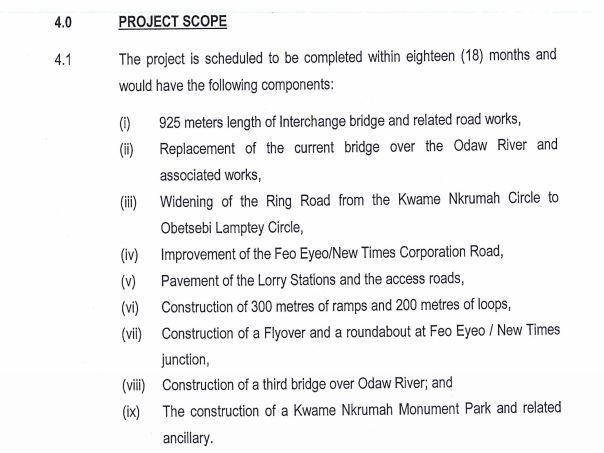
The Kwame Nkrumah interchange’s scope includes engineering design, the construction of the interchange, the construction of a road-over-rail bridge, improvement of the intersection of the Ring Road at the Feo Eyeo Road, and improvement of road drainage works.
For the Ringroad flyover, the scope, as captured in the report of the Parliamentary select committee on roads is as follows,
Tamale interchange
On April 10, 2019, President Akufo-Addo cut sod for construction work to begin on the Tamale interchange project which is being executed under the $2 billion China Synohydro deal.
According to a report by the Roads and Transport Committee of Parliament, the original project cost is $35 million. However, the cost including deferred payment amounts to $46 million.
“The scope of work includes bridge/ramps and slip roads as well as a carriageway of a width of 7 meters with a 2×2 number of lanes,” the report indicates.
Obetsebi Lamptey interchanges
The Obetsebi Lamptey interchanges project was commenced in 2019 after President Akufo-Addo broke the grounds for work to start in October.
The project report by Parliament’s roads and transport committee showed that it is to cost €87 million ($135 million). The three-tier interchange is to have an East-West flyover and another flyover on the Ring Road West.
Pokuase interchange
The Government of Ghana secured funding from the African Development Bank (AfDB) for the construction of the 3-tier Pokuase interchange in Accra at a cost of $94 million.
AfDB was to provide about $83million of the funds while the Government of Ghana provided $11.7million. The project, which is being executed by Zhongmei Engineering Group Limited under the Accra Urban Transport Project (AUTP), began in 2018.
The interchange was later redesigned into a 4-tier interchange.
The scope of the project includes 4-Tier Stack Interchange at Pokuase as well as the Construction of Storm Drains. There will also be the construction of 10km of Local Roads, construction of 6.6 km of Awoshie-Pokuase-Kwabenya Road, the widening of 2.0 km of Accra-Kumasi Road, provision of pedestrian facilities including walkways, footbridges, signalized crossings, Streetlights, and free health screening exercises for communities within the project catchment.
Tema interchange
Vice President Dr Mahamadu Bawumia in July 2018 cut sod for the construction of the Tema interchange.
The project cost is $57 million and was funded by the Japanese government through the Japanese International Cooperation Agency (JICA).
The first phase of the project has been completed.
The project involved the conversion of the Tema motorway roundabout into an interchange and extended for some 500 metres from the roundabout to the Ashaiman Timber Market Roundabout, 400 metres along the Aflao road, 300 metres towards the Tema Harbour and about 300 metres to join the main Tema-Accra Motorway.
The second phase of the project, which is the construction of a tiered flyover including detailed design and construction supervision, is yet to be completed.
PROJECT
COST (US$ million)
PROJECT
COST (US$ million)
Kwame Nkrumah Circle interchange
270
Tamale interchange
35
Pokuase interchange
94
Obetsebi Lamptey interchange
135
Tema interchange
57
TOTAL
270
321
TOTAL
270
321
The sum of all four projects by the NPP government is $321 million, according to documentary evidence we found, contrary to the $280 million claimed by Dr Bawumia.
We found it to be true that the single Kwame Nkrumah interchange project cost about two-thirds of the sum of the Tamale, Pokuase, Obetsebi Lamptey and Tema interchange project costs.
However, drawing a conclusion based on the project cost alone to make claims of no value for money ignores other critical information such as the scope of the projects in question.
A civil engineer, Abdulai Mahama, says there are many elements that go into the cost of construction projects hence it is unfair to compare similar projects solely based on contract sums.
“You can never be fair with that analysis. When you are dealing with a road construction, [and you are constructing] a 1 kilometer road from for instance from Circle towards Nima police station, and you are doing the same 1 kilometer from Circle to Alajo, the cost will vary especially because of the nature of the soil and the built environment.”
He cites depth of excavation, type of soil, built environment; demolishing and compensations, and materials used as some critical factors that affect the cost of construction projects.
“For some of the soil nature, when you are supposed to improve upon their stability, it can cost about 30 percent of the total cost of the project so if Tamale Interchange is on a very firm ground and Circle due to floods is on an unsuitable ground, the costs will differ,” he says.
From the above information, the scope of each project varies and will need to be assessed in detail to be able to make a fair comparison and definite conclusion on claims of no value for money.
We, therefore, rate this claim as misleading.
Claim 3: No government has achieved in its first term in office what the Akufo-Addo government has achieved in the area of infrastructure in its first term.
Verdict: Over generalised and non-contextual.
The Vice President after highlighting the various projects initiated by the Akufo-Addo government in different sectors including health, agriculture, education and sports, said his government’s achievement is incomparable to what has been achieved under all other governments in the fourth republic.
“Ladies and Gentlemen, notwithstanding the impact of the COVID-19 pandemic on the completion times of some projects, the data indicates that in the fourth republic, no government that has achieved as much in its first term of office in terms of infrastructure projects it initiated its first term as the NPP government of Nana Addo Dankwa Akufo-Addo,” Dr Bawumia said.
The spokesperson for the Vice President, Dr Gideon Boako in clarifying the claim during an interview on Citi TV’s Point of View on Wednesday 19, 2020, said the claim was made without direct comparison to any specific government
“We have put out what we think represents the superior records of any government in the first term. If there is any previous government or anybody that feels that what we are saying is not true and in comparative terms stands a better position to produce results that appears more convincing and robust than the argument we are making, we welcome it and we want that to be shown so that the Ghanaian people can also see,” he said.
Ghana’s fourth republic commenced in January 1992. The republic has so far seen five presidents from two political parties.
Below is the breakdown of all presidents in the four republics.
President
Term
Political party
Jerry John Rawlings
1993 – 2001
NDC
John Agyekum Kufuor
2001 – 2009
NPP
John Evans Atta Mills
2009 – 2013
NDC
John Dramani Mahama
2013 – 2017
NDC
Nana Akufo-Addo
2017 – to date
NPP
Given that this claim was not made against any benchmarks or any independent index or source, it cannot be verified.
The ranking member on the Education Committee and NDC Member of Parliament (MP) for Akatsi North, Peter Nortsu-Kotoe, claims the cancellation of trainee allowance was based on the Prof. Anamuah-Mensah Committee report and the Government White Paper on the education reform review committee.
No evidence could be found in the documents mentioned by MrPeter Nortsu-Kotoe to support the claim.
Full text
The cancellation of the Nurse and Teacher Trainee Allowances in 2014 became a topical campaign issue in the run-up to the 2016 elections.
The then National Democratic Congress (NDC) government had argued, after scrappingthe allowances, that it was to allow for an increased intake of students in those training institutions.
The quota system at the time put a limit on the number of students the training institutions could admit every academic year as a result of the allowances paid to students.
In the heat of the 2016 electioneering campaign, the NDC argued that the removal and subsequent replacement of the allowances with student loans had increased intake from over 6000 students the previous year to 14000 students.
However, the then opposition New Patriotic Party (NPP) condemned the move and accused the government of being insensitive to the plight of the trainees.
The Ghana Registered Nurses and Midwives Association (GRNMA) also registered its displeasure at the cancellation of the allowances
It became one of the major campaign messages of the NPP which promised to restore the allowances if it won political power.
Speaking to the media after delivering a parliamentary statement on education and teacher reforms on August 11, 2020, the Minister of Education, Dr Mathew Opoku Prempeh, touted the current government’s decision to restore the allowances, arguing that it had done even better than the NDC in terms of increase in intake in spite of the restoration of the allowances.
“The fact is teacher trainee allowance had been cancelled. But even more so is what you hear, that because of the cancellation the numbers have increased. Yes, it is true; it moved from nearly 7000 to 14000 but when we restored the teacher trainee allowance, in fact we are hovering 15700, many more than when they cancelled, or double when they cancelled [the allowances],” he asserted.
In response, the ranking member on the Education Committee and NDC Member of Parliament (MP) for Akatsi North, Peter Nortsu-Kotoe, said the cancellation of the allowances followed the recommendation of the Prof. Anamuah-Mensah Committee report and the government white paper endorsing the recommendation.
“With the cancellation of teacher trainee allowances this was in a white paper signed by the former president of this country, HE John Agyekum Kufuor. I want him to refer to that white paper. A committee was formed and Prof. Anamuah-Mensah was the chairman of that committee. He recommended the cancellation of allowances at the teacher training colleges and that was what was implemented. And the implementation of that rather provided access for more students to enter training colleges,” he argued.
Verification of claim
The 29-member Prof. Jophus Anamuah-Mensah Committee was inaugurated on 17th January 2002 to review the entire educational system in the country with the view to make it more responsive to current challenges.
The committee submitted its report to the government on the basis of the government white paper issued in 2004.
We also spoke to Prof Anamuah-Mensah who said the Committee did not recommend a cancellation of allowances.
“No, not at all,” Prof Anamuah-Mensah said.
Additionally, after careful scrutiny of the committee’s report, Dubawa could not find any specific recommendation for the cancellation of the allowances.
It recommended that the government should continue “to pay the allowances for teacher trainees for the time being but should be reviewed from time to time.”
It said, “the government should encourage the use of other innovative and cost-effective strategies such as distance learning and modular courses in the training of pre-service teachers.”
The cost-sharing recommendation was explained in Table 7.8 below.
Thus, though the committee’s report shifted most of the recurrent expenditure items to parents/students, it did not recommend a cancellation of the allowances.
What did the government white paper say?
On page 41 section 23.1, under Financing of Education, the government white paper accepted the recommendation of cost-sharing captured in the committee’s report.
Source: White Paper on the Report of the Education Reform Review Committee 2004
“In addressing the crucial issue of financing of education the committee identified various innovative ways by which Government could generate additional resources to cope with the perpetual insufficiency of the educational budget. Government endorses the recommendations to explore the variety of sources proposed and is open to additional suggestions from the public on the matter. In addition, the GETFund has proved to be of great benefit. Government will continue its policy of revenue diversification as a strategy for financing education. In this regard, the government accepts the cost-sharing arrangements proposed in the report,” it stated.
Again, after a careful study of the government white paper on the report of the education reform review committee, Dubawa could not find any explicit plan by the then government to cancel the allowances of trainees.
Conclusion
Based on the specific claim of the Ranking Member on parliament’s education committee, Peter Nortsu-Kotoe, that the cancellation of the allowances was implemented based on the recommendation of the Prof. Anamoah Mensah committee and the government white paper on the committee report, we rate the claim as false.
The reporter produced this fact-check under the auspices of the Dubawa 2020 Fellowship in partnership with The Finder Newspaper to facilitate the ethos of “truth” in journalism and to enhance media literacy in the country.
With the upcoming general elections in December 2020, the major political parties in Ghana have been throwing light on their achievements during their administrations in the bid to win favour in the eyes of Ghanaian voters.
After this presentation on August 18th, 2020, the opposition National Democratic Congress (NDC) came out to highlight some of the inconsistencies in the figures quoted by the Vice President and some officials of the New Patriotic Party (NPP).
As stated by the Member of Parliament for North Tongu, Hon. Okudzeto, via his Twitter page, the figures stated on the Community Day Senior High Schools completed during the NDC administration by the Vice president and the Education Minister are inconsistent.
Image source: Twitter.com
This is unfortunately true.
On March 7th, 2017 graphic.com.gh published an article in which the Minister of Education, Mr. Matthew Opoku Prempeh, is reported to have quoted a different figure.
“Only forty-six out of the 200 planned Community Day Senior High School projects initiated by the National Democratic Congress (NDC) government has been completed,” the article stated.
Fast forward to 18th August, 2020. The Vice President of the Republic of Ghana, Dr. Mahamudu Bawumia, stated during the “Presentation of the Government Infrastructure Development During The First Term in Office” that the NDC government completed 29 community day senior high schools. This can be seen on page 56 of the speech read by the Vice President, in the column named “Completed by 2016”. See Screenshot below.
Another instance of inconsistent figures on executed government projects was the July 2020 report on Facebook, by the Deputy Education Minister, Dr. Yaw Osei Adutwum, which stated that Three Hundred and Thirteen Thousand, Eight Hundred and Thirty-Seven (313, 837) senior high school students would be writing the West African Senior Schools Certificate Examination (WASSCE). This was repeated on the official Facebook and Twitter pages of the President, Nana Akufo- Addo.
Both Facebook accounts of the President and the Deputy Minister have since corrected the mistake in the figure stated, however, the twitter account of the President still has the wrong figure in the post made on July 19th, 2020. This was evident when Dubawa made a followup to see if the error had been rectified on the various accounts. See below screenshot taken on August 20th, 2020 below.
Why does this matter?
Millions of Ghanaians are exposed to wrong figures either intentionally or otherwise. Based on the followership of the parties or examples used in this article alone; President Akufo-Addo (1.5 Million followers on Twitter), V.P Bawumia (835,712 followers on Facebook), Hon. Okudzeto Ablakwa (90.4K followers on Twitter), and Hon. Osei Adutwum (113, 476 followers on Facebook), it is clear what a large number of citizens are exposed to by information from state actors.
The broad ecosystem of false information, corrected information, true figures, and contested figures, create a web of uncertainty and possible confusion for people who are exposed to them. This is why it is important for government, politicians, and government agencies to come clear and be consistent with information they put out in the public space. This is vital in ensuring that the citizenry are able to make informed decisions based on actual and truthful information without any uncertainties.
PS: Dubawa has contacted the relevant agencies for clarity on the claims made by Dr Bawumia and that members of the opposition have made regarding the number of community day SHS built so far.
A Facebook user claims Ghanaian President, Akufo-Addo, has criticised the poor state of Nigeria’s economy and security.
Available information so far indicates that no report fromGhana shows Akufo-Addo has made such statements concerning Nigeria’s economy and insecurity.
Full text
A Facebook user on 5 August 2020, claimed that Ghana’s President, Akufo-Addo, has made statements in reaction to Nigeria’s economy and insecurity.
He is purported to have stated that the mistakes of Nigeria must be learnt from by Ghana, adding that he finds it hard to understand why Nigerians ‘are not angry enough to change the situation.’
The full statement reads;
We must learn from the mistakes of Nigeria, and never in our entire history be ever so foolish. You cannot declare war on your country and still be enjoying federal allocation as a state except in complicity with the government. The Nigerian government is an ethnic government, not a nationalistic government. WHAT I CANNOT UNDERSTAND IS WHY NIGERIANS THEMSELVES ARE NOT ANGRY ENOUGH TO CHANGE THE SITUATION – NANA AKUFO-ADDO DANKWA, Ghanian President reacting to the Nigerian economy & insecurity
Verification
Background of the Facebook user
Scanning through the Facebook page of the user who made the posts, Dubawa found that according to the bio section, the owner of the account lives in Kaduna, Nigeria.
Further, beyond his post purporting to be a statement by Akufo-Addo, the Facebook user has also attributed statements to other African leaders including President of Rwanda, Paul Kagame, and President of South Africa, Cyril Ramaphaso, claiming that these presidents are in opposition to the state of Nigeria’s current leadership as a response to the killings in Southern Kaduna.
Beside attributing claims to presidents, Dubawa noted that the Facebook user has a series of posts, here, here, here and here expressing strong views on Nigeria’s political climate and leadership, as well as condemning the recent killings in Southern Kaduna.
Identifiably, it is against the background of the political commentaries on the leadership of Nigeria in view of the recent killings in Southern Kaduna that the Facebook user has posted statements purporting to be from some African leaders, including Akufo-Addo, on the subject matter.
Notwithstanding, Dubawa has reached out to the Facebook user to ascertain where such statements purported to be from the President of Ghana were made, but we have not received any response from him as yet.
Additionally, no Ghanaian mainstream media has reported on any such statements purported to be made by the Ghanaian president concerning the state of Nigeria’s recently.
Dubawa has also contacted the Director of Communications at the Office of the President, Eugene Arhin, concerning such statements purported to have been made by the President, and is awaiting a response from him.
Conclusion
Information available so far shows that the claim by a Nigerian Facebook user that Akufo-Addo has made statements concerning the economy and insecurity in Nigeria is false. There is no report of Akufo-Addo making such statements in the Ghanaian media. And Dubawa will update readers in the event of new information.
The information ecology has in the recent past been inundated with materials that have often proven to be either misleading or completely false after subjecting such information to thorough scrutiny.
The preponderance of such information has not only become widespread but has also largely polluted the information ecosystem, putting the end receivers of information at risk of taking actions that may be injurious to their person or the greater society.
These misrepresented facts, commonly termed ‘fake news’ (Shu et al, 2018), manifest in forms such as satire, false context, imposter content, manipulated content, false connection, leaks and hate speech on both traditional and social media platforms (Wardle & Derakhshan, 2017).
A more generic terminology called information disorder, as proposed by Wardle & Derakhshan, is now widely accepted in deconstructing and unpacking the large swath of contortion in the information ecosystem. The concept categorizes and contextualizes misrepresented facts into three broader scopes – dis-information, misinformation, and mal-information
The taxonomy explains dis-information as false information that is knowingly shared with an intent to harm and misinformation as false information shared without the intent to harm. Mal-information, on the other hand, refers to the use of true information with the intent to harm.
At the core of information disorder is the treatment of messages, news, and facts in media spaces; and the expanse of information disorder typology has further enabled the deconstruction of media messages for researchers to better understand the import of disseminated information. Often, treatment of the media messages is explained within the context of media framing.
Nonetheless, how media messages are presented or framed for audience consumption and the angle or perspective from which a news story is told is not always the exact representation of reality but rather a reconstruction from various angles of a small section of reality.
Framing of messages and images in the media in the wake of the outbreak of the coronavirus has reignited the debate on how the media treat and represent reality. Thus, in the coverage of the COVID -19 pandemic, the media, more often than not, presents reality from the perspective from which they observe events and unfolding actions in society (Critical Media Review, 2015).
Therefore, the dichotomy between information disorder and framing of media messages is widely amplified in the coverage of the COVID–19 pandemic (UNDP, 2020). In most cases, the treatment of stories on the pandemic is characterized by an avalanche of misleading information presented on media platforms and the frames into which these media messages are presented accentuate the thematic underpinnings that constitute information disorder.
An evaluation of selected media messages is analyzed in this text to highlight how media framing of the pandemic is laden with paradigms spawned by constructs of information disorder. A postmodern perspective in assessing information is applied in evaluating the various media frames and situating them within the broader spectrum of information disorder.
Media Framing of the Pandemic
Since the World Health Organization (WHO) declared the coronavirus diseases a pandemic, media organizations and media platforms have been giving attention to all aspects of the pandemic. Key among them are media assertions of a found cure or a supposed cure for the disease that is causing a global meltdown and killing tens of thousands of individuals across continents.
In Ghana, for example, the first two cases of infection from the virus were reported on March 12, 2020. Since then, the cases have spiralled and have crossed the 40,000 marks, causing over 200 deaths. The state of confusion that the virus has thrown the world into has made all persons edgy and are readily clutching onto any information without verification, so long as it will help save them from the ravaging impact of the virus. In telling their story, the media has given varied slants to the perspectives from which it reports on the COVID-19 pandemic. It ranges from stigmatization, fear peddling, false hope to pseudo-science.
Stigmatization
The novel coronavirus disease caused by severe acute respiratory syndrome coronavirus 2 (SARS-CoV-2) was first detected in December 2019 in Wuhan, a city in China’s Hubei Province with a population of 11 million, after an outbreak of pneumonia without an obvious cause. The virus has now spread to over 200 countries and territories across the globe, and was characterized as a pandemic by the World Health Organization on March 11, 2020 ( Zhu, Wei, & Niu, 2020).
Headlines across the media spectrum have been buzzing with stories on the pandemic. However, the visibility given to the pandemic is sometimes diluted with information that is quite worrying. Media headlines such as one attributed to the President of the United States of America calling the virus the ‘Chinese Virus’ and another newspaper headline ‘coronavirus made in china’ were but a few of the reports that did not only stoke the flames of stigmatization against the Chinese but also portrayed china as the cause of the world’s woes.
Though it is factually correct to trace the origin of the pandemic to homeland China, a further association and renaming of the pandemic as a Chinese virus or a virus made in China is a subtle stigmatization of the People’s Republic of China as carriers of the virus. In Ghana and some other parts of the world, some medical equipment from China were either received reluctantly or rejected outrightly, in fear that since they are coming from China, they may have been compromised. This phenomenon, also amplified by newspapers on their front pages is a typical example of mal-information within the information disorder spectrum – though it is true that the origin of the virus can be traced to China, media slants to the publications soiled the image of the country in the eyes of the world at large.
Fear peddling
Media reportage on the pandemic again suggested strongly that the aged are most at risk when they contract the virus to the extent that death appears inevitable. This representation in the media on one hand emboldens the youth to disregard safety protocols and on the other hand creates fear in persons in the 65 and above age bracket.
The overarching effect of such media representations has reinforced a sense of security for one generation and a no hope situation for the other in the face of the ravaging effect of the pandemic. Though evidence from many countries has suggested that the aged fell quickly to the virus, it was not exclusively a risk prone situation only to the oldies. Some media reports showed that children and the youth were also vulnerable to the virus, thus eventually causing their deaths. In Ghana, some medical practitioners in their prime have lost their lives while battling the disease.
Media portrayals of the aged as risk-prone to the diseases while the youth are risk-averse to the pandemic are thus misleading. A better story may have been told if the picture painted in the eyes of the public had been that the virus does not discriminate between ages and that all persons are at risk of the virus’ capacity to infect and destroy people, regardless of age.
False Hope
Traditional and social media platforms have been flooded with a multiplicity of information to the effect that extracts from hibiscus flower (sobolo), a concoction made from the neem tree and a certain Madagascar tonic are considered by many as the surest antidote to the cure of COVID -19. Some media reports suggested further that countries in the tropics who are exposed to the harsh humid conditions from the sun are less likely to contract the disease.
The framing of such stories to suggest an African cure to the pandemic flies in the face of WHO’s continued insistence that there is still no known cure for the virus; hence, the suggestion that some plant extracts can cure the disease is not only false but is also willfully propagated to mislead.
Pseudo-science
Media reports on the COVID-19 pandemic are not devoid of pseudo-science. Technology has been widely attributed to the cause of the pandemic. Particularly mentioned is the emergence of 5G technology. Media reportage of 5G technology as the source of the coronavirus pandemic caused public uproar in some countries.
As often as experts continue to debunk a linkage of the pandemic to the technology, the media through its coverage gave credence to it. While originators of the information know the falsity of the information and still go-ahead to distribute such, others unknowingly redistribute a ‘false information’ they have believed in.
Implications
The increasing rate of information disorder comes with its implications. Generally, end receivers of information may take one action or the other based on a piece of information that its credibility is wobbly. Indeed, the acceptance by a section of the public that 5G may be the cause of the pandemic resorted to the destruction of 5G equipment in some developed countries. The act of destruction is borne out of fear that the technology, when fully implemented, will threaten the existence of the human race.
Also, the belief that some herbs hold the magic wand for the cure of the corona virus resulted in a number of persons trying any medication or herb that is reported in the media to fight the virus. The Madagascan tonic was touted as the invention that is here to save the world; ironically, its healing prowess is not full proof and the country continues to record increasing coronavirus cases with some deaths long after popularizing its own remedy for the virus.
As media messages fail to meet the expectations of the audiences, they will be dismissive of media messages. The phenomenon may result in audiences ignoring very important information that will need their support towards the promotion of the well-being of society.
Conclusion
It is evident from the discussion that the media is as powerful as it is in informing on key policies and serving as a conduit in promoting behavioural change, but misleading information on media platforms can create unnecessary anxiety and create a schemata for judging people. Framing of media messages often accounts for the contorted reality that the public is exposed to. The media, thus have a role in consciously ensuring that news and all other news enhancements are not skewed to mislead the audience across the globe.
Again, as cases of information disorder in all its forms – misinformation, disinformation, and mal-information – soar, fact-checking every claim has become a vital arsenal in media literacy, a weapon that will enable consumers of media messages to subject media publications to thorough scrutiny to ascertain the factual basis of the information distributed.
Bibliography
Critical Media Review (2015, October 19). What is framing? Retrieved from What is Media Framing?
Shu, K, Sliva, A, Wang, S, Tang, J, & Liu, H. (2018). Fake News Detection on Social Media: A
The researcher produced this analysis under the auspices of the Dubawa 2020 Fellowship to facilitate the ethos of “truth” in journalism, to enhance media literacy in the countryand to contribute to a body of knowledge on information disorder in the country.
The running mate of the opposition National Democratic Congress (NDC), Professor Jane Nana Opoku-Agyemang, claims that there is a daycare centre at the new Kotokuraba market.
There is currently no daycare centre in the new Kotokuraba market. ThePublic Relations Officer (PRO) of the Cape Coast Metropolitan Assembly (CCMA), Richmond Yeboah, said the plan to have a daycare centre in the market was changed at the initial stages of its construction.
“It was during the time of John Evans Atta Mills that the Kotokuraba market was initiated. It was completed by John Mahama and there is a daycare in that place,” she said while indicating that the NDC had put in place policies that demonstrated care for women and vulnerable groups.
The Kotokuraba market was built and commissioned by former President John Mahama in 2016.
Verification
To verify the claim, this reporter visited the Kotokuraba market to check if there is a daycare facility there.
The market has 246 lockable shops, 496 stalls, 26 supermarkets, two banks, 14 office spaces, fire station, butchery, cold store, warehouse, and two-level car parks with a total of 188 parking lots. This reporter did not see a daycare centre at the market.
We also spoke to some traders in the market on the issue. All the traders we spoke to said they were not aware of the existence of a daycare centre in the market.
“If there is anything like that, then I am yet to know where it is located in the market,” said Emelia Baidoo of store number AGS43.
We further spoke to Mr Yeboah, the public relations officer of the Cape Coast Metropolitan Assembly (CCMA), managers of the market, who confirmed that the market in its current state has no daycare facility.
According to him, although it was part of the initial plan to have a daycare centre in the market, the plan was altered at the initial stage of construction of the market.
“When the market was handed over to us, that plan had been altered. It changed initially when they realised the number of stores did not correlate to the number of registered market traders.”
Conclusion
Based on the information gathered from a physical inspection of the market and speaking to the relevant bodies, it is evident that there is no daycare centre at the new Kotokuraba market at the moment. Though the initial plan was to have a daycare facility at the market, that plan never materialised.
The reporter produced this fact-check under the auspices of the Dubawa 2020 Fellowship to facilitate the ethos of “truth” in journalism and to enhance media literacy in the country.
Education Minister, Matthew Opoku Prempeh, claims opposition NDC cancelled book and research allowance before leaving office.
The NDC did not cancel the book and research allowance. Thereis evidence of continuous payment of the allowance throughout the NDC’s administration until it lost power in December 2016.
Full text
Ghana’s Minister for Education, Matthew Opoku Prempeh, on Tuesday, August 12, while speaking in Parliament, claimed that the National Democratic Congress (NDC) government cancelled the Book & Research Allowance for tertiary institution lecturers.
He said it took the Akufo-Addo government’s coming into office to restore the allowance and also increase it from GHS500 to GHS 1,500.
“Mr Speaker, the Book & Research Allowance which was abolished by the NDC government, has been restored by this government. We have not only restored it but we have approved a 200% increase in the allowance, from the GHS500 to GHS 1,500,” the minister said.
But the Ranking Member for the Education Committee in Parliament and MP for Akatsi North constituency, Peter Nortsu-Kotoe, challenged the claim, insisting that the NDC government never scrapped the allowance.
“There is record to show that the Ministry of Finance in 2016 paid Book and Research allowance to lecturers and affiliated workers in tertiary institutions in this country,” Peter Nortsu Kotoe said.
The NDC government was in power from 2008 to 2016.
Verification
Few days to the presentation of the 2014 budget in parliament in November 2013, the Executive Secretary of the National Council for Tertiary Education (NCTE), Professor Mahama Duwieju, revealed at a public lecture organized by the Association of African Universities (AAU) that the NCTE was working with the Ministry of Education and the various public universities to establish a research fund.
In that budget presented by the then Finance Minister, Seth Tekper, the government announced that it had decided to replace the payment system for the Book and Research allowance with a research facility.
The matter generated controversy with some tertiary teacher unions protesting against the envisaged cancellation of the Book and Research allowance which they believed was going to be replaced with the proposed research fund announced in the budget.
In the 2015 budget, Seth Tekper indicated that a draft Bill for the research fund was undergoing stakeholders’ consultation and review.
As at November 2016, the research fund which was envisaged to replace the Book and Research allowance was yet to be laid before parliament.
During that period, the NDC government was still paying the Book and Research allowance in its regular form. Publications on Citifmonline.com and Graphic.com.gh confirmed payments for the 2014/2015, 2015/2016 and 2016/2017 academic years.
A recent report found a letter from the Ministry of Finance authorizing payment for the Book and Research allowance in 2016, the year the NDC government lost power.
When we followed up with a phone call to the 2015–2017 National President of the University Teachers Association of Ghana (UTAG), Dr Harry Agbanu, he said the allowance was never cancelled during the NDC administration.
“It wasn’t cancelled. There was the intention of the NDC government to cancel that and we protested. There were discussions to that effect but it was never cancelled. They paid the last book and research allowance to us before they left [office in 2016].”
Conclusion
Based on the evidence above, we conclude that the NDC at no point during its administration cancelled the Book and Research allowance although it had considered reviewing the system of payment to be replaced with the Tertiary Education Research Fund.
–
The reporter produced this fact-check under the auspices of the Dubawa 2020 Fellowship in partnership with Citinewsroom to facilitate the ethos of “truth” in journalism and to enhance media literacy in the country.
Enewsghana.com says the Christian Council has endorsed the use of the military to intimidate some Ghanaians who are political opponents.
The Christian Council has not endorsed military intimidation ofany group of Ghanaians. The claim is a misconstruction of a radio interview granted by the Chairperson of the Christian Council, Joseph Mante, on Ghana’s 2020 voter registration exercise.
Full text
According to some news publications such as this and this, the Chairperson of the Christian Council, Joseph Mante in an interview on Accra-based Happy FM on Wednesday, August 5, 2020, endorsed the use of the military to intimidate political opponents.
The headlines of the stories read: “Christian Council Endorses The Use Of The Military To Intimidate Ghanaians Who Support Their Opponents.”
The reports also quoted the chairperson as saying: “Tribalism in politics is not a new thing. Since we have a lot of tribes in Ghana, any time there will be any political process, people will trigger tribalism. However, the leaders in politics and anyone who has studied political science know that at a point, when you feel you are losing out in politics, tribalism can help. So they know how to use that tactic.”
The news reports added that “From an objective point of view, the Christian Council is corroborating with the NPP.”
Contextualising the Claim
The Electoral Commission of Ghana on Tuesday, June 30, 2020, began a nationwide voter registration exercise which ended on Thursday, August 6, 2020.
In the course of the five-week exercise, some individuals and groups including the opposition National Democratic Congress (NDC) have alleged that there were various incidents of military intimidation and suppression targeted at specific groups of people with the aim of discouraging them from registering to acquire the voter’s identity card.
The allegations have mostly been from the Volta and Oti regions which share a border with Togo on the right.
While earlier narratives suggested that the uniformed personnel were deployed to stop the influx of non-Ghanaians into Ghana through unapproved routes amidst the COVID-19-induced international border closure, the opposition party insisted that military personnel had been seen at various voter registration centres.
The Christian Council, which is seen as a peace arbiter in the country was criticized in July by a leading member of the National Democratic Congress (NDC) and former Municipal Chief Executive for Ejisu-Juaben Afrifa Yamoah Ponkoh who said he was disappointed the council had not called out the government over the alleged military intimidation.
Verification
We engaged Yeboah Mante in a phone conversation to seek clarity concerning the report attributed to him.
He denied the claim, indicating that there is no way he would take such a stance especially given his capacity.
“I never discussed the use of military or backing the government. Even my position doesn’t allow me. We were speaking Twi and we were speaking about tribalism in politics and I said that there are politicians who trigger tribalism during elections and that it is a bad thing and they should stop [because] it is a disgrace,” he said.
We then accessed a copy of the radio interview the clergyman granted Samuel Eshun on Happy FM and transcribed the text of his response to questions about the alleged military intimidation below:
Transcription: [1 hour 5 mins – 1 hour 14 mins]
Samuel Eshun: Yesterday the NPP held a press conference, the NDC also held a press conference and it was all about who a Ghanaian is and who isn’t a Ghanaian. And there are claims about a certain group of people being Ghanaians and others not Ghanaians. Also, there are issues of the use of soldiers to intimidate and harass some Ghanaians so that they cannot vote. As a Council, how do you view this?
Rev. Yeboah Mante: The Electoral Commission (EC) has its regulations. Whether you are NDC or NPP you need to follow those regulations. I know the EC, for instance, says that nobody can physically challenge someone over allegations of not being a Ghanaian. It says if you suspect that someone is not Ghanaian, you report the person to the authorities and the authorities have a way of dealing with the person.
That is what I believe if everyone follows, everything will be peaceful.
Samuel Eshun: Reverend, it appears tribalism is getting into our politics. It appears it has become intense now. As an organization, [Christian Council] if you look at this situation, where did it come from?
Rev. Yeboah Mante: It is not new in our politics. We have many tribes in Ghana, and anytime we are approaching elections, people trigger it. The experienced politicians and those who have studied political science know that in Ghana if you are at the losing end you trigger the tribalism card and so they know how to do that. But the young people involved must be wise and know that this is a trick politicians use, so that they avoid doing that too.
In some cases, all they [politicians] are saying is false but they are deliberately triggering tribalism to win some political points. Every election year, as a Ghanaian since Kwame Nkrumah’s time, I have seen that happen.
There must be a massive group of Ghanaians who will rise up and say that they do not want anyone to use tribalism to deceive us. We are all Ghanaians and we are one. If we do this, it will really help us.
As for the experienced politicians behind some of these things, I pray they repent else God will deal with them. We only have one Ghana.
Samuel Eshun: As much as we say tribalism isn’t good, the two political parties are all making legitimate points. The NPP for instance says the NDC is saying people are being intimidated at Ketu South in the Volta Region, and that the soldiers are there so that people who are not Ghanaians cannot cross over into Ghana to register. They [NPP] have provided evidence that about seven individuals [non-Ghanaians] have been arrested and some have been prosecuted with some being jailed [for not attempting to register], what is tribal about it?
Rev. Yeboah Mante: Let the system, the law, take its course. So the one who feels that he is being intimidated should bring evidence they are being intimidated and that the other side is telling lies. If they bring that evidence and the system in place says they will ignore you in spite of your evidence, then we will know what to say.
Samuel Eshun: The NDC at their press conference yesterday brought footages to show that at some registration centres there were shootouts, other places people’s nationality was being questioned by soldiers and other paramilitary groups over there. So the NDC also provided evidence to the effect that people there were being intimidated.
Rev. Yeboah Mante: Then they [NDC] have a point so long as they have evidence. In fact, Christian Council will meet these political leaders to hear them well, to see their points and see what we can say so that there is peace because we don’t know why anyone would be denied their rights as Ghanaians.”
-END-
Conclusion
Based on the above, we note that the report clearly misrepresented the Chairman of the Christian Council.
We find that Rev. Mante’s comment was largely geared towards eschewing all acts that fuel tribalism and not an endorsement of military intimidation of political opponents as the news reports falsely claimed.
The reporter produced this fact-check under the auspices of the Dubawa 2020 Fellowship in partnership with Citinewsroom to facilitate the ethos of “truth” in journalism and to enhance media literacy in the country.