Featured

  • UPDATED: False: Joe Biden did not kneel before Ghanaian actor Don Little nor George Floyd’s son!

    US presidential candidate, Joe Biden, kneels before Ghanaian actor Don Little or George Floyd’s son in the US

    The photo used as the basis for the claim shows someone other than Don Little. It also does not show George Floyd’s son. The little boy is CJ Brown, son of Clement Brown, the owner of Three Thirteen clothing store on Livernois Avenue in the USA.

    Full text

    An image that was widely circulated last year of U.S. President Joe Biden kneeling before a child has been revived. Last year, social media users said the child in the picture was the Ghanaian actor, Don Little. This time, they claim he is George Floyd’s son; President Biden, according to the posts, knelt before Floyd’s son to ask for forgiveness.

    Last year, many news portals in Ghana including Kasapafmonline and GhPage published reports that claim that former US vice president; Joe Biden, has been captured in a photo kneeling before Ghanaian actor, Stephen Atanga popularly known as Don Little. 

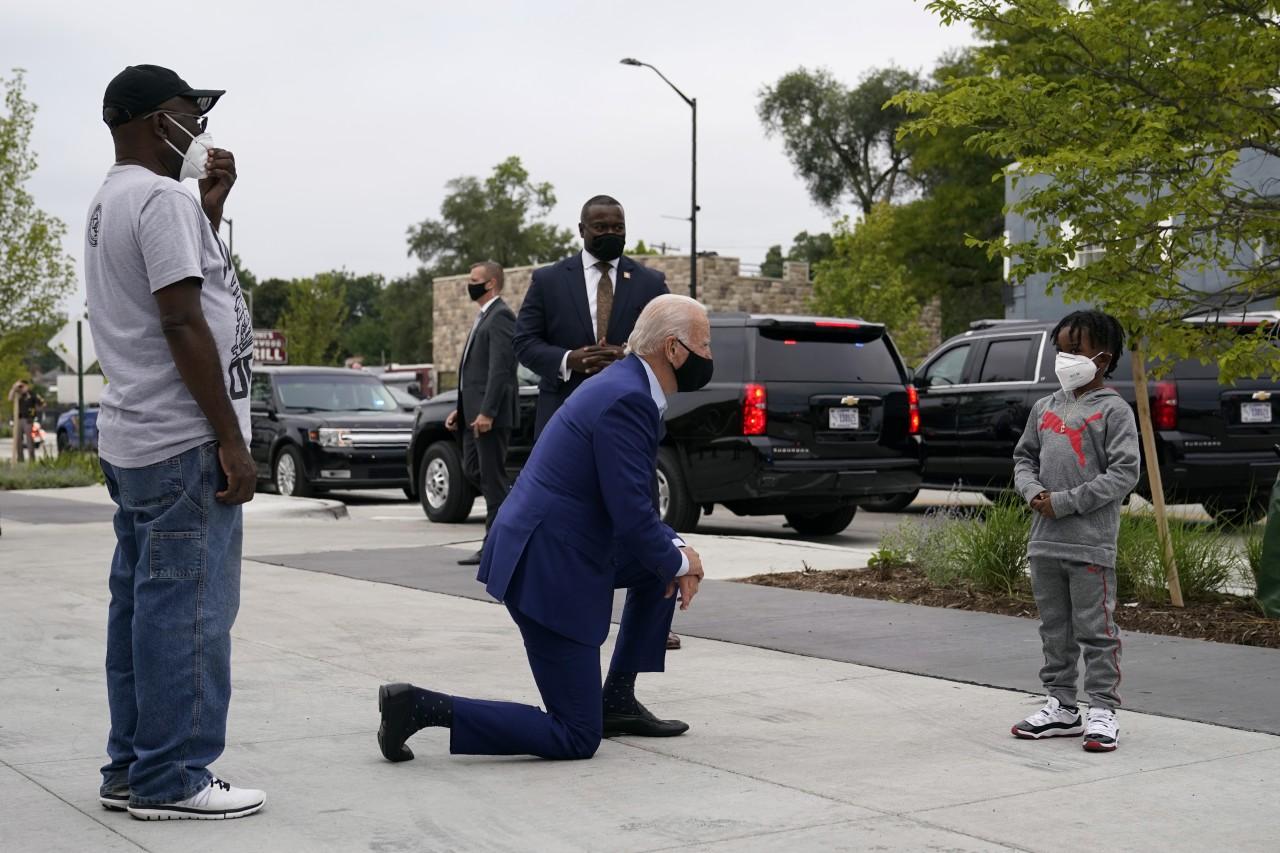
    The accompanying photo shows the politician, who was the Democrats’ presidential candidate for the 2020 US elections, down on one knee talking to a little boy. 

    The reports cite Joe Biden’s Instagram account as a source for the photo which has since been shared many times on social media

    At the time, the actor, Don Little in an interview on Angel FM’s evening news bulletin on Thursday September 17, 2020 also claimed that he was the one in the photo. 

    He said the then presidential candidate knelt before him after he predicted victory for him. 

    “I was on my way to the Ghana Embassy in the US and on my way they showed me where they have meetings. I waved at him [Joe Biden] and said ‘hi’ and he called me. I didn’t even know that he was contesting Trump. I prophesied to him that in the upcoming elections, he will win the elections and that if my prophecy fails, he should walk past me if he sees me. 

    “He was shocked and knelt before me and asked me to repeat what I said. He told one of his people to take a photo of us… It is in Ghana that leaders don’t allow us to get close to them but elsewhere, the leaders are humble,” he told host Kofi Adoma Wanwani [17 mins – 28 mins]. 

    Don Little in a Joy News interview said he started acting in 2011 but could not gain public attention because most of the movies were never released. He said he later started selling airtime in traffic and was noticed by comic actor Funny Face who featured him in his Cow and Chicken series. Don Little became famous from that series owing among other things to his diminutive stature.

    Verification

    The original photo, which was published on Biden’s Instagram page on 15th September 2020 was geotagged Detroit, Michigan.

    A reverse image search conducted based on location and date clues directed us to a September 17, 2020 publication by a local newspaper, the Detroit Free Press that showed similar photos like the one used to make the claim. 

    The photos show different angles of the single-shot shared by the Ghanaian news portals claiming that the boy who was captured was Don Little. 

    According to the Detroit Free Press publication, the photo was taken on September 9, 2020, at the Three Thirteen clothing store on Livernois Avenue after a campaign event at the UAW Region 1 headquarters in Macomb County. 

    The report further indicates that the little boy is CJ Brown, son of Clement Brown, the owner of the clothing store.

    An assessment of the additional photos shown in the publication provided compelling evidence that it was not Don Little although the two individuals appear to have the same hairstyle and height and are of a similar skin complexion.

    C:\Users\Jonas\Desktop\c9c021ba-9b58-45de-a03f-d926dd9188e370-horz.jpg

    CJ Brown (Left), Don Little (Right)

    Below are more photos of Joe Biden and the supposed ‘Don Little’ published by the Detroit Free Press and ABC News’ local portal in Detroit.  
    C:\Users\Jonas\Desktop\download.jpg
    C:\Users\Jonas\Desktop\ff87b317-0aa6-49c9-b3ee-e02fa10236ff-GTY_1271608759 (1).jpg

    A news report by Citinewsroom.com published on August 19, 2020, indicated that Ghanaian actor, Don Little returned to Ghana in August 2020 after being held-up in the US due to the COVID-19 pandemic. On August 19, 2020 the actor published a video on his Instagram page in which he expressed appreciation to some state officials for facilitating his return to Ghana.

    When we contacted Don Little on phone via his local number on the matter, he said he was at the moment on a movie set in Ghana and will revert at an agreed time to further speak on the matter. 

    His phone has since gone unanswered.   

    Conclusion

    Based on the evidence above, we rate as false the claim that Don Little was pictured with Biden and that the US presidential candidate had knelt before Ghanaian actor.  

    The reporter produced this fact-check under the auspices of the Dubawa 2020 Fellowship in partnership with Citinewsroom to facilitate the ethos of “truth” in journalism and to enhance media literacy in the country.

  • NDC 2020 Manifesto Launch: Mahama’s Introductory Speech Fact-checked

    Ahead of the 2020 elections in December, the National Democratic Congress (NDC) launched their manifesto, the ‘People’s Manifesto’ on Monday, 7 September 2020.

    At the launch, the presidential candidate of the party, John Dramani Mahama, in his introductory speech (1:59:22- 2:06:45 of the recorded Facebook live video) was heard making a number of claims centred mainly on the economic state of Ghana and on a government’s COVID-19 management. 

    A transcript of Mahama’s speech which captures the context in which the identified claims were made reads:

    “…In many cases, countries considered relatively less advanced with smaller economies are emerging more resilient and less affected by the global shocks than some countries that are considered advanced. The case of Vietnam, a relatively smaller country bordering China, and therefore closer to the original source of the Coronavirus pandemic has survived much better with relatively less infections and deaths than known global superpowers...Excessive borrowing over the last four years has placed Ghana in a high debt risk category, with absolutely nothing to show for it…”

    Consequently, Dubawa accessed the available facts concerning some identified claims, in producing its attendant verdicts.

    Claim 1: Vietnam has survived the Coronavirus pandemic much better with relatively lesser infections and deaths than known global superpowers

    Verdict: Reports from the WHO, CDC, COVID-19 data sites and media show that Vietnam has recorded relatively lesser infections and deaths compared to the known global superpowers.

    The countries largely referred to as the global superpowers are the five permanent members of the UN Security Council namely the United States of America (US), the United Kingdom (UK), Russian Federation, China and France.

    Dubawa accessed the statistics for the population, confirmed cases/infections and deaths as at 7 September 2020, recorded for Vietnam, US, UK, Russian Federation, China and France tabulated below:

    CountryPopulationConfirmed casesDeaths
    Vietnam97,338,5791,04935
    US331,394,2216,189,488187,541
    UK67,957,887347,15641,551
    Russian Federation145,946,9921,030,69017,871
    China1,440,441,98590,5514,737
    France65,302,500307,47630,547
    Source: 
    Population: Worldometer
    Confirmed case & deaths: WHO

    Comparatively, from the tabulated statistics, Vietnam, which has a population higher than the UK and France, has recorded smaller rates of infection and death than the two countries.

    Vietnam is reported to have confirmed its first COVID-19 case on 23 January 2020, not long after the outbreak in Wuhan, and yet, there were no reported Covid-19 deaths until July 31, 2020. 

    Moreso, the Vietnam Coronavirus tracker also reveals that out of the 1,059 confirmed cases, there have been 902 Covid-19 recoveries in Vietnam, with no critical cases treated in Intensive Care Unit and an 84% recovery rate of the total cases.

    In June 2020, the Centre for Disease Control (CDC) described Vietnam’s response to controlling the pandemic as an excellent credit to the country’s leadership strategies.

    “Vietnam has excelled in controlling COVID-19 through strong leadership and coordination, rapid case detection and isolation, aggressive contact tracing, and strict quarantine measures,” the CDC said.

    Media sites such as the BBC, the Star and publications such as the Policy Forum have also reported on Vietnam’s proven effective response to the pandemic.

    Claim 2: Excessive borrowing over the last four years has placed Ghana in a high debt risk category

    Verdict: Even though Ghana is in high-risk debt distress category due to excessive borrowing, it is not as a result of events of the last four years. Ghana has been in this category since 2015 when an IMF and World Bank report published in April 2015 concluded Ghana to be so on account of breaches in the debt-service to revenue ratio.

    Two documents were accessed to ascertain this claim.

    The first document titled Joint Ghana World Bank-IMF Debt Sustainability Analysis document dated December 2019, an analysis of Ghana’s joint bank-fund sustainability, shows that Ghana’s risk of external debt distress and overall risk of debt distress were truly both high.

    “External and overall debt are at high risk of debt distress… Nonetheless, debt is assessed as sustainable thanks to favourable market access, the authorities’ commitment to macroeconomic stability and fiscal discipline, and the potential for steeper than assumed fiscal consolidation. In the short term, fiscal discipline is necessary to ensure debt sustainability and maintain market confidence, but external factors, including worsening global risk sentiment, still pose significant risks,” the IMF document reads.

    However, Mahama’s assertion that this is a result of excessive borrowing specifically from over the last four years is inaccurate as we found Ghana’s categorisation by the IMF was since 2015. 

    An IMF Ghana report on the ‘Request For A Three-Year Arrangement Under The Extended Credit Facility’ (pg13&14) published in April 2015 also judged Ghana’s debt at a high risk distress. 

    “The Debt Sustainability Analysis (DSA) concludes that Ghana is at a high risk of debt distress, on account of breaches in the debt-service to revenue ratio over 2015–17 and after 2021. The authorities are committed to limit their borrowing plans to loans with a minimum grant element of 35 per cent, with possible exceptions in line with the debt limits policy… Bank of Ghana gross financing to the budget in 2015 will be limited to 5 per cent of previous year’s revenue, using only marketable financial instruments”, the report read.

    In 2015, the IMF stated in the report that Ghana’s public debt continued to rise at an unsustainable pace, however, in the 2019 report, the IMF judged Ghana’s debt as sustainable. 

    Another document titled, The fall and rise of Ghana’s debt jointly published by the Integrated Social Development Centre Ghana, Jubilee Debt Campaign UK, SEND Ghana, VAZOBA Ghana, All-Afrikan Networking Community Link for International Development, Kilombo Ghana and Abibimman Foundation Ghana in October 2016 was accessed to verify the claim. 

    The document, in analysing how Ghana had at the time, ‘fallen in a new debt trap’, also shows that Ghana was categorised as a high risk of debt distress by the World Bank in 2015.

    “In April 2014 Ghana was assessed as at moderate risk of debt distress but ‘approaching high-risk levels’. At the next review in March 2015 this changed to being confirmed as at “high risk of debt distress”. Yet, seven months later in October 2015, the World Bank broke its own rules based on its own assessment by giving a guarantee for (high-cost) bonds for a country rated as at high risk of debt distress,” the document reads

    Therefore, even though Ghana is in a high risk of debt distress category due to excessive borrowing, it is not a matter of the last four years as Mahama claimed. Ghana has been in this category since 2015 when an IMF and World Bank report published in April 2015 concluded Ghana to be so on account of breaches in the debt-service to revenue ratio.

    Conclusion

    Conclusively, from the claims identified in Mahama’s introductory speech at the NDC Manifesto launch 2020, one was true and another was false.

  • Alhaji and Alhaji: Did Akufo-Addo Promise to Build 350 Schools?

    In the recently aired Alhaji and Alhaji political show on 12 September 2020,  two invited panellists on the show, Kojo Twum Boafo and Kamal-Deen Abdulai, were heard debating a claim. 

    Boafo, who is the former CEO of Free Zones Authority and affiliated with the National Democratic Congress (NDC), was heard asserting that President Akufo-Addo promised to build 350 schools when he was a presidential candidate. Boafo was supported by another panellist, Gabriella Tetteh, a member of the NDC Communication Team, who was also heard claiming that this promise was stated in the New Patriotic Party’s (NPP) 2016 Manifesto.

    However, both claims by Boafo and Tetteh were contested by Abdulai, the Deputy Director of Communications of the NPP, who indicated that Akufo-Addo made no such promises. 

    A transcription of the trilogue is captured below:

    Boafo: “The president when he was a candidate said ‘Mahama said he’s built 200, I will build 350’ (translated from Twi) and today when you ask them where the 350 are, they tell you they painted classrooms”

    Abdulai: “Kojo! Where?”

    Tetteh: “Your 2016 manifesto said you were going to build 350 schools… You’ve forgotten?” 

    Abdulai: “Oh no no no no!”

    Claim: Akufo-Addo, as a presidential candidate, said he will build 350 schools

    Verdict: In 2012, Akufo-Addo, as the NPP presidential candidate, said in an address to UDS tertiary students association of the party in Navrongo that the first 18 months of the next NPP government would involve the building of 350 new Senior High Schools from scratch. 

    A 2-minute 23-second video news report published by the Ghana Broadcasting Corporation (GBC) on 4 December 2012 confirms Boafo’s assertion as true. 

    In the video, Akufo-Addo, who was the NPP 2012 presidential candidate was heard making commitments of building a new society of job creation in his address to the NPP tertiary students association of the University for Development Studies (UDS) Navrongo campus.  

    “We plan a rapid and vigorous development of educational infrastructure in the first 18 months of the next NPP government. This would involve the building of 350 new senior high schools from scratch while rehabilitating and expanding existing ones,” Akufo-Addo said.

    Again in 2016, a news report by JoyFM on 7 March 2016 shows that the former NPP Communications Director, Nana Akomea, mentioned that the NPP had a strategy to make this promise a reality.

    “This whole idea of John Mahama saying I will build 200 schools was in reaction to Nana Addo’s plan to build 350-day schools as part of the free SHS agenda. So John Mahama also brought this thing that I am also going to build schools, it wasn’t part of their initial plan,” Nana Akomea said.

    Claim: Akufo-Addo’s promise of building 350 schools is stated in the NPP 2016 manifesto

    Verdict: There is no promise of the building of 350 new schools in the NPP 2016 manifesto nor in the NPP 2012 manifesto.

    Contrary to Gabriella Tetteh’s claim that Akufo-Addo and the NPP’s promise of building new schools is stated in the NPP 2016 manifesto, there is no evidence of such promises by the NPP in the entire NPP 2016 Manifesto. There are no such promises found either under the infrastructure nor under education policies in the manifesto. 

    Furthermore, since Akufo-Addo mentioned this promise in 2012 in his address at UDS, one would assume that perhaps it might be stated in the NPP 2012 Manifesto; however, there is also no such promise stated in the entire  NPP 2012 Manifesto

    Conclusion

    The claim by both Boafo and Tetteh that Akufo-Addo promised to build 350 schools is true. Akufo Addo said this in 2012 as the NPP flagbearer while addressing the NPP tertiary students association at the UDS Navrongo campus. But there is no such promise stated in the 2016 NPP manifesto as Tetteh has claimed. It is also not found in the 2012 NPP manifesto. 

  • NDC 2020 Manifesto Launch: Fact-checking Professor Jane Naana Opoku-Agyemang’s Opening Remarks

    The opposition National Democratic Congress (NDC), On September 8th, 2020, launched its 2020 manifesto titled, “Jobs, Prosperity, and More. The People’s Manifesto.

    The Vice Presidential candidate of the party, Professor Jane Naana Opoku-Agyemang, in her opening remarks made some claims regarding the 2020 elections and elections in Ghana in general. 

    “Today is September 7th and we are exactly three months away from the 2020 presidential and parliamentary election. This election will be historic in many ways. It will be the first time that such an election has been conducted in the midst of a global pandemic. It will be decided by the largest electorates in the nation’s history. It will be the first in the fourth republic to be contested by a former president and the first in which a major political party’s ticket will feature a woman…This will be the youngest electorate in the history of this nation. Seven out of every ten people who registered to cast a ballot December 7th were born a decade before the fourth republic. Nearly half of them have only ever known Ghana as a multi-party democracy,” Prof Opoku-Agyemang said (2:48:40 to 2:50:54).

    Dubawa examined three main claims made by Prof Opoku-Agyemang in her address.

    This is the first time in the fourth republic that a former president is contesting for the seat of the president.

    President John Mahama is the first former president to contest for the seat of President in the fourth republic of Ghana.

    The 1992 Constitution came into full force in 1993, marking the beginning of the fourth republic.

    And since 1992, Ghana has had five (5) presidents:

    1. Jerry John Rawlings
    2. John Agyemkum Kuffour
    3. John Evans Atta Mills
    4. John Dramani Mahama
    5. Nana Addo Danquah Akufo-Addo

    Of this five, John Mahama is the only one to have lost power and to again contest for the presidential seat.

    PresidentTermPolitical party
    Jerry John Rawlings1992 – 2000NDC
    John Agyekum Kufuor2000 – 2008NPP
    John Evans Atta Mills2008 – 2012NDC
    John Dramani Mahama2012 – 2016NDC
    Nana Akufo-Addo2016 – to dateNPP
    *The years stated are when elections were held

    This is the first election in Ghana in which a major party’s ticket will feature a woman.

    As checked by Dubawa, Professor Jane Naana Opoku-Agyemang is indeed the first female vice-presidential candidate of a major political party in Ghana.

    Although there have been a number of female vice-presidential candidates in Ghana over the years, those parties are largely not considered major political parties in the country. 

    In 2012, three female vice-presidential candidates were nominated during in the presidential and parliamentary elections. They are Madam Helen Matervi of the People’s National Convention (PNC), Eva Lokko of the Progressive People’s Party (PPP), and Madam Nana Akosua Frimpomaa II for the Convention People’s Party (CPP). 

    These parties as earlier stated, are, however, not considered to be major political parties even though Ghana has been a multi-party political system. Only the National Democratic Congress (NDC) and the New Patriotic Party(NPP) have amassed the highest number of votes in the elections held. 

    A previous fact-check by Dubawa confirmed this. 

    The 2020 elections will be decided by the largest electorates in the nation’s history.

    This image has an empty alt attribute; its file name is image-5.png

    Based on the information available, this new voters register has the largest number of registered voters in the country’s history.

    Information available on the Electoral Commission (EC) website indicates 16,845,439 voters have been registered. This figure is subject to change depending on the outcome of the upcoming Voters Register Exhibition which is scheduled to begin from September 18th, 2020. 

    In a Facebook live stream held on August 12, to inform the media and the public about notable statistics recorded during the 2020 voters registration compilation, the EC Chairperson, Jean Adukwei Mensa, had announced that the Commission had recorded a total of 16,963,306 eligible voters. This was a provisional figure and was subject to change based on the resolution of challenges reported during the registration exercise. 

    Image source: Electoral Commission of Ghana

    The table below shows a list of elections held in Ghana’s history from the year 1957 to 2016 and the yet to be held 2020 elections.

    S/NoYearElection TypeNumber of registered voters
    1February 1951 Legislative Assembly Electionn/a
    215 June 1954 Legislative Assembly Electionn/a
    317 July 1956 Legislative Assembly Election1,392,874
    427 April 1960 Plebiscite2,098,651
    527 April 1960 Presidential Election2,098,651
    631 January 1964 Constitutional Referendumn/a
    729 August 1969 National Assembly Election2,360,000 (approx.)
    830 March 1978 Referendum4,497,803
    9June 1979
    Presidential Election5,000,000 (approx.)
    1018 June 1979 National Assembly Election8,255,690
    113 November 1992 Presidential Election8,229,902
    1229 December 1992 Parliamentary Election7,336,846
    137 December 1996 Presidential Election9,279,605
    147th / 28th December 2000 General Elections10,698,652
    157 December 2004 General Elections 10,354,970
    167th and 28th December 2008 General Elections12,472,758
    172012General Elections14, 03,793
    182016General Elections15, 712,505
    192020 (Yet to be held)General Elections16,845,439
    Data Source: African Elections Database, Electoral Commission and eisa.org
    N.a: Data unavailable
  • ‘Dr UN’ And Purported Affiliations with Harvard, UN and Kofi Annan: Here’s What We Know

    ‘Dr. Fordjour’, aka ‘Dr UN’ who presented Global Excellence awards to influential personalities and organised conferences claims he is a UN-Kofi Annan ambassador

    Both the Kofi Annan Foundation and the United Nations have confirmed with Dubawa that they have no associations with ‘Dr UN’, his organisation and his award schemes as he claims.

    Full text

    One of the top trends that have surfaced on Ghanaian Twitter timeline over the week is ‘Dr UN’- a nickname by the Ghanaian Twitter community given to a man who refers to himself as Dr Kwame Owusu Fordjour. Fordjour is reported to be presenting purported United Nations (UN) global awards of excellence to some high-profile Ghanaian personalities detailed in this article by Dubawa

    Amidst the Twitter banter and ridicule of personalities who have fallen prey to the alleged scam, the Ghanaian Twitter community identified that Dr Kwame Owusu Fordjour is not who he claims to be, especially as he is reported to have had allegations of fraud made against him ten years ago.

    The UN BluePrint Mission website (which has since been taken down) dedicated to introducing Dr Kwame Owusu Fordjour and his ‘UN-Kofi Annan ambassadorial mission’ indicates that Fordjour, who also attributes the title ‘His Excellency’ to his name, is also known as Wayne Winston.

    On the website, Fordjour claims that he has been assigned by the 7th UN General-Secretary Kofi Annan as a millennium ambassador to monitor and assess the state of governments and to make them accountable to the citizens. 

    The website also alleges that Fordjour has worked with the UN over a number of years, after having completed Harvard Kennedy School, and has devoted his attention to projecting African countries’ achievements.  

    In view of this supposed responsibility, Fordjour holds a ‘Service to Humanity Awards’ ceremony where recognised Ghanaian personalities have received awards from him. 

    The awards are purportedly meant to honour personalities whose works and activities have been deemed to be of excellence in leadership, in accordance with the vision of Fordjour and his ‘UN Kofi Annan BluePrint mission.’ 

    Verification

    Dubawa contacted the National Information Officer for the United Nations Information Centre (UNIC) in Ghana, Cynthia Prah, to confirm Fordjour’s association with their organisation.

    Subsequently, in a detailed email Prah sent to Dubawa as a model of a public disclaimer, the United Nations in Ghana stated that they have no affiliation with Fordjour’s BluePrint Global Challenge Awards nor with his BluePrint Mission organisation.

    “We advise the general public to access genuine information by visiting the relevant UN agencies’ websites or the UN Ghana website on https://ghana.un.org/en,” the disclaimer reads. 

    Source: UN in Ghana

    Dubawa further contacted the Kofi Annan Foundation in Geneva to confirm Fordjour’s alleged association with the foundation. 

    The Programme Manager for the Kofi Annan Foundation, Natalie McDonnelle, responded that Fordjour was using the name of Kofi Annan in an unauthorised way for his works, despite prior warnings from the foundation for him to stop. 

    “Dr Fordjour has used the name of Kofi Annan, as well as his photograph and signature, without permission on a number of occasions and indeed has ignored a cease and desist letter sent to him regarding this matter. I can also indicate that he is not a representative of the UN, as they wrote to us recently asking if we knew anything about him,” McDonnelle said.

    Dubawa interviewed Abdul-Karim Ibrahim, a researcher and journalist, who spearheaded investigations into Fordjour’s identity and awards. 

    Ibrahim explained to Dubawa that when he started investigations in July, it was difficult to get Fordjour to respond to the drafted story for publication. Consequently, he reached out to a former colleague at Ghanaweb, Benefo Buabeng Abrantepa, who was able to hold an interview with Fordjour.

    In the 41-minute audio interview sent to Dubawa, transcribed by PoliticoGh, Fordjour is heard insisting on his claim of holding an ambassadorial mission from Kofi Annan and the UN even after it was revealed to him by the interviewer that such awards are not indicated as a programme or project under the UN.

    When questioned about the alleged arrest for fraudulent activities on the Association of Rural Banks and Apex Bank Limited, he confirmed the arrest by stating in the interview that:

    “…The journalists came, the police came, we went to the police station and then I wrote my statement and they said then it’s false, then I am right. None of the APEC people came there, none of them came to the police station. They just wrote their irrelevant information to the CID in their own office and never came there for us to battle it ourselves. So we went to court, and the court cleared me.”

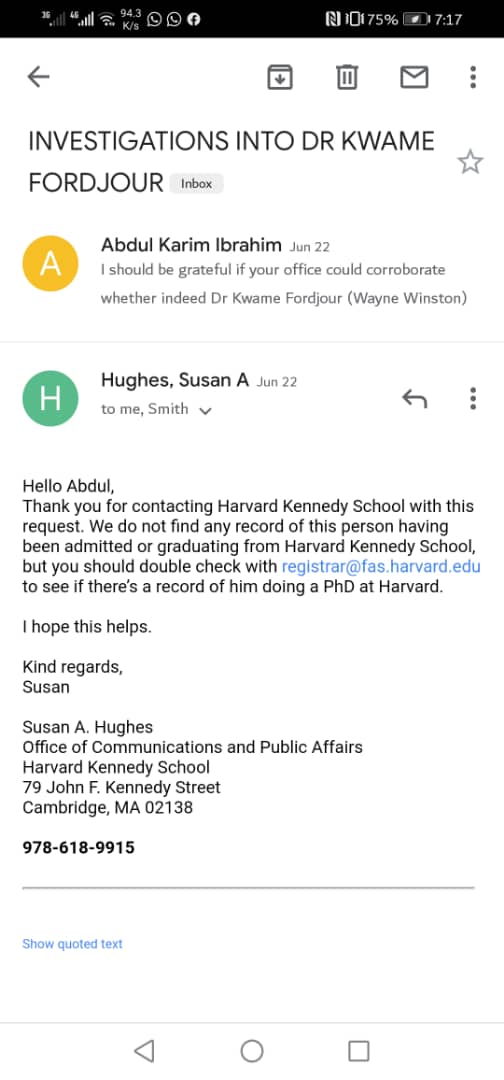
    Ibrahim also told Dubawa that in his initial investigations, he contacted Harvard Kennedy School about Fordjour’s claim of attending the institution. They denied having records of him. 

    Source: Abdul Karim Ibrahim

    Conclusion

    The facts known about ‘Dr UN’ is that he is not a Kofi Annan-UN ambassador associated with the Kofi Annan Foundation nor with the United Nations as he claims. Also, his arrest based on fraudulent allegations on Rural Banks and Apex Bank Limited is true, albeit the veracity of the allegations remains unknown till now. Further, he did not attend the Harvard Kennedy School as he claims. 

  • How the ‘Dr. UN’ scandal casts light on ‘fake awards’ in Ghana

    Ghana’s media space has recently seen a major discussion on what many term as a “fake” award scheme that has rather become an unfolding scandal.

    The conversation has centred around one man who addresses himself as H.E. Dr. Kwame Owusu Fordjour, alias Dr Wayne Winston.

    Fordjour describes himself as the “Global Chair under the UNSG of the United Nations Blueprint Mission of Excellence”

    He claims that the mission was “spearheaded and instituted by Former UN Secretary-General Kofi Annan as the finest Global Performing Honour or Achievement Belt of defined Service to Humanity that has Divine Cord of Global Governance, in building Nations through Peace and Prosperity, Democracy, Law and Order etc.”

    The spotlight on him and his activities in Ghana comes after his “2020 Global Leadership Service to Humanity Awards” held at Alisa Hotel in Accra on Friday, August 28.

    That event saw famed Ghanaians including rapper Sarkodie being given an award supposedly affiliated to the United Nations and spearheaded by former Secretary-General Kofi Annan.

    More than 20 influential Ghanaians including a Member of Parliament, a University Vice-Chancellor, and many media personalities have been awarded at various ceremonies under Fordjour’s United Nations Blueprint Mission.

    Source: Citinewsroom

    ‘How is it fake?’

    Many Ghanaians strongly hold the view that the awards are fake, despite a denial from Fordjour.

    In Ghana, there is no law barring people from organizing award schemes or recognizing others involved in legal activities.

    In some instances, organizers register the venture with the Registrar General’s department.

    So why is there a strong view that the award is fake?

    According to a researcher and journalist, Abdul-Karim Ibrahim, who started making allegations of the award’s fakeness, his conviction was based on Mr Fordjour’s incoherent statements when he appeared on Wontumi TV in June 2020 to present the said award to the owner of the media house, Bernard Antwi Boasiako, alias Chairman Wontumi, who is the Ashanti Regional Chairman of the governing New Patriotic Party (NPP).

    He said while he was shocked that the UN would award Chairman Wontumi, Fordjour’s comments gave impetus to suspicions that the award was dubious.

    “There was also the other issues of communication; horrible grammar, the citation was incoherent, the storyline that the winner was only 5 of 200 people selected across the world by a UN panel among others. Generally, Fordjour’s demeanour too. He didn’t cut the regular figure of someone at such high levels in diplomatic circles. This may seem a bit classist but it’s a poignant fact nonetheless,” he told Dubawa.

    “I looked into his official website (UN blueprint missions) and found out the UN had no such mission. I also found out that he’d been arrested in the past over attempts to defraud,” Ibrahim added.

    Indeed, a September 2010 Ghanaian Times newspaper report republished on ModernGhana.com indicated the said arrest of Fordjour over an attempt to defraud rural and community banks.

    “Fordjour was alleged to have written a letter to 40 rural and community banks asking them to pay GH¢200 each as participation fee and to submit 10-minutes documentary of their projects to commence publicity on various media networks as a prelude to the event. The bank’s officials handed over Fordjour to the police when he went there in response to an invitation to come for further discussion on the project,” excerpts of the report read.

    A claim of a fake award could be hinged, among other things, on a false claim of affiliation, suspicious or dubious character being the organizer and the revelation that the programme is a pay-to-get scheme. Many fake awards fall under similar activities.

    The above are broad categories under which most alleged ‘fake’ awards could fall under.

    ‘Borrowed credibility’

    In an attempt to inject credibility into the awards venture, the organizers sometimes tout the credentials of influential persons or organizations that are purported to be affiliated to the awards.

    In most instances, this turns out to be false and was only intended to restrain the minds of doubters from raising objections. 

    It becomes safe to state that an award is questionable if those claiming to be affiliated to it publicly deny any such connection.

    Associating former UN Secretary-General, Kofi Annan or the United Nations (UN) to award ceremonies by Fordjour would create a huge amount of credibility. But the scam was unveiled when the United Nations on September 7, 2020, denied any affiliation with Fordjour’s  Blueprint Global Challenge Awards.

    ‘Who is the organizer’

    The credibility of promoters or organizers of awards events is almost always directly related to the quality of awards.

    With the advantage of the internet, looking up background record and history of organizers of awards is relatively easy. Their history could provide useful information about the credibility of their awards offering.

    The news report of Fordjour’s arrest on the allegation of fraud was a major development that would prompt anyone who does a little background check to see how suspicious it was.

    Another detail in the ensuing conversation about fake awards is many different names under which awards at various terms were named.

    ‘Swinging award names’

    In the 2010 news report, Fordjour was linked to what was known as “Millennium Achievers’ Gold Award.” Subsequent reportage mentioned awards given to different people under his United Nations Blueprint mission of Excellence initiatives under various names, such as “GPE Gold Star Order of Leadership Excellence,” “UN Kofi Annan Excellence Awards”, “Blueprint Global Challenge Awards,” and “Global Leadership Service to Humanity Awards.”

    While this alone cannot be a clear-cut indication of a fake award, it remains curious in the case of Fordjour that there is no record of previous editions or winners of the Global Leadership Service to Humanity Awards which was said to be the 7th edition.

    Dubawa found no record of the series before what Fordjour cited as the 7th edition of the award ceremony. 

    ‘Why pay’?

    Why should there be payment if the nominee or selected person is deserving of it?

    If one is meritorious of an award by dent of their personal efforts, do they need to justify that with a monetary contribution to the organizers? 

    Why should there be payment if the nominee or selected person is deserving of it?

    The case of Fordjour’s supposed “UN Awards” may be the biggest in the recent history of scams, especially in terms of the notable characters associated to the award programme and the personalities involved in the scam, particularly the high publicity it received in the media.

    This development provides some useful lessons for Ghanaians and Ghana where many awards; however credible, however fake, are fast becoming commonplace.

  • Fact-check: Dr Bawumia’s 15 million mobile money users claim, others checked

    The Vice President of Ghana, Dr Mahamudu Bawumia on Wednesday, August 19, 2020, while addressing the New Patriotic Party’s (NPP) third town hall meeting and results fair in Accra, made a number of claims regarding mobile money interoperability and the gains made with its introduction.

    Among other things, Dr Bawumia said Ghana has become the fastest growing mobile money market in Africa owing to the operationalization of mobile money interoperability and that, 15 million people in the country have mobile money accounts as a result.

    “Thanks to mobile money interoperability, Ghana is now the fastest growing mobile money market in Africa. Mobile money transactions now dwarf banking transactions. The total number of transactions recorded under mobile money as of December 2019 was 200 million whereas that of banks was 599,000 (just about 3% of the mobile money number). Over 15 million people have mobile money accounts in Ghana!” the Vice President said.

    We fact-checked three claims from the above statements and report as follows:

    Claim 1: “Thanks to mobile money interoperability, Ghana is now the fastest growing mobile money market in Africa.” – Dr Bawumia

    Verdict: True

    Mobile Money Interoperability is a service that allows direct and seamless transfer of funds from one mobile money wallet to another mobile money wallet across networks. It was launched in May 2018 by the Vice President Dr Bawumia in Accra.

    According to the Ghana Interbank Payment and Settlement Systems Limited (GhIPSS) which manages the system, the interoperability platform was used 5.12 million times between January and March 2020, up from 1.1 million times reported in the first quarter of 2019.

    press release by the World Bank on June 14, 2019, indicates the interoperability system has ensured “growth in the number of financial access points over the past five years” despite the challenges in making the economy financially inclusive.

    The World Bank in its 4th edition of the Ghana Economic Update, the latest report, published on June 1, 2019, and related to the above observation, rated Ghana as being the fastest growing Mobile Money market in Africa.

    “Mobile phone penetration has created opportunities for the expansion of financial services and increased the role of non-financial institutions as much as e-money issuers, positioning Ghana as the fastest growing mobile money market in Africa,” excerpts of the report reads.

    Claim 2: Mobile money transactions now dwarf banking transactions

    Verdict: True

    The Bank of Ghana which regulates the banking sector in the country released a report on the country’s financial and economic performance for December 2019.

    In the document, the data captured financial transactions for the period of December 2018 to December 2019.

    The total number of mobile money transactions for December 2019, per the report, was 200 million with a value of GH¢ 32.8 billion.

    The total number of cheques cleared for December 2019 was 599,000, as stated by the Vice President.

    Other data in the document included ACH Debit which recorded 73,000 transactions while ACH credit transactions were 772,000 transactions.

    The number of E-zwich transactions was also 982,000.

    Source: Bank of Ghana

    Per the data, we notice that the 599,000 figure quoted by the Vice President was specific to the number of cheques cleared.

    In providing education on whether clearance of cheques alone represents the meaning of banking transactions, a banking consultant, Nana OtuoAcheampong said there were various types of banking transactions including clearance of cheques.

    In reference to the claim, he indicated that ACH credit and ACH debit as reported in the Bank of Ghana’s statement “are banking transactions.”

    “Unless in his speech he tried to differentiate between the types of banking transactions… Maybe he took the cheque clearing segment only but globally, it is not the only transaction that a bank can undertake.” Nana OtuoAcheampong explained.

    On what the ACH credit and ACH debit system was, he said they were interbank transactions that had to do with the debiting one’s account and crediting another’s account upon the instruction of the payee.

    “If I give instructions to my bank and ask them to make payment to you, I haven’t signed a cheque but through ACH, they are able to do the clearing,” he said.

    However, we find that in whichever way we look at it, mobile money transactions dwarf banking transactions.

    Claim 3: Over 15 million people have mobile money accounts in Ghana

    Verdict: Insufficient evidence

    This is not the first time the Vice President has made this claim. An opposition Member of Parliament for Ningo Prampram, Sam George, has much earlier publicly challenged it.

    To look into this claim, we accessed the Bank of Ghana’s latest Summary of Economic and Financial Data; for May 2020.

    In the report, we found information on the number of registered Mobile Money accounts as well as the number of active Mobile Money accounts from March 2019 to March 2020.

    The data for both periods and the two categories are represented in the table below:

    March 2019March 2020
    Registered mobile money accounts29.6 million34.3 million
    Active mobile money accounts12.7 million14.8 million

    From the table above, we gather that Ghana’s Vice President was making reference to the number of active mobile money accounts, 14.8 million as of March 2020 (15 million approximately) in his speech.

    Relying on data for the number of active mobile money accounts to make a case for the number of users may appear misleading, which is the position of Sam George in his argument.

    Indeed, with the number of registered mobile money accounts far exceeding Ghana’s estimated population, it will only be reasonable to assume that some people in Ghana use more than one mobile phone or numbers and possibly have two or more active mobile money accounts.

    According to the Ghana Telecommunications Chamber, the number of mobile voice subscriptions in Ghana is over 41 million. But this number far exceeds the country’s estimated population of 30.9 million which also makes a good case about some users having multiple accounts.

    The above notwithstanding, it is important to note that getting the actual number of users will require a lot more work including mobile networks collaborating to de-duplicate their data.

    This may not entirely solve the problem because according to Dr William Derban, the founder of the Forum for Financial Inclusion Africa, a critical mass such as persons who do have personal mobile money accounts but conduct MoMo transactions through merchants over the counter may still not be accounted for.

    “People using mobile money is not the same as registered accounts [but] some people can use mobile money over the counter to receive money and are not counted by this definition,” he said.

    “While the GSMA [Global System for Mobile Communications] is an authority in this, it could be that a country may have its own definition that they use,” he added.

    However, Dr Derban, while focusing on financial inclusion, said “[it] is more than just access to accounts (bank or mobile). It is more about the number of people who use it and most importantly, how they can use financial services to improve their lives. Can they save, can they borrow, do people have the right level of financial and digital skills to make informed decisions about their finances? Are they protected? These are areas that we need to look into carefully to ensure that the growth in access to finance via mobile money has the maximum impact on our people.”

    While it appears most appropriate to make reference to mobile money accounts rather than mobile money users, industry players sometimes use both interchangeably, owing to the complexity involved in deriving the exact number of mobile money users in most populations.

    …..

    The reporter, produced this fact-check under the auspices of the Dubawa 2020 Fellowship in partnership with Citinewsroom to facilitate the ethos of “truth” in journalism and to enhance media literacy in the country.

  • Facebook Updates Terms Of Service: To Remove and Restrict Access to Users’ Content

    Facebook says it is updating its Terms of Service (TOS) to enable it to remove or restrict access to content, services, or information on its platform which may expose the company to legal troubles. 

    The technology giant in a notification to users announced that implementation of the new policy, an update to its Terms of Service (TOS), takes effect on October 1.

    “Effective October 1, 2020, section 3.2 of our Terms of Service will be updated to include: “We also can remove or restrict access to your content, services or information if we determine that doing so is reasonably necessary to avoid or mitigate adverse legal or regulatory impacts to Facebook.”

    Image Source: windowcentral.com

    Offences which may result in content being removed or restricted include content that is considered to be unlawful, fraudulent, discriminatory or content which infringes on other peoples rights and intellectual. Content which violates Facebook’s community standards may also be affected by the new policy.

    Affected users will be notified of such actions and the review options available to them to reverse them.

    “If we remove content that you have shared in violation of our Community Standards, we’ll let you know and explain any options you have to request another review, unless you seriously or repeatedly violate these Terms or if doing so may expose us or others to legal liability; harm our community of users; compromise or interfere with the integrity or operation of any of our services, systems or products; where we are restricted due to technical limitations; or where we are prohibited from doing so for legal reasons,” the notification reads.

    These changes may also affect Facebook’s Community Standards, Commercial Terms, Advertising Policy, Self-Serve Ad Terms, Pages, Groups and Events Policy, Facebook Platform Policy, Developer Payment Terms, Community Payment Terms, Commerce Policies, Facebook Brand Resources, and Music Guidelines.

    Read full terms here.

    Has Facebook already started rolling out the pending changes?

    Facebook has already started implementing some restrictive activities on its platform in a bid to stem misinformation and infringements. 

    On September 3rd, 2020, Facebook introduced a forwarding limit on messenger, stating that the move is to help slow the spread of viral misinformation on the platform.

    “As a part of our ongoing efforts to provide people with a safer, more private messaging experience, today we’re introducing a forwarding limit on Messenger, so messages can only be forwarded to five people or groups at a time. Limiting forwarding is an effective way to slow the spread of viral misinformation and harmful content that has the potential to cause real-world harm,” the company said.

    Earlier in the year, Facebook also introduced other features to stop the spread of misinformation by using artificial intelligence to identify certain behavioural patterns that are considered unusual and may be correlated to scamming or harmful activities. 

  • Infrastructure Development: The KEEA Sea defence project triggers a debate on the identity of the sponsors

    The ongoing sea defence project in the area Komenda-Edina-Eguafo-Abrem (KEEA) Municipality is being constructed by some NGOs and not by the government.

    The Elmina sea defence project is part of the phase III of the construction of the Takoradi/Elmina emergency sea protection project by the Government of Ghana under the Ministry of Works and Housing.

    Full Text

    The  Omanhen of Elmina  Traditional Area, Nana Kodwo Conduah VI said that a vast majority of the people in Komenda-Edina-Eguafo-Abrem (KEEA) doubt that the ongoing sea defence project in the area is being constructed by the government but believe that some NGOs are sponsoring the project. 

    The chief made the claim when President Akufo-Addo cut the sod to commence the construction of Elmina fishing port rehabilitation and expansion project at Elmina in the Komenda-Edina-Eguafo-Abrem (KEEA) Municipality on Thursday August 20, 2020.

    “There are  a lot going around in our Municipality. I am happy that the chief of Komenda, Nana Kodwo Kru II,  is here. The truth is that, people are claiming that the sea defence which is being constructed along the coast of Komenda through to Elmina is the initiative of some NGOs and not the government”, the chief  said and pleaded with  the Works and Housing Ministry to clear the air on the issue. When contacted via telephone, the chief was not able to name any NGO but insisted that the situation was so in Komenda.

    The chief’s claim came a few days after Vice President Bawumia had mentioned on page 45 of his presentation of the Government’s infrastructure development  on Tuesday August 18, 2020 that the Elmina sea project was constructed during the first term of the NPP government.

    Verification

    Upon further research, Dubawa discovered that the Elmina sea defence project is captured in page 88 of the 2020 NPP’s manifesto as part of an ongoing sea protection project being undertaken by the current government together with the ones in Axim, Amanful Kumah, Kommenda, Cape Coast, and Anomabu.

    The same project is also captured in page nine of the Medium Term Expenditure Framework (MTEF) for (2018 -2021) of the Ministry of Works and Housing. 

    It is stated in the MTEF that “Works are currently ongoing on the New Takoradi/Elmina, Adjoa, Blekusu and Dansoman whose current statuses of implementation are 40%, 65%, 45% and 45% respectively.” 

    We visited the project site and saw signage detailing the nature of the project, location, clients, consultants, and the name of the contractor.

    According to the inscriptions on the signage, the Elmina sea defence is part of the phase III of the construction of the Takoradi/Elmina emergency sea protection project. It is being constructed by Vuluxx Company Limited, a fully-owned Ghanaian company with the Hydrological Services Department as the consultants. 

    While responding to the chief’s claim, the Minister for Works and Housing, Mr Samuel Atta Akyea, emphasised  that the Government of Ghana was financing the construction of the sea defence in the area. He said the project was a five kilometer stretch with a construct sum of $70 million. He added that the project was about 50 percent complete.

    “This is a project we awarded to Vuluxx Company Limited. It is a five kilometer stretch which is ongoing. For now, the contractor has done 50 percent of the work. The contract sum is 70 million dollars. So before we started this project (Elmina fishing port), the President had already cut sod for this coastal protection project currently ongoing. So let us not be deceived,” he said. 

    Also, outlining some major projects his ministry has implemented as part of the Coastal Protection Project aimed at protecting the beaches and environs at a media briefing in Accra on Wednesday June 24, 2020, Mr  Atta Akyea  mentioned the Elmina sea defence project.

    Conclusion

    In the process of our verification, we did not come across anything that suggested that the Elmina sea defence project was being financed by some NGOs. The chief himself was not able to name any NGO. Therefore, the claim by the people of KEEA that the sea defence project currently under construction in their area was being financed by some NGOs and not by the government of Ghana is false.

    The reporter produced this fact-check under the auspices of the Dubawa 2020 Fellowship to facilitate the ethos of “truth” in journalism and to enhance media literacy in the country.

  • Dr Bawumia on Mobile Money Interoperability: Two Claims Rated False

    During a one-on-one interview on Peace Fm’s Kokrooko on August 25th, 2020 between 54:56 to 55:06 minutes into the interview, the Vice President, Mahamadu Bawumia, made some claims about mobile money interoperability in Ghana and Africa as a whole.

    The Vice president stated emphatically that,

    “But the other part of it is that you have made the bank account and the mobile money wallet interoperable. So you can move money between the bank account and the mobile money wallet and vice versa and you can also do the same with the E-Zwich account. So triangular interoperability is what we have done. And Kwame this is the first country in Africa to do so. There is no other country in Africa that has been able to deliver mobile money interoperability.”

    During the interview, viewers and listeners contested the statement citing Kenya as a country that had also adopted mobile money interoperability.

    A video of the interview has been uploaded on Youtube.

    We look at the two claims made by Bawaumia: first, “there is no other country in Africa that has been able to deliver mobile money interoperability” and second, that Ghana is the only country in Africa to implement interoperability between bank account and mobile money wallets.

    What is mobile money operability?

    This is a service that allows direct and seamless transfer of money from one mobile money wallet to another across networks.

    Over time, this has grown to include integration in broader payment infrastructures, connecting a variety of financial services providers.

    In this regard, there is a move from restricted transactions between just mobile money providers (MMPs) and one that offers the added opportunity for transfers or transactions between  two accounts, like MMPs and a bank.

    According to the report published by GSMA, 

    “Of the 95 markets where mobile money services are live, 48 have interoperability with either a bank or MMPs…On average, mobile money providers with bank integrations are connected to 13 banks.”

    Claim 1: No country in Africa has been able to deliver mobile money interoperability.

    Verdict: Ghana is not the only country to adopt and deliver on money interoperability. 

    Dubawa ran an online check for African countries who have functioning mobile money interoperability and found that many African countries, for instance, Kenya, Uganda, Tanzania and others have adopted and implemented the mobile money interoperability. 

    Quartz Africa in 2018 reported Tanzania to be the leading country in delivering interoperability. However, this level of operability is limited to Mobile money providers.

    “Indeed, there’s precedent in Tanzania, the first African country to adopt interoperability, where there has been increased transactions among users. It’s a measure that’s also been adopted in Kenya and Ghana,” the report reads.

    On June 4th, 2014, The East African also published a report on Tanzania being the first African country to implement the interoperability system. 

    Further search also led to GSM Association, an organisation that represents the interest of mobile network operators worldwide.

    GSMA released a report titled “Tracking the journey towards mobile money interoperability Emerging evidence from six markets: Tanzania, Pakistan, Madagascar, Ghana, Jordan and Uganda” in June 2020.

    The report was based on  a study using a mixed-method analysis  which included 32 key informant interviews, both remote and in-country, as well as desk research and field interviews conducted between December 2019 and February 2020. 

    It provides detailed insight into the state of mobile money operability in the selected countries and some limited information on others. See below.

    Image source: GSMA

    Claim 2: “There is no interoperability between bank account and the mobile money wallet anywhere in Africa…”

    Verdict: Other countries, Tanzania for instance, have mobile money wallet to bank account  interoperability which has been and is currently in use.

    Dr Bawumia in responding to the host’s comment that other countries, including Kenya, have implemented interoperability said Ghana is the only African country to implement interoperability with banks inclusive (1:38:30 to 1:39:48).

    This claim is false. Dubawa found information available that points to the fact that other African countries, for instance Tanzania, have mobile money wallet to bank account transfer services available. 

    Tanzania has platforms that link and allow funds transfer from mobile wallet to bank accounts and even to wallets and accounts outside their country. In some cases, aggregators serve as a link between these accounts. Selcom, Craftsilicon or Cellantis are examples of such platforms that enable such transfers.

    Dubawa further spoke to Victor Makere, Head of Digital Banking, Standard Chartered Bank, Tanzania, who explained that indeed mobile money wallet to bank account transfers are done in Tanzania in two ways. 

    The first way (Direct Integration between Mobile Network Operator and Bank) requires the bank to have a wallet with the mobile network provider. The second option is similar but between the bank account  and MNO there is an aggregator.”

    This was corroborated in another conversation with Emmanuel Mwinuka, Chief Information Officer (CIO), Absa Tanzania. He explained that mobile money wallet to bank account interoperability is functional in Tanzania. 

    He further indicated that there is a plan to launch a project called “Tanzania Instant Payment System (TIPS)” which will create a platform that supports instant centralised settlement between MNOs and bank accounts, bank accounts and MNOs and MNOs to other MNOs. This project will eventually fade out the existing interoperability systems that are in place, promoting ease. 

    Based only on the statement made by the vice president, this claim is false.

    Conclusion

    Ghana is not the first or only country to deliver on mobile money interoperability. It is also not the only African country to implement triangular interoperability.

Back to top button