A cloud of uncertainty hangs ominously on the chamber of Parliament after the Speaker of Parliament Alban Bagbin declared four seats of ‘disloyal’ Members of Parliament vacant.
With two months to the end of the parliamentary cycle, the declaration manifestly alters the sitting positions of Members of Parliament, making the hitherto Minority members, become the Majority.
But the leader of government business in Parliament Alexander Afenyo Markins is convinced the Speaker’s ruling and declaration on Thursday October 17, is a travesty of justice and cannot stand the test of legal inquest.
He has filed a suit at the country’s Supreme Court, the highest court of the land in a bid to overturn the Speaker’s ruling
Background
The National Democratic Congress (NDC) threatened to compel a number of MPs on the majority side to vacate their seats after they announced plans to run as independent candidates in the upcoming 2024 elections.
The party says it will invoke Article 97(1)(g) of Ghana’s 1992 Constitution, which states:
“A member of Parliament shall vacate his seat in Parliament (g) if he leaves the party of which he was a member at the time of his election to Parliament to join another party or seeks to remain in Parliament as an independent member;”
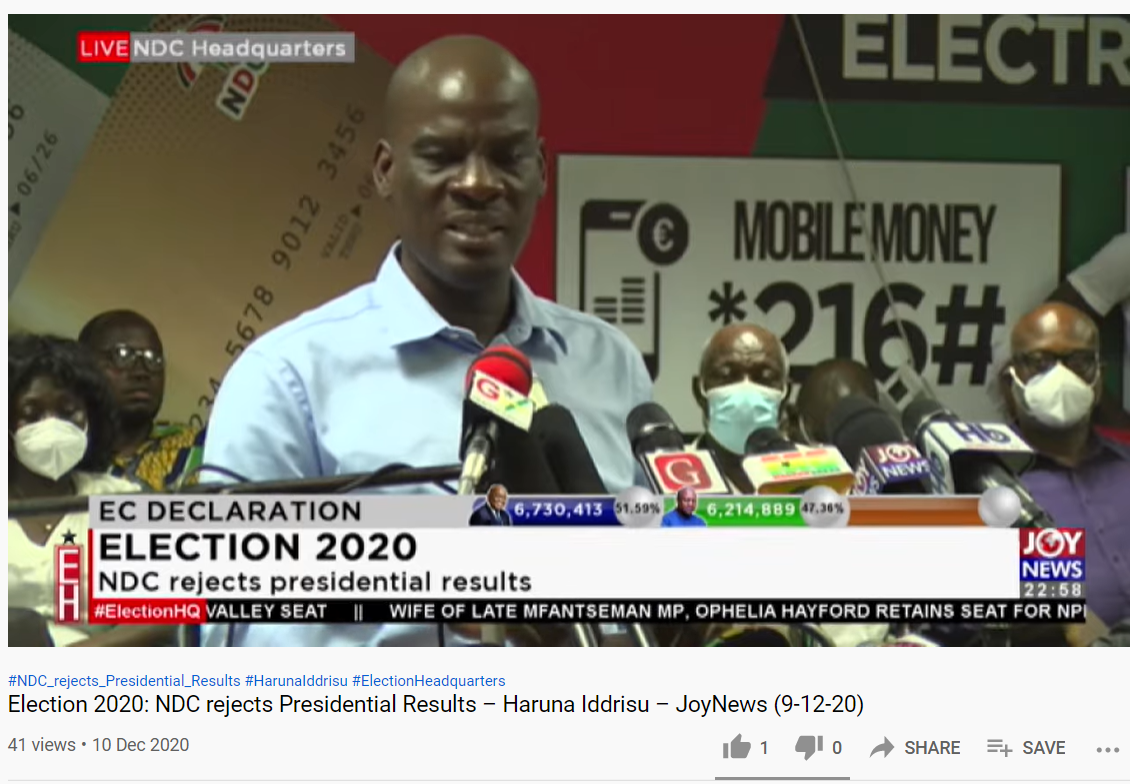
Haruna Iddrisu, the Member of Parliament for Tamale South, who made the threat, believes this move could shift the current parliamentary dynamics and give the NDC a majority in Parliament.
“The minority must become the majority for Wednesday next week. I assume this must happen if there is constitutional and legal proprietary law in Ghana.
“Because any nuanced interpretation of Article 97 provides that if a member of parliament on a political party ticket like NPP defects and files to be independent, that MP ceases to be a member of parliament.”
On Thursday, the NDC Minority in Parliament brought the issue to the attention of the Speaker for a decision to be made.
The Speaker obliged, citing the law and precedents and terminating the parliamentary careers of the four MPs, at least for the eighth Parliament of the fourth Republic.
Alban Bagbin said the decision by the MPs to contest the 2024 elections in December as independent candidates is evidence of disloyalty to their constituents and must vacate their seats.
The affected MPs are Gender Minister Cynthia Morrison who intends to run independently. The others are the Second Deputy Speaker of Parliament and MP for Fomena, Andrew Asiamah Amoako, Kwadjo Asante of Suhum, and Peter Yaw Kwakye-Ackah, the National Democratic Congress (NDC)’s MP for Amenfi Central.
Even before a decision will be taken, the matter had already become a subject of interest and conversation
The Political Context
The opposition NDC held a narrow minority, but the potential disqualification of four MPs running as independents could change this.
According to Haruna Iddrisu, the Article clearly mandates that MPs who contest elections as independents, after being elected on a party’s ticket, forfeit their parliamentary seats. He argues this would automatically disqualify the MPs in question, including Cynthia Morrison.
Iddrisu’s interpretation suggests that the MPs’ decision to run as independents signalled their defection from the New Patriotic Party (NPP). Hence, they are no longer recognised under the Constitution.
“And if an independent member of parliament, by virtue of the provision of Article 97 1(g), an independent joins a political party, that independent loses constitutional recognition and does not belong to parliament. And even if an NDC candidate, MP, defects to become an independent, he ceases to be a member of parliament,” he said.
Article 97(1)(g) in perspective?
Article 97(1)(g) of Ghana’s Constitution states that:
“A member of Parliament shall vacate his seat in Parliament if, having been elected to Parliament as a member of a political party, he leaves that party to join another party or becomes an independent member.”
This clause provides the constitutional basis for MPs to vacate their seats under two conditions:
1. If they leave the party under whose ticket they were elected to join another party.
2. If they become independent after being elected as a party member.
The article aims to prevent “cross-carpeting” or switching allegiances mid-term, a practice that can disrupt parliamentary stability.
Constitutional Interpretation and Precedent
However, there is room for a nuanced interpretation of Article 97(1)(g). Constitutional lawyer Alexander Abban explains that MPs elected on a party’s ticket are only required to vacate their seats if they formally leave the party during the term of the current Parliament. Simply expressing an intention to contest future elections as an independent does not necessarily trigger this clause.
Cynthia Morrison remains an NPP MP in the current Parliament despite announcing her plans to run independently in 2024. According to Abban, unless Morrison formally declares she has left the NPP, she cannot be forced to vacate her seat. The mandate she received from her constituents in the 2020 elections remains valid until the end of this parliamentary term in January 2025.
“If Cynthia Morrison were to declare that from today, she is no longer NPP but CPP, then it will kick in immediately because she has declared so,” Abban explained. “But for now, she says she is NPP, but in the ensuing election of 2024, she wants to contest as an independent candidate.”
Abban further pointed out that an MP’s mandate is for the full parliamentary term, adding that a political party can choose not to enforce its own internal rules against the MP.
“It would be the responsibility of the political party to oust the person if they choose to enforce their laws,” he added. “But unless the person has formally switched allegiances during this term, Article 97(1)(g) would not automatically take effect.”
This position is supported by past precedents. For instance, in 2020, the MP for Fomena, Andrew Amoako Asiamah, contested as an independent after being ousted by the NPP. However, he retained his seat until the end of the parliamentary session because he did not formally declare himself independent during the life of the 7th Parliament. The NPP only wrote to the Speaker, triggering Article 97(1)(g) when Asiamah officially defected.
The NDC’s Strategy: Political or Legal?
The NDC’s move to invoke Article 97(1)(g) could be seen as both a legal manoeuvre and a political strategy. Legally, the NDC would have to prove that the MPs have officially defected from the NPP. Unless the NPP formally writes to the Speaker indicating that these MPs have left the party, Article 97(1)(g) may not apply.
Sammy Obeng, Executive Director of Parliamentary Network Africa, explains that the precedent set by the Fomena MP’s case would require the NPP to take formal steps to trigger the MPs’ disqualification.
“In the case of the Fomena MP, the NPP wrote to the Speaker, indicating that the MP was no longer a member of the party, hence triggering Article 97(1)(g),” Obeng noted. “I’m not too sure if either the NPP or NDC have written yet to the Speaker to indicate that these MPs are no longer members of their party.”
Obeng also emphasised that if the NPP does not formally declare the MPs as defectors, the NDC may face challenges in enforcing the constitutional provisions.
“If the precedent is anything to go by, we may now need to hear if the parties have officially communicated to Mr Speaker about these MPs [and why they are] no longer being part of their party,” he added.
Politically, however, the NDC could use this issue to create uncertainty within the NPP ranks, potentially weakening their hold on Parliament. The NPP may also hesitate to expel the MPs, as doing so could reduce their majority and complicate the government’s legislative agenda two months into the next election.
Conclusion
While Article 97(1)(g) provides a clear mechanism for disqualifying MPs who switch allegiances, it remains unclear whether the NDC can force the four MPs to vacate their seats merely based on their intent to run as independents.
The NPP’s response and whether they formally declare these MPs as defectors will be key in determining the outcome of this issue.