Akufo-Addo

  • Did Ghana’s fire service last receive fire tenders under Atta Mills?

    Claim: A Social media user, Twinsdntbeg Jnr., has disputed claims that the last time the Ghana National Fire Service (GNFS) received Fire Tenders was under the late John Atta Mills. He suggests the Akufo-Addo-led administration also donated fire tenders to the service.

    Full Text

    The Ghana National Fire Service (GNFS) PRO, ADO 1 Alex King Nartey, has said that the Service has not received any fire tenders since the Atta-Mills administration. 

    This claim has circulated widely and attracted pushback from social media users, most notably from the account Twinsdntbeg Jnr., who shared photographic evidence of Vice President Bawumia handing over what he described as proof that the Akufo-Addo government did indeed provide equipment to the fire service.

    DUBAWA Ghana examined the claim and the counterclaim.

    Verification

    The images cited by Twinsdntbeg Jnr. depict an event in December 2022, when Dr Bawumia commissioned two hydraulic platforms and a Rapid Intervention Vehicle (RIV) for operational use of the Ghana National Fire Service. 

    A hydraulic platform is not a fire tender. According to Safeopedia, an occupational health and safety reference platform is a type of large appliance attached to some fire trucks, comprising a crane with a caged platform at the end, used to rescue those trapped at significant heights, and often including fire hose reel attachments that allow water to be directed at fires from height. 

    According to Jon’s Mid America, a US-based fire apparatus supplier and industry resource, a fire tender is a water-carrying vehicle designed primarily to transport and pump water at a fire scene. 

    On the Rapid Intervention Vehicle: an RIV does carry water and can suppress fires, but it is by design a first-attack unit, not a substitute for a fire tender. 

    According to Fire Rescue Truck, an international fire apparatus industry publication, Rapid Intervention Vehicles are smaller, faster units used to reach an incident before major tenders arrive, and play a vital role in providing immediate suppression during the early stages of a fire. 

    ABO DEMAN, a certified RIV manufacturer, further clarifies that RIVs are used for the initial attack and effective suppression of small fires before the arrival of main forces, with tank capacities typically ranging from 350 to 600 litres, a fraction of the water-carrying capacity of a standard fire tender. The two serve related but distinct purposes in firefighting operations.

    It is worth noting that the Akufo-Addo administration did make other investments in the GNFS during its tenure. Vice President Bawumia, speaking at the commissioning of a fire training school in 2024, cited equipment provided to the Service, including command vehicles, modern fire engines, drones, rapid intervention vehicles, buses, personal protective equipment, and rescue and firefighting equipment.

    Conclusion

    The counterclaim by Twinsdntbeg Jnr. is misleading. The images shared show hydraulic platforms being handed over to the GNFS — a category of aerial rescue apparatus that is distinct from fire tenders. Using those images to rebut the GNFS PRO’s specific claim about fire tenders conflates two different classes of equipment. 
  • Explainer: Understanding OSP’s Investigation of former Finance Minister Ken Ofori-Atta

     The Office of the Special Prosecutor (OSP) is currently conducting a high-profile investigation into the activities of Ken Ofori-Atta, the former Minister of Finance under the government of former President Akufo-Addo. The probe focuses on five major issues related to alleged mismanagement of public funds and procurement irregularities during his office. Mr Ofori-Atta was directed to appear in person at the OSP headquarters on June 2, 2025. The OSP stated that failure to do so will result in his reclassification as a fugitive, reinstating his name to the wanted list, and requesting an INTERPOL Red Notice. This action would internationalise efforts to apprehend him. This explainer outlines the reasons behind the investigation and provides a timeline of key events relating to Mr Ofori-Atta’s engagement with the OSP.

     Issues Under Investigation

    The OSP has launched inquiries into five cases involving Mr Ofori-Atta, each raising serious concerns about transparency, public accountability, and the use of state resources.

    • National Cathedral Project:
      One of the most contentious issues concerns the procurement and financial transactions associated with the construction of the National Cathedral. The OSP is investigating whether procurement laws were breached and whether public funds were misused to support the project, which has been both politically and publicly divisive.
    • Electricity Company Contract Termination:
      The OSP is examining the cancellation of a contract between the Electricity Company of Ghana (ECG) and Beijing Xiao Cheng Technology (BXC). Questions have arisen about the legality and implications of the termination, particularly whether due process was followed and whether it resulted in financial loss to the state.
    • GRA Tax P-Fund Management:
      Finally, the handling and disbursement of funds from the GRA’s Tax P-Fund Account is being investigated. The focus is on how the funds were managed and whether there were instances of misappropriation or misuse under Mr. Ofori-Atta’s leadership as Finance Minister.
    • Ambulance Procurement:
      The Ministry of Health’s contract with Service Ghana Auto Group Limited for the purchase and maintenance of 307 ambulances is also under scrutiny. The OSP is reviewing the procurement process, cost, and possible irregularities in the delivery and maintenance of the ambulances.

    Chronology of Events

    The investigation formally began in January 2025 when the OSP notified Mr. Ofori-Atta of his status as a suspect in the five cases and requested his appearance on February 10, 2025. However, Mr Ofori-Atta’s legal team responded on January 31, 2025, stating that he was abroad for medical treatment and unable to return indefinitely, offering to represent him in his absence.

    This was rejected by the OSP on February 5, 2025, which emphasised that legal representation could not substitute for a suspect’s presence in a criminal matter. The OSP demanded a definitive return date by February 10, 2025.

    In response, on the deadline day, Mr Ofori-Atta’s lawyers submitted a medical note suggesting he was undergoing tests and possibly surgery. Still, it did not specify when he would be able to return. As no concrete cooperation followed, the OSP declared Mr Ofori-Atta a fugitive from justice and issued a warrant for his arrest on February 12, 2025.

    This led to a turning point on February 18, 2025, when Mr Ofori-Atta appealed to the OSP to remove his name from the wanted list, finally providing a specific return date in May 2025. Accepting this assurance, the OSP took his name off the list.

    In March 2025, Mr Ofori-Atta initiated legal proceedings against the OSP and the Special Prosecutor, seeking compensation for what he termed an unlawful declaration of him as “wanted.” He also demanded the removal of all related posts from the OSP’s social media platforms. On March 28, 2025, the Human Rights Court heard an interim application from Mr. Ofori-Atta to prevent the OSP from repeating such an action.

    Due to an unexpected decline in his health, former Finance Minister Ken Ofori-Atta will not be able to appear before the Office of the Special Prosecutor (OSP) as initially scheduled. This development has now affected his return, which was expected on June 2.

    As a result, the Office of the Special Prosecutor (OSP) has once again declared former Finance Minister Ken Ofori-Atta a wanted person after he failed to appear in person before the office as directed. According to him, his patience with Mr Ofori-Atta has run out, following what it describes as repeated delays and noncompliance with ongoing criminal proceedings against him.

    Conclusion

    The investigation into Ken Ofori-Atta by the Office of the Special Prosecutor marks a significant step in Ghana’s efforts to strengthen public accountability and combat high-level corruption. With five major cases under scrutiny, ranging from revenue assurance in the extractive sector to controversial public procurement decisions, the inquiry reflects broader concerns about governance and financial stewardship during his tenure as Finance Minister. The timeline of events reveals a tense stand-off between the OSP and Mr Ofori-Atta, highlighting the legal and procedural complexities involved in holding influential public figures accountable. 

  • Ghana’s Government exaggerates tally of ministries, staffers under predecessor

    As part of celebrating its 120 achievements, the government, through the Information Services Department, posted a flyer with a narrative about achieving a promise of a lean government. DUBAWA intends to subject the narrative to critical scrutiny.

    The government agency circulated a flyer on its Facebook page claiming that the ruling party, the National Democratic Congress (NDC), has cut the number of presidential staff from 336 to 30 and the country’s ministries from 30 to 23.

    This flyer, which was reshared several times on the agency’s X account, claimed former president Nana Akufo-Addo’s New Patriotic Party(NPP) administration ballooned the size of his government by increasing the number of ministries to 30 and presidential staffers to 336. 

    The post, which celebrates Mahama’s 120 days in office, suggests that the sitting president has taken a markedly different approach from his predecessor. 

    The hashtag #120dayssocialcontractdelivered references Mahama’s governance promise to run a lean administration within his first 120 days in office. 

    As of May 15, 2025, the flyer had attracted 213 shares and over 110 comments on Facebook and appeared on X here, here, and here.

    As part of efforts to promote truth in public discourse, DUBAWA decided to investigate the two claims and the narrative accompanying them. 

    Claim 1: Nana Akufo-Addo’s New Patriotic Party (NPP) administration increased the number of ministries to 30

    According to official government records and a 2021 press release from the Office of the President, the number of ministries under the New Patriotic Party (NPP) was streamlined from 36 during President Akufo-Addo’s first term to 28 in his second term. 

    This contradicts the claim in the flyer, which inaccurately states that the NPP created 30 ministries.

    The 28 ministries include longstanding portfolios in finance, education, health, and interior, and restructured or newly introduced ministries. For instance, the Ministry of Energy emerged after a merger involving the former Power Ministry, while Lands and Natural Resources remained distinct entities. 

    During the first term, new ministries were created, including the Ministry for Business Development, the Ministry for Monitoring and Evaluation, the Ministry for Regional Reorganisation and Development, the Ministry for Special Development Initiatives, the Ministry for Zongo and Inner City Development, and the Ministry of Railway Development.

    However, many of these were either realigned or scrapped in the President’s second term, leading to the official reduction in the total number of ministries. 

    The flyer’s claim not only inflates the count by two but also overlooks the realignments and reductions acknowledged in the 2021 press release, thereby misleadingly suggesting a more expansive administrative structure than was officially maintained.

    Claim 2:   Nana Akufo-Addo’s New Patriotic Party (NPP) administration employed 336 presidential staffers, while Mahama had only 30.

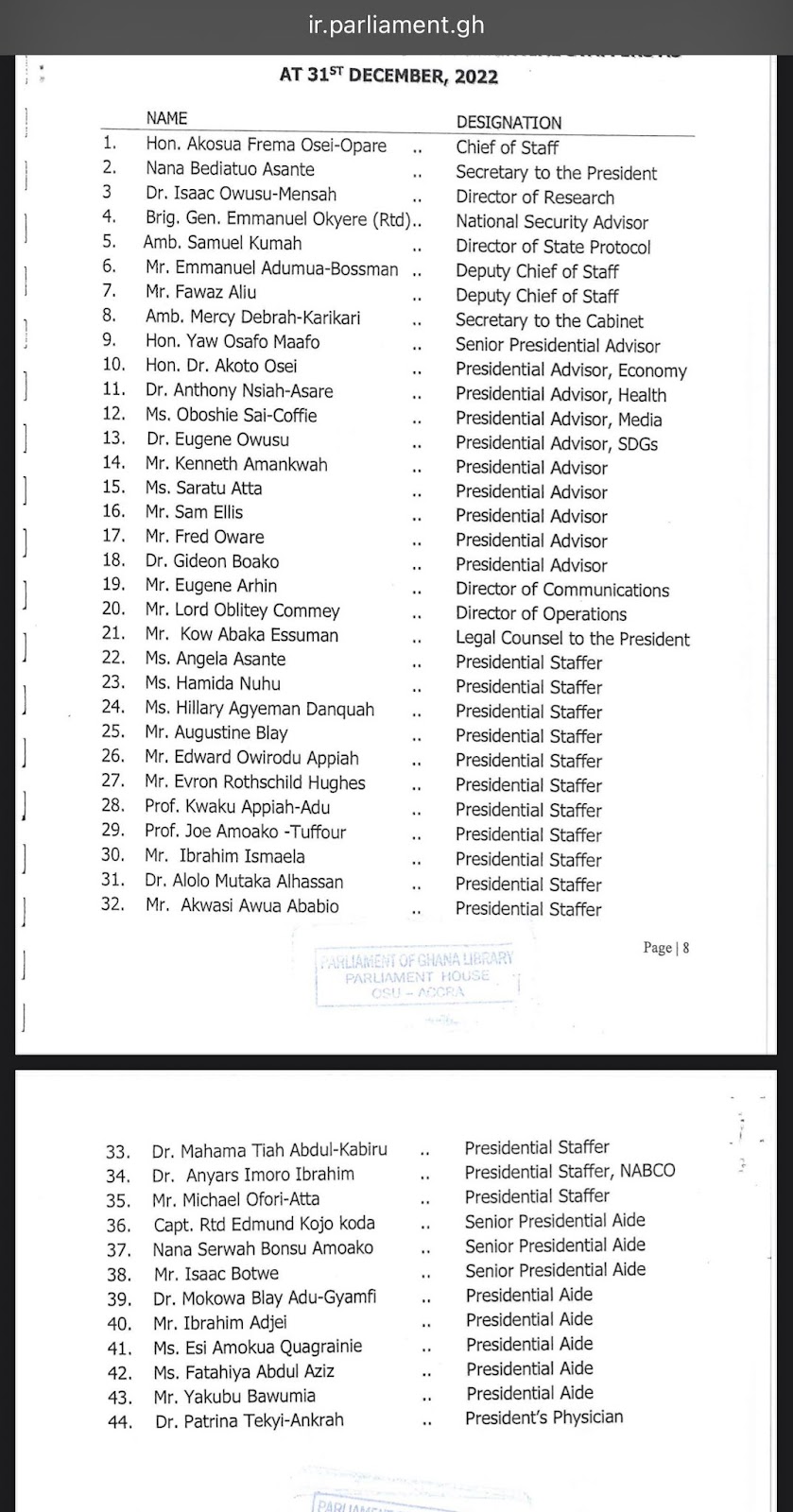
    Data available via the Parliamentary Repository presents different data. 

    According to official records submitted to Parliament by the Office of the President, 44 senior presidential staffers were appointed during President Akufo-Addo’s administration. 

    These included core presidential advisers, directors, and secretaries. Additionally, 315 other political appointees, such as executive assistants, liaison officers, personal aides, and technical staff, were engaged in supporting various departments. 

    Two Ministers of State at the Presidency were also listed, bringing the total number of political operatives working to over 361.

    In contrast, under President Mahama’s administration, exactly 30 presidential staffers were appointed, a number he publicly confirmed. Of these, 27 were appointed to direct staff roles, while three were directors of key governmental initiatives. 

    The flyer confuses total political appointees with core presidential staff. 

    According to the Deputy presidential spokesperson, Shamima Muslim, there’s a distinction between actual presidential staff and supporting staff. She confirmed the data for the actual staff, but stated that data on supporting staff was not yet available.

    Since the newly elected NDC administration has not published its complete list of presidential staff or support staff, it is premature to suggest that it has outperformed the NPP in reducing staff numbers.

    Screenshot of the official list of parliamentary staffers for Akufo-Addo

    When contacted, a government official, deputy presidential spokesperson Shamima Muslim, acknowledged the distinction between actual presidential and supporting staff. She provided data for the actual staff but stated that data on supporting staff was not yet available. 

    As such, it is premature to conclude that the current administration has significantly reduced overall staff numbers compared to the NPP era.

    Conclusion

    The flyer’s claim that the NPP had 30 ministries and 336 presidential staffers is false. Verified records from Parliament and official government releases show that the Akufo-Addo administration operated 28 ministries, not 30, and had 44 senior presidential staffers, not 336. The flyer misleadingly includes auxiliary staffers in its count.

    While Mahama’s administration did maintain a smaller number of ministries and staffers, the comparative data used in the viral post exaggerates the difference. 

  • False, Akufo-Addo was not excluded in Daily Graphic’s past leaders feature

    Claim: Social media users have claimed that former President Akufo-Addo’s image was excluded in a Daily Graphic publication meant to honour past leaders. 

    Full Text 

    On March 5, 2025, a Facebook user, Abraham Lawrence Tetteh, posted a video claiming that the state-owned Daily Graphic newspaper had omitted the picture of former President Nana Addo Dankwa Akufo-Addo in a publication honouring Ghana’s past leaders. The claim comes in the wake of Ghana’s 68th Independence Day celebration, which took place at the forecourt of the Jubilee House.

    Mr Tetteh’s post stated, “Today, 5th March 2025, ahead of the Independence Day tomorrow, Daily Graphic posted pictures of all former presidents and excluded Nana Addo Dankwa Akufo-Addo. Is that how we want to progress as a country?” 

    The video accompanying the post showed a newspaper section where images of past leaders were displayed, but the image of Akufo-Addo was missing.

    X user @christiansirse has also published this. The caption of his post claims Ghanaians are already erasing ex-president Akufo Addo’s name from history. 

    Other Facebook users, including the NPP Project Bureau, have also shared the claim. 

    Picture of an image of a daily graphic story displaying former past leader of Ghana with former President, Akufo Addo, excluded.  

    Given the potential political and democratic implications of such an omission, verifying whether this claim is accurate and, if so, whether it was deliberate or an editorial oversight is crucial.  

    Verification

    The only way to verify this claim is to obtain a copy of the Daily Graphic newspaper and check the specific page.

    DUBAWA discovered that the relevant section could be found on page 16 of the March 5, 2025, edition of the Daily Graphic. The article by Edmund Smith-Asante highlighted Ghana’s journey to independence and democratic governance. It featured all Ghanaian leaders since independence.

    At first glance, it appeared that former President Akufo-Addo was omitted. However, a closer examination revealed that the story continued on another page.

    DUBAWA’s checks confirmed that on page 22 of the Daily Graphic, the continuation included images of former President Akufo-Addo and the current President, John Mahama.

    C:\Users\News25\AppData\Local\Microsoft\Windows\INetCache\Content.Word\Screenshot 2025-03-06 131055.jpg

    Image of the continuation of a feature story honouring past leaders, with former president Akufo Addo included.

    Why did Mahama’s picture appear twice? 

    This was because the images depicted a timeline of Ghana’s leaders. John Mahama was president from 2012 to 2016, lost, and was again re-elected in 2025.

    Conclusion 

    The claim that President Akufo-Addo’s image was excluded from a publication meant to honour past leaders is false. 

  • Akufo-Addo’s claim about decline in food prices, false

    Claim: Ghana’s president, Nana Akufo-Addo, says that food prices have begun to experience a decline.

    Full Text

    President Nana Addo Dankwa Akufo-Addo, on Friday, January 3, 2024, presented his final State of the Nation’s Address before leaving office.

    Touting the government’s efforts to ease the country’s cost of living situation, Akufo-Addo reported to lawmakers that food prices had begun to decline.

    “Encouragingly, food prices have also begun to decline, bringing some relief to households and contributing to a reduction in the overall cost of living,” he said. (See page 10 of the full speech, or from minutes 1:02:30 to 1:02:42 of the livestream).

    Several media organisations, including GhanaWeb and TV3, have reported on the president’s claim.

    Is Ghana seeing a reduction in food prices? DUBAWA Ghana chose to investigate this claim because it can influence political commentary and discourse.

    Verification

    On Wednesday, January 8, 2025, the Ghana Statistical Service (GSS) published the Consumer Price Index for December 2024

    The publication highlights the change over time in the general price level of goods and services that households acquire for consumption. The data on inflation for food and non-alcoholic beverages showed a consistent rise from 19.1% in August 2024 to 27.8% in December 2024.

    Source: Ghana Statistical Service CPI December 2024

    Conclusion

    Nana Akufo-Addo’s claim that food prices have begun to decline is false. Official inflation data from the Ghana Statistical Service points to a consistent rise in food prices since August 2024.

  • False to suggest only 3 heads of state attended Akufo-Addo’s inauguration

    Claim: A social media user, Albert Nat Hyde, known as Bongo Ideas, posted on X that only three heads of state attended President Akufo-Addo’s inauguration.

    Full Text

    Albert Nat Hyde, popularly known as Bongo Ideas, posted a photo of former President John Mahama shortly after his swearing-in on January 7, 2025. 

    In his post, Bongo Ideas claimed: “He was the first president to have almost all African presidents at his inauguration, including heads of state from the Caribbean and Europe; Akufo-Addo had only three. A new dawn in Africa! Reset!”

    The tweet has garnered more than 140,000 views on X, tending to propel the X algorithm to keep spreading it to other users’ feeds, including people who have not even subscribed or followed him.

    Meanwhile, reacting to it, X user Ato Wise, with the handle @ato_Nala, wrote: “That’s true. How could he [Mahama] attract so many Heads of State.”

    Another user, The Real Kumasi Confidential with the handle @gyenyamenot9ice, wasn’t happy about what he believed to be the misinformation Bongo Ideas was putting out. He wrote, “Nana Addo had 12 presidents attending his inauguration, tho, get ya facts right.”

    Lastly, another user who believed Bongo Ideas’ statement that only three people attended the inauguration resorted to defending ex-president Akufo-Addo. He or she wrote: “MR. LAW @LawrenceAmpons9 Common sense should tell you that there was a COVID-19 era.

    Verification

    Contrary to the claim, DUBAWA’s research can confirm that President Nana Akufo-Addo’s inaugurations in 2017 and 2021 were well attended by international dignitaries, including several heads of state and government officials.

    2017 Inauguration

    The event, held at the Black Star Square in Accra, saw the attendance of over 15 African leaders, including Muhammadu Buhari (President of Nigeria), Ellen Johnson Sirleaf (President of Liberia), Faure Gnassingbé (President of Togo), Alpha Condé (President of Guinea), Macky Sall (President of Senegal), and Alassane Ouattara (President of Côte d’Ivoire).

    Other dignitaries included representatives from the African Union, the European Union, and other international organisations.

    2021 Inauguration

    The swearing-in ceremony, held at Parliament House in Accra, was also graced by many high-profile figures

    Among them were Cyril Ramaphosa (President of South Africa), Roch Marc Christian Kaboré (President of Burkina Faso), Julius Maada Bio (President of Sierra Leone), George Weah (President of Liberia), Filipe Nyusi (President of Mozambique), and Alpha Condé (President of Guinea). 

    Vice President Yemi Osinbajo of Nigeria, delegates from the Caribbean and European countries, and envoys from France and the United Kingdom also attended.

    Conclusion

    The claim that only three heads of state attended President Akufo-Addo’s inauguration is false. 

  • Photo claiming reconstruction of Akufo-Addo’s destroyed statue is misleading!

    Claim: Social media posts on X (formerly Twitter) have circulated a photo claiming that the recently destroyed statue of Ghana’s ex-President Nana Akufo-Addo is currently under reconstruction.

    Full Text

    Some users on X, Eddie (@dfwEddie) and Ãbdül (@IamAbdul___), both with substantial followings, shared a photo claiming that the statue of former President Akufo-Addo, damaged in January 2025, is being reconstructed.

    The statue, unveiled in November 2024 at the Effia-Nkwanta roundabout in Sekondi-Takoradi, was erected to honour Akufo-Addo’s contributions to the Western Region. 

    The unveiling, led by Regional Minister Kwabena Okyere Darko-Mensah, celebrated the projects initiated during Akufo-Addo’s administration.

    On December 16, 2024, a noticeable gaping hole in the statue’s leg was discovered. Whether this damage was intentional or due to a defect remains unclear. Investigations commenced shortly after.

    However, the statue became a subject of criticism and was mysteriously destroyed at about 1:30 a.m. on January 13, 2025, days after the inauguration of a new administration. 

    Hours later, at 9:11 a.m., Eddie (@dfwEddie) posted a photo captioned, “Fixing in progress…the statue de3 efor dey (sic),” which quickly garnered over 250,000 views. Many users were misled into believing reconstruction was underway.

    One user, @Listo_Mensah, commented: “It will be destroyed again. Don’t worry.” 

    Another user, @DensuAddo, accused the statue’s creator, alleging he orchestrated the damage to claim funds for repairs.

    Given the potential for misinformation, DUBAWA launched an investigation.

    Verification

    Using Google Reverse Image Search, DUBAWA traced the image to a video widely shared in November 2024. On November 8, Instagram user @KSSnewsglobal posted the video with the caption: “The making of President Akufo-Addo’s infamous statue in the Western Region.”

    The video shows the same craftsman, tools, and materials in identical positions, proving the image is from the statue’s creation, not its reconstruction.

    More videos of the construction from two months ago can be seen here, here, and here

    Additionally, a keyword search showed no credible news outlet reporting any ongoing statue reconstruction.

    Conclusion

    The claim that Akufo-Addo’s statue is under reconstruction is misleading. The circulating image is from November 2024, predating the statue’s destruction.

  • False! Ghana’s democracy has not been its best under President Akufo-Addo

    Claim: Majority Leader Alexander Afenyo-Markin says that Ghana’s democracy was best experienced during President Nana Akufo-Addo’s tenure.

    Full Text

    Majority Leader and Member of Parliament for the Effutu constituency, Alexander Afenyo-Markin, asserts that democracy in Ghana improved significantly during President Akufo-Addo’s tenure.

    He made the remark in Parliament when the President delivered his last State of the Nation Address on January 7, 2025, before his tenure expired.

    “Mr President, your country is proud of you. Democracy has experienced its best under your leadership,” Mr Afenyo-Markin said on January 3, 2025.

    Accra-based television channel TV3 posted a clip (from minutes 0:22 to 0:40) on social media that captures the lawmaker commenting.

    Has democracy improved in Ghana during President Nana Akufo-Addo’s tenure? DUBAWA Ghana decided to investigate this since the assertion will likely influence political commentary. 

    Verification

    In 2023, the Economic and Intelligence Unit (EIU) released its democracy index for the year. EIU’s Democracy Index gives a snapshot of the state of democracy in over 160 countries, including Ghana. 

    The Democracy Index, rated on a scale from 0 to 10, evaluates five categories: electoral process and pluralism, functioning of government, political participation, political culture, and civil liberties.

    Ghana’s overall score for 2023 was 6.30 after scoring 8.33 for Electoral process and pluralism, 5.00 for Functioning of government, 6.67 for Political participation, 5.63 for Political culture, and 5.88 for Civil liberties.

    Data from the EIU shows that Ghana’s overall score dropped from 6.75 in 2016 to 6.30 in 2023.

    John Mahama (2013-2016)
    20136.33
    20146.33
    20156.86
    20166.75
    Nana Akufo-Addo (2017 – 2024)
    20176.69
    20186.63
    20196.63
    20206.50
    20216.50
    20226.43
    20236.30
    2024N/A

    Table comparing Ghana’s democracy score during the tenures of John Mahama and Nana Akufo-Addo | Source: EIU

    Other institutions, such as the World Bank and UNESCO, cite the EIU report when reporting on the state of democracy worldwide.

    Page 21 of the EIU  report showing Ghana’s democracy score since 2006 | Credit: EIU

    One of the core principles of democracy is the freedom of the press. However, this metric still does not support the assertion that democracy improved during the Nana Akufo-Addo administration.

    From a score of 82.05 in 2016, the country dropped to 67.71 in 2024, according to data from the World Press Freedom Index and published by Reporters Without Borders (RSF). 

    Conclusion

    Alexander Afenyo-Markin’s claim that democracy in Ghana improved significantly during the tenure of President Akufo-Addo. Relying on the 2023 EIU Democracy Index, Ghana’s best-experienced democracy was in 2015 during the tenure of John Mahama.

  • MISLEADING! Ghana’s 2016 economic growth rate was 3.7%, not 3.4%

    Claim: Ghana’s President Nana Akufo-Addo has alleged that his government inherited a country with an economic growth rate of 3.4% on Jan. 7, 2017.

    Full Text

    Ghana’s President Nana Akufo-Addo delivered his final State of the Nation Address to the country’s legislature on Jan. 3, 2025, touting his government’s achievements in everything from infrastructure to the economy.

    Mr Akufo-Addo told lawmakers that the economic growth in West Africa has bounced back with renewed strength after the challenges.

    “Mr Speaker, economic growth has also returned to the pre-COVID-19 trajectory with impressive growth rate rising from 4.8% in the first quarter of 2024, 7% in the second quarter, and 7.2% in the third quarter,” the Ghanaian leader said.

    Please find Mr Akufo-Addo’s claim from minutes 1:21:43 to 1:22:04 of the video uploaded on YouTube by state media, GTV.

    Drawing a comparison with the 2016 economic situation, Mr Akufo-Addo said the country’s economic growth rate is projected to rise to 6.3% at the end of 2024.

    “It is projected that this year’s [2024] growth rate will be 6.3%, significantly higher than the 3.4% [that] my administration inherited in 2017,” he said.

    See minutes 1:22:03 to 1:22:17 of the video uploaded on YouTube by state media, GTV, for Mr Akufo-Addo’s comment.

    The social media platform data showed the video has over 20,356 views as of Jan. 05, 2025.

    DUBAWA decided to probe the claim as part of its campaign against misinformation and disinformation in Ghana.

    Verification

    DUBAWA’s research showed that Ghana’s economic growth rate as of Dec. 31, 2016, was not 3.4%, as the President alleged. 

    Although the country’s economic growth rate for Dec. 31, 2016, was 3.4%, it was revised to 3.7% after the economy was rebased. 

    According to the International Monetary Fund (IMF), rebasing is “the process by which constant price aggregates are updated using the prices of a more recent period.”

    The Ghana Statistical Service (GSS) data published in 2017 and 2018 revealed the country recorded a 3.7% economic growth rate at the end of 2016. 

    The GSS “Revised 2016 Annual Gross Domestic Product,” published in Sept. 2017, pegged Ghana’s economic growth rate at 3.7%. 

    “[The] revised GDP estimates for 2016 showed a growth rate of 3.7 per cent compared to 3.8 per cent in 2015,” the GSS said.

    See page 3 of the newsletter here

    Also, the GSS “Provisional 2017 Annual Gross Domestic Product” newsletter, published in Apr 2018, confirmed the 2016 economic growth rate was 3.7%.

    “[The] provisional GDP estimates for 2017 showed a growth rate of 8.5 per cent compared to 3.7 per cent in 2016,” the GSS said. 

    See page 3 of the newsletter here

    Conclusion

    As of Dec. 31, 2016, Ghana’s economic growth rate was 3.7%, not 3.4%, as President Nana Akufo-Addo alleged. 

  • Akufo-Addo makes misleading claim about 2016 WASSCE results

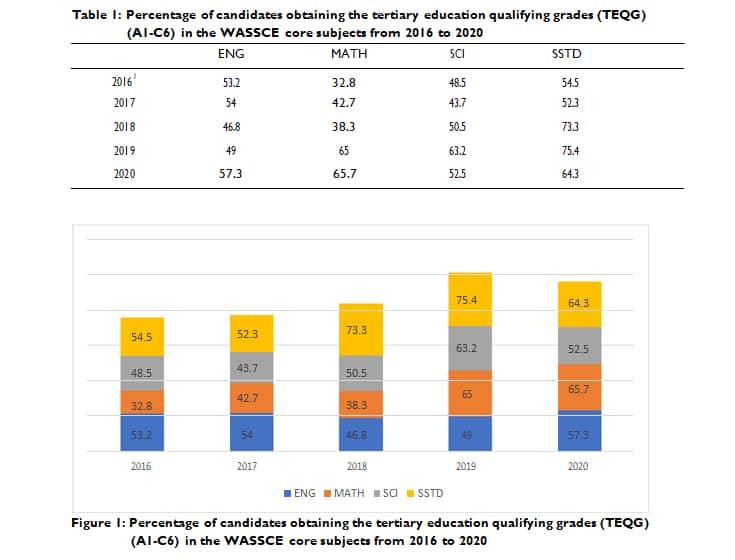
    Claim: President Akufo-Addo has claimed that in 2016, 51.6% of candidates passed in English, 48.35% passed in integrated science, and 33.12% passed in mathematics.

    Full Text

    President Nana Akufo-Addo delivered his final State of the Nation Address on January 3, 2025. Among the topics discussed, he reflected on the state of education, referencing the performance of Ghanaian students in the 2016 West African Senior School Certificate Examination (WASSCE). However, a closer examination of his statements reveals discrepancies in his cited figures.

    President Akufo-Addo stated that, 

    “From 2020, when the first cohort of Free Senior High School candidates sat for the WASSCE exam, Ghana has consistently recorded over 50% of candidates scoring A1 to C6 in all four core subjects. This marks a stark improvement compared to the years prior, particularly the period when pass rates in core subjects were largely below 50%.

    “Indeed, only 51.6% of candidates achieved A1 to C6 in English in 2016, compared to a much higher 69.52% in 2024. For integrated science, the pass rate improved from 48.35% in 2016 to 58.77% in 2024,” the president added.

    “Mathematics demonstrated the most dramatic progress, rising from a mere 33.12% pass rate in 2016 to an impressive 66.86% in 2024.”

    In retrospect, the president’s figures for the 2024 results are correct, based on WAEC’s official results.

    These figures were presented in contrast to students’ performance under his administration, presumably to highlight improvements in educational outcomes.

    However, the president’s use of incorrect statistics for the 2016 WASSCE results may not seem significant at first glance, but accuracy in data is crucial, especially in official addresses. 

    Fact-checking such claims ensures accountability and fosters a more informed public discourse.

    Verification

    The West African Examinations Council (WAEC), responsible for administering the WASSCE, released the official results in 2016. Here are the accurate figures:

    • English: 53.19% of students passed.
    • Science: 48.48% of students passed.
    • Mathematics: 32.8% of students passed.

    The data presented below is from the National Council for Curriculum and Assessment (NaCCA), a public statutory authority dedicated to improving all Ghanaian students’ learning experiences and results by establishing world-class curriculum, assessment, and reporting standards.

    Discrepancies in the President’s Statement

    1. English: The President’s claim of 51.6% understates the actual performance by 1.6 percentage points.
    2. Science: He cited 48.35% which is 0.15 percentage points lower than the recorded 48.5%.
    3. Mathematics: The reported figure of 33.12% is 0.32 percentage points higher than the official 32.8%.

    Conclusion

    While President Akufo-Addo’s administration has undoubtedly made strides in education, his remarks on the 2016 WASSCE results contained inaccuracies. According to WAEC’s official data, students performed slightly better in English and Science than he claimed, while Mathematics results were marginally lower. 

Back to top button