Dr UN

  • ‘Dr UN’ And Purported Affiliations with Harvard, UN and Kofi Annan: Here’s What We Know

    ‘Dr. Fordjour’, aka ‘Dr UN’ who presented Global Excellence awards to influential personalities and organised conferences claims he is a UN-Kofi Annan ambassador

    Both the Kofi Annan Foundation and the United Nations have confirmed with Dubawa that they have no associations with ‘Dr UN’, his organisation and his award schemes as he claims.

    Full text

    One of the top trends that have surfaced on Ghanaian Twitter timeline over the week is ‘Dr UN’- a nickname by the Ghanaian Twitter community given to a man who refers to himself as Dr Kwame Owusu Fordjour. Fordjour is reported to be presenting purported United Nations (UN) global awards of excellence to some high-profile Ghanaian personalities detailed in this article by Dubawa

    Amidst the Twitter banter and ridicule of personalities who have fallen prey to the alleged scam, the Ghanaian Twitter community identified that Dr Kwame Owusu Fordjour is not who he claims to be, especially as he is reported to have had allegations of fraud made against him ten years ago.

    The UN BluePrint Mission website (which has since been taken down) dedicated to introducing Dr Kwame Owusu Fordjour and his ‘UN-Kofi Annan ambassadorial mission’ indicates that Fordjour, who also attributes the title ‘His Excellency’ to his name, is also known as Wayne Winston.

    On the website, Fordjour claims that he has been assigned by the 7th UN General-Secretary Kofi Annan as a millennium ambassador to monitor and assess the state of governments and to make them accountable to the citizens. 

    The website also alleges that Fordjour has worked with the UN over a number of years, after having completed Harvard Kennedy School, and has devoted his attention to projecting African countries’ achievements.  

    In view of this supposed responsibility, Fordjour holds a ‘Service to Humanity Awards’ ceremony where recognised Ghanaian personalities have received awards from him. 

    The awards are purportedly meant to honour personalities whose works and activities have been deemed to be of excellence in leadership, in accordance with the vision of Fordjour and his ‘UN Kofi Annan BluePrint mission.’ 

    Verification

    Dubawa contacted the National Information Officer for the United Nations Information Centre (UNIC) in Ghana, Cynthia Prah, to confirm Fordjour’s association with their organisation.

    Subsequently, in a detailed email Prah sent to Dubawa as a model of a public disclaimer, the United Nations in Ghana stated that they have no affiliation with Fordjour’s BluePrint Global Challenge Awards nor with his BluePrint Mission organisation.

    “We advise the general public to access genuine information by visiting the relevant UN agencies’ websites or the UN Ghana website on https://ghana.un.org/en,” the disclaimer reads. 

    Source: UN in Ghana

    Dubawa further contacted the Kofi Annan Foundation in Geneva to confirm Fordjour’s alleged association with the foundation. 

    The Programme Manager for the Kofi Annan Foundation, Natalie McDonnelle, responded that Fordjour was using the name of Kofi Annan in an unauthorised way for his works, despite prior warnings from the foundation for him to stop. 

    “Dr Fordjour has used the name of Kofi Annan, as well as his photograph and signature, without permission on a number of occasions and indeed has ignored a cease and desist letter sent to him regarding this matter. I can also indicate that he is not a representative of the UN, as they wrote to us recently asking if we knew anything about him,” McDonnelle said.

    Dubawa interviewed Abdul-Karim Ibrahim, a researcher and journalist, who spearheaded investigations into Fordjour’s identity and awards. 

    Ibrahim explained to Dubawa that when he started investigations in July, it was difficult to get Fordjour to respond to the drafted story for publication. Consequently, he reached out to a former colleague at Ghanaweb, Benefo Buabeng Abrantepa, who was able to hold an interview with Fordjour.

    In the 41-minute audio interview sent to Dubawa, transcribed by PoliticoGh, Fordjour is heard insisting on his claim of holding an ambassadorial mission from Kofi Annan and the UN even after it was revealed to him by the interviewer that such awards are not indicated as a programme or project under the UN.

    When questioned about the alleged arrest for fraudulent activities on the Association of Rural Banks and Apex Bank Limited, he confirmed the arrest by stating in the interview that:

    “…The journalists came, the police came, we went to the police station and then I wrote my statement and they said then it’s false, then I am right. None of the APEC people came there, none of them came to the police station. They just wrote their irrelevant information to the CID in their own office and never came there for us to battle it ourselves. So we went to court, and the court cleared me.”

    Ibrahim also told Dubawa that in his initial investigations, he contacted Harvard Kennedy School about Fordjour’s claim of attending the institution. They denied having records of him. 
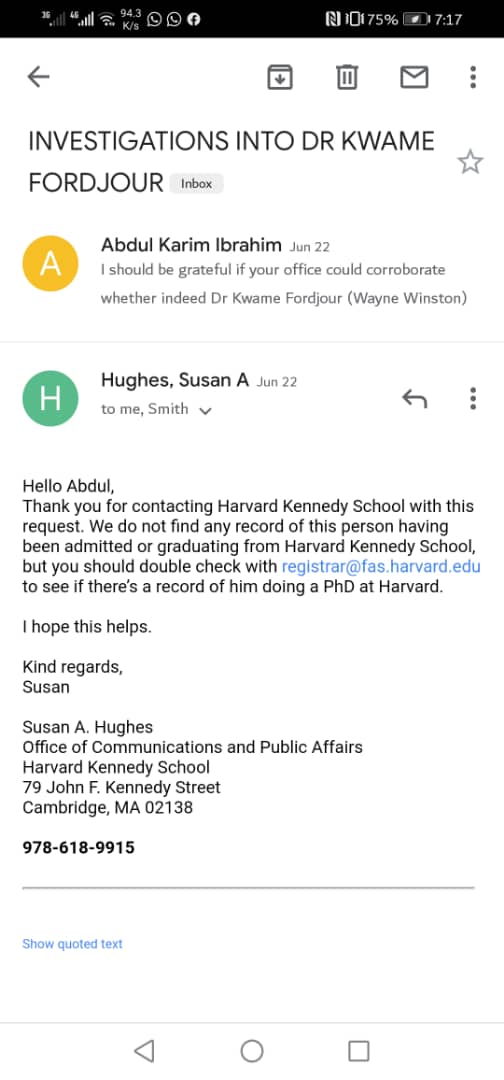
    Source: Abdul Karim Ibrahim

    Conclusion

    The facts known about ‘Dr UN’ is that he is not a Kofi Annan-UN ambassador associated with the Kofi Annan Foundation nor with the United Nations as he claims. Also, his arrest based on fraudulent allegations on Rural Banks and Apex Bank Limited is true, albeit the veracity of the allegations remains unknown till now. Further, he did not attend the Harvard Kennedy School as he claims. 

  • How the ‘Dr. UN’ scandal casts light on ‘fake awards’ in Ghana

    Ghana’s media space has recently seen a major discussion on what many term as a “fake” award scheme that has rather become an unfolding scandal.

    The conversation has centred around one man who addresses himself as H.E. Dr. Kwame Owusu Fordjour, alias Dr Wayne Winston.

    Fordjour describes himself as the “Global Chair under the UNSG of the United Nations Blueprint Mission of Excellence”

    He claims that the mission was “spearheaded and instituted by Former UN Secretary-General Kofi Annan as the finest Global Performing Honour or Achievement Belt of defined Service to Humanity that has Divine Cord of Global Governance, in building Nations through Peace and Prosperity, Democracy, Law and Order etc.”

    The spotlight on him and his activities in Ghana comes after his “2020 Global Leadership Service to Humanity Awards” held at Alisa Hotel in Accra on Friday, August 28.

    That event saw famed Ghanaians including rapper Sarkodie being given an award supposedly affiliated to the United Nations and spearheaded by former Secretary-General Kofi Annan.

    More than 20 influential Ghanaians including a Member of Parliament, a University Vice-Chancellor, and many media personalities have been awarded at various ceremonies under Fordjour’s United Nations Blueprint Mission.

    Source: Citinewsroom

    ‘How is it fake?’

    Many Ghanaians strongly hold the view that the awards are fake, despite a denial from Fordjour.

    In Ghana, there is no law barring people from organizing award schemes or recognizing others involved in legal activities.

    In some instances, organizers register the venture with the Registrar General’s department.

    So why is there a strong view that the award is fake?

    According to a researcher and journalist, Abdul-Karim Ibrahim, who started making allegations of the award’s fakeness, his conviction was based on Mr Fordjour’s incoherent statements when he appeared on Wontumi TV in June 2020 to present the said award to the owner of the media house, Bernard Antwi Boasiako, alias Chairman Wontumi, who is the Ashanti Regional Chairman of the governing New Patriotic Party (NPP).

    He said while he was shocked that the UN would award Chairman Wontumi, Fordjour’s comments gave impetus to suspicions that the award was dubious.

    “There was also the other issues of communication; horrible grammar, the citation was incoherent, the storyline that the winner was only 5 of 200 people selected across the world by a UN panel among others. Generally, Fordjour’s demeanour too. He didn’t cut the regular figure of someone at such high levels in diplomatic circles. This may seem a bit classist but it’s a poignant fact nonetheless,” he told Dubawa.

    “I looked into his official website (UN blueprint missions) and found out the UN had no such mission. I also found out that he’d been arrested in the past over attempts to defraud,” Ibrahim added.

    Indeed, a September 2010 Ghanaian Times newspaper report republished on ModernGhana.com indicated the said arrest of Fordjour over an attempt to defraud rural and community banks.

    “Fordjour was alleged to have written a letter to 40 rural and community banks asking them to pay GH¢200 each as participation fee and to submit 10-minutes documentary of their projects to commence publicity on various media networks as a prelude to the event. The bank’s officials handed over Fordjour to the police when he went there in response to an invitation to come for further discussion on the project,” excerpts of the report read.

    A claim of a fake award could be hinged, among other things, on a false claim of affiliation, suspicious or dubious character being the organizer and the revelation that the programme is a pay-to-get scheme. Many fake awards fall under similar activities.

    The above are broad categories under which most alleged ‘fake’ awards could fall under.

    ‘Borrowed credibility’

    In an attempt to inject credibility into the awards venture, the organizers sometimes tout the credentials of influential persons or organizations that are purported to be affiliated to the awards.

    In most instances, this turns out to be false and was only intended to restrain the minds of doubters from raising objections. 

    It becomes safe to state that an award is questionable if those claiming to be affiliated to it publicly deny any such connection.

    Associating former UN Secretary-General, Kofi Annan or the United Nations (UN) to award ceremonies by Fordjour would create a huge amount of credibility. But the scam was unveiled when the United Nations on September 7, 2020, denied any affiliation with Fordjour’s  Blueprint Global Challenge Awards.

    ‘Who is the organizer’

    The credibility of promoters or organizers of awards events is almost always directly related to the quality of awards.

    With the advantage of the internet, looking up background record and history of organizers of awards is relatively easy. Their history could provide useful information about the credibility of their awards offering.

    The news report of Fordjour’s arrest on the allegation of fraud was a major development that would prompt anyone who does a little background check to see how suspicious it was.

    Another detail in the ensuing conversation about fake awards is many different names under which awards at various terms were named.

    ‘Swinging award names’

    In the 2010 news report, Fordjour was linked to what was known as “Millennium Achievers’ Gold Award.” Subsequent reportage mentioned awards given to different people under his United Nations Blueprint mission of Excellence initiatives under various names, such as “GPE Gold Star Order of Leadership Excellence,” “UN Kofi Annan Excellence Awards”, “Blueprint Global Challenge Awards,” and “Global Leadership Service to Humanity Awards.”

    While this alone cannot be a clear-cut indication of a fake award, it remains curious in the case of Fordjour that there is no record of previous editions or winners of the Global Leadership Service to Humanity Awards which was said to be the 7th edition.

    Dubawa found no record of the series before what Fordjour cited as the 7th edition of the award ceremony. 

    ‘Why pay’?

    Why should there be payment if the nominee or selected person is deserving of it?

    If one is meritorious of an award by dent of their personal efforts, do they need to justify that with a monetary contribution to the organizers? 

    Why should there be payment if the nominee or selected person is deserving of it?

    The case of Fordjour’s supposed “UN Awards” may be the biggest in the recent history of scams, especially in terms of the notable characters associated to the award programme and the personalities involved in the scam, particularly the high publicity it received in the media.

    This development provides some useful lessons for Ghanaians and Ghana where many awards; however credible, however fake, are fast becoming commonplace.

Back to top button