Claim: News reports claim Former President John Agyekum Kufuor has invited the 98 New Patriotic Party Members of Parliament for a meeting over their threat to boycott the 2023 budget presentation.
Verdict: Completely false. A statement released from the former President’s office and signed by his Senior Aide and Spokesperson, Dr Kwabena Osei-Adubofour, described the reports as untrue.
Full Story
The claim that Former President Kufuor has invited some NPP Members of Parliament threatening to boycott the 2023 budget presentation if President Akufo-Addo does not sack Finance Minister Ken Ofori-Atta went viral, with several news portals publishing it. These news reports claim the former president wants to resolve the matter amicably.
Already, President Akufo-Addo has pleaded with the MPs to hold on till Ghana concludes negotiations with the International Monetary Fund (IMF). The President says that terminating the appointment of Mr Ofori-Atta will disrupt the program. The MPs claim that the current economic hardship in the country is enough grounds for the finance minister to be sacked.
We first examined the social media handles of the office of Former President John Agyekum Kufuor to find out if such a call had been made to these NPP MPs, but there was none.
DUBAWA, however, found out that the office of the former president has described such reports as false. This was sighted in a statement on Thursday, November 17, signed by his Senior Aide and Spokesperson, Dr Kwabena Osei-Adubofour.
“We wish to bring to the public’s attention that there is no truth to the said publication,” the statement indicated.
It further added that the former president “vehemently detests the developing trend in disinformation that mischievously seeks to draw President Kufuor into issues that he has not commented on.”
“The former President is as concerned as, or more so than others, for the wellbeing and stability of Ghana, and is in his own way doing whatever he can for the nation to get on top of the seemingly intractable difficulties currently engulfing our society, and would be the last person to play petty and uninformed politics in the circumstances.”
Source: Office of H.E John Agyekum Kufuor
The office also expressed worry over what it felt has become a blatant attribution of stories to the former President.
“The office of the former President vehemently detests the developing trend in disinformation that mischievously seeks to draw President Kufuor into issues that he has not commented on,” the statement added.
Conclusion
The report that former President John Agyekum Kufuor has invited the 98 NPP Members of Parliament over their call on President Akufo-Addo to sack Finance Minister Ken Ofori-Atta is false.
Manchester United has also reacted on its website, and social media handles, indicating that the “club is taking appropriate steps in response to Cristiano Ronaldo’s recent media interview.”
Verification
The game of football is full of legends. Many individuals have garnered the attention necessary to elevate them from popular players to legendary status over the course of their history in sports. People like these have those fleeting moments of brilliance that last a lifetime.
Long after their deaths, stories are told about such individuals. Beyond scoring goals, these individuals have left their mark on the game, qualifying them as legends.
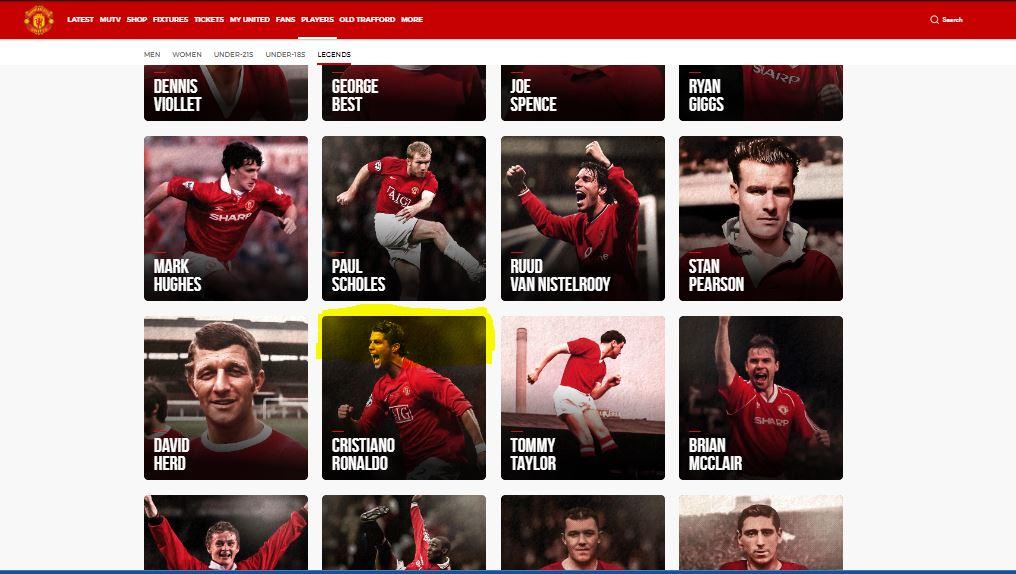
Manchester United’s legends list is in two categories. There is the top scorer and the top appearance section. The top appearance and top scorer sections all have 25 players each. When DUBAWA surfed through the list, we discovered that Cristiano Ronaldo is part of the top scorer section. He is positioned between David Nerd and Tommy Taylor.
Source: Manchester United
Conclusion
The claim that Manchester United’s forward Cristiano Ronaldo is no longer a part of the legendary list of the club is untrue.
Claim: Communication Team Member of the National Democratic Congress (NDC), Kwaku Owusu Banahene, claims the Single Spine Pay Policy in Ghana was implemented in 2013.
Verdict: False. A statement issued by the Finance Ministry in 2012, when John Mahama was president, indicated the policy was implemented in 2010 under former President John Evans Fiifi Atta Mills, not in 2013.
Full Story
A communication team member of the National Democratic Congress (NDC), Kwaku Owusu Banahene,has claimedthat the Single Spine Pay Policy was introduced in 2013 when former President John Mahama was in office.
On the show, he said, “In 2013, when we started the single spine pay policy, the wage bill had increased by 49%.” He made the claim when there was a discussion on the newly approved minimum wage by the government, which is expected to take effect from January 1, 2023.
Right in the middle of his commentary, a New Patriotic Party member on the show challenged Mr Banahene, insisting the single spine pay policy was implemented in 2011 under the late John Mills and not under ex-president John Mahama in 2013.
As a result of the controversy the commentary has generated, DUBAWA decided to fact-check the claim.
More so, it has become necessary to fact-check this assertion because of the recent proposal made by the public sector workers for government to increase their base pay by 60% due to the recent announcement of the increase in the minimum wage.
Verification
Our first research lens was directed at documents issued by the government on the Single Spine Pay Policy. DUBAWA found out that a white paper was issued in November 2009 by the late President John Evans Atta Mill’s administration. The policy was to restore equity and transparency in public service pay administration, including salary inequalities and distortions.
When the white paper was published, it indicated that the “policy would be implemented in phases over a five-year period effective January 1, 2010.”
It further stated, “The first six months of the implementation process will be used to address some persistent technical problems to ensure that the policy does not re-introduce inequities which it was designed to address.”
But was it implemented on January 1, 2010, as intended?
According to him, “the government took the mantle of implementing the SSPP in 2010. This is the culmination of attempts that had been initiated in the 1990s. The rationale for formulating the SSPP is to resolve four important issues in public sector pay management.”
Review of the Single Spine Pay Policy
There have, however, been various calls for the review of the policy. In view of this, President Akufo-Addo said on May 1, 2022, as captured by citinewsroom.com, that a technical committee has been set up to review the policy.
According to him, the report from the committee, when completed, would help to avert the many agitations on the labour front, especially those involving public sector workers.
“I am happy to announce that following the national labour conference at Kwahu, the Ministry of Employment and Labour Relations and the partners have set up a technical committee to review the Single Spine Pay Policy and advise the government accordingly.
“The goal is to find out whether the Single Spine Pay Policy is living up to expectations and, if not, find a way forward. I hope that the report, which is expected to be ready in July, will help to end most of the unrest we see on the labour front involving public sector workers,” President Akufo-Addo said during a May Day celebration at Independence Square in Accra.
Conclusion
With the explanation given, DUBAWA can conclude that the Single Spine Pay Policy was not implemented in 2013, as claimed by NDC’s Kwaku Owusu Banahene. The policy was implemented in 2010 as intended.
Social media users are sharing videos of some women going topless at a sporting event. They claim it happened at the ongoing FIFA World Cup in Qatar.
Verdict
DUBAWA Ghana’s investigation shows that the videos pre-date the Qatar World Cup.
Full text
Different videos of women going topless at sporting events have gone viral on the internet since the start of the 2022 FIFA World Cup in Qatar on Sunday, November 20.
Did these incidents happen in Muslim-majority Qatar?
Verification
While investigating the source of these videos, DUBAWA Ghana used the InVID verification tool to fragment the video into keyframes.
A Google reverse image search was then conducted to identify matching images.
Video 1: Woman in England Jersey who went topless on an escalator
A photo of the lady as she was about to go topless.
We found one of the videos uploaded on a pornographic website on July 11, 2021, with the caption “England Fan Flashing. It’s Coming Home.” DUBAWA cannot share the link to that website due to ethical considerations. Another user posted the same video on the same website on February 9, 2022. Clearly, the footage existed on the internet at least months before the start of the FIFA World Cup in Qatar.
Video 2: Woman in supporters stance who went topless after a penalty kick was converted
A photo of the topless woman in a jubilant mood at the stadium.
Our search led us to an online publication by the British tabloid newspaper, The Sun. The publication, dated October 19, 2022, is headlined “Fan flashes boobs in ‘wildest celebration ever’ and poses for selfies while topless with fellow supporters.” The publication features the same video, which has gone viral, with social media users claiming it occurred during the Qatar – Ecuador game.
A comparison between a scene in the game highlight uploaded on YouTube and the viral video with claimants suggesting that it happened in Qatar. The areas marked with the same shape and colours indicate notable similarities.
Again, whereas Qatar, who also conceded a goal from the Spot in their game against Ecuador, wore a red jersey, we observed that the colour of the jersey of the team that had conceded the goal in the viral video was not red.
Enner Valencia of Ecuador converts the penalty to score his side’s first goal during the FIFA World Cup Qatar 2022. As can be seen, the Qatar side were in a red jersey. [Photo by: Lars Baron/Getty Images].
Conclusion
The two viral videos, both showing a woman going topless, did not happen during the 2022 FIFA World Cup in Qatar.
Ghanaians and several government officials have lamented over the issue and have called for drastic measures to be taken to salvage the situation.
In discussing the matter, the Director General of the National Lottery Authority Samuel Awuku has indicated that Ghana’s worst inflation rate was 40.5% in the year 2000 under the late Former President John Jerry John Rawlings.
With the continued rise in inflation, DUBAWA decided to give a history of the worst inflation rates recorded in Ghana with the claim by Sammy Awuku in context.
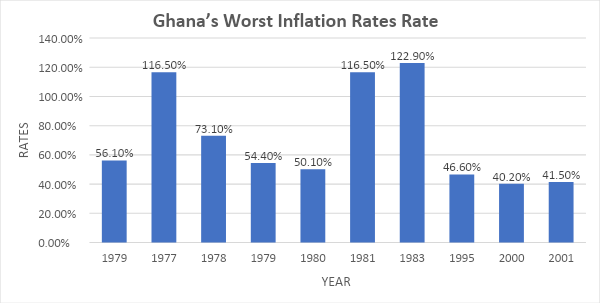
Even though the inflation rate was 40.5% in the year 2000 when Flt. Lt. Rawlings was president, that year cannot be said to be the worst inflation rate under Mr Rawlings. There were other worse inflation rates recorded when Rawlings was still president and when John Agyekum Kufuor was also president. We relied on data from the World Bank, an international financial institution supporting countries including Ghana.
1978 inflation rate was 73.1%. In 1979, it dropped to 54.4%. In 1980 and 1981, inflation rates were 50.1% to 116.5%. This was during the reign of Hilla Liman.
Ghana’s Worst Inflation Rates
Year
Rate
1979
56.1%
1977
116.5%
1978
73.1%
1979
54.4%
1980
50.1%
1981
116.5%
1983
122.9%
1995
46.6%
2000
40.2%
2001
41.5%
Source: World Bank
Former President Flt. Lt. Jerry John Rawlings came to take charge of the government for 11 years as a military ruler from 1982 to 1992. Rawling’s rule began with the worst inflation rate ever recorded in the history of Ghana. In 1983, inflation stood at 122.9%. This was the year when food was scarce, leading to higher food prices.
In 1995, 1996, and 2000 inflation rates were 59.5% and 46.6%, and 40.2% respectively. These years were when the fourth republic began, with former President Rawlings being its first president.
Source: World Bank
In 2001, the inflation rate was 41.5%. This was a slight increase from the inflation rate in the year 2000, which stood at 40.2%. This was during the reign of Former President John Agyekum Kufuor. In 2001, inflation rates were recorded on the high side–over 40%– ended.
Conclusion
The assertion by Samuel Awuku that the 40.2% inflation rate recorded in the year 2000 under former president Rawlings was the worst rate Ghana has ever recorded is misleading.
It is clear, however, that Mr Rawlings recorded the worst double-digit inflation rate in the fourth republican constitution in 1995 and not in 2000. As a military ruler, Rawlings recorded the worst triple-digit rate.
Claim: Social media users are quoting minimum wage figures for France, the UK, and Germany to make a case that Ghana’s increased wage is insufficient.
Whilst it is true that Ghana’s minimum wage, when compared to France, the UK, and Germany is very low, the figures being quoted for the European countries are inaccurate.
The figure, which stood at GHC 13.53, was set to be increased to GHC 14.88 with effect from January 1, 2023.
Following the announcement, Ghanaians took to various social media platforms to react to the development. Essentially, they were comparing the new minimum wage to that in other countries such as France, Germany, and the UK.
A tweet by Berla Mundi, a popular Ghanaian media personality, was found among several others making such comparisons here, here, and here.
The claimants asserted that whereas Ghana’s minimum wage was GHC 14.88 ($1.06), the minimum Wages in France, the UK, and Germany were $10.71 per hour, $11.43 per hour, and $ 10.59 per hour, respectively.
A collage showing several online users who have made the claim.
It will not be surprising if the minimum Wages in France, the UK, and Germany are higher than that of Ghana, considering the strength of their respective economies. However, how accurate are the figures quoted by the claimants?
When we converted 11.06 euros to US Dollars, the figure became $11.44. Using a rate of 1.03 – this is above the $10.71 quoted by the claimants.
Currently, the minimum wage for people who are 23 years and above in the UK is 9.50 pounds. When the conversion to US Dollars is done, the figure becomes $11.32, using a rate of 1.19. The UK’s $11.32 minimum wage per hour is lower than the $11.43 quoted by the claimants.
With regard to the minimum wage in Germany, DUBAWA Ghana found that it has been pegged at 9.82 euros per hour since January 1, 2022. When the Euro-to-US Dollar conversion is done, the figure will be $10.16, using a rate of 1.03. Whereas we found Germany’s minimum wage per hour to be $10.16, the claimants quoted $10.59.
Country
Claimed rate
Official rate (in original currency)
Rate when converted to US Dollars
Rate when converted to GHC
France
$10.71
11.06 Euros
$11.44 (at a rate of 1.03)
165.91 (at a rate of 15.00)
United Kingdom
$11.43
9.50 Pounds
$11.32 (at a rate of 1.19)
163.85 (at a rate of 17.25)
Germany
$10.59
9.82 Euros
$10.16 (at a rate of 1.03)
147.31 (at a rate of 15.00)
A collage showing DUBAWA Ghana’s conversion.
Evidently, the figures quoted by the claimants are inaccurate.
How does Ghana’s current minimum wage compare to what exists in neighbouring countries?
Ghana’s neighbours are Ivory Coast, Burkina Faso, and Togo.
In finding out about the wage situation in these three countries, we relied on data from WageIndicator Foundation, an organisation that “provides coherent, independent and accessible labour market information for 206 countries.”
The wages (monthly) for Ivory Coast, Burkina Faso, and Togo are originally in CFA West African Franc but would be converted to US Dollars. Also, the monthly wage will be divided by 30 days to ascertain the daily value before the conversion.
Country
Monthly Wage / Daily Wage
Conversion to US Dollars (at a rate of 0.0016)
Rate when converted to Ghana Cedis (at a rate of 0.023)
According to WageIndicator, these figures are valid as of November 2022.
Conclusion
The minimum wage figures quoted for France ($10.71), the UK ($11.43), and Germany (10.59) by the claimants are inaccurate. However, even among neighbouring countries, Ghana’s revised minimum wage of GHC 14.88, which is equivalent to $1.03 (at a rate of 0.069), is far less when compared to the rates in neighbouring countries.
The Centre for Journalism Innovation and Development (CJID), through its fact-checking project DUBAWA, is accepting applications for the 2022/2023 Kwame Karikari Fact-checking and Research Fellowship.
The fellowship is inspired by the urgent need to expand the reach of verified and accurate information to grassroots communities, which are targeted constituencies for political, social and cultural misinformation and disinformation.
To apply, applicants must meet the following criteria:
Applicants must be affiliated with a media organisation, especially from grassroots communities (television, online media, radio, and print).
Applicants must be able to publish their work with a media institution. Freelance journalists should not apply.
Applicants must be willing to dedicate time to activities, events and meetings that will arise in the course of the fellowship.
Applicants from Nigeria must be prepared to work with the DUBAWA team during the 2023 general election.
Applicants must be residents in the following countries: Nigeria, Ghana, Sierra Leone, Liberia or The Gambia.
Applicants must possess good writing skills and be fluent in the English language.
If selected, applicants must provide a managerial buy-in from the newsroom management that authorises the applicant to undergo this fellowship and provide an assurance that fact-checks will be widely circulated or published on their media platforms without interference.
Female journalists are encouraged to apply. Knowledge and experience in fact-checking are not required.
The details of the fellowship are outlined as follows:
Duration: Three months.
Training: December 2022.
Mentorship: January to March 2023.
Support: Fellows will receive hands-on technical training based on current realities and trends in the fact-checking world. This will be followed by one-on-one project mentorship by the fact-checking team from DUBAWA. Fellows will also receive additional support to establish fact-checking desks in their newsrooms.
Publishing: Fellows will be expected to publish their projects or reports in their media institution and will also receive support to publish on DUBAWA’s platforms.
Promotion: Fellows will be expected to promote fact-checking on all social media, radio or TV platforms as necessary monthly.
The Kwame Karikari Fact-checking and Research Fellowship is supported by the National Endowment for Democracy.
Complete thisto apply for the fellowship. Deadline for submission: November 16, 2022.
In recent years, the youth of Sierra Leone have taken to the use of synthetic marijuana/drug called “Kush.” It is popularly known to be a variant of marijuana (weed), which a lot of young folks smoke nowadays to, as they say, make them feel good.
Research conducted by the American Drug Enforcement Administration (DEA), described Kush as a synthetic version of tetrahydrocannabinol mixture of plant material sprayed with synthetic psychoactive chemicals similar to the psychoactive ingredient in marijuana/weed.
The Urban Dictionary also describes Kush as a strain of Cannabis that is almost solely of the Indica variety. It states further that Kush is a sweet-smelling plant part of the Cannabis-Indica family that makes the plant short and squat in appearance.
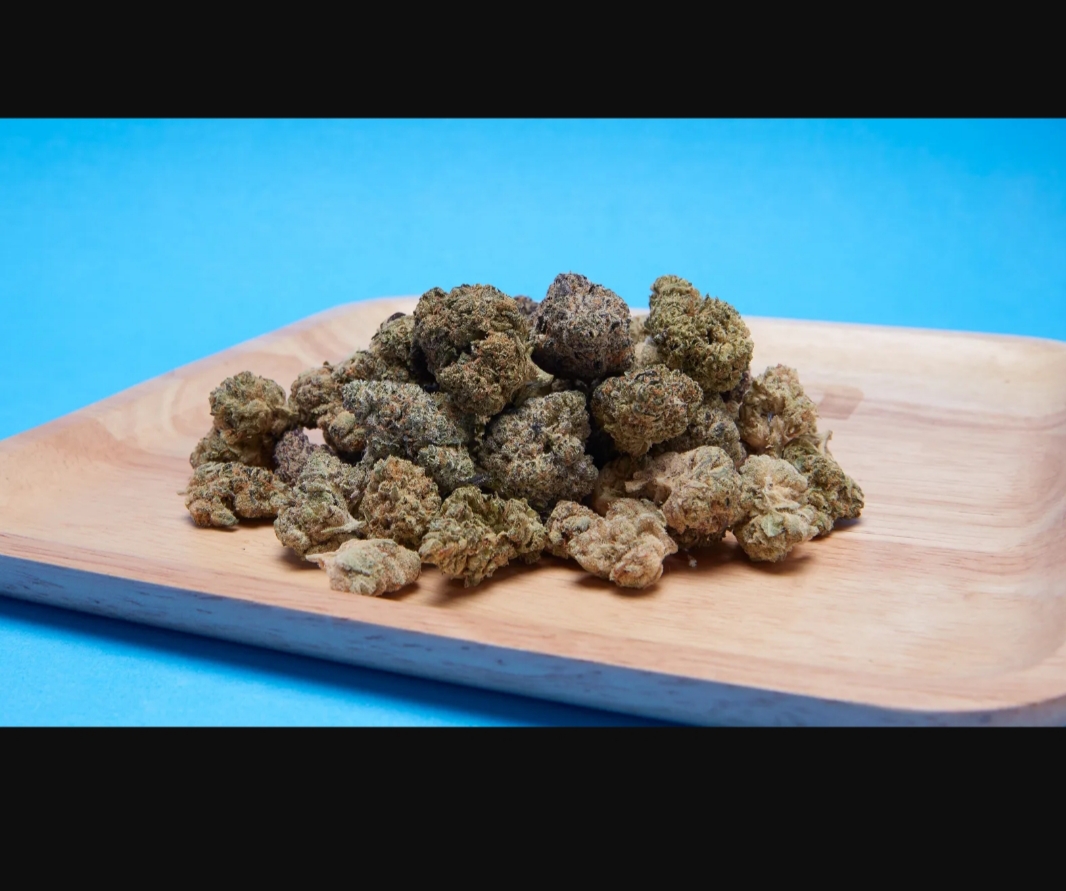
The drug comes in different colours and textures. According to research, most Kush drugs have some purple colouration and very dense buds. Kush is part of the Cannabis Genius indica family. The following are some of the various types of Kush — Afghan Kush, Hindu Kush, Green Kush; Purple Kush, OG Kush and Bubba Kush – which are classified as the popular Kush strains of the Cannabis-indica drug family.
Kush looks a bit different from marijuana, and according to consumers, its reaction on them is quite different from the reaction they get after smoking marijuana.
The Kush variant of marijuana is also renowned for its heavy sedative effects on its users.
The drug has numerous “street names.” However, some call it: Bliss, Black Mamba, Blaze, Bombay Blue, Fake Weed, Legal Weed, Genie, Zohai, etc. Of all these street names, two of them stand out — “Spice” and “K2.”
Research shows that all Kush strains trace their roots back to the Kush Mountain range in India, hence their name.
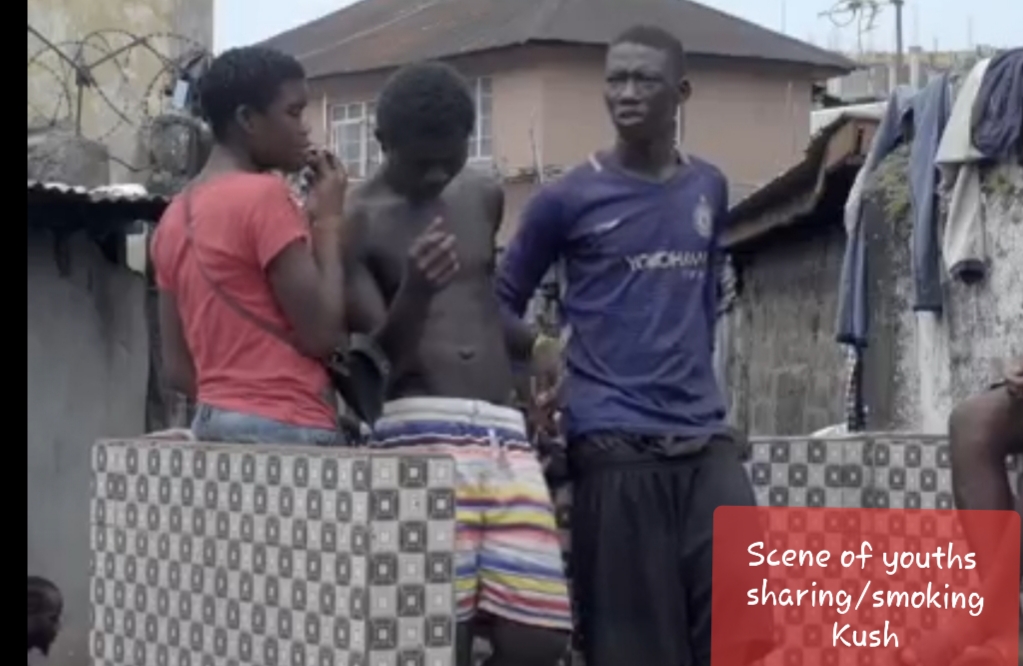
A scene of youths smoking Kush.
The arrival of Kush in Sierra Leone
“Kush” is one of the popular substances (drugs) that have recently arrived in Sierra Leone. This drug certainly came to the spotlight sometime around 2020/2021. Other sources say that the drug arrived much earlier but was not in widespread circulation.
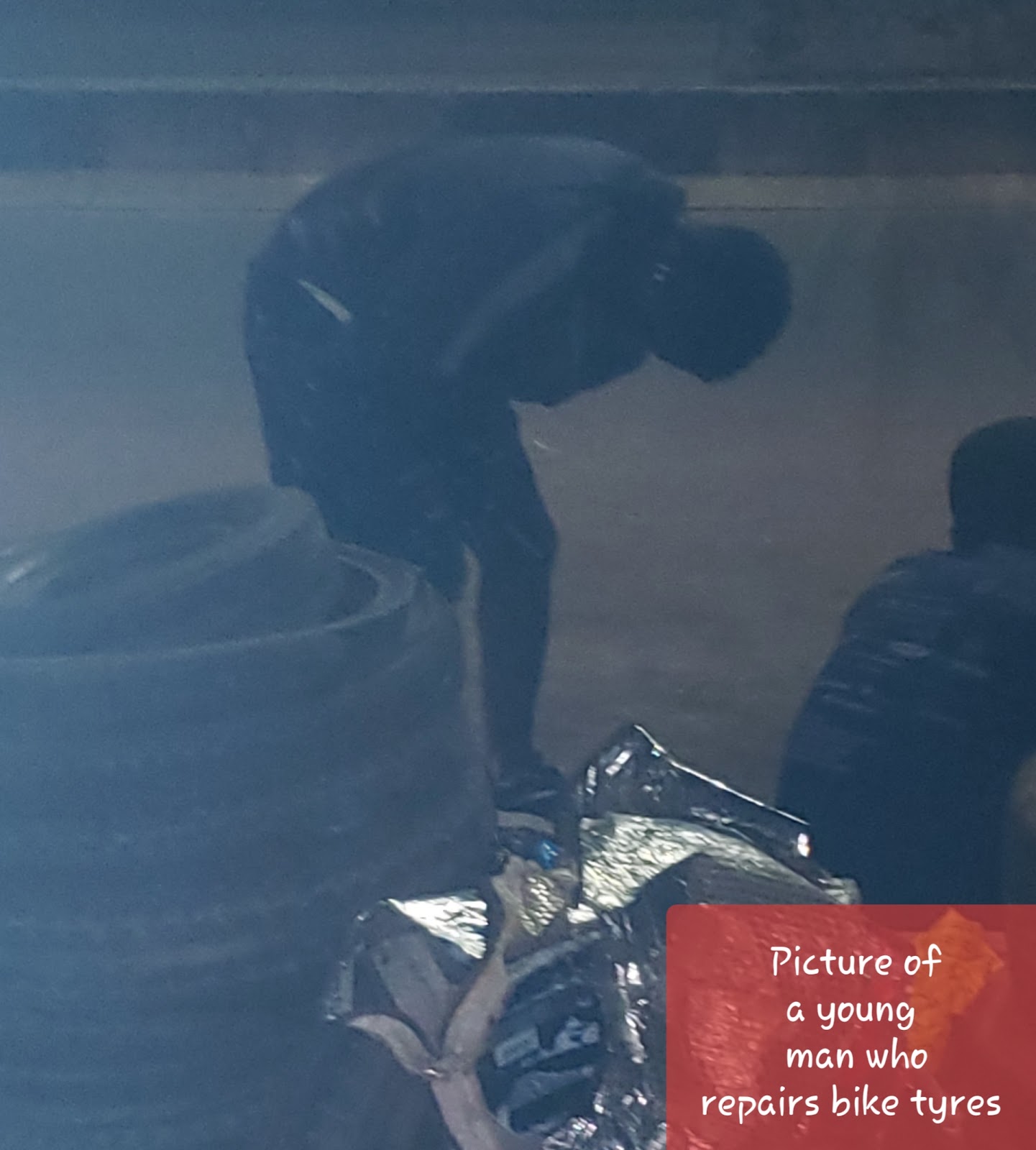
A young man who repairs bike tyres.
Why do youths smoke Kush, and how does it affect them?
Even though Kush is a drug labelled as “not meant for human consumption,” humans, particularly young folks, have made food and water out of the drug with dire repercussions. They see it as a temporary solution to their economic challenges.
Youths, who are frequent users of dangerous drugs, like, cocaine, marijuana, have resolved to take Kush for their gratification, as stated by one of the users of Kush I spoke to.
“When I smoke Kush, it gives me strength and courage to do my sex work. Frankly, I am not happy to smoke Kush, but it is the only thing that gives me the power, strength, and courage to do my sex job,” Kadiatu Lahai (not her real name), a commercial sex worker, disclosed to DUBAWA.
With that strength, she can have sex with ten or more men, she added.
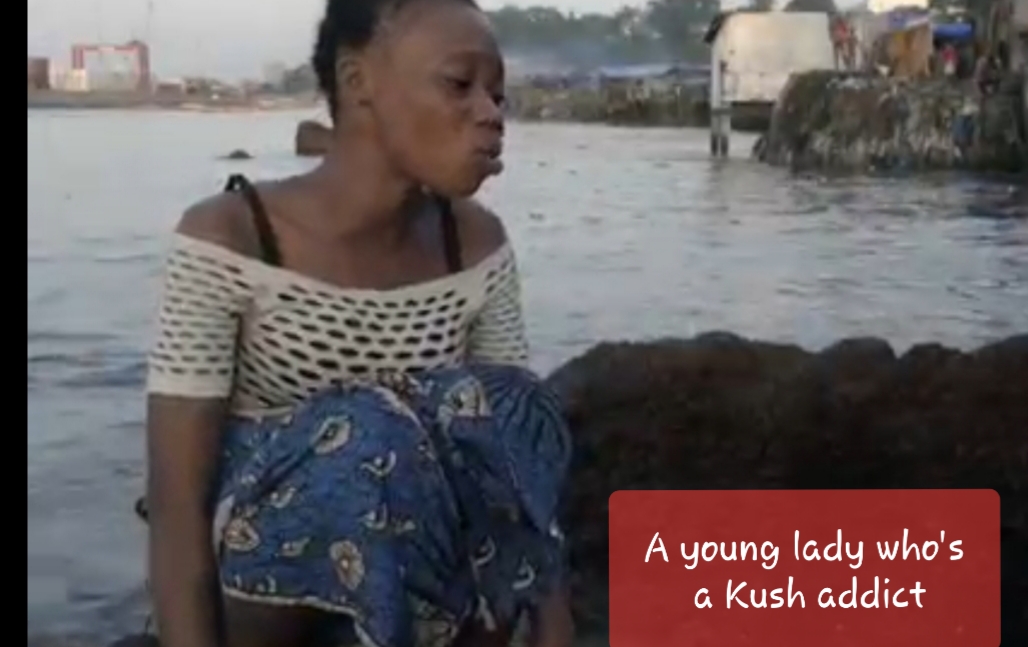
A young Kush addict.
Mohamed Koroma and Alfred Sesay (not their real names) also indicated that they smoke Kush to feel good and get the strength and power to carry out their daily activities.
Koroma and Sesay started smoking Kush as a result of peer influence.
“The first time I smoked Kush, I felt my right foot was missing. I started accusing my friends of losing my right foot, not knowing that my feet were intact. It is interesting, though, laughs! My friends laughed about it but ensured that I remained seated until the friction left me.
“Kush is a bad drug which can make someone get seriously embarrassed. But, now, my system has gotten used to the drug and it hardly affects me like the way it did to me the first time I took it,” Koroma said.
When asked if they’re aware of the adverse effects of Kush on their health, Koroma said that he is not. On the other hand, Sesay told DUBAWA that he is aware of the negative impacts of Kush, more so to those who smoke it frequently, adding that he wants to stop taking Kush, but it seems challenging for him.
The difficulty, according to him, is that Kush is the only thing that makes him forget his worries and feel good
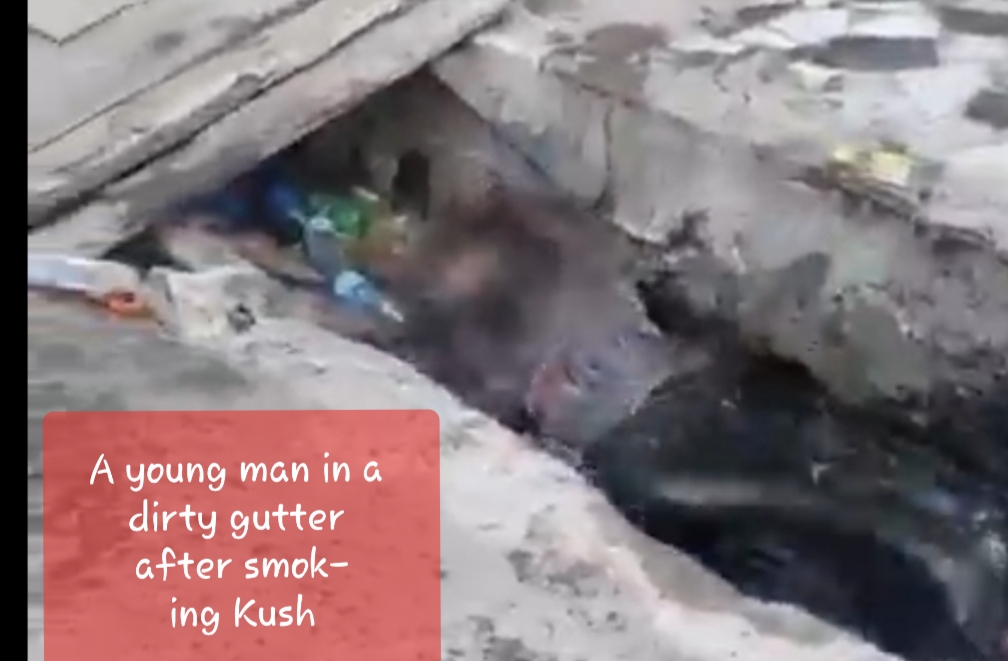
A young man in a gutter after smoking Kush.
How dangerous is Kush to those who frequently smoke it?
DUBAWA spoke to Abdul Aziz Suma — a medical doctor working at the country’s leading health centre — Connaught Hospital in Freetown. He stated that there are a lot of negative effects on the systems of those who smoke it, more so on those who are persistent smokers of the drug.
He said that, in Sierra Leone, Kush is normally laced with formalin (a substance used mainly in the mortuary to preserve dead bodies). So, mixing Kush and formalin makes the drug even worse for consumption by the living.
“Kush is a synthetic drug/marijuana that causes severe respiratory system [defects], which leads to dizziness, headaches, drowsiness, acting abnormally etc. And, in Sierra Leone, for instance, people who process it normally add formalin to it and that is more dangerous to the systems of those who smoke it,” he indicated.
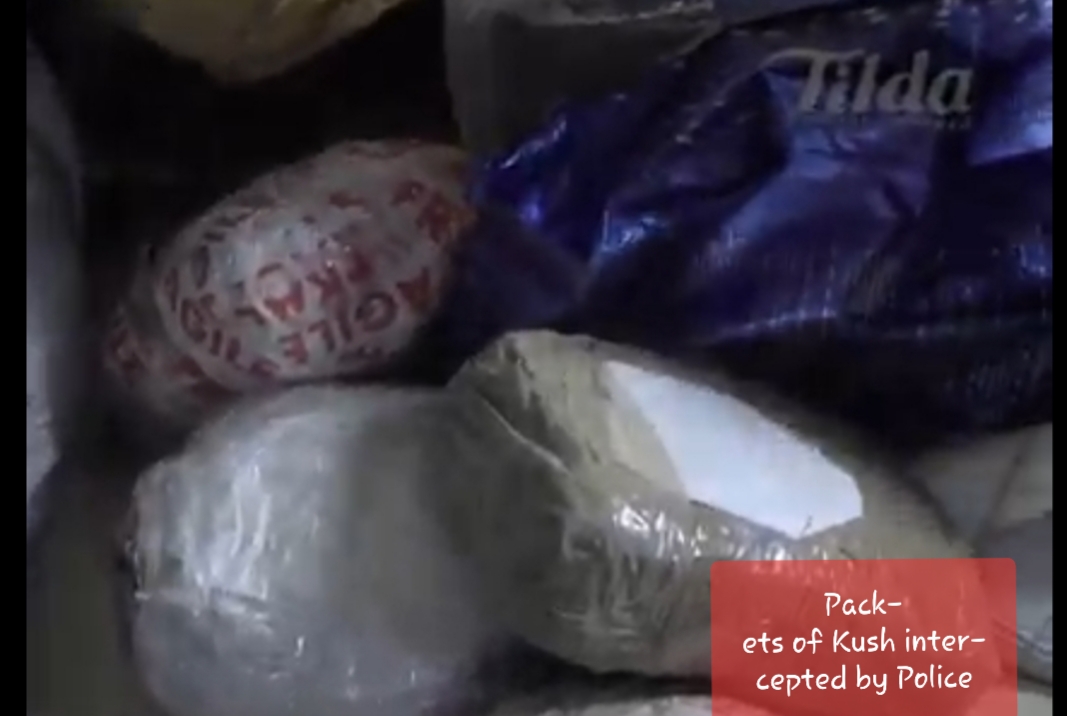
He added that the Sierra Leone Police (SLP) Force had conducted several raids to clamp down on peddlers of these hard drugs, like, tramadol, molly and Kush in the country.
He, however, disclosed that despite their robust efforts, there is little success in clamping down on the activities of the peddlers. He admitted that the peddlers of these drugs are on the increase.
When asked for the statistics of drug peddlers in the police net — Superintendent Kamara noted that he couldn’t give an accurate number of people who have been arrested or are in police custody for peddling Kush.
However, he disclosed that dozens of young men, including women, have been arrested and charged for possession of “illegal drugs.
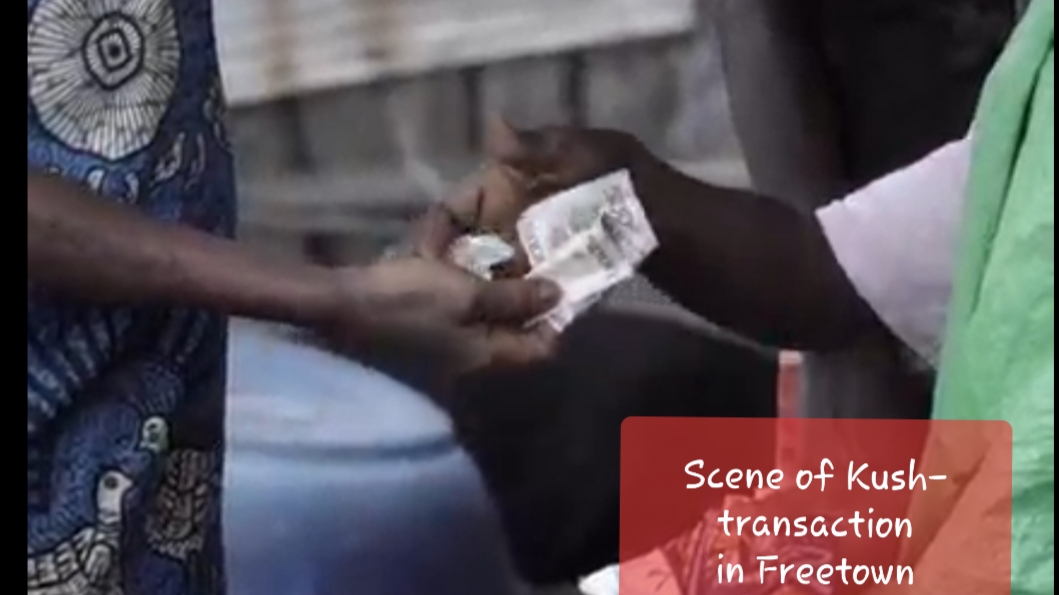
A scene of Kush transaction in Freetown
What did Kush peddlers have to say?
While speaking to DUBAWA, Foday Sesay (not his real name, aka ‘Father’) — a drug peddler in Freetown; said that he is into the Kush business as a means of survival. He added that the police usually raid the area where they sell Kush, but they have now gotten used to the raids and even the raiders (police).
He disclosed that youths who smoke Kush are always weak, lazy, and unproductive. Noting further that the hard nature of the drug causes those who smoke it to act abnormally and even sleep against their will until it leaves their systems.
He added that it is rare to see an individual who smokes Kush do something productive when the Kush’s friction is in their head.
“Most of the youth who smoke Kush will not be able to engage in anything productive until the drug leaves their systems,” another peddler indicated.
A peddler in the Western part of Freetown stated that the police had arrested her and other peddlers on several occasions for peddling Kush and other hard drugs.
She said, “Many of us, the peddlers, have become friends with them (police), and that is the only thing saving us from the numerous raids.”
She added that Kush, unlike, marijuana (weed) and tramadol tablets, consumes a lot of money, stating that Kush is sold at 5Nles ($0.29), 7Nles ($0.41) and 10Nles ($0.58) in some places.
She indicated that Kush, unlike regular weed and tramadol, has a short-lived friction or effect on those who smoke it.
“As recently as Tuesday, October 19, 2022, — the SLP conducted a raid on us and took away drugs worth over millions of leones and hard cash of over 15 million leones,” a peddler told DUBAWA.
Another peddler (nicknamed: A – Plus) disclosed that people who sell Kush usually get a 100 percent profit on every business they transact.
What do youths who don’t smoke Kush think about it?
Alpha Bah, a student at Fourah Bay College (FBC), University of Sierra Leone (USL), informed DUBAWA that “Kush has disgraced dozens of young guys. It is obvious that some students also smoke Kush for only God knows why they smoke it. However, some say that the drug aids them to be able to study for a long time.”
He suggested that; “cold water can help to reduce or kill the power of Kush in the system because I experienced a situation where cold water was used to kill the power of Kush in a friend, and that helped him to feel better.”
Can chilled water help to kill the power of Kush in the system?
Dr Suma noted,“I have heard some youths who smoke Kush saying that cold water helps to cool down the power of the drug in the head. However, I will have to research as a medical doctor to know if chilled water can kill or reduce the power of Kush in the system.”
When asked if addicted Kush smokers have a way out of their addiction, Dr Suma said that people whose systems are addicted to Kush could be cleansed, adding that flushing the entire system of drug addicts can help to revive their systems.
He told this medium that dozens of youth in the country are seriously involved in drugs and alcoholism due to their numerous challenges.
He noted, according to his investigation as the ED for a viable youth organisation in the country, “unemployment” and “depression” are the two primary reasons why a lot of young people are into ill practices, like drugs and alcoholism. He further said they are the country’s two major causes of the ‘mental health’ challenge.
“My brother, a lot of youths, men and women inclusive, are going through a lot, and that is what is leading them into taking hard drugs, which is seriously affecting them.
For instance, unemployment is killing our youth, and the government and other organisations have to do something about it, and it should be done quickly,” Babadie indicated. He called on young folks to desist from hard drugs because they would only harm them and make them unproductive.
Conclusion
Kush has led dozens of youths to injure themselves, with others losing their lives on account of using the banned substance. It is evident that law enforcement agencies and other bodies have clamped down on importers and peddlers of the drug, but those efforts have yielded little success.
It is, however, clear that humans consuming Kush drug are at high risk of acting abnormally and even dying from the banned substance. There is need for more research on the factors leading to the use of the drug on users of Kush and on effective interventions on social and psychological effects of the availability of this dangerous drug in Sierra Leone.
DUBAWA (Ghana) has ended the first of three fact-checking training workshops for journalists in non-urban communities in Ghana.
The two-day training which took place in Tamale and ended on Thursday, October 13, 2022, brought together 20 journalists from the Northern and Upper Regions of Ghana.
It was organised by DUBAWA Ghana, the fact-checking arm of the Center for Journalism, Innovation and Development (CJID) and funded by the U.S Embassy in Ghana.
Rationale:
The project’s main objective is to train journalists outside the major cities of Ghana, who play a crucial role in the country’s development but are often neglected in media development efforts.
The project is in two parts: the first part is a fact-checking capacity-building workshop that will help 60 journalists (20 each from the Nothern, Middle, and Southern zones) in non-urban communities of Ghana acquire the needed skills to combat misinformation and disinformation.
With the Northern zone now over, the attention of the organisers and funders has shifted to the Middle and Southern zones for the remaining 40 journalists to be trained and to ensure that access to quality information for audiences across the country is enhanced. The two remaining workshops will take place in Kumasi and Accra and will draw participants from the Central and Southern zones of Ghana with the dates as follows:
October 19 and 20, 2022, at the Royal Lamerta Hotel, Kumasi.
October 24 and 25, 2022, at AG Hotels and Suites, Accra.
What next?
The second part of the training programme is a three-month-long mentorship program that will focus on nurturing the fact-checking skills of selected journalists and to assist them in establishing fact-checking desks in their media organisations.
With the Northern sector training over, the selection is underway for the mentorship programme.
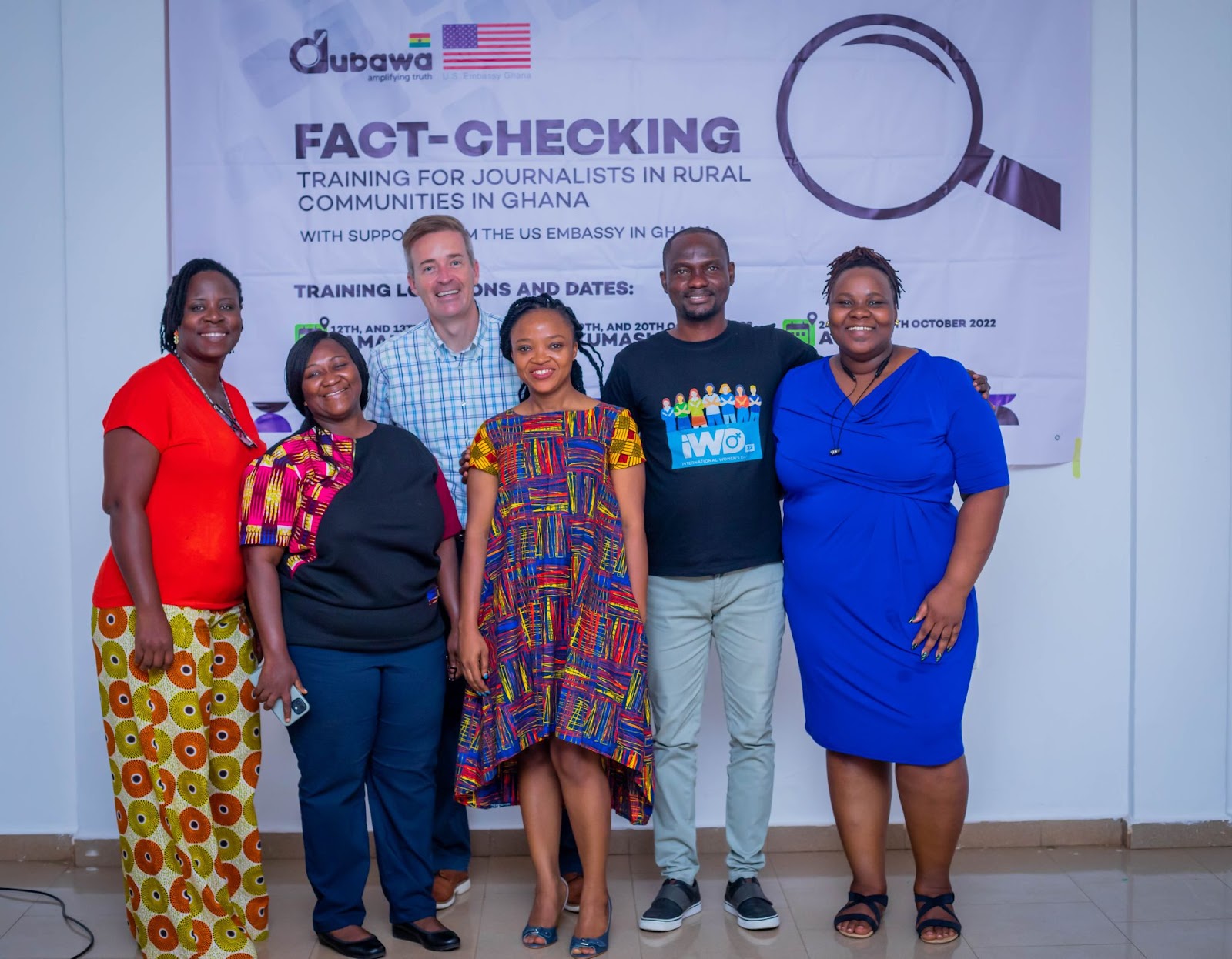
Image: Facilitators, the U.S. Embassy team, and Dubawa Ghana Team
(From left, Dr Abena Yeboah-Banin, Department of Communication Studies, UG; Joyce Asiedu, Press and Media Affairs, U.S. Embassy Ghana; Kevin Brosnahan, Press Attache, U.S. Embassy Ghana; Caroline Anipah, Dubawa Ghana Country Lead, Nathan Gadugah, Editor Dubawa Ghana; and Roselena Ahiable, Programme Officer, Dubawa Ghana.)
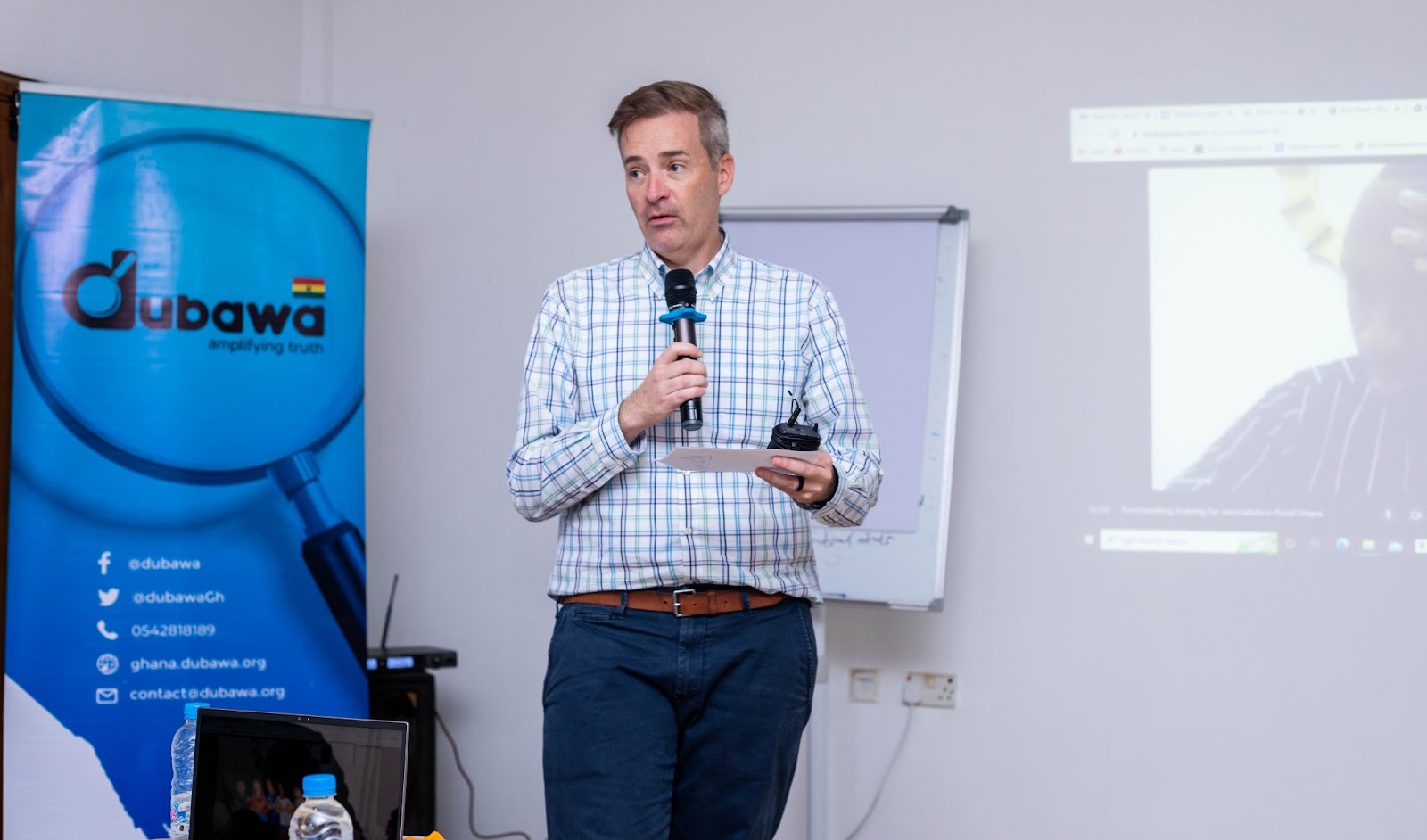
While delivering the opening remarks for the Northern sector training, Kevin Brosnahan, Press Attache at the U.S. Embassy Ghana, said that fact-checking forms part of the foundation for democracy because people need truth and facts to make electoral decisions. He added that it is essential that people living in non-urban areas have access to verified information to enhance their ability to effect better community policies.
Photo: Kevin Brosnahan, Press Attache, U.S. Embassy in Ghana, giving his opening remarks.
Dr Tobi Oluwatola, Executive Director of the Center for Journalism Innovation and Development, welcomed participants, expressing his appreciation for their interest in learning and contributing to the fight against mis/disinformation in their organisations. He also underscored the need for journalists in non-urban areas to undertake this important project and incorporate fact-checking and verification desks in their newsrooms to ensure a sanitised information ecosystem.
Photo: Dr Oluwatola delivering his opening remarks to participants.
The participants were taken through topics including, Understanding information disorder, actors and techniques of mis/disinformation; Verification and fact-checking: skills and steps involved; “Fake news” and the law, fact-checking and the right to information law.
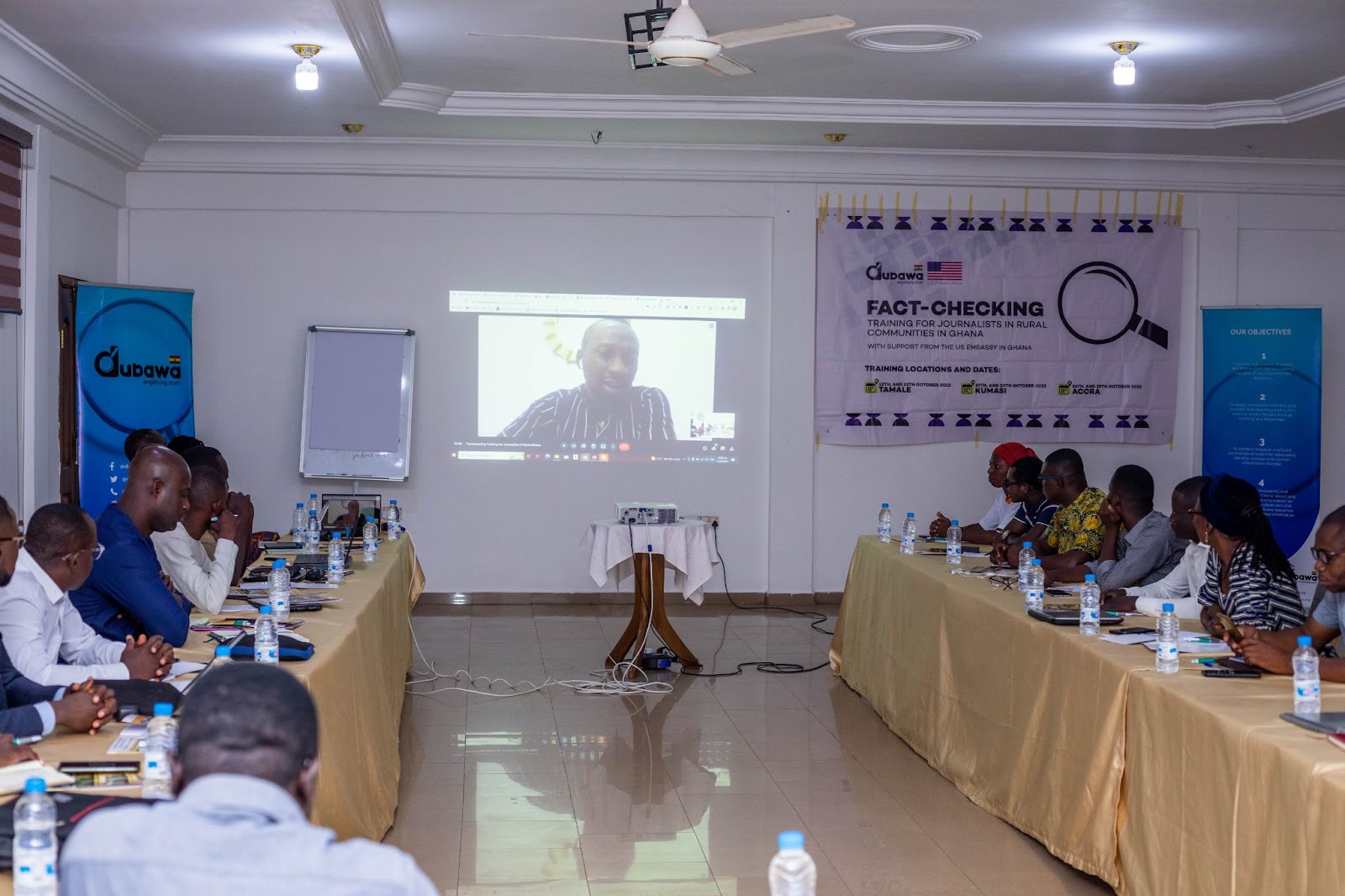
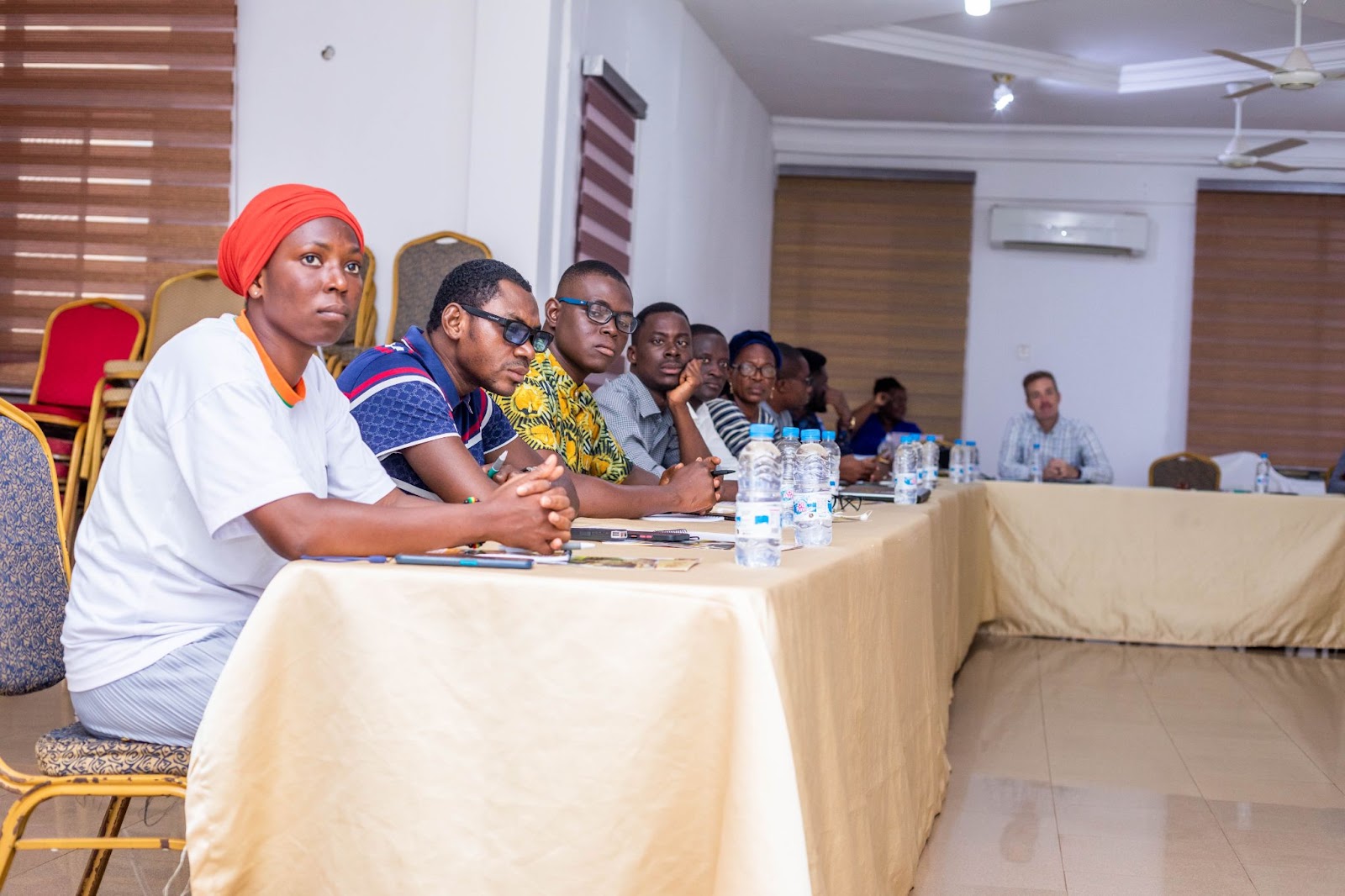
Photo: Some participants at the training in Tamale.
Dubawa is looking for volunteers to join a nationwide outreach to educate students/youth corp members on media and information literacy, basic fact-checking, and critical thinking skills.
We are looking for individuals who are passionate about media literacy, and who are willing to learn and share their knowledge with others.
Eligibility and Expectation
Volunteers must:
Be resident in Ghana, Nigeria, Sierra Leone, Liberia, or The Gambia.
Be willing to undergo online training if selected.
Be willing to visit a senior high school (preferably their alma mater) in their resident country to sensitize and educate students on media and information literacy and fact-checking.
Will be available for the ‘‘week for truth’’ in the last week of October.