As the National Communications Officer for the opposition party, National Democratic Congress (NDC), Sammy Gyamfi has addressed the press and granted several interviews for his party and candidates. During these public appearances, some of his statements were inaccurate, and DUBAWA has presented the facts to those claims in reports.
When He Stated That Every Interpol Red Notice Is Published On The Interpol Website
When an alleged airbus scandal involving Adam Mahama, the brother of former president John Mahama was revisited, Sammy Gyamfi, in an interview with Joy FM, stated that the Interpol Red Notice being circulated for Adam Mahama is fabricated and fake. According to him, every Interpol Red Notice is published on their website, and there is no evidence of Adam Mahama’s alert on the Interpol website. However, while there were reports from Interpol Accra and the Ghana Police Service to prove the alert to be true, we also found that not every Interpol Red Notice is published on the Interpol website. Read more about it here.
When He Said The Regional Maritime Hospital Is The Only Hospital With A Helipad in Ghana
In an interview with Asempa FM, Sammy Gyamfi highlighted some of the infrastructural achievements of the Mahama-led administration. He mentioned that the Regional Maritime Hospital (an institutional health facility constructed by the Mahama administration) is the only hospital with a helipad and can receive patients flown in for treatment. Unfortunately, this is not the case. We found that at least the Komfo Anokye Teaching Hospital and the 37 Military Hospital also have helipads that allow helicopters evacuating accident victims and other emergencies to land directly at the hospitals. Read all about it here.
When He Quoted Some False Figures Regarding Some Aspects Of The Economy
The NDC held a press conference to address Ghana’s economic situation at the time. Addressing the press, Sammy Gyamfi made some comparisons on the economic performance between the incumbent government, NPP and the NDC (as the former government). Assessing Gyamfi’s entire speech, we found that, while his statements on Ghana’s cedi depreciation, Ghana’s unemployment rate and the budget deficit for other African countries were true, the figures he attributed to Ghana’s debt increment, Ghana’s debt to GDP ratio, Ghana’s debt servicing, Ghana’s growth rate for the construction sector, Ghan’s tax revenue, and Ghana’s budget deficit were all inaccurate. Read the entire report in the two-part fact-check series here and here.
When He Said The UK Inflation Rate Was Experiencing A Downward Trend
During a panel discussion on TV3, Sammy Gyamfi responded to comparisons made by a presidential staffer, Edward Aboagye, regarding the rising rate of inflation in the economy of some of Ghana’s trade partners including Turkey, Brazil, the USA and the UK. In his response, Gyamfi argued that inflation in the UK was getting better and the rate was getting lower. Meanwhile, data from the UK’s Office of National Statistics show that the country’s inflation rate has been rising since October 2021. Read the full fact-check here.
When He Said That Ghana’s Inflation Rate Was Above 20% When The NDC Won The 2008 Election
Speaking in an interview on Peace FM, Sammy Gyamfi described the current economic state led by the NPP as a mess and worse than before. He added that Ghana’s inflation rate had crossed 20% when his party won the 2008 general elections. However, data from the World Bank, Bank of Ghana and the Ghana Statistical Service proved otherwise, showing a 16.5% inflation rate for 2008 by the end of December. Read all about it here.
Google has announced DUBAWA as one of the recipients of its third Google News Initiative (GNI) Challenge in the Middle East, Africa and Turkey region.
The GNI is part of Google’s ongoing $300 million commitment to support news and journalism to thrive in the digital age through innovation challenges and to create new business models.
DUBAWA, a verification and fact-checking project initiated by the Centre for Journalism Innovation and Development (CJID), is among 34 selected projects across 17 countries to receive $3.2 million in funding for their proposed innovation – to build an automated radio fact-checker application.
Considering DUBAWA’s continued fight against false information, the ubiquity of radio in Africa as the primary source of news consumption is an identified challenge in addressing the issue. Thus, the application, which will have a trained Artificial Intelligence (AI) algorithm, is intended to listen to radio stations in Nigeria and Ghana, record all audio, convert it to text and identify claims which could be false or misleading. It will also have the function of categorising a list of claims in order of priority for human fact-checkers to verify.
The Deputy Director of CJID’s Verification and Media Literacy practice, Caroline Anipah, expressed her excitement about the opportunity and stated the importance of the proposed innovation in contributing to the fight against false information.
“For us, this is a particularly important project considering the role that radio plays in the lives of many in the West African subregion and the pervasive nature of misinformation and disinformation. We anticipate that in addition to helping source claims for fact-checking on the platform, the tool will offer us and others in the media space the opportunity to explore, with empirical evidence, how much of a challenge misinformation on the radio is and to develop appropriate responses or interventions to address it,” Anipah said.
Dr Tobi Oluwatola, the Executive Director of the Centre for Journalism Innovation and Development (CJID), also emphasised the importance of the Google grant in enhancing the work CJID does through DUBAWA.
“The Google partnership is a validation of our efforts as a media innovation think tank and a harbinger of the product innovation we can expect to start seeing from West Africa’s media ecosystem,” Dr Oluwatola said.
The DUBAWA (Nigeria) team The DUBAWA (Ghana) team
The grant application was announced in February 2022, and as Google revealed, they received 425 applicants from 42 countries. The 34 selected applicants won based on all the five criteria assessed by Google.
“The call for applications listed five criteria: impact on the news ecosystem; innovation; diversity, equity and inclusion; inspiration; and feasibility – and the chosen projects clearly demonstrated all five,” Google said.
After flagrantly violating Food and Drugs Authority (FDA) guidelines and putting the health of Ghanaian citizens at risk with the sale of toxic, expired products, both consumables and non-consumables, Ghana’s largest wholesaler and distributing company, Fareast Mercantile, is now groping in the dark, looking for the source who leaked the information to DUBAWA.
An employee, a warehouse supervisor, has been forced to resign on suspicion he volunteered information about the conduct of top management members of the company who, according to evidence gathered by DUBAWA, gave direct orders for the sale of expired products including 11-month-old expired Mcvities biscuits. The biscuits, which were in cartons, over 2000 of them, were sold in December ahead of the Christmas celebrations last year. Between January and April 2022, there were multiple sales of expired products including Blue Band margarine, Jacobs Cream Crackers, Mcvities rich tea, hobnobs, Glide mini, several buckets of milk, cartons of vaseline, a range of Harpic Gel Citrus, a range of Airwick products, and other products from SC Johnson, Unilever, National and Oriental Food Industries etc.
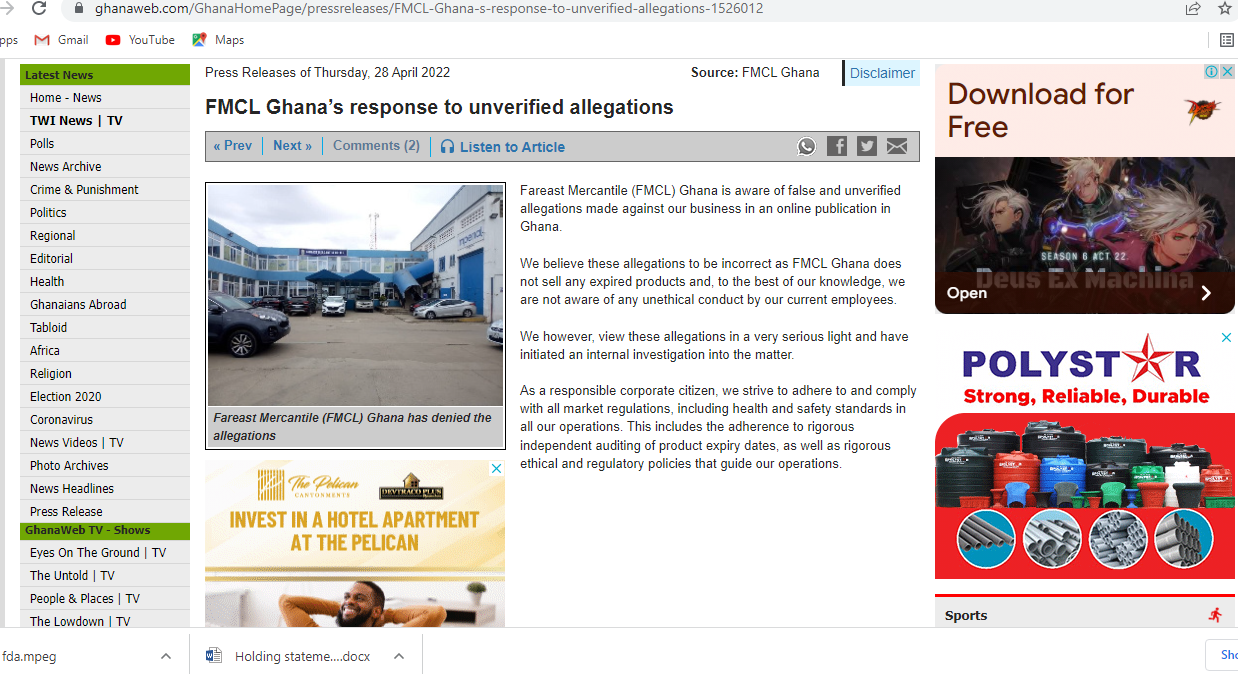
DUBAWA has intercepted a memo issued by the managers of the company to workers, denying the content of the DUBAWA publications and threatening to fish out the source of the leakage rather than mending its ways and putting a stop to its corporate strategy of selling expired products.
The memo dated April 27, 2022, in part read: “FMCL takes these allegations extremely seriously and we have instituted an internal investigation to establish the veracity of these allegations, which we believe to be inaccurate. Our legal team is engaging directly with the publication regarding the ‘facts” and sources of the article.”
The full details of the memo
Days after publishing this memo, the company went hunting for the source of information to DUBAWA. Convinced about what they claim to be the findings of their own internal investigation, the warehouse supervisor was reported to have been interdicted by the company even though he is said to have categorically denied the allegations against him. According to our sources at the company, the supervisor was later invited by the Manet Police upon a report filed by Fareast Mercantile. It was not clear exactly what charges were levelled against him. What is clear though is that the supervisor has since resigned from the company. According to our sources, he resigned on May 30.
Few days after his resignation, DUBAWA confirmed a sales meeting held at the Fareast Mercantile Head Office by top managers of the company on June 1, 2022.
According to our sources, the meeting was addressed by Raja Mohammed, the General Manager Sales (Non-food), who is also implicated in our investigation as having supervised the sale of the expired products.
In the meeting, Mohammed is reported to have mounted a spirited defence of his integrity before the sales representatives, denying any involvement in the sale of expired products.
This is one of the correspondences between top managers of the company which led to the sale of an expired Glade mini. Aney Mate, Head of Finance, clearly stated in this mail that this product expired in March 22, and yet on March 30, he gave account numbers into which proceeds of the sale of expired products would be paid.
In responding to the mail by Mate, Mohammed fixed the price for the sale of the expired product at 12 cedis per carton. With DUBAWA’s vigilance and support from the Police Criminal Investigation Department, Edward Sarpong, a dealer in expired products at Agbogbloshie, Accra’s Central Business District, was arrested on March 31, for buying this same expired product just around the same quantity. Sarpong confessed to dealing in three months expired products and that he has been doing that for the past eight years, a confession we have on record and will be included in our Consuming Trash full documentary.
After Sarpong’s truck was impounded and a search conducted, these were the expired products found which corresponds to the order of sale given by Mohammed in the mail sent the day before.
Manual Waybills
To further corroborate Sarpong’s confession of his eight years of experience in dealing in expired stocks, DUBAWA has in its possession multiple Manual Waybills detailing expired products bought by Sarpong over the last five years. A waybill, according to the Logistics manual of the Redcross, is an “official document that travels with a shipment, (transport) identifies its shipper, transporter and consignee, origin and destination, describes the goods and shows their weight and freight.”
Consuming Trash
While Mohammed was busy selling expired products at the non-food section, his counterparts at the food section, Rayul Kashyap, General Manager (Food), Swapnil Sakharkar, Associate Manager, Supply Chain and Logistics, were also busy selling expired, toxic, biscuits and margarines to the same dealers at Agbogbloshie for onward sale to consumers.
DUBAWA intercepted email conversations that led to the sale of cartons of 11-month-old expired digestive biscuits, hobnobs, and rich tea, the full content of which can be read here. As can be seen in the following email correspondence, over 2000 cartons of the biscuits were sold on December 8 and December 22, 2021, even though the biscuits had expired in January-February 2021
.
FDA Assurance
DUBAWA submitted the evidence of the Consuming Trash Investigations to the FDA for appropriate action. We have assurances from top-level management members of the Authority to deal with the matter.
DUBAWA was initially informed that the company was going to be fined but given the weight of evidence provided, the FDA would prosecute the company. According to the FDA, it has sent a docket to the Attorney General’s Department for counsel and prosecution.
However, when DUBAWA checked with the Attorney General, Godfred Dame and her Secretary, they were yet to receive the docket from the FDA.
DUBAWA will follow up on the matter until justice is served.
Team Lead for DUBAWA Ghana, Caroline Anipah, has charged journalists to be key actors in the prevention of the spread of information disorder, popularly known as fake news.
In an era where social media has become a popular source of information, some of which are false, Ms. Anipah said legacy media and by extension, professional journalists, must become torchbearers in the fight against fake news.
She made the statement on Thursday 5 May 2022, when DUBAWA Ghana participated in the US Embassy’s World Press Freedom film show and seminar in partnership with the Ghana Institute of Journalism (GIJ).
The seminar was under the theme “Fake News, Disinformation and Misinformation”.
Ms. Anipah was joined by two other speakers, Bernard Koku Avle, General Manager of Citi FM and Citi TV, Nathaniel Attigah, Principal Lead, Odekro, and Assistant and Project Lead at Ghana Decides for the seminar held at the GIJ, North Dworwulu campus.
Reiterating DUBAWA’s core mandate of fighting information disorder through a rigorous fact-checking process, Ms. Anipah said,
“With social media platforms identified as breeding ground for the spread of fake news, journalists need to be guarded in the use of the media type. Thus, there is a need to build the capacity of journalists in young democracies like Ghana, still trying to keep up with the daily evolution of social media. We believe that if journalists are able to spot fake news, they will tailor their reporting so as to counteract the effects of mis/disinformation.”
DUBAWA Ghana Team Lead, Caroline Anipah, speaking from a trainer’s perspective on fact-checking in Ghana
Bernard Avle shared some of his practical experiences as a practising journalist for twenty years which included the need for journalists to uphold truth in their storytelling and to go beyond Internet searches and get to the field and listen to people for their perspective on matters. He also advised that journalists become knowledgeable in all fields so as to limit what he termed as the ‘tyranny of experts’ by always calling experts on shows.
Quoting a popular dictum for media practitioners, Avle said,
“The journalists’ first obligation is to the truth, journalism is a discipline of verification and the practitioners’ loyalty is first to the public.”
On his part, Nathaniel Attigah also explained how necessary it was for information received online to be verified before sharing given the mischievous and economically-motivated intent of mis and disinformation peddlers. In a documentary aired, he showed how misinformation could negatively impact the outcome of presidential elections and the possibility of creating chaos.
Caroline Anipah, Bernard Avle and Nathaniel Attigah answering questions asked by attendees.
The Information Officer at the US embassy, Kevin Brosnahan, was excited about the interest shown by the students and the resource persons and pledged the Embassy’s commitment towards fighting misinformation.
The seminar was attended by a cross-section of students, faculty members of the Institute as well as some staff from the US Embassy and DUBAWA Ghana.
The Ghana Commission for UNESCO has partnered with DUBAWA Ghana and the Ghana Institute of Journalism (GIJ) for a two-day training of journalists on information disorder. The training was to increase media awareness on the subject and teach journalists ways to mitigate its effects. The training held on Thursday the 25th and Friday the 26th of April 2022, in a seminar room at GIJ, North Dzorwulu campus, had 20 broadcast journalists from Radio XYZ, Radio Latenu, Radio Wisconsin, Radio Univers, Radio GIJ, Top Radio, Rainbow Radio, Accra FM, Class FM, and Radio UNIIQ attending.
Three facilitators, Caroline Anipah, DUBAWA Ghana’s team Lead; Roselena Ahiable, DUBAWA Ghana’s Programme Officer; and Zakaria Tanko, a GIJ media law and ethics lecturer and legal practitioner, conducted the workshop from 9am to 4 pm on each of the two days. The training focused on the information disorder ecosystem, the practice of fact-checking and its research process, digital verification tools, social media hacks for identifying mis/disinformation, ethics and laws governing the fact-checking practice, and how to use the Right to Information (RTI) law for the fact-checking process.
DUBAWA Ghana’s Country Lead, Caroline Anipah, explaining the information disorder ecosystem to participants
Caroline Anipah, in acknowledging the outcome of the partnership, stated that information disorder has existed from the inception of humanity but the advent of the Internet has made its impact even more dangerous and necessary to be curtailed.
“We are happy to have partnered with the Ghana Commission for UNESCO to build the capacity of participants. We look forward to more of such collaborations. We hope that the participants’ enthusiasm will reflect in their work, and they will apply the skills and knowledge gained,” she added.
Roselena Ahiable also emphasised the importance of the training.
“It is clear that training is needed across the industry. This is because, during the training, we observed that the availability of information such as the existence of the RTI and the free and easy access to basic verification tools did not mean that all journalists knew how to use them,” she said.
Some participants with some trainers, Roselena Ahiable (DUBAWA Ghana Programme Officer) and Zakaria Tanko (GIJ media and law ethics lecturer), some DUBAWA Ghana staff, and Ghana Commission for UNESCO’s Secretary-General, Ama Serwa Nerquaye-Tetteh and Programme Officer, Joan Agyekum Nsowah.
At the end of the two-day training, the Secretary-General of the Ghana Commission for UNESCO, Ama Serwah Nerquaye-Tetteh, awarded all the trainees a certificate of participation. She also highlighted the theme of the training, “Capacity building for journalists on fact-checking and effective use of social media” as she admonished the trainees to utilise the knowledge received from the training.
“Every journalist present has a distinct role essential to our common objective of achieving zero speed or less spread of fake news. We at the Ghana Commission for UNESCO and our key partners thought of organising this workshop specifically to enhance and develop journalists’ capacity in producing and reporting factual and correct news,” Nerquaye-Tetteh said.
Like all facilitators of the training, she was emphatic that journalists are critical players in the global fight against information disorder.
Personnel from the Police Criminal Investigative Department (CID) attached to Ghana’s Food and Drugs Authority (FDA) have confiscated on Thursday two laptops and two desktop computers belonging to managers of Imperial Logistics, owners of Fareast Mercantile.
The confiscation is part of an inquiry into DUBAWA’s “Consuming Trash” investigation in which managers of Fareast Mercantile, together with their ‘clients’ at Accra Central Business District, are suspected to be selling expired products to consumers.
The confiscation of the machines is also to preserve and protect the sanctity of potential evidence that may be on the computers. With a court order, the police and the FDA can access information on those machines to facilitate investigation into what could potentially be one of the biggest expired food saga with its attendant public health crisis.
The owners of the machines, including Sharab Sharma, Logistics and Supply Chain Manager, Michael Bassaw, Warehouse Supervisor, have also been invited to the FDA to assist with investigations.
Background
Months of investigations by DUBAWA have uncovered what appears to be a deliberate company strategy to sell expired products to unsuspecting consumers.
Intercepted email conversations, part of which have already been published by DUBAWA, show top managers of the company including the Acting General Manager, Sales (Food), Rayul Kashyap; head of Finance at Fareast Mercantile, Aney Mate; the Logistics and Supply Chain Manager, Saurabh Sharma; and Manager for Sales (Non-food), Raja Mohammed, have been fixing prices and ordering the sale of damaged and expired products, consumables and non consumables, that ought to have been trashed under strict Food and Drugs Authority guidelines.
Before his arrest though, he had successfully purchased truckloads of expired non-consumables including assorted types of Dettol, Njoi soap, Jennifer’s floral anti-bacterial wipes, Enchanteur perfumed HBL, Airwick, Mortein fly and mosquito killer insecticide, on March 17, 2022 and December 17, 2021, all of which DUBAWA tracked by mail and with supporting video and pictorial evidence.
In a casual conversation at the police CID, which DUBAWA has on record, Sarpong admitted selling three months old expired products and has been engaging in the business for eight years.
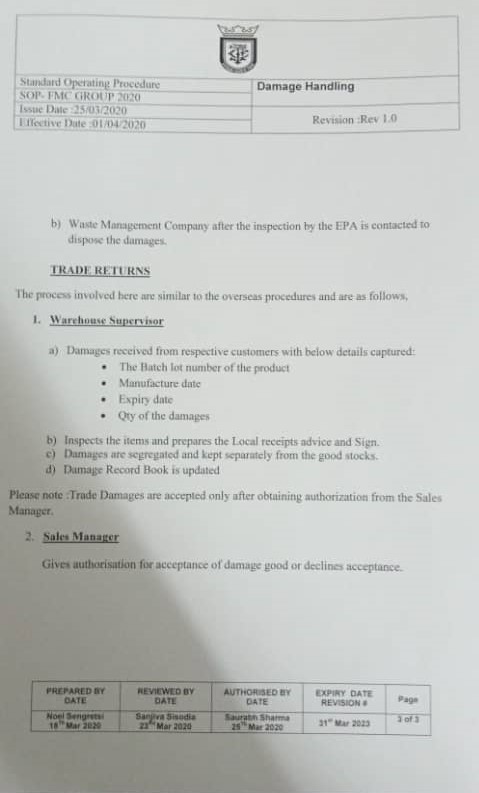
As promised to share in Part One of this investigation, DUBAWA has in its custody a March 2022 email conversation with the subject “Damages-Liquidation Jul-Oct 2022” and what top management members of the company did with those damaged products. DUBAWA also has in its possession portions of Fareast Mercantile’s own Standard Operating Procedures (SOP) issued on March 25, 2020 with effective date being 01/04/2020. The SOP specifies what should be done with damaged products. For the avoidance of doubt, the SOP states that damaged products, like expired products, must be QUARANTINED, and destroyed after alerting the appropriate statutory authorities.
Again, there is also a globally acceptable warehousing principle which frowns on the sale and distribution of products that will expire within six months.
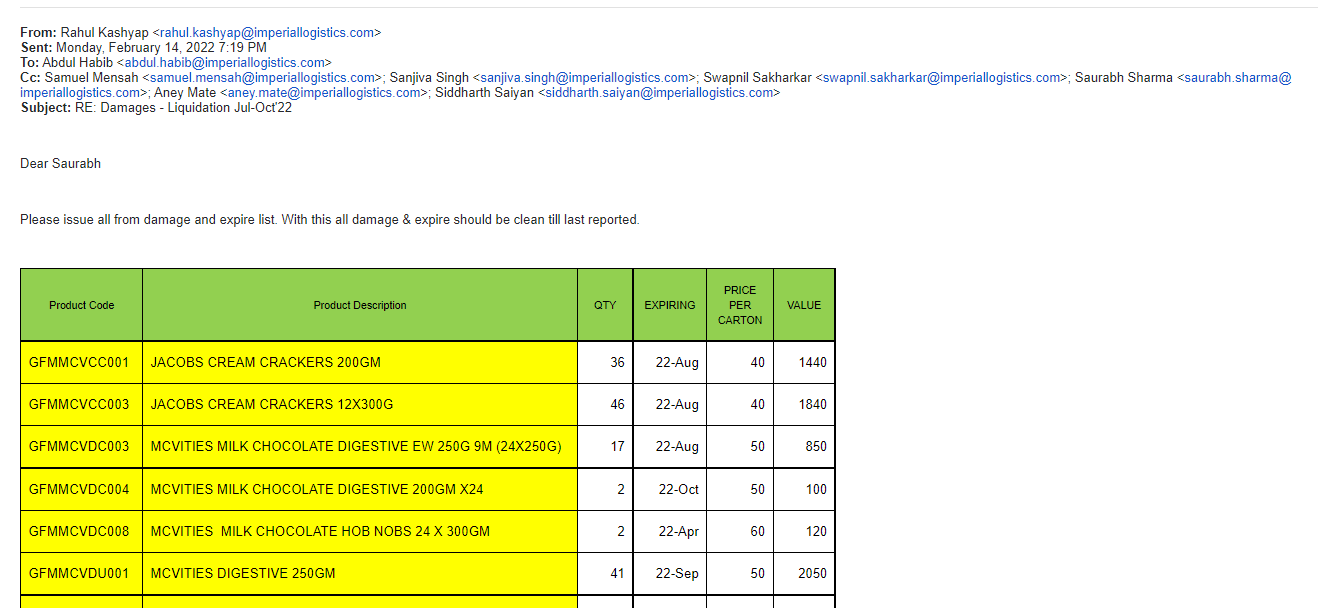
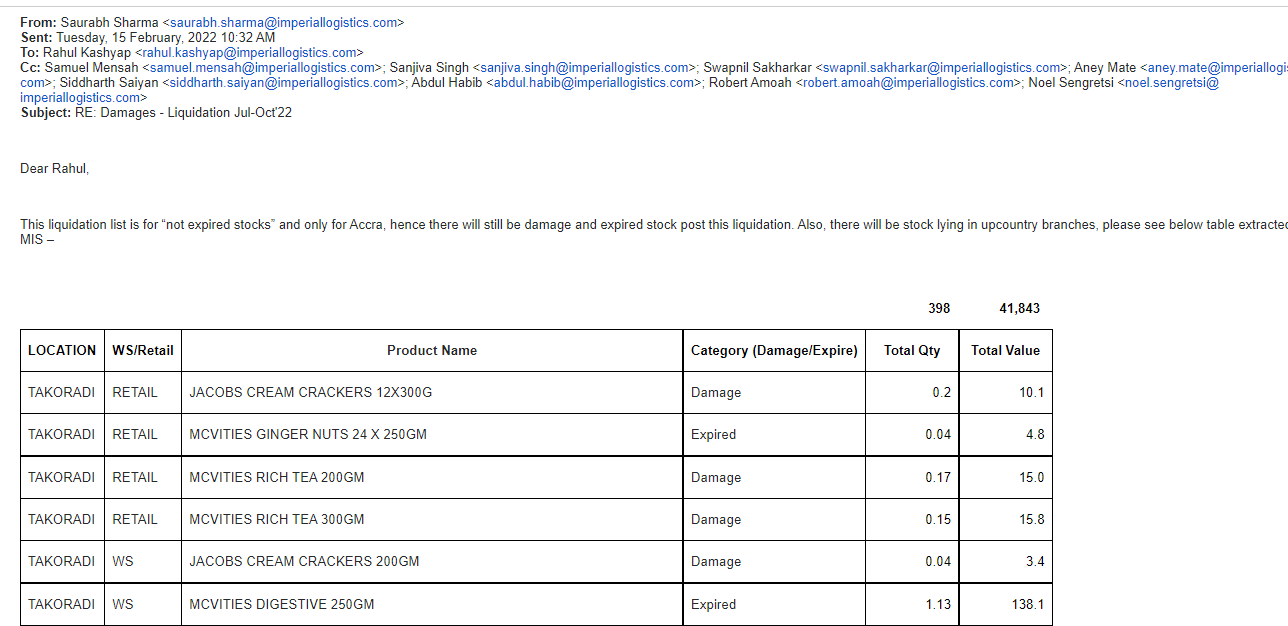
Despite the impressive Fareast SOP on paper, our investigation reveals the company does not observe what is contained in the document. Additional evidence shows that on February 14, 2022, Kashyap, instructed Saurabh to issue some ‘damage and expired list.’
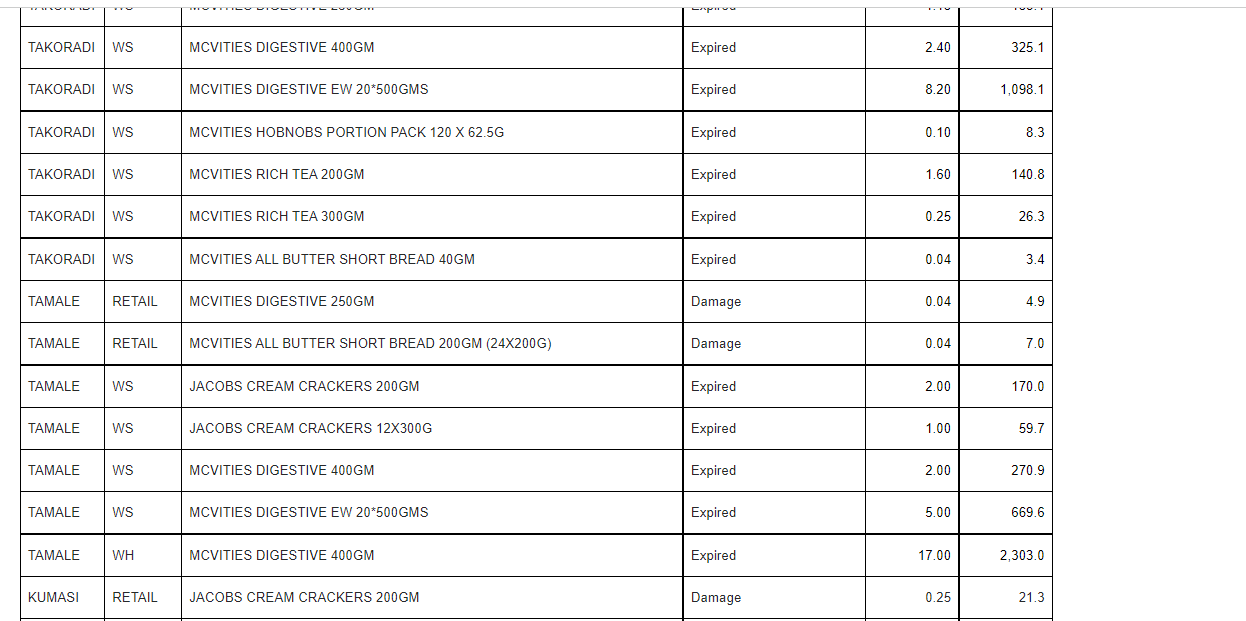
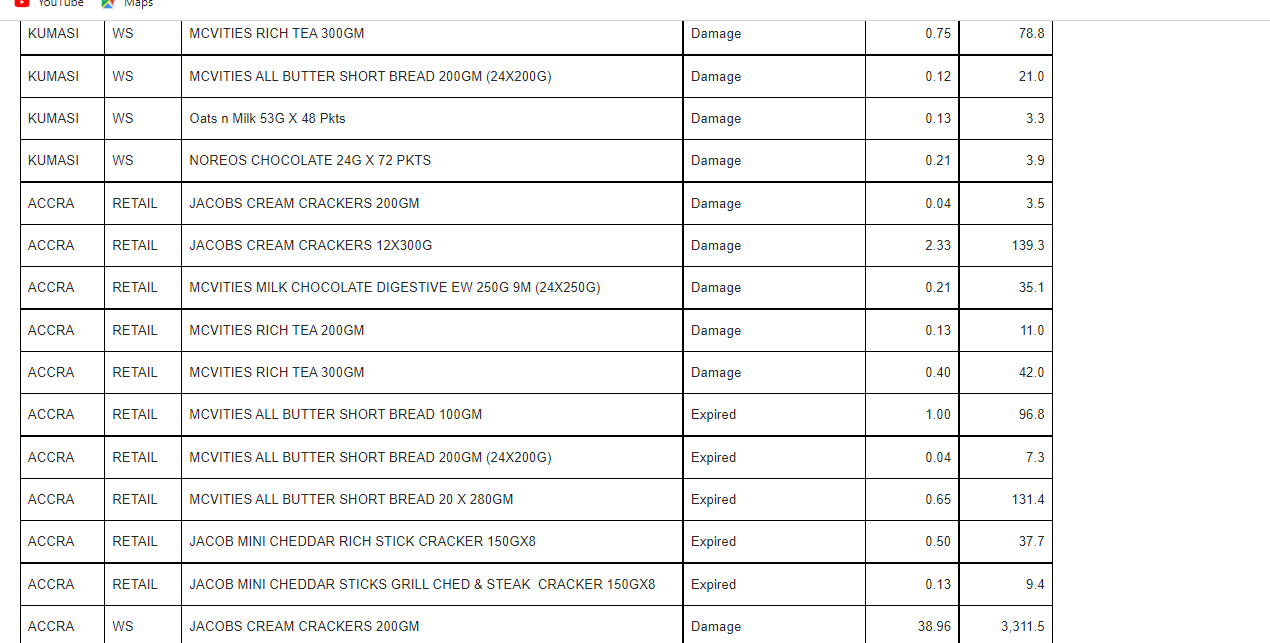
The following day, Saurabh responded with a tall list of damaged and expired goods in all four Fareast warehouses across the regions of Ghana which he said would be “liquidated.”
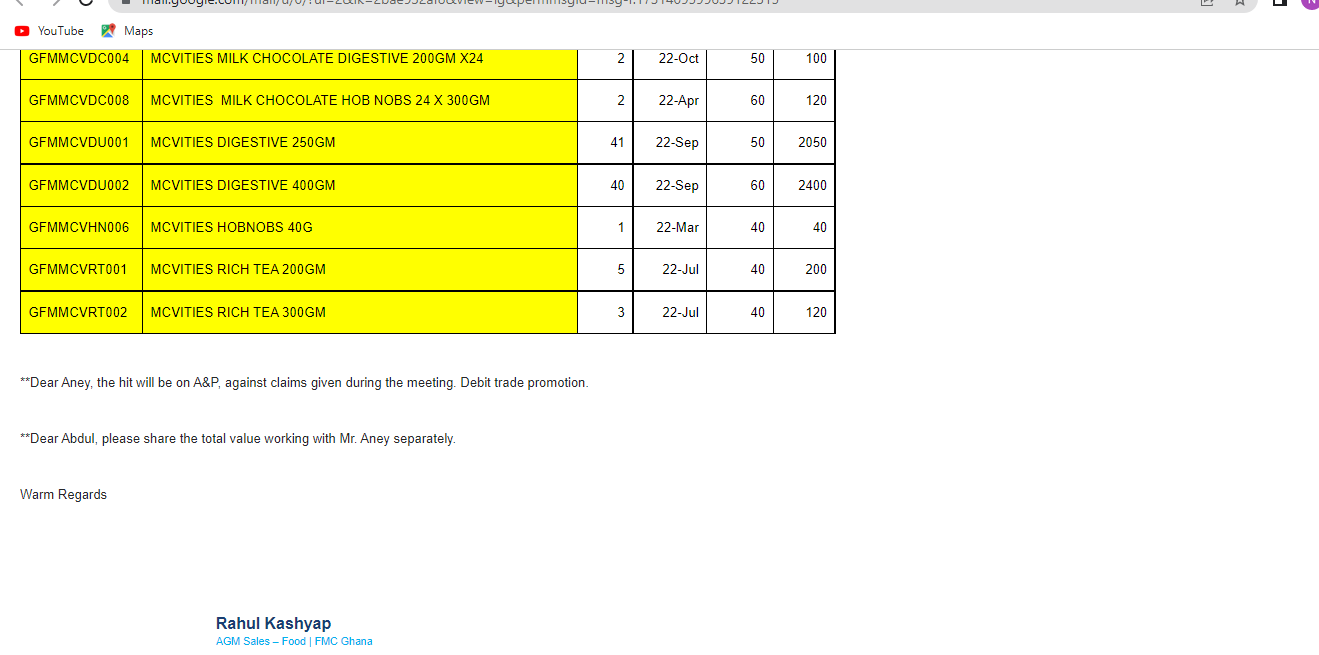
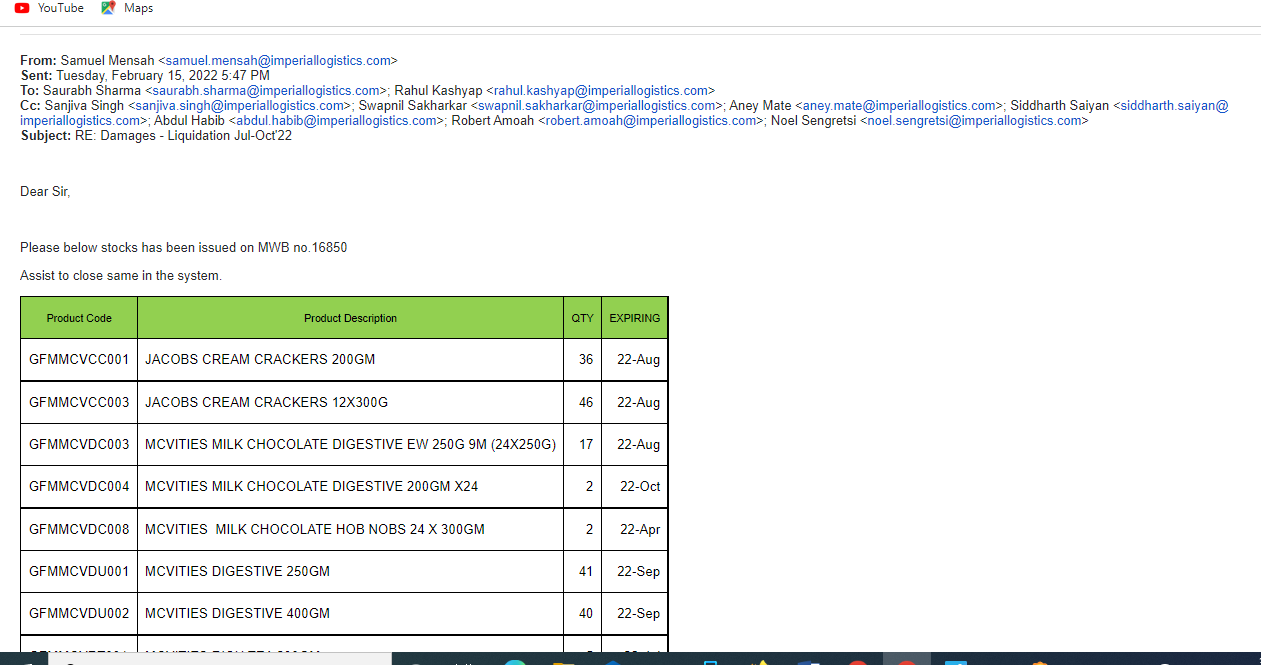
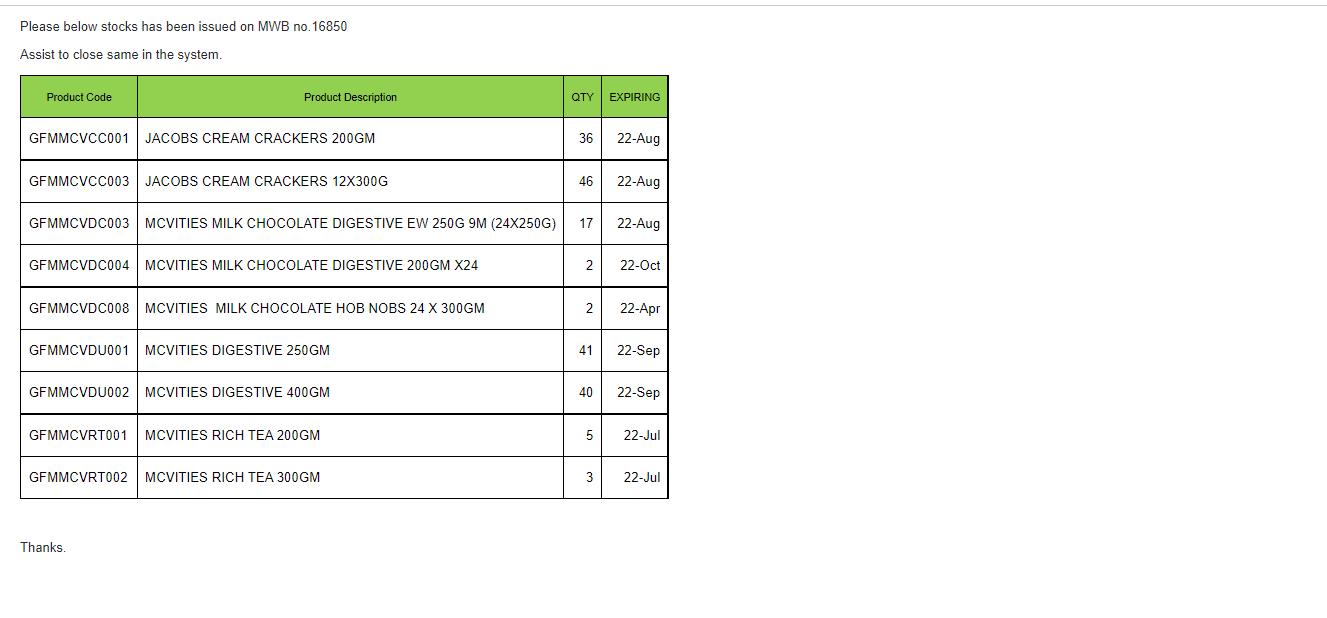
After the long list of damaged and expired goods that should be “liquidated,” Samuel Mensah gave an idea what it means to liquidate damaged and expired goods in his February 15 mail sent to Shaurabh. In that mail, a picture of which is shown below, Mensah said the same stock which Rayuh had described as damaged (a picture of which is shown above in yellow) had been issued on a Manual Way Bill (MWB) No 16850. As we have learnt from part one of this investigation, this MWB is an agent that buys expired goods.
Above is the full list of the products sent by Samuel Mensah all of which have been sold contrary to the company’s own SOP and against the FDA guidelines on dealing with damaged products which would expire within six months.
This evidence and more have all been presented to the FDA for further investigations.
FDA Promise
The FDA in an interview with DUBAWA reiterated its commitment to investigate the matter thoroughly and apply the appropriate sanctions that would protect the interest of consumers.
The Director of Legal and Corporate Affairs at the FDA, Mr Joseph Yaw-Bernie Bennie, stated that an expired product, whether consumable or not, is not fit for purpose and anyone who sells the same, has fallen foul of the law.
“Most products that the FDA regulates might contain chemicals. These chemicals might break down into something else. It is the reason why manufacturers put expiry dates or best before use dates on their products and therefore you cannot guarantee that the health and safety of the consumer can be preserved or not negatively affected by the use of expired products. Whether they are food or not food items, it is expected that once it expires, it should not be used,” he said.
He will not give details of the extent of investigations into the Fareast Mercantile saga, except to say that the FDA by law has the power to prosecute, sanction, fine and withdraw licenses. He insists the FDA will weigh the evidence and provide a commensurate sanction.
He charged Ghanaians to provide information about any wrong doing so that the FDA could timeously act upon the same.
DUBAWA will follow this investigation by the FDA to its logical conclusion in the interest of public health.
Months of painstaking investigations by DUBAWA, a fact checking organisation in Ghana, have uncovered a business model involving one of Ghana’s biggest importers and wholesalers, Fareast Mercantile and a network of some ‘get-rich-quick’ business men who deal in expired products at a popular section of the Central Business District (CBD) in Accra called CMB.
The model, which is in flagrant violation of Ghana’s Food and Drug Authority (FDA) guidelines, as well as the United Nations Guidelines for Consumer Protection, has some businesses buying the expired products (consumables and non-consumables) at a beat down price from Fareast Mercantile and later selling them at CMB to unsuspecting buyers or others who care little about public health.
Stock at the warehouse ready for the next buyer
Pictures, videos, surveillance and email conversations taken and intercepted by DUBAWA points to a cultured and coordinated plot by top management members of the company in cahoots with some goods dealers to cash in on expired products fit only for the trash bin. All they need are willing buyers from CMB who will package and re-sell these items to unsuspecting consumers and this they have done for years.
But with the lead from DUBAWA and a swift surgical operation by officers from the Criminal Investigations Department (CID), one of the dealers, Edwin Sarpong, was arrested on March 31, 2022, with truck-full of expired products hidden under a few wholesome cartons of Dettol.
Another suspect, only known as ‘Bogger,’ is under police surveillance after he successfully chauffeured cartons of expired margarine, Colgate and Jacobs Cream Crackers from the food section of the Far East Mercantile warehouse to CMB.
Managers of Fareast Mercantile, represented by the Corporate Affairs head, Nafisa Quainoo, have since been invited for questioning by the Food and Drugs Authority (FDA) in connection with pending investigations and possible prosecution.
The wholesale company was founded in Karachi India in 1860 and has offices in Lagos, Dubai, Mumbai, China, Singapore and the Canary Island. In Ghana, it was incorporated in 1997 and has four branches in Accra, Kumasi, Takoradi and Tamale. In 2018, Reckitt Benckiser, a consumer goods company producing health, hygiene, and home products awarded Fareast Mercantile with the Best Distributor Award.
Managers of Fareast receiving the award in 2018
The company was again adjudged by Colgate the best Distribution Company in Ghana in 2019. The company’s profile online indicates that it has 400 workers and generates sales in excess of $47 million annually. It is entirely possible, from the investigation by DUBAWA, that part of this annual sales by the company are proceeds from the unlawful sale of expired products. Stocks which are meant to be disposed of under strict supervision from Ghana’s Food and Drugs Authority (FDA), find their way into the market and by extension into homes and stomachs of consumers, with dire public health implications.
The Public Health Act 851
It is important to understand the modus operandi of Fareast Mercantile and the buyers of expired products within the context of Ghana’s Public Health Act 2012. Section 100 of the Public Health Law Act 851 states in part:
(3) A person commits an offence if that person sells or offers for sale a food that
(a) has in or on it a poisonous or harmful substance;
(b) is unwholesome or unfit for human or animal consumption;
(c) consists in whole or in part of a filthy, putrid, rotten, decomposed or diseased animal or vegetable substance;
(d) is adulterated;
(e) is injurious to health; or
(f) is not of the nature, substance, quality or prescribed
Also the United Nations Guidelines for Consumer Protection charges businesses to ensure consumer protection which starts “with good business practices that meet the legitimate needs of consumers. In summary, the Guidelines state that businesses should achieve this by:
• Dealing fairly and honestly with consumers at all stages of their relationship;
• Avoiding practices that pose unnecessary risks or harm to consumers, particularly those who are vulnerable and disadvantaged;
• Giving consumers accurate information about goods and services, terms and conditions, fees and costs to enable them to make informed decisions.”
Fareast modus operandi and FDA Guidelines
Fareast Mercantile imports and takes stocks – consumables and non-consumables – from leading manufacturers in Ghana and other global companies for distribution into malls and other wholesale and retail outlets across the country. In its process of distribution, stocks get damaged or expired, making them unwholesome. Under regulations of the FDA, unwholesome products are: “products that do not meet regulatory requirements or when consumed/used can be injurious to the health of the consumer; Including Substandard / Falsified (SF) products.”
The FDA has on numerous occasions asked traders and wholesalers to desist from selling such products to unsuspecting consumers. There are countless stories of seizures, destructions and sanctions meted out to companies who violate the FDA guidelines.
Checks by DUBAWA indicate an arrangement between Fareast Mercantile and its clients, which makes it possible for the clients to pay and return their expired stock to Fareast to be discarded under the strict FDA guidelines.
Expired Stock and FDA’s guidlines
In March 2022 alone, products worth GH₵294,211 from the principal suppliers to Fareast Mercantile, were deemed to have been damaged and or expired.
The sum of expired products for March 2022
The FDA guidelines do not only prohibit the sale of expired products, they do not even allow companies to dispose of expired products by themselves.
For the avoidance of doubt, the FDA guidelines state;
“3.1.1 No person shall dispose of any unwholesome product without permission and supervision from the Food and Drugs Authority (FDA).
3.1.2 Approval of application and safe disposal of any unwholesome product shall be sought from the FDA.
3.1.3 The applicant shall pay a prescribed fee for destruction as specified in the fee schedule.
3.1.4 The applicant shall arrange with the appropriate Waste Management Agency to assist in the destruction and also be responsible for conveyance of the unwholesome products to the site of destruction.
3.1.5 Where necessary, representatives from the Environmental Protection Agency, Customs Excise and Preventive Services (CEPS), Audit Service and the Ghana Police Service shall be present as witnesses.
Tracking the expired goods dealers at Fareast Merchantile
Having received information about the activities of Fareast and the expired goods dealers, DUBAWA began to monitor and track the movements of the products and other activities at Fareast to CMB.
The one-year-old expired biscuits
Early in the year 2022, a chain of email conversations at the highest level of management centred on what to do with a stock of expired digestive biscuits which had been in the warehouse for close to or a little more than a year. There was no word on inviting the FDA for the safe disposal of the unwholesome biscuits. Rather, the e-mail conversations focused on the pricing and sale of the biscuits.
On January 20, 2022, the e-mail conversation was triggered by the Acting General Manager (AGM) Sales- (Food), Rahul Kashyap, with the subject title “RE: LIQUIDATION OF TWIN PACK HOB AND DIGESTIVE JAN – FEB’21”.
On copy in the email were some top management members of the company including the head of finance; the Logistics and Supply Chain Manager, Saurabh Sharma; the Associate Manager, Supply Chain and Logistics, Swapnil Sakharkah; as well as MIS Executive, Abdul Habib.
Swapnil Sakharkah reminded Abdul on February 14, 2022, almost a month later, to act on the mail sent by the AGM. With a subtitle “Importance High” Swapnil directed Abdul to process the products “ASAP.”
On February 14, 2022, Habib responded by providing the product description, quantity, cost as well as the expiring dates.
After Habib had provided details, Swapnil again directed Abdul to “expedite” action hinting of an expected stock audit.
The mail trail did not go further to explain what kind of action was to be taken by Abdul, but the answer to that has been clipped in the Gmail messages. A gentle click on “view entire message” button revealed details of how the expired biscuits, priced at GH₵5,380.00 by Abdul Habib, had been sold in December 2021 almost 10-11 months after expiry.
Other similar stocks were also sold within the same period. The managers were only waiting to regularize the sold expired products, hence the January 20, 2022 mail sent by Kashyap.
On December 8, 2021, Kashyap issued the directive for the expired stocks to be released and sold.
Emmanuel is one of the known dealers in expired products at CMB. The expired products supplied to him, as stated in this mail, were the same products said to have expired in January and February 2021. This can be verified by checking the product code, description and quantity. They are the same as the information provided by Abdul on February 14, 2022. For efficient warehouse management, it is highly irregular for different products to have the same code.
Under the same subject “Liquidation of twin pack hob and digestive Jan-Feb’21” 800 cartons of expired biscuits originally sold to customers at 40 cedis each per carton, were discounted at a price of 25 cedis and sold. Another 930 cartons of expired biscuits were sold on December 8, 2021, biscuits that expired in Jan-February 2021.
Abdul provided the status of some 930 expired biscuits detailing their product code, description and date of expiry in the mail communication above. He would later on December 21, 2021, inform Mate and Kashyap the breakdown of how the 930 cartons were sold in the mail below;
A Warehouse Officer, Samuel Mensah, would later on January 19, 2022, provide details of the dates, the Manual Way Bill (MWB) numbers on which the expired stocks were sold. One of them included the stock sold to Emmauel with MWB number 16823.
After cashing in on the expired biscuits, this was Rahul’s decision on how to account for the money.
DUBAWA has tons of emails from top management categorised as “damaged products” but which were sold under similar arrangements, contrary to the FDA Guidelines and the Public Health Act. We will serialize them in our subsequent publications.
Food poisoning and expired food
Consuming expired products, including biscuits, have dire public health implications, especially as far as food poisoning is concerned. Food poisoning is deemed to be one of the main problems in public health worldwide. The World Health Organisation (WHO) states that 600 million people around the world, or 1 out of 10 each year, become ill after consuming contaminated food. Out of this population 420,000 die, including 125,000 children under 5 years of age, due to their vulnerability to develop a diarrheal syndrome, about 43% of Food Borne Diseases (FBDs) occur in these patients. About 70% of FBDs result from food contaminated with a microorganism.
In Ghana, over 625,000 food poisoning incidents are recorded annually with over 297,104 people hospitalised annually, according to a Ministry of Food and Agriculture and World Bank 2007 report. Even though the data does not show how many of these incidents of food poisoning are as a direct result of eating expired food, a registered dietician in Ghana and a popular TV Show host, Nana Kofi Owusu, told DUBAWA it is entirely possible for a person who consumes expired product to suffer food poisoning.
“Consuming expired food and biscuits may have negative health implications which may range from minor issues such tastelessness, reduction in quality of the product to severe cases of food poisoning which come with lots of diarrhoea and may lead to death especially in children,” he said.
Part 2 of this investigation, to be published tomorrow, which will delve into the DUBAWA/CID operation, the arrest of Sarpong, a kingpin in expired products at CMB, his confession and the activities of the ‘Bogger’ dealer as well as the FDA intervention.
As part of its core mandate of championing research-based factual and verifiable content online and offline, Dubawa, a transnational fact-checking project of the Premium Times Centre for Investigative Journalism (PTCIJ), is set to begin its annual Media and Information Literacy campaign for 2021.
The campaign, dubbed Week for Truth, is a week-long lineup of events and activities all advocating for accurate information to be upheld in public policy, public discourse, and journalistic practice.
Running for the second time since 2019, this year’s Week for Truth starts on Monday the 15th of November till Friday the 19th of November 2021 across all five Anglophone West African countries Dubawa operates in – Nigeria, Ghana, Sierra Leone, Liberia, and The Gambia.
Events and activities scheduled within the week include:
A one-day nationwide senior high school outreach by over 90 Dubawa-trained volunteers, to educate students on Media and Information Literacy, and basic fact-checking and critical thinking skills.
A one-day media and information quiz session across Dubawa’s social media pages, which promises prizes to winners.
A two-day Information Disorder conference, which will engage professionals, academics, researchers, and the general public in analysing the consequences of information disorder, approaches, and experiences in tackling it; government and civic engagement; balancing and regulations; and fact-checking.
A week-long mainstream and social media literacy campaign, on radio stations and Dubawa’s Facebook, Twitter, and Instagram page respectively.
Dubawa’s Programme Manager, Mr. Adedeji Adekunle, explains the purpose of Week for Truth and what it hopes to contribute to society.
“At Dubawa, we believe that the best way to counter the information disorder problem is to preempt it. That means the goal is to equip every citizen with the necessary knowledge to discern the veracity of the information they come across. This campaign, while imparting such skills, will also draw the attention of the public to the risks around the information they receive and share, and the consequences of enabling misinformation,” Mr. Adekunle said.
In a present age faced with diverse global digital and information challenges, the need for all media users to become media and information literate has become even more crucial. Dubawa, thus, calls on the entire public to participate in its week-long programme, Week for Truth, to further the agenda of amplifying the culture of truth in society.
Over 600,000 global breast cancer deaths recorded in 2020 while diagnosed cases trump 2 million
By Roselena Ahiable
Breast cancer is the most prevalent cancer and the leading cause of death in women globally.It is a disease that results from overgrown cells in the breast. The disease occurs in both men and women; however, women are at a higher risk of getting breast cancer in comparison to men.
Cancer of the breast can start in different areas of the breast like the lobules, the ducts, and in some instances the tissue in between. There are two main types of breast cancer namely invasive (Ductal Carcinoma in situ and Lobular carcinoma in situ) and non-invasive (Invasive ductal carcinoma, invasive lobular carcinoma, Paget’s disease of the nipple, Inflammatory breast cancer, Phyllodes tumors of the breast, Locally advanced breast cancer, metastatic breast cancer).
The subtypes of breast cancer are hormone receptor-positive breast cancer, HER2 positive breast cancer and triple-negative breast cancer.
Global outlook
A report by the World Health Organisation (WHO) released on March 26, 2021, indicates that in the year 2020, 2.3 million women were diagnosed with breast cancer and 685,000 deaths were recorded globally.
At the end of that same year, a total of 7.8 million women had been diagnosed with breast cancer in the past five (5) years.
Records for incidence of breast cancer in men, on the other hand, is about 0.5-1% according to the WHO.
A TikTok video showing a man cutting into a coconut with a resulting flow of blood from it has gone viral on social media. In the video, the man was heard saying “I plucked one coconut on the tree, I peeled it and what I saw in the coconut, the content in the coconut was amazing, surprising. I cut and what I was is blood!!!. Yes, blood. Real blood”. However, he admitted it was fake when Dubawa contacted him. He often makes such videos on TikTok to showcase his creativity, even though his videos do not state that intent.
A viral WhatsApp message claims there has been a change in WhatsApp’s group privacy settings after the external system breakdown. Dubawa contacted the WhatsApp Support Team and was informed that indeed, anyone can be added to a group if the option “Everyone” is selected instead of “My Contacts,” with the latter ensuring that the individual is added only to groups created by people in their personal contact list only. However, this is not a new setting as it was available prior to the global WhatsApp outage. WhatsApp has not made any new changes or updates to the already existing group privacy settings. All users are free to change the group settings to their preferred choice.
Are you passionate about making an impact? Do you want to help in the personal development of young adults in the various Senior High and Tertiary schools in the country?
If yes, then we need you. This is your chance to leave a mark.
Dubawa, a fact-checking and verification project of the Premium Times Centre for Investigative Journalism (PTCIJ), is looking for volunteers to join a nationwide outreach to educate students/youth corp members on media and information literacy, basic fact-checking and critical thinking skills!
Eligibility and Expectation
Volunteers must
Be resident in Ghana, Nigeria, Sierra Leone, Liberia and The Gambia.
Be willing to undergo an online training if selected
Be willing to visit a senior high school (preferably their alma mater) or a tertiary institution in their resident country to sensitize and educate students on media and information literacy and fact-checking as a means of combating fake news.
Will be available for the ‘‘week for truth’’ in the second week of November.