Claim: Social media users claim that couples who seek a divorce in Ghana’s court must appear in the same attire they used for their wedding.
The claim is false. Ghana’s law regarding divorce does not require couples to appear in their wedding attire when seeking a divorce. Moreover, the picture being circulated does not originate from Ghana.
Full Text
A post that has gone viral on social media claims that the appearance of Ghanaian couples seeking a divorce in court must be the same as they did when they got married.
“In Ghana, you must be present in the same suit you wore on your wedding day, in order for the divorce proceedings to take place,” the claim when translated to English reads.
A photo of the claim on Facebook
This is not the first time such a claim has come up. In 2018, the same claim was made on several social media platforms, as can be seen here, here, here, and here.
“Ghanaians are allowed to divorce but as long as people attend court dressed the same way when they get married. This condition creates very humorous situations in the so-called «Divorce Rooms», where Ghanaians must go if they want to end their marriage,” the story reads.
We also found the circulating photo in the image collections of Alamy, a British privately owned stock photography agency. In their photo description, they indicated that the image was taken in Uganda in 2009.
“Friends and family gather for the group wedding of six couples in the church at the Lacekocot Internally Displaced Persons Camp in Pader. The wedding was made possible by the donation of wedding dresses and wedding items from the United Kingdom,” Alamy indicated.
The photo is available on Alamy.
Mrs. Juliana Addo-Yobo, a private legal practitioner, in an interview with DUBAWA dismissed the claim that couples must appear in their wedding attire when they appear in court for a divorce hearing.
“They are not to appear in their wedding attire. They can dress as ordinary people and appear in court, provided it is decent,” Mrs. Addo-Yobo said.
“That is not true. It is never never true,” she added.
Mrs. Addo-Yobo, speaking to DUBAWA on what the procedure for divorce is in Ghana, said that a party seeking a separation must see a lawyer to discuss his or her side of the story.
“Your issues are written and put before the court. The other party is served, and because it is a divorce petition, it must be served personally to the defendant,” she explained.
Conclusion
Ghana’s law regarding divorce does not require couples to appear in their wedding attire when seeking a divorce. Moreover, the picture being circulated does not originate from Ghana.
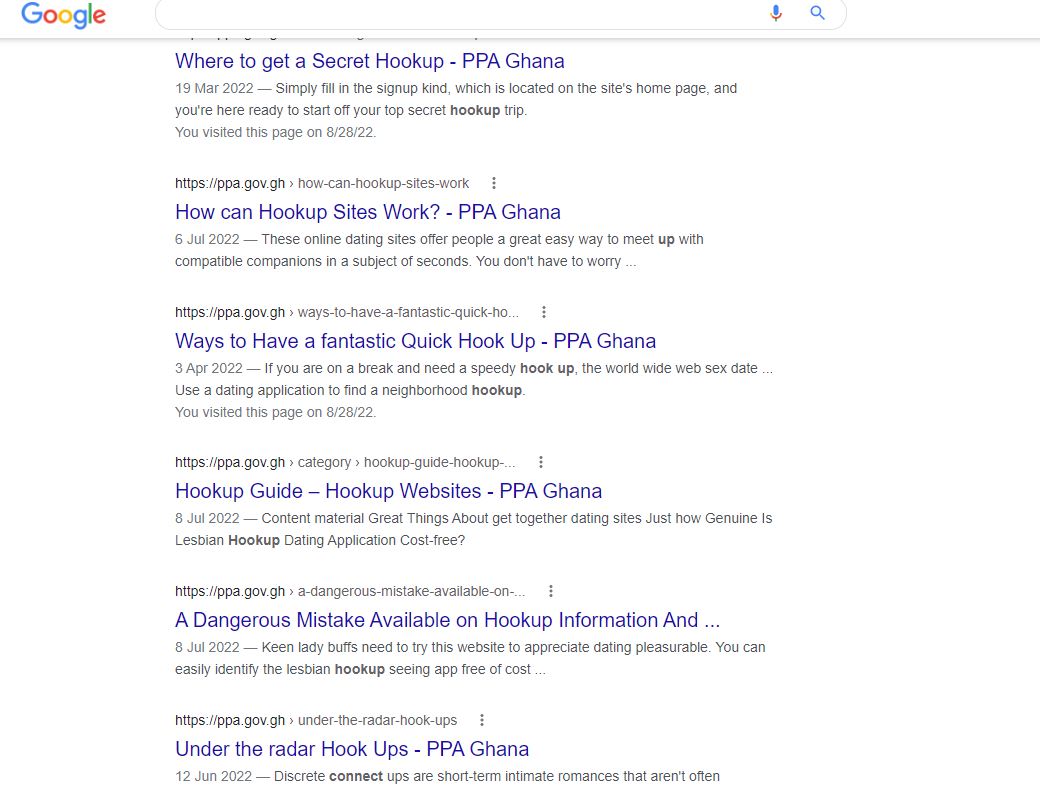
On Saturday, August 27, 2022, a photo of an article promoting an adult website on the official website of the Public Procurement Authority (PPA) went viral on social media.
Dubawa Ghana’s research showed that at least seven different articles of that nature had been published on the website.
The articles have since been deleted, but below are insights from our findings and advice from experts on protecting websites from such unpleasant developments.
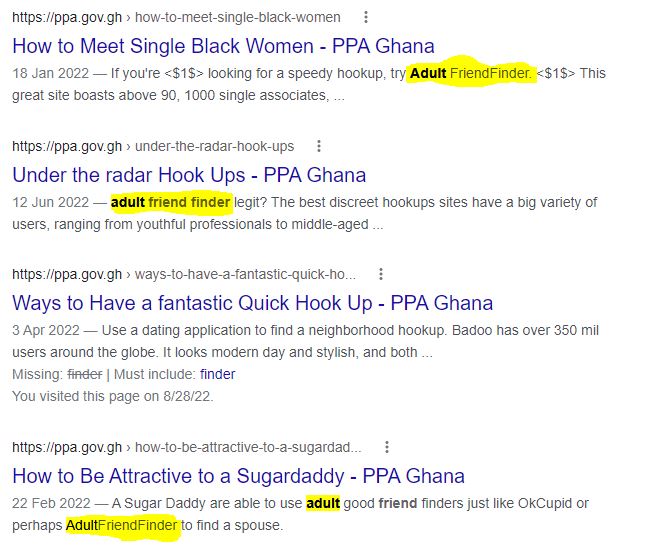
All the posts were meant to promote adult-oriented social networking services, including Adult Friend Finder.
The many grammatical errors in the meta description of the various articles when searched on Google suggest that the articles were written in bulk using an inexpensive AI copywriting tool.
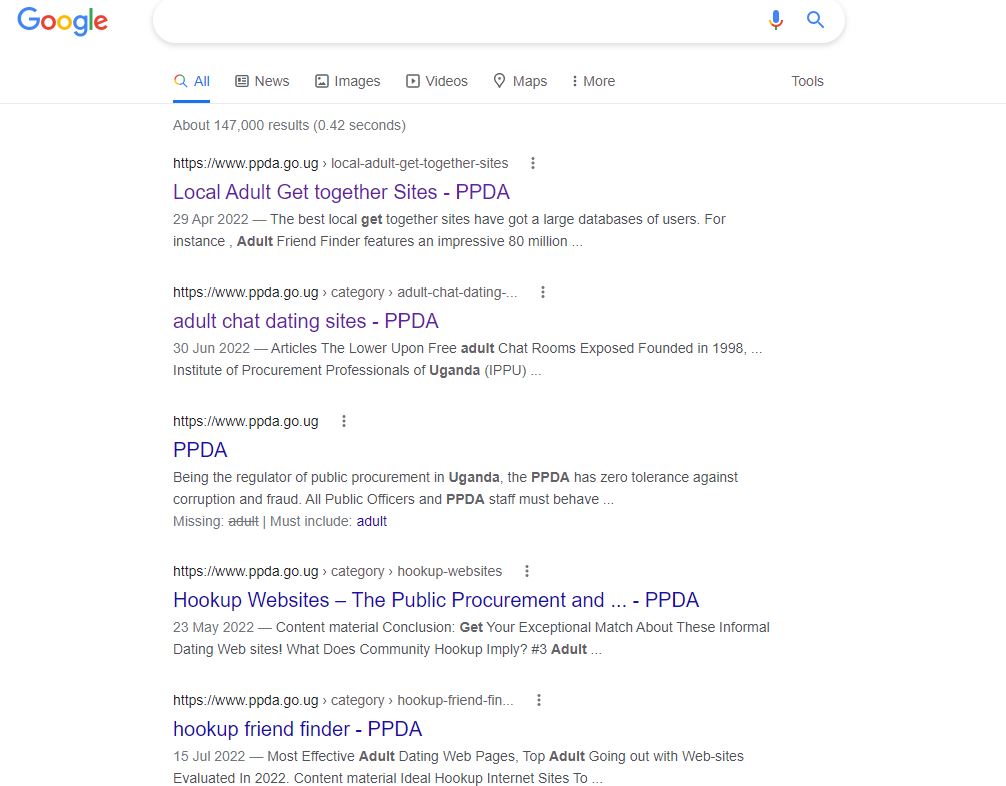
We also found evidence that around the same time the publications were made on the State agency’s website, similar publications promoting the same websites were being done on other websites.
Although some of the articles have subsequently been pulled down, we accessed some of them that were still live, like this one.
PPA statement
Ghana’s Public Procurement Authority, in a statement, said its website had been “compromised by hackers” and it is working to ensure that such incident does not reoccur.
“The Authority continues to work with the relevant Cyber Security Agencies to ensure appropriate measures are put in place to prevent future cyber attacks on our official website and in the event it happens, it will be swiftly resolved,” it said.
Hacking
Website hacking is the unauthorised access to or control over computer network security systems for some illicit purpose.
Apart from attempts to get access to company data, cybercriminals may hack a website in a way that ruins the organisation, like redirecting some critical web page links to adult websites or injecting the website with new articles with backlinks to adult websites, as was the case of the PPA website.
Statistics show that almost one out of every six WordPress-powered sites are vulnerable to attacks. More than half a million WordPress sites were compromised by attackers in 2021.
How does this happen?
Divine Puplampu, the technology lead for Accra-based web services provider, Stimulus, told DUBAWA that, besides hacking, getting access and taking control of a website author’s account to make unwarranted posts, hackers may also take advantage of vulnerabilities on websites as a result of the use of outdated themes and plugins.
“There are different levels at which this can happen. The account of an administrator can be hacked directly. Also, somebody may be able to inject some codes into the Structures Query Language (SQL) of the website, which gives them access to the website’s database and allows the person to make posts on your site. In such a case, you won’t see those articles in the posts section, but when someone opens the website, they’ll be able to see them [the posts]. There is also the case of outdated themes and plugins that can allow hackers access to make posts on the website because of the vulnerabilities they have,” he said.
Puplampu said a cursory assessment of the ppa.gov.gh website shows that the WordPress version being used is yet to be updated to the latest version of 6.0.1 and the minimum recommended PHP of 7.4.
He advised that preventing such attacks in future will require that “the PHP, WordPress core, themes and plugins are updated to the latest version as the updates tackle security vulnerabilities.”
“I will advise administrators to ensure that they prevent people from getting access to the accounts by implementing two-factor authentication and also change their password periodically… Website owners must also employ technical and security maintenance engineers to police their websites to ensure that such things are detected and tackled soon enough. A simple google recaptcha system can also help prevent the situation where bots are used to hack websites,” he added. An extensive explanation of how to protect a website from hacking can be found here.
Claim: Black Stars coach, Otto-Addo has disclosed in a Facebook post that his choice of who will be invited into the national team to the 2022 World Cup will be based on the individual’s performance and commitment as well as age.
The coach has denied making any such comment and has disassociated himself from the Facebook page that is claiming to him.
Full Text
A purported Facebook account of Black Stars coach, Otto Addo has stoked controversy with a post on Thursday, August 18 saying that a call-up to the Black Stars for the 2022 World Cup will be based on performance and commitment.
The page, making a definite pronouncement in the name of the coach said, “I am building a new team that will bring back the love and make our motherland proud!”
The post has since received more than 400 reactions, including shares by influential Ghanaian figures, with some of them believing the page is owned by the Black Stars coach as can be seen here and here.
Even more interesting is the timing and tone of the post, which has raised some suspicion.
Ghanaian sports enthusiasts are divided over whether or not former Black Stars captain Asamoah Gyan should be called up into the team for the 2022 World Cup in Qatar.
The discussion stemmed from a recent interview Gyan granted the BBC, where he expressed his interest to join the team to play at the international tournament.
While some believe that Gyan, 36, should not be allowed into the team, others insist he still has something to offer.
If the post purported to be from Otto Addo is true, it takes a definite position in the ensuing debate.
Verification
According to Facebook’s page transparency feature, the page, with over 93,000 followers, was created only four months ago in April 2022.
While it is publicly known that the coach is largely based in Germany due to his other major commitment as assistant Borussia Dortmund coach in Germany, Facebook’s page transparency feature further shows that the page is being managed in Ghana by at least two Ghana-based Facebook profiles.
Phone number traces conducted on +49 231 900200, which was listed on the purported Facebook page as Otto Addo’s contacted number revealed that it was a landline operated in or around Dortmund in Germany.
Otto Addo in a WhatsApp conversation with Dubawa Ghana editor, Nathan Gadugah has disassociated himself from the page and its content.
He further revealed that he has no official public social media account except on Instagram.
Conclusion
The Facebook page purporting to be Black Stars coach, Otto Addo is fake and does not in any way represent the person of the football manager.
Claim: Deputy Public Relations Officer of the Education Ministry says that the expected increment in water and electricity tariffs in September this year will be the first in five years.
The claim is false. In 2019, the Public Utilities Regulatory Commission approved a 5.94% increment in electricity tariffs and a 2.22% upward adjustment in water tariffs.
Full Text
Ghanaians have been asked to brace themselves for an upward review of utility tariffs.
Deputy Public Relations Officer of the Education Ministry, Yaw Opoku Mensah, whilst urging Ghanaians to bear with the upward adjustment, said it was necessary for such decisions to be taken to ensure that utility companies run efficiently despite the country’s economic situation.
According to him, this is going to be the first time in five years since utility tariffs have gone up.
“You will agree with me that for the past five years, the government has not adjusted utility tariffs. Unlike before when our utility tariffs were automatically adjusted with increments in the world crude prices and the exchange rate. On that score, you can say that the government has been very truthful and has cushioned Ghanaians for the past five years,” he said in the Akan language.
Yaw Opoku Mensah is not the only one found to have made the claim.
State media, Graphic, in an earlier online publication about the expected increase, made a similar statement – “Utility tariffs are expected to go up next week, the first since 2017.”
Several other online news outlets such as myjoyonline.com and pulse.com.gh have also made the claim in their respective reports.
Verification
The Public Utilities Regulatory Commission is a state agency mandated to regulate the provision of electricity and water utility services. One of their key tasks is to examine and approve utility rates.
In investigating the claim, we analyzed the Public Utilities Regulatory Commission’s annual reports for the years 2016/2017, 2018, 2019, and 2020.
DUBAWA observed that in the 2019 annual report (Chapter 3.2, page 57), it was indicated that the Commission had upwardly reviewed electricity and water tariffs on October 1, 2019.
“Using available macroeconomic variables, generation mix, and fuel prices, the Commission’s analysis, indicated a marginal upward adjustment in tariffs, with the Commission approving a 5.94% increase in electricity tariffs and 2.22% increase in water tariffs across all customer categories effective October 01, 2019,” the report reads.
In the reports for 2016/2017, 2018 (Page 38), and 2020, it was indicated that the Commission decided against reviewing tariffs.
For instance, in the 2016/2017 (Page 12) report, the Commission said “although macroeconomic variables (Ghana Cedi: US Dollar exchange rate and inflation) experienced some positive variations, the effect of these increases on the tariff was mitigated by an increase in the hydro component of the generation mix…Consequently, the Commission decided to maintain both electricity and water tariffs at the same levels as approved in December 2015.”
In the 2018 report (Page 38), it was indicated that “…there was a decision not to adjust electricity and water tariffs.”
Similarly, in the 2020 report (Page 47), the “Commission approved no change in electricity, natural gas and water tariffs for all four quarters of 2020.”
Conclusion
It is not true that the expected upward review of utility tariffs in September will be the first such increase since 2017.
Claim: The Minister of Agriculture, Dr Afriyie Akoto, has claimed that the highest fertilizer imports before they (NPP) came into office were less than 200,000 metric tonnes and that in 2015 the NDC government did not import even a bag of fertilizer into the country.
Data from the Africa Fertilizer Organization, the International Fertilizer Development Centre (IFDC), Ghana Fertilizer Dashboard, and Statista, a global data sourcing hub show that in 2015 Ghana imported over 200,000 tonnes of fertilizers into the country.
Full Text
The Minister of Agriculture Dr Afriyie Akoto has said that during the tenure of the National Democratic Congress (NDC), its highest import of fertilizer was less than 200,000 metric tonnes. He added that in the year 2015 the NDC government did not import fertilizer into the country.
According to him, “Before we (NPP) came into power, the highest import of fertilizer had not surpassed 200,000 metric tonnes. When NDC came into government, its highest import of fertilizer was 180,000 metric tonnes. There was a year that they did not import fertilizer. And that year was 2015. They did not even import a bag of fertilizer.”
According to the International Trade Administration of the U.S. Department of Commerce, Ghana imports almost all the fertilizer it consumes. The role of fertilizers is to increase yield and ensure healthy produce by supplying the right balance of nutrients to the soil. Ghana uses primarily nitrogen, phosphorus, potassium (NPK), urea, sulfate of ammonia, and bulk organic compost fertilizer.
It should be noted that the data on the Ghana Fertilizer Dashboard excludes November and December data, which basically means there was no import of fertilizer in those months. But collating the figures from January to October, fertilizer import into Ghana surpasses 200,000 metric tonnes.
However, data from October to December, which is 25,669 metric tonnes for the fourth quarter, is almost similar to that of the data from the Ghana Fertilizer Dashboard, which also quotes 25,615 metric tonnes as data for October to December.
Source: Africa Fertilizer Organization and International Fertilizer Development Centre (IFDC)
Statista is also a global data sourcing hub. Its data also pegs fertilizer importation in 2015 at 290,156 metric tons. This figure is the second lowest from 2015 to 2019. In 2016, fertilizer importation for farmers was 239,883. Within the reviewed timeframe which is from 2015 to 2019, the year 2017 reported the largest quantity of imported fertilizer, at 444,236 thousand metric tons.
Conclusion
Even though in November and December 2015, there was no import of fertilizer into the country, the claim by the Minister for Food and Agriculture that in 2015 there was no fertilizer import into the country is untrue. It is also false that fertilizer imports before the NPP government came into power did not surpass 200,000 metric tons.
Claim: National Communication Officer of the National Democratic Congress, Sammy Gyamfi, claims that the UK is experiencing a downward trend regarding its inflation.
According to data from the UK’s Office of National Statistics, the country’s inflation rate has been rising since October 2021.
Full Text
The National Communications Officer of the National Democratic Congress, Sammy Gyamfi, has said that inflation is easing in the United Kingdom.
He made the claim during a panel discussion on TV3’s The Key Point show on Saturday, August 13, 2022.
Sammy Gyamfi was responding to comparisons made by Dennis Edward Aboagye, a presidential staffer with responsibilities for local government, decentralization and rural development, about the rising inflation rate in some of Ghana’s trade partners such as Turkey, Brazil, the United States of America, and the United Kingdom.
According to Dennis Aboagye, the factors driving the inflation in those countries are the same influencing Ghana’s situation.
But Sammy Gyamfi, who argued that the inflation rates in some of Ghana’s trade partners were still lower when compared to Ghana’s, said that the situation was getting better in the United Kingdom.
“For convenience, Edward cited just a few countries, and 90% of the countries he cited, the rate of inflation is significantly lower than in Ghana. Brazil’s rate of 10%, America’s inflation of 8.5% which is coming down by the way, and the inflation rate of the UK is coming down. You cannot use that to justify the point that the high rate of inflation we are experiencing in Ghana today is largely a result of global factors,” he said.
The Office of National Statistics (ONS) is the UK’s largest independent producer of official statistics and the recognized national statistical institute of the UK.
In investigating the claim, we relied on information from the ONS’ inflation data for the UK.
The bulletin also reported that “the Consumer Prices Index including owner occupiers’ housing costs (CPIH) rose by 8.2% in the 12 months to June 2022, up from 7.9% in May.”
“Rising prices for motor fuels and food made the largest upward contributions to the change in both the CPIH and CPI 12-month inflation rates between May and June 2022,” the bulletin, released in July 2020, added.
We observed that since September 2021, the UK has been experiencing an increase in its inflation rates as can be seen in the areas marked red and blue.
The UK’s inflation rate for July 2022 has not been included in the analysis since it was neither available at the time the claim was made nor at the time of filing the report.
According to the OFN, its next bulletin which will have the current inflation data for July 2022 will be released on August 17.
It is worth noting that Sammy Gyamfi’s assertion that inflation has eased in the USA is true.
As can be seen on the chart, inflation has eased in the US.
Conclusion
Official data from the Office of National Statistics does not authenticate Sammy Gyamfi’s claim that the UK’s inflation is easing, although his claim about the US is true.
Claim: A Facebook user stated the aphelion phenomenon as the reason for the blowing cold breeze in Ghana. He insists the phenomenon will last till 22 August and impact flu-like ill-health.
False. Meteorology and astronomy experts explain that the aphelion phenomenon happens once a year and does not directly affect weather conditions nor cause flu-like symptoms.
Full Text
A Facebook user in Ghana stated that the current cool weather will last till 22 August and attributed it to the aphelion phenomenon. The post added that the phenomenon would cause it to be colder than in previous years and with health implications such as flu, shortness of breath and cough. The same post appears to be circulating in other parts of the world. The post is seen below:
There is a time the earth is at its farthest from the sun. This phenomenon is what astronomy experts call aphelion. Aphelion happens annually in early July, and this year it happened on 4 July 2022, as the National Aeronautics and Space Administration (NASA) of the US government and other reports here and here have recorded.
Scientists indicate that even though the earth is farthest from the sun during this period, the earth is warmer then.
Roy Spencer, an expert at the Global Hydrology and Climate Center in Alabama, said,
“In fact, the average temperature of Earth at aphelion is about 4o F (2.3o C) higher than it is at perihelion.”
DUBAWA interviewed Joshua Asamoah, a meteorologist at the Ghana Meteorological Agency, to further situate the phenomenon in the Ghanaian context and explain the weather conditions.
He explained that the earth rotates and revolves around the sun. Due to the earth’s shape, there are times when the earth will be closest to the sun (Perihelion) and other times when the earth will be farthest away from the sun (Aphelion). These two processes happen each year.
“It is logical to assume that the earth will be hotter during perihelion and colder during aphelion. However, this is not the case. The heat from the sun does not differ much during these periods,” Asamoah said.
He also emphasised that aphelion lasts for only a day, which was 4 July, contrary to the claim suggesting it will last till 22 August.
Why is it cold in Ghana?
Asamoah further explained that August is the coldest month in Ghana, which is not a discovery. He mentioned some factors that affect Ghana’s cold weather conditions in July and August and highlighted that the factors influencing this season are favourable for fisherfolks.
“In August, there are low sea surface temperatures over the Gulf of Guinea, as deep cold water rises to the surface of the sea. This water is full of nutrients; fishes move from the bottom of the sea to the surface around this time, a process known as ‘Upwelling.’ There is also a cold current in the Atlantic Ocean (Benguela current). High pressures build up over the Atlantic while low pressures develop over West and North Africa. As a result, winds move from the Atlantic to feed the low-pressure areas in West and North Africa. As the winds move, they carry the cold conditions from the Benguela and Gulf of Guinea through Ghana before feeding the low-pressure centres. This accounts for the cool conditions around this time,” Asamoah said.
Asamoah continued by detailing that the cool temperature during this period varies per year, and contrary to the claim, this year is not the coldest compared to previous years. He adds that the cold situation is not a result of climate change since Ghana is considered a tropical zone.
“Because the winds from the ocean are moist, they help in cloud formation over Ghana. Most parts of the day remain cloudy with few breaks of sunshine. As a result of the clouds, the rays from the sun are reflected and do not reach the earth’s surface. This also leads to the lower temperatures recorded around this time. These conditions happen each year. However, variations in the conditions over the Gulf and Benguela currents affect the formation of clouds over Ghana and lead to variations in the temperature recorded around July and August each year. Aphelion and Perihelion may indirectly affect seasons but are not the cause of the seasons. Because the earth’s axis is tilted at an angle, it gets more or less of the sun’s rays at different times. This leads to the seasons. The cold temperatures depend on other factors, and it’s normal around late July and August. Still, the severity may vary yearly due to the intensification or weakening of these conditions,’’ Asamoah explained.
Does aphelion affect flu-like symptoms?
Asamoah indicated no proven correlation between the aphelion phenomenon and flu-like symptoms.
Similarly, astronomers have confirmed to other fact-checkers that aphelion has no proven effect on the earth’s temperature and human health, as has also been debunked here.
DUBAWA spoke to two health experts practising in the northern and southern parts of Ghana, and both confirmed that there is, however, a rise in flu-like reported cases during July and August in Ghana.
A medical doctor at Tantra Hospital in the Greater Accra Region in Accra, Dr Senyo Misroame, said that flu and cough are prevalent during this season.
Also, a medical doctor at the Upper East Regional Hospital in Bolgatanga, Dr Kasule Iddrisu Yakubu, explained the spike in flu and cough during the period.
“When it is cold, viruses live longer and mature faster because the air is less humid outside. Also, since it is windy during this period, Aerodrops such as saliva from sneezing and coughing have an easier transmission mode,” he said.
Conclusion
The Facebook posts attributing the aphelion phenomenon to the cold breeze blowing in Ghana are false. The claim that the aphelion phenomenon is expected to last till 22 August with flu-like health implications is also false. However, there is a rise in flu-like symptoms during the cold season in Ghana. Aphelion happens once a year and happened on 4 July 2022 this year. In Ghana, low sea temperatures carrying moist and forming clouds cause cool weather during July and August annually.
Claim: The Member of Parliament for Kwadaso, Dr Kingsley Nyarko, has claimed Ghana recorded a 40% depreciation rate in 2014.
While it is true that Ghana recorded its worst annual currency depreciation and was pronounced the country with the worst-performing currency in 2014, it is misleading to say that the cedi depreciated by 40 percent in that year, as claimed by Dr Nyarko. The year 2014 ended officially with a cedi depreciation of 31.2 percent.
Full Text
The Member of Parliament for the Kwadaso constituency in the Ashanti region, Dr Kingsley Nyarko, was a panellist on Metro TV’s Good Morning Ghana show on Thursday, July 28, 2022. He was contributing to a discussion about the health of Ghana’s economy. In his analysis, Dr Nyarko sought to compare administrations, insisting that NPP administrations have always performed better than those of NDC.
“Randy, do you know that the worst depreciation of our currency happened in 2014? [It was] 40%, 40%under Mahama. That was when our cedi was adjudged the worst-performing currency in the world, 2014. Randy, the figures are here,” he said.
But that wasn’t the first time an NPP official would make such a claim. Indeed, a leading member of the party, also a private legal practitioner, Mr Gabby Asare Otchere-Darko, on March 22, 2022, tweeted an August 3, 2014 publication by the London-based Financial Times, which asserted a similar claim that has already warranted an independent verification.
Verification
Depreciation of a currency is a fall in the value of that currency in comparison to other currencies, especially the dollar. If orderly and gradual, cedi depreciation helps to improve export competitiveness and trade deficit. On the other hand, abrupt and sizable cedi depreciation may scare away foreign investors who fear the currency may fall further.
So, to verify the claim by Dr Kingsley Nyarko, Dubawa Ghana combed through data from major statutory institutions including the Bank of Ghana and the budget statements for 2014 in order to get the accurate data on the exchange rate depreciation for 2014.
Indeed, at the time of the Financial Times publication of August 3, 2014, which Mr Otchere-Darko tweeted, the Ghana cedi wasn’t faring well against the dollar. According to the 3rd paragraph of the Bank of Ghana Monetary Policy Report: Inflation Outlook and Analysis of July 2014, the cedi had depreciated in the 1st quarter by 17.6%, in the 2nd quarter by 8.8%, and cumulatively by 26.7%.
However, by the close of the 4th quarter and of the year, the Ghana cedi’s depreciation stood at 31.2%, as announced by the then-governor, Dr Henry Kofi Wampah in a February 19, 2015 Daily Graphic report.
According to the World Bank (see page 4, paragraph 1), by July 2014, the cedi had depreciated officially by 35% to the dollar in the official interbank market. But on the Forex Bureau market, the currency had depreciated by 43%.
Ghana’s Central Bank regulates all financial activities in Ghana. It also provides annual data on the country’s fiscal and monetary performances, particularly, the exchange rate depreciation. The 2014 Bank of Ghana Annual Report (see page 15) put the cedi depreciation at 31.19%.
The budget statements also provide information on the health of an economy with data on economic performance for a particular year under review and a projection or estimates for the ensuing year. DUBAWA examined the 2015 Budget Statement and Economic Policy (see page 17), which provided data for the 2014 financial year including the exchange rate depreciation. According to the statement, the cedi depreciation for 2014 was 31.3%.
Conclusion
On the evidence of DUBAWA’s investigation, we can report that the 40% claim by the Member of Parliament for the Kwadaso constituency, Dr Kingsley Nyarko, is misleading. This is so despite the fact that in 2014 Ghana’s cedi witnessed the highest annual depreciation against the dollar, the official rate of depreciation at the banks was 31.2%.
Claim: Deputy General Secretary of the National Democratic Congress, Peter Boamah Otokunor, claims that the Akufo-Addo-led government has so far accrued GHC 500 billion in revenue whereas the erstwhile John Mahama administration made GHC 200 billion.
DUBAWA has analyzed data from the Ministry of Finance and the Bank of Ghana and have found the figures to be inaccurate.
Full Text
Deputy General Secretary of the National Democratic Congress, Peter Boamah Otokunor, has accused the ruling New Patriotic Party of having “nothing to show” despite accruing “a total GHC 500 billion in revenues.”
Making comparisons, he said that the total revenue garnered by the government during the erstwhile John Mahama administration was a “meager GHC 200 billion.”
“The NPP government has been privileged to benefit from a total GHC 500 billion Ghana Cedis in revenues and about GHC 400 billion in borrowed inflows, compared to some meagre GHC 200 billion accrued to your predecessor, the Nation Builder, H.E John Dramani Mahama, yet you have nothing to show. Absolutely nothing,” he said at the Conference which was broadcast live across the country on several major media platforms.
The 2 minutes, 19 seconds video has since attracted 34.4K views.
The former Presidential staffer also shared his full speech at the Conference on his Facebook page. The claim can be found in the sixth paragraph of the text.
Verification
Government revenue refers to the total amount of money that is generated from various sources, such as taxes, social contributions, grants receivable, and interest on investments made by the government.
According to figures from the Bank of Ghana between 2013 and 2016, which was the period within which John Mahama was President, the government had accrued a total of GHC 108,983.46 million.
This is slightly different from the budget statements for the period of John Mahama’s administration.
With the exception of 2016, documents sighted by DUBAWA only gave the government’s projected revenue for 2013, 2014, and 2015.
Regardless, if these figures are summed, the government’s revenue from 2013 to 2016 was GHC 111,407.60 million.
These figures are below the GHC 200 billion quoted by Peter Boamah Otokunor as the government’s accrued revenue during the tenure of John Mahama as President.
Below is a breakdown of the government’s revenue based on data from the Bank of Ghana and the Ministry of Finance and Economic Planning from 2013 to 2016.
Similarly, data from the Bank of Ghana and the Ministry of Finance do not back the claim that the current government, led by President Nana Akufo-Addo, has so far accrued GHC 500 billion in revenues.
Below is a breakdown of the government’s revenue based on data from the Bank of Ghana and the Ministry of Finance and Economic Planning from 2017 to 2021.
Given the huge disparity between the figures provided by Peter Boamah Otokunor and data gathered by DUBAWA, an attempt was made to get the Deputy General Secretary to provide his source of data but to no avail. This report will be updated with his response when received.
Conclusion
On the basis of data from the Bank of Ghana and the Ministry of Finance, DUBAWA has found that the figures quoted by Peter Boamah Otokunor are inaccurate.
The ‘Tucker Carlson Tonight show’, FOX News Channel’s flagship primetime cable news program, hosted by Tucker Carlson is described as the “sworn enemy of lying, pomposity, smugness, and group thinks,” asking questions that citizens would ask and demand answers to them.
The show, which airs at 8 PM/ET on cable, features interviews and analysis that bring perspectives to what’s happening in America and across the globe.
The July 13th, 2022 edition has so far gathered over 750,000 views on YouTube, thus creating urgent reasons for timely verification. This episode caught the attention of Ghanaian Journalist, Nana Aba Anamuah who shared the video on her Twitter page. Other Twitter users have questioned the contents of the show with one of them, @sonofkharis asking: “He thinks dumsor is because of Ghana’s decision to cut down carbon emissions and possible food shortage because of the use of organic fertilizers?”
Dubawa dissected claims made within the show to determine the truth or otherwise. Findings in this report do not in any way support claims by the host relating to fossil fuel, energy, climate change, and actual occurrences in Ghana, even though for other claims he was spot on.
Claim 1: Three years ago (2019), Ghana was in great shape and had one of the fastest-growing economies in the world (5:02).
The International Monetary Fund (IMF) in its 2019 World Economic Outlook report highlighted many positive developments in the Ghanaian economy and projected the country’s growth rate at 8.8, making it one of the fastest growing economies in the world at the time.
Fact-checker: Jonas Nyabor
Verification
The World Bank in a 2019 press release indicated that Ghana was on a “strong path” toward economic growth and projected the economy to grow at a rate of 7.6.
“Economic growth is expected to be stronger in 2019, but over the medium term a more diversified economy is vital,” said Henry Kerali, World Bank Country Director for Ghana in the release.
The IMF around the same time in its 2019 global economic outlook presented Ghana as one of the world’s fastest-growing economies with a GDP growth rate projected to reach 8.8 by the end of that year.
Analysts attributed the growth to factors such as the discovery and operationalization of new oil fields, and new investments into the agriculture and industry sectors.
Claim 2: Last year (2021) Ghana experienced a complete shutdown of its national power supply, and blackouts have continued since then. (6:00)
True, in March last year, Ghana experienced a national interruption in power supply. Since then, there have been sporadic cases of power outages across the country.
Fact-checker: Jeffrey Nyabor
Verification
Ghana has witnessed power outages in the past, especially in the fourth Republican Constitution but governments through energy sector reforms were able to fix the crisis. However, on March 7, 2021, Ghana experienced an interruption in power supply to all parts of the country. According to the Ghana Grid Company Limited (GRIDCo), the situation was due to “a challenge in the power system which led to a total system shutdown”
“The Technical team is currently working to restore power supply to all Bulk Supply Points (BSPs) in the country,” the statement which was issued on Sunday, March 7, 2021, continued.
According to the IES, even though Ameri Energy had informed the Ghana government about plans to hand over the plant; however, necessary steps to ensure a smooth handing over had not been taken.
Before the national power shutdown in March, parts of the country experienced an interruption of power supply on Wednesday, March 3, 2021. That shutdown, according to GRIDCo, was due to “the closure of an emergency valve at the West Africa Gas Pipeline Company (WAPCo).”
On March 15, parts of Accra experienced a power outage, a situation the Electricity Company of Ghana said was “due to a technical challenge from GRIDCo.”
Days afterwards, the power supply to parts of the Volta Region was also interrupted for five days due to maintenance works by GRIDCo.
Claim 3: Ghana is now running out of fertiliser (6:38)
Even though data from the Ghana Fertilizer Dashboard records a reduction in inorganic fertilizer from February to April 2022, the Chamber of Fertilisers indicates that despite the reduction in fertiliser imports, Ghana can’t run out because there is about 200,000MT fertiliser as of June 2022, and some amounts yet to be imported into the country. However, the problem has got to do with the purchasing power. He says farmers can’t buy them.
Fact-checker: Kennedy Twumasi
Verification
There are two types of fertilisers– organic and inorganic fertilisers. According to AfricaFertilizer.org, Ghana does not produce inorganic fertilisers. It says only a small percentage of organic fertiliser is produced in Ghana.
The International Trade Administration of the U.S. Department of Commerce indicates that Ghana primarily uses nitrogen, phosphorus, potassium (NPK), urea, sulphate of ammonia, and organic compost as fertilisers. It says Ghana imports almost all the inorganic fertiliser it consumes. According to Bloomberg, the Russia-Ukraine war which began on February 24, 2022, is the reason for fears of shortage in fertiliser.
The Ghana Fertiliser Dashboard is a dashboard that visualises key information on Ghana’s fertiliser sector, and it includes all these primary requirements of fertiliser in them.
Its data shows the reduction of fertiliser availability across the country. Up from about 49,200MT to 47,163MT in February and January 2022, there was a drastic drop to 3,291MT in April 2022. This drop is the second lowest since May 2021. The previous lowest drop was in October 2021.
Source: Ghana Fertiliser Dashboard
The Ministry of Agriculture and the Ghana Cocoa Board (COCOBOD) has also been cited to have on several occasions reiterated the need to resort to organic fertiliser due to the shortage of fertiliser worldwide.
However, to better understand the claim, DUBAWA reached out to the Chief Executive Officer of the Chamber of Fertilisers in Ghana, Prince Akoto-Adiph to elaborate more on the claim. According to him, we can’t conclude that Ghana is running out of fertiliser because even though the availability has dwindled in the past months due to global challenges while there are some amounts of fertiliser in the country, adding that the issue has got to do the rising cost of fertiliser, which has exceeded farmers’ purchasing power.
According to him, “at the peak, the government was able to do 530,000MT of all types of fertilisers but as at June 2022, the fertiliser in the system was only about 200,557MT in the country.” He further indicated that there are a few more vessels of fertilisers on the sea to support production in the northern part of the country.
However, Mr Akoto says that even though there is a general shortage in terms of the total annual import, we can’t say we are running out of fertiliser because the available amount of fertiliser in the system is not being utilised due to the prohibitive cost.
“So, there is a shortage in terms of what we’ve done annually, but the little we have is also not being patronised the way it should because of the price. So, we are not running out because there are small amounts of fertiliser in the system, but because the purchasing power is the problem. The farmers can’t buy it,” Mr Akoto said.
Claim 4: According to World Economic Research, Ghana has achieved a near-perfect ESG (environmental impact score) of 97.7
Data from the World Economics Research indicates that Ghana’s Environmental Impact Score is 97.7
Fact-checker: Kennedy Twumasi
Verification
Environmental, Social, and Governance factors (ESG) are relatively new global terms that focus on environmental, social, and governance matters, which affect various stakeholders across society.