Claim: Viral social media posts claimZimbabweans are selling their toes for money.
Zimbabwean Deputy Information Minister, Kindness Paradza, says investigations show no such thing is happening in the country. Reports also indicate that David Kaseke, the Zimbabwean who first posted the claim, is facing criminal nuisance charges for making and circulating same.
Full Text
Social media has been set ablaze after pictures and videos went viral indicating that Zimbabweans are selling their toes for money.
The claim is widespread in other countries and has gained popularity in the Ghanaian space as well.
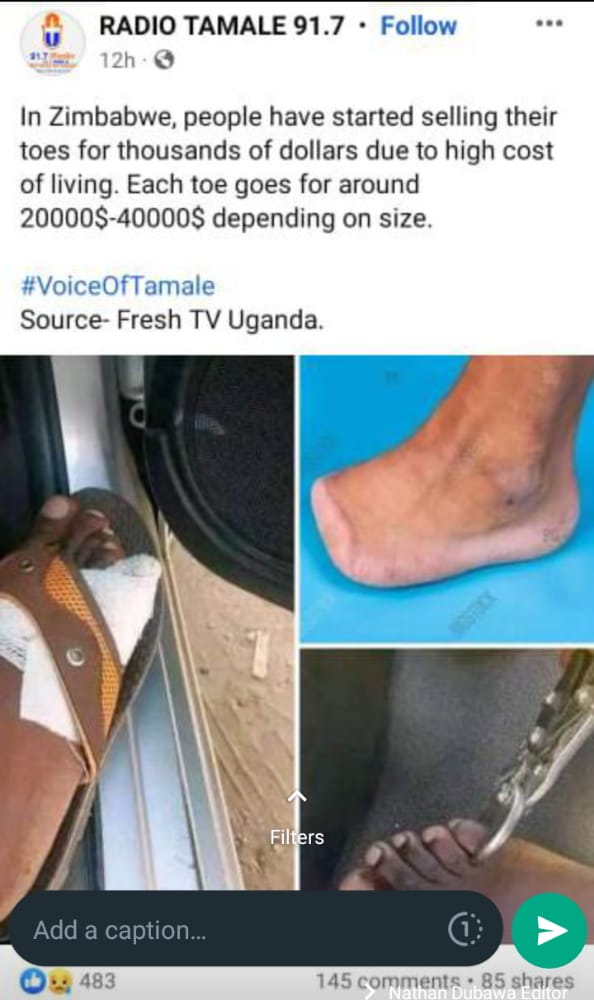
One of the most recent is a post from Radio Tamale 91.7, a radio station in Tamale in the Northern Region shared on its Facebook page. The post has received over 800 likes and has been shared over 200 times.
Source: Facebook
“In Zimbabwe, people have started selling their toes for thousands of dollars due to high cost of living. Each toe goes for around $20000-$40000 depending on size,” the post reads.
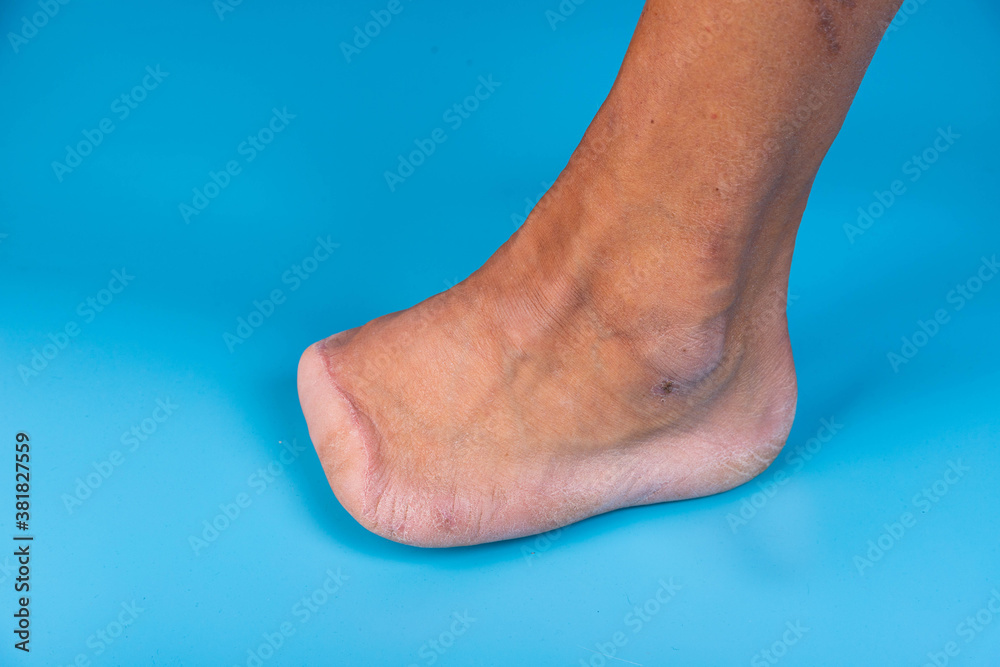
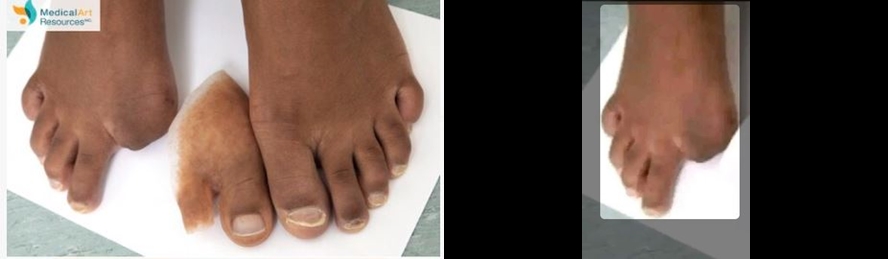
Original Image (as seen on here) Edited Image (as seen here)
A Zimbabwean government official has debunked the claim. In a report published on June 2, 2022, by The Herald, which describes itself as one of Zimbabwe’s leading newspapers, the Zimbabwean Deputy Information Minister Kindness Paradza, is quoted to have labelled the claim as false.
“As Government we did research on this issue and we realised it is false. These are social media reports aimed at tarnishing the image of the country,” said Deputy Minister is quoted to have said.
The newspaper further reported on June 7 that a cellphone dealer at Ximex Mall in Harare, David Kaseke, has been charged with criminal nuisance for making the viral claim and is expected to appear in court.
Conclusion
There is no evidence that Zimbabweans are selling their digits.
Claim: A Facebook user claims the Ghanian government has introduced uniforms for its school teachers.
The claim that the government of Ghana has introduced uniforms for its school teachers is false. The Public Relations Officer for the Ghana Ministry of Education and the Spokesperson, Ghana Ministry of Education, both confirmed that the information is false.
Full Text
For reasons such as equality, safety and sense of belonging, the concept of school uniform among primary and secondary schools in Africa has come to stay. Uniforms are the clothing students are required to wear at school. Schools often have specific styles and colours, “to identify students as attending a particular institution.”
Unlike students, school teachers in Africa are, however, rarely seen wearing school uniforms. Rather, they adopt corporate dresses as their dress code.
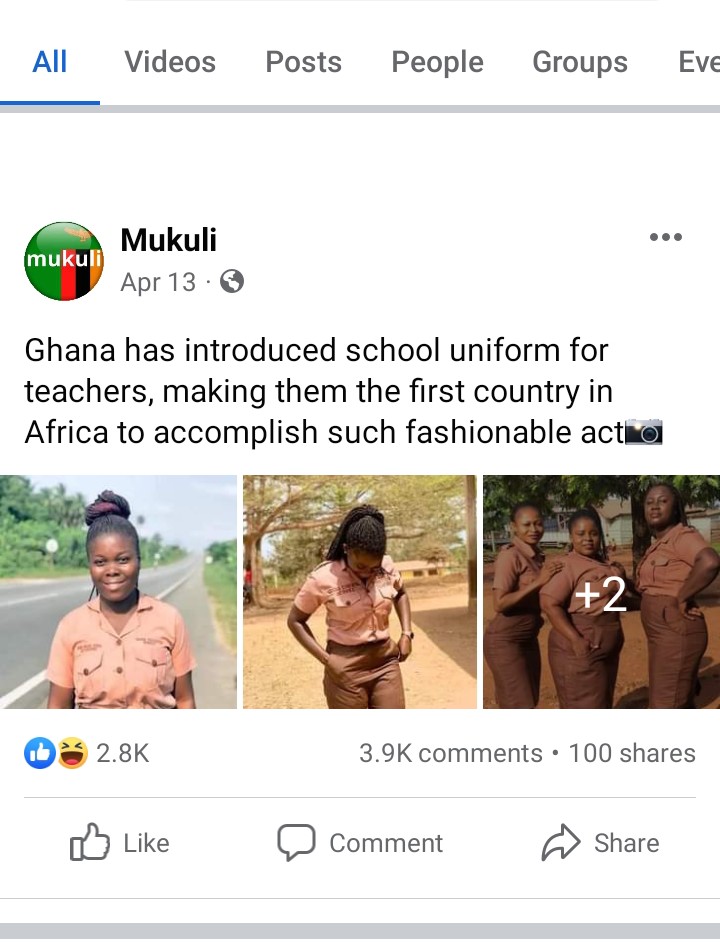
This claim surprisingly indicates that the Ghana government has implemented the wearing of school uniforms by teachers. The post was shared by this Facebook user. The post, accompanied by the post are pictures of some women and a man kitted in dull peach-coloured shirts and deep brown skirts and trousers, went viral and even resurfaced on Twitter. The chest pocket of the shirts reads ‘Ghana Education Service.’
The post, which has been widely shared and retweeted, has also caused controversial debates among users who saw the uniform as “unacceptable” and those who regarded it as ‘a welcomed development.’
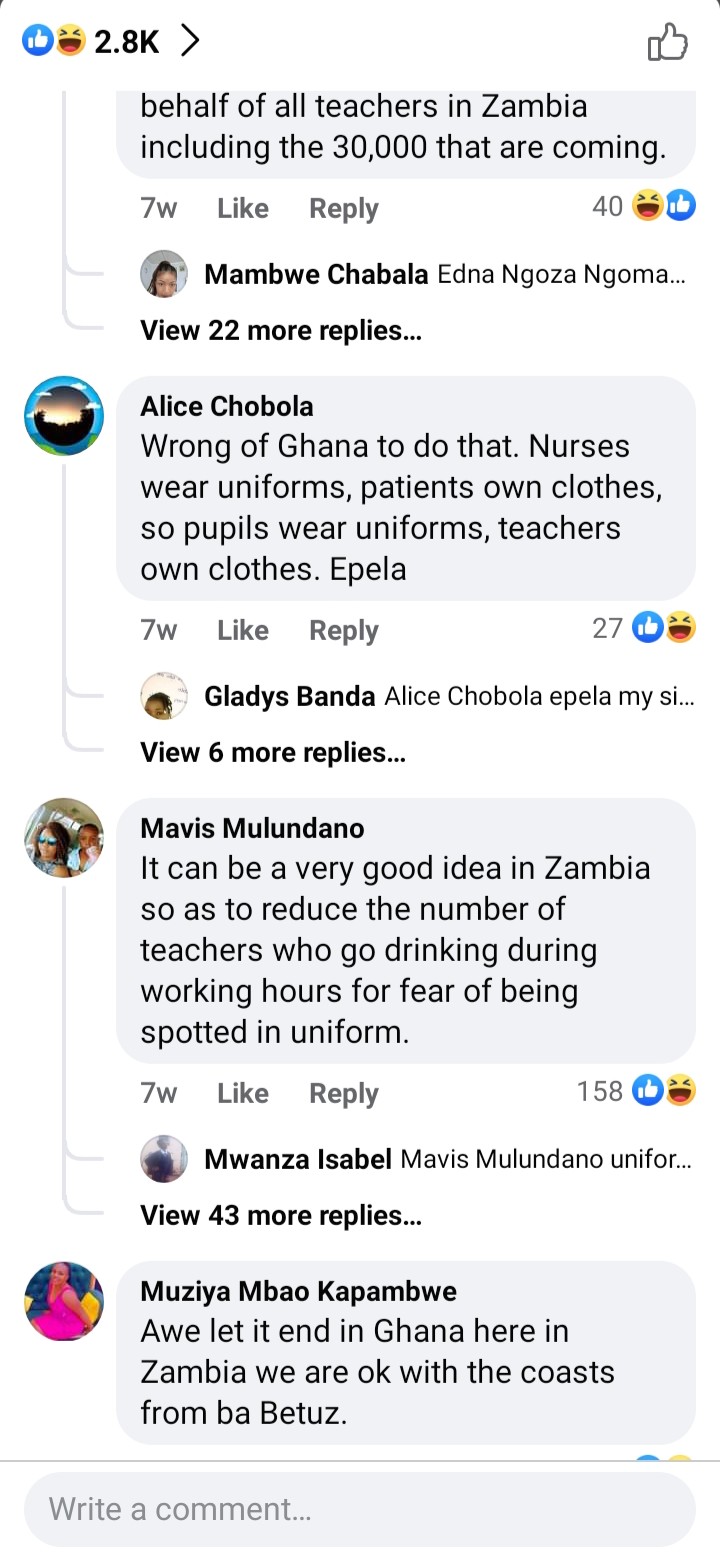
Reacting to the claim, Alice Chobola, a Facebook user, condemned the government’s act, saying it was not right for teachers to wear uniforms.
She wrote: “Wrong of Ghana to do that. Nurses wear uniforms, patients own clothes, so pupils wear uniforms, teachers own clothes, Epela.”
However, unlike Alice, Mavis Mulundano said introducing school uniforms to teachers will curb secret activities performed by them during school hours.
She wrote, “It can be a very good idea in Zambia so as to reduce the number of teachers who go drinking during working hours for fear of being spotted in uniform.”
One of the Facebook posts with over 2k likes, over 3k comments and 100 sharesA fragment of the many comments
It is due to this virality that DUBAWA decided to conduct a fact check.
Verification
DUBAWA first conducted a Google keyword search and discovered that the claim has also been published by this blog, this blog, and this blog. However, it was not reported by any credible news platform.
DUBAWA then contacted Cassandra Twum, the Public Relations Officer for Ghana Education Service. Bluntly but clearly, she discredited the claim, saying:
“Oh but this is an old fake story. Disregard! not true.”
Furthermore, DUBAWA also spoke with Kwasi Kwarteng, the Spokesperson of Ghana Ministry of Education who also debunked the news, saying in a WhatsApp chat:
“The Ghana Education Service has not approved of any uniform/attire for its teachers.”
Conclusion
The Public Relations Officer for Ghana Ministry of Education and the Spokesperson, Ghana Ministry of Education, have debunked the news. The circulating claim that the Ghana government asked its teachers to wear uniforms to work is, therefore, false.
Claim: A news artwork by Atinka FM claims to show the image of the British High Commissioner to Ghana, Harriet Thompson.
The photo used on the artwork is not the British High Commissioner to Ghana, Harriet Thompson, but that of the British High Commissioner to Canada, Susannah Goshko.
Full Text
On Tuesday, May 31, 2022, many Ghanaian news portals including Citi Newsroom and Myjoyonline published stories about a letter written by the Inspector General of Police, Dr George Akuffo Dampare, to the British High Commissioner of Ghana, Harriet Thompson, in which the former criticized the diplomat for commenting (in a tweet) about the recent arrest of Ghanaian activist Oliver Barker-Vormawor.
The story dominated headlines for the day as many stories were published in reaction to the IGP’s letter such as this and this.
However, the publications, including various artworks that came with them and were shared widely, especially via WhatsApp had different photos depicting the British High Commissioner to Ghana.
Publications like those made by Multimedia Group’s Joy FM, UTV News, and Atinka FM on their respective platforms came under the radar after radio presenter and entertainment pundit, George Quaye, mentioned it in a Facebook post and asked for clarity.
Verification
We collected the three photos that have been used by the news organizations for their artworks and ran a series of reverse image searches on each of them.
Photo 1 from Joy FMPhoto 2 from UTV NewsPhoto 3 from Atinka FM
Photo 1 after being subjected to a reverse image search identifies the lady as Harriet Thompson, the British High Commissioner to Ghana. The exact photo also appears on the UK government’s website as the High Commissioner to Ghana serving effectively since August 2021.
In photo 2, the results revealed the identity of the lady in the photo to be the British High Commissioner to Ghana, Harriet Thompson. This is also confirmed by a Twitter post by musician Okyeame Kwame in which he is pictured with the diplomat in the same attire.
Photo 3 is of Susannah Goshko, British high commissioner to Canada according to the Google reverse image search. A news publication by CTV News in Canada confirmed her to be the British High Commissioner to Canada and not Ghana.
Conclusion
The photo used by Atinka FM to represent the British High Commissioner to Ghana, Harriet Thompson, is false as it is photo of the High Commissioner to Canada.
On Wednesday, December 15, 2021, a Twitter campaign under the hashtag #JusticeForAlbert trended in Ghana.
The campaign demanded ‘justice’ for a young man who reportedly died two days after taking a COVID-19 vaccine. The push appeared to be a genuine call by friends and sympathisers of the deceased, Albert Owusu. However, there is more to it.
Part of the directive required state security officials and commercial drivers to be fully vaccinated, while citizens were mandated to show proof of vaccination before accessing stadiums and beaches.
The objection to vaccination was accelerated following the death of one, Albert Owusu. The deceased reportedly passed away barely 48 hours after being vaccinated.
Top keywords (Source: ILab, Code4Africa)
Did Albert Owusu die from taking a COVID-19 vaccine?
Close family members disclosed that Owusu, a 20-year-old student at the University of Ghana, had returned home from school about three weeks earlier with mild sickness but died about two weeks later after taking the vaccine.
An uncle of the deceased, identified as Yaw Sarpong, said that doctors believe his nephew had contracted COVID-19 when he took the vaccine. He took ill later and died.
“He returned from the University of Ghana, Legon, on Saturday. He went to get the vaccine and began feeling feverish. His mother was praying in the house from around 2 pm to about 2 am. It was during the prayers that they realized he had passed out and died so the mother said she was of the view that he died from taking the vaccine. Three doctors at the Central Hospital said the boy had been infected with the COVID-19 before returning home. I can’t tell if he had any underlying condition because when he left for school he was fine,” he said.
The Eastern Regional Health Director, Dr Winfred Ofosu, also stated in an interview on December 22, 2021, that he was unaware of any such incident.
The development was followed by a spike in what appeared to be a network of Twitter users engaged in inauthentic coordinated behaviour to influence public opinion about Ghana’s COVID-19 vaccination programme. This was from hashtag #JusticeForAlbert.
Top hashtags for review period (Source: ILab, Code4Africa)
The network posted several thousand tweets to bastardise COVID-19 vaccines while calling the public to shun the jabs. Additionally, there were calls to attack key officials and government agencies over the planned vaccination programme.
Anti-vaccine conspiracy theories (up, down) already in circulation before hashtag (Source: Twitter)
By the time the hashtag gained popularity, Ghana had vaccinated 6,609,366, representing 22% of its population. Common vaccines were provided by AstraZeneca, Johnson and Johnson, Pfizer, Moderna, and Sputnik V vaccines.
Analysing the network
The investigation was mainly on Twitter, where amplification and coordination were detected. On Facebook and Instagram, we noticed an amplification of the hashtag but no evidence of coordination.
A thorough analysis of the trend pattern suggested a coordinated action hinged on different online content and a 26-second video uploaded by Twitter user @jashuawonder, who described himself as a friend of Owusu.
At the time of filing this report, the video had been shared more than 2,500 times and received over 178,000 views. For this investigation, over 3,000 tweets (including retweets) made between December 15, 2021, and December 18, 2021, related to the hashtag were downloaded into a spreadsheet and analysed. Retweets constituted 84% of all the data around the hashtag.
Key metrics for hashtag for review period (Source: ILab, Code4Africa )
“You may not artificially amplify or hinder conversations by using multiple accounts or coordinating with others,” the policy spells out.
Who are those behind the hashtag?
The first tweet using the hashtag was made by @jashuawonder who blamed the vaccine for cutting short Owusu’s life.
First tweet with the hashtag (Source: ILab, Code4Africa)
It was subsequently tweeted and retweeted from what appeared to be from other parts of the world.
Top locations (Source: ILab)
A sentiment analysis of the hashtag showed that several Twitter users innocently used the hashtag, while most others appeared to be part of a coordinated operation discrediting COVID-19 vaccines.
Sentiment around the hashtag was largely negative (Source: CfA/Meltwater)
Our analysis revealed that some of the accounts central to the hashtag’s amplification had bot-like behaviour, which is very common in most Twitter disinformation campaigns.
Accounts with bot-like tendencies typically tend to be active all day, have long dormancy periods but are suddenly involved in a coordinated campaign and are newly created with an incommensurately high number of tweets, and support a specific hashtag.
Dozens of other accounts with the same characteristics were discovered, most of which were created in December 2021, just a few days before the hashtag trended.
A visualisation of the network of tweets around the hashtag showed that those involved in the coordinated inauthentic behaviour mentioned President Akufo-Addo, often criticising him and the government for the vaccination plan.
Screengrab showing diffusion network of the #JusticeForAlbert campaign on Twitter with bot-like accounts (in red) involved in the coordinated operation. (Source: Hoaxy)Screengrab showing amplification network of #JusticeForAlbert campaign on Twitter. (Source: CfA/Meltwater – Gephi)
‘The influencers’
An analysis of the downloaded data in Microsoft Excel revealed that while some accounts posted the hashtag sparingly, their huge online following and influence helped to amplify the campaign.
@Efiaodo1, with over 508,000 followers and a record of a stance against the government’s planned ‘mandatory’ vaccination programme tweeted the #JusticeForAlbert hashtag once but was mentioned by several Twitter accounts involved in the coordinated inauthentic behaviour.
@Sammy Gyamfi, (150,000 followers) the National Communications Officer of the National Democratic Congress (NDC) never used the hashtag but was mentioned and referenced many times by the top influencers involved in the campaign.
Most retweeted (source: ILab)
Another visualisation of the network does not depict any distinct clusters or strange behaviour; however, it highlights some of the influential accounts involved in the CIB; tweeting and retweeting to amplify the hashtag in a coordinated manner. These influential accounts, that tweeted, retweeted and or had their tweets retweeted by many people are captured in the graphs below:
The accounts had their tweets retweeted by others the most.
Screengrab showing the most retweeted accounts (Source: CfA/Python)
The accounts below retweeted others’ tweets the most.
Screengrab showing the most retweeters accounts (Source: CfA/Python)
A total of 23 Twitter accounts were identified to be leading voices on the #JusticeForAlbert campaign. Each of these accounts has been analysed, and details presented in the table below indicate when they were created, the percentage of the chance of being a bot account, their most popularly used hashtag since creation, and other unique traits of their Twitter behaviour.
The accounts involved in the operation retweeted each other’s tweets about COVID-19 and vaccines.
Follower of Pastor Chris Oyakhilome and LoveWorld Incorporated. Anti-vax stance. Previous involvement in an anti-COVID, anti-vaccine campaign targeted at Nigeria and UK.
The hashtag dominantly used by the influencers identified appears to show that they were closely coordinating to sway public conversation on the COVID-19 and vaccines inorganically.
Politics?
This investigation could not prove that the coordinated behaviour was politically motivated; however, many of the accounts involved in the campaign often cited the national communications officer of the opposition National Democratic Congress (NDC), Sammy Gyamfi, who had made public statements denouncing the government’s vaccination plan. The accounts applauded him for the “good fight.”
‘Nigeria in Ghana’
An analysis of tweets of some of the influential accounts and the source of the viral video that gave the campaign momentum on Wednesday, December 15, 2021, shows that they had previously participated in similar anti-vaccination campaigns, mainly in Nigeria.
As the analysis shows for Ghana, these accounts identified an influential figure’s anti-vaccination stance and made several tweets to amplify their campaign and mentioned government agencies and officials implementing COVID-19 vaccination programmes in vile tweets.
@jashuawonder, for instance, prior to a 12-month break on Twitter in 2020, consistently shared images of Christopher Oyakhilome and some of his anti-vaccine comments.
@AyewaMensah also, between April and May 2020, engaged actively and frequently on COVID-19 issues relating to Nigeria on Twitter. He often mentioned/responded to (former) anti-vaxxer and influential politician, Femi-Fani Kayode.
@AyewaMensah again was one of those who actively shared and engaged with Pastor Christopher Oyakhilome’s solidarity hashtag, #iStandWithPastorChris.
Ayewa Mensah’s previous tweets involved in an anti-vax/anti-covid campaign in the past
Rallying around Pastor Chris
Internal or external parties often sponsor coordinated inauthentic behaviour. There was no concrete evidence that this operation was financially sponsored. However, the evidence points to an ideological drive focused on religion and of church members rallying around Pastor Christopher Oyakhilome and his LoveWorld Incorporated.
Among others, the tweets in the campaign claimed that the pandemic is a hoax and that vaccines are generally dangerous and have been covered up by governments.
Twitter’s policy on coordinated harmful behaviours defines informational harm as one that “adversely impacts the ability for an individual to access information fundamental to exercising their rights, or that significantly disrupts the stability and/or safety of a social group or society including medical misinformation i.e. COVID-19” and takes actions against accounts engaged in such actions.
Again, evidence in the campaign points to deception in bios on some accounts including the use of different locations from Nigeria to Ghana to amplify the campaign.
“You can’t use a fake identity to disrupt the experience of others on Twitter. Using fake accounts in conjunction with other behaviors that violate the Twitter Rules will result in stricter enforcement actions. This includes operating fake accounts to engage in spam, interfere in civic processes, carry out financial scams, artificially inflate engagement, or abuse and harass others…. [including] Intentionally misleading profile information, such as profile location,” Twitter’s policy states.
The #JusticeForAlbert campaign in Ghana ended before January 1, 2022; however, this report may be updated when new information about this operation emerges.
Whilst speaking about his anti-LGBT+ advocacy, Sam George argued that the subject of homosexuality has not “even been settled” in America and in Europe and wondered why anyone should shove it under the throats of Africans and Ghanaians in particular.
He went on to make some claims about the LGBT+ activities in US and Europe and the laws in those places that regulate such activities. Some of these claims have been brought to the attention of DUBAWA to be fact-checked.
The full interview was streamed on Facebook and the claim can be found in minutes 26:53 – 27:50
Claim 1: “There are 50 States in America. Only 23 have laws that promote LGBT. [The remaining] 27 have laws that criminalize or fight or restrict the rights of this practice of homosexuality.”
The US Supreme Court which is the highest court of the land in 2003 legalized activities of homosexuals. The ruling is binding on all 50 states.
In June 2015, the Supreme Court ruled that same-sex marriage is legal across the US. If the court acknowledges marriage between same-sex couples, obviously, it only implies that homosexual activities are deemed legal in America.
Unless there are particular metrics that are being looked at, such as Conversion Therapy and Discrimination, it will be difficult to be specific as to the number of states that promote LGBT+ activities, considering that the practice and the acceptance of gay marriage are legal across the US.
South Dakota Governor has also signed an anti-transgender sports bill into law, thus restricting transgender women and girls from playing on school sports teams that match their gender identity in public schools and post-secondary institutions.
Those are some seven states in the U.S. that have recently passed laws that limit the rights of LGBT.
Claim 3: “When you go to Europe, only 17 have legislation that supports LGBT.”
Completely False! Data show that 29 of the countries in Europe have legislations that support either gay marriages or some form of same sex unions and the remaining 22 countries have legislations that support LGBTQ activities even though they do not support same sex marriages.
The European Union considers equal treatment as a fundamental right. In view of that, it has taken several measures to combat discrimination on the basis of sexual orientation and gender identity.
According to the EU, “since 1999 it has had the power to act in cases of discrimination based on sexual orientation and has since adopted legislation and taken measures to extend legal and social protection for LGBT people.”
For instance, even though homosexuality is legal in Turkey, the country does not recognize same-sex marriages, LGBT+ and persons cannot serve in the military, among other limitations.
The data suggests that a further 11 allows for some form of same-sex unions/civil partnerships but not marriage.
However, in some 22 others, same-sex union of any kind is not legal, according to the Research Centre. Even though these 22 countries do not support same-sex unions, all of them including the Vatican City do have legislations that support LGBTQ activities. For instance in Albania, gay activities are legal except for gay marriage. In Bulgaria too, LGBTQ activities are legal. The same thing goes for Russia and Serbia,
Conclusion
Sam George’s claim that 23 states in the US have laws that promote LGBT whereas 27 states do not is misleading as each of the 50 States has at least a rule that limits or restricts the rights of homosexuals – Blood donations by Men Sleeping with Men (MSMs).
Again, it is not true that homosexuality is illegal or has been criminalized in some parts of the US.
Also, his claim that only 17 countries in Europe have legislations that support LGBT activities is also false.
However, the MP’s claim that some six states in the US have recently passed laws that limit the freedoms of LGBT persons is true.
Claim: Multiple claims on social media suggest the Achimota Forest Reserve has been sold
The Forest Reserve remains intact. It is the peripheral lands around the reserve that have been released to allordial owners of the land, which is the Owoo Family.
Given the controversy the issue has generated, DUBAWA set out to investigate and provide an understanding of the whole issue.
Owoo family and the 361 acres of land
In 1921, the Government of the then Gold Coast, by a Certificate of Title dated 16th December 1921, made under the Public Lands Ordinance, 1876, acquired from the Owoo Family the parcel of land on which the Achimota Senior High School is situated.
Subsequently, by another Certificate of Title dated 17th May, 1927, the Government acquired from the same family another tract of land measuring approximately four hundred and seventy-nine (479) hectares as an extension to the Achimota Senior High School.
Even though there are receipts indicating payment of compensation for the 1921 acquisition, there are no records of payment of compensation for the 1927 acquisition.
Fast forward, in 1930, a section of the land was constituted into a Forest Reserve by the government to provide cheap fuelwood for the Achimota school and that’s how the name Achimota Forest Reserve came about.
What happened during President Kufuor’s tenure?
Following several encroachments on the forest reserve, the pre-acquisition owners, the Owoo Family, in 2007, submitted a petition to the then President, John Agyekum Kufuor, for the release of the portion of the Forest Reserve adjoining the Tema motorway since the land was not being used for its intended purpose. After consultations with relevant stakeholders, the government agreed to release the lands to the family. Consequently, there was a 24th November 2008 agreement with the Owoo family for the government to release the lands, but that agreement was not executed until President Kufuor left office.
Whathappened during President Evans Attah Mills tenure?
In 2011, the Owoo Family, submitted another petition to the Minister for Lands and Natural Resources, Mike Hammah during the President Evans Attah Mills era, for the grant of portions of the Forest Reserve as agreed on by the previous government. After the Minister constituted a committee to inquire into the legitimacy of the request and its impact on the Forest Reserve,it concluded that the Owoo family’s request is legitimate. As such, the minister sought executive approval to implement the recommendations of the Committee but that approval was not given due to the death of the former president, John Evans Attah Mills.
Whathappened during President John Mahama’s tenure?
When President Mahama came to power in 2013, he gave the Executive Approval for the conversion of the Forest Reserve into an Ecotourism Park and to also release the peripheral portions of the Forest Reserve to the Owoo Family, in accordance with the recommendations of the Committee set up by the then Minister for Lands and Natural Resources, Mike Hammah.
Pursuant to the approval by President Mahama, the Owoo family then registered the land in its name and granted sub-leases to other private developers. However, because the land was still registered as a Forest Reserve, by virtue of Order 31 of 1930, the developers whom the land had been given to could not work on the land.
Pursuant to the same Executive Approval, the Forestry Commission, acting on behalf of the then President of the Republic, H.E. John Dramani Mahama, entered into an agreement with Aikan Capital, a limited liability company for the development of the core area of the Forest into an Ecotourism Park in August 2016.
Whathappened during President Akufo Addo’s tenure?
This led to the publication of the two instruments, the Forests (Cessation of Forest Reserve) Instrument, 2022 (E.I 144) and the Forests (Achimota Firewood Plantation Forest Reserve) (Amendment) Instrument, 2022 (E.I. 154).
However, as part of measures to ensure that the Forest reserve is not compromised, the government says the Land Use and Spatial Authority shall prepare a Master Plan for the development of the area, taking into consideration the ecological integrity of the remaining portions of the Forest Reserve.
It further indicated that for any development to take place on the lands given to the Owoo family, the Minister for Lands and Natural Resources needs to give an express approval taking into consideration the ecological integrity of the Forest.
The Achimota Forest reserve has not been sold. 361 acres of the land, which according to the government are peripheral lands, has been declassified as a forest reserve and given to its custodians which is the Owoo family.
Team Lead for DUBAWA Ghana, Caroline Anipah, has charged journalists to be key actors in the prevention of the spread of information disorder, popularly known as fake news.
In an era where social media has become a popular source of information, some of which are false, Ms. Anipah said legacy media and by extension, professional journalists, must become torchbearers in the fight against fake news.
She made the statement on Thursday 5 May 2022, when DUBAWA Ghana participated in the US Embassy’s World Press Freedom film show and seminar in partnership with the Ghana Institute of Journalism (GIJ).
The seminar was under the theme “Fake News, Disinformation and Misinformation”.
Ms. Anipah was joined by two other speakers, Bernard Koku Avle, General Manager of Citi FM and Citi TV, Nathaniel Attigah, Principal Lead, Odekro, and Assistant and Project Lead at Ghana Decides for the seminar held at the GIJ, North Dworwulu campus.
Reiterating DUBAWA’s core mandate of fighting information disorder through a rigorous fact-checking process, Ms. Anipah said,
“With social media platforms identified as breeding ground for the spread of fake news, journalists need to be guarded in the use of the media type. Thus, there is a need to build the capacity of journalists in young democracies like Ghana, still trying to keep up with the daily evolution of social media. We believe that if journalists are able to spot fake news, they will tailor their reporting so as to counteract the effects of mis/disinformation.”
DUBAWA Ghana Team Lead, Caroline Anipah, speaking from a trainer’s perspective on fact-checking in Ghana
Bernard Avle shared some of his practical experiences as a practising journalist for twenty years which included the need for journalists to uphold truth in their storytelling and to go beyond Internet searches and get to the field and listen to people for their perspective on matters. He also advised that journalists become knowledgeable in all fields so as to limit what he termed as the ‘tyranny of experts’ by always calling experts on shows.
Quoting a popular dictum for media practitioners, Avle said,
“The journalists’ first obligation is to the truth, journalism is a discipline of verification and the practitioners’ loyalty is first to the public.”
On his part, Nathaniel Attigah also explained how necessary it was for information received online to be verified before sharing given the mischievous and economically-motivated intent of mis and disinformation peddlers. In a documentary aired, he showed how misinformation could negatively impact the outcome of presidential elections and the possibility of creating chaos.
Caroline Anipah, Bernard Avle and Nathaniel Attigah answering questions asked by attendees.
The Information Officer at the US embassy, Kevin Brosnahan, was excited about the interest shown by the students and the resource persons and pledged the Embassy’s commitment towards fighting misinformation.
The seminar was attended by a cross-section of students, faculty members of the Institute as well as some staff from the US Embassy and DUBAWA Ghana.
As a matter of civic duty, Ghanaian Ministers of State, Regional Ministers, and Members of Parliament are invited on a number of talk shows by television and radio broadcast stations and occasionally hold town hall meetings to speak on issues relevant to the state of the ministries, regions, and constituencies they govern – a good opportunity for the public to receive diverse sectoral and regional information on the progress of the country. But fact-checking will let you know that sometimes these experts in their areas of public service do not always have their facts right. Below are, among several others, five times some Ministers and Members of Parliament were caught five times with citing inaccurate figures and stating false positions on matters concerning the ministries, regions, constituencies, and country they have oversight of.
When the Minister for Food and Agriculture mentioned Ghana to be the only West African country with Fertiliser Subsidy for Farmers
The Minister, Dr. Owusu Afriyie Akoto, said this on the Kokrokoo Morning Show on Peace FM when the host, Kwame Sefa Kayi, questioned him on the reasons fertiliser was being smuggled out of the country and measures taken by the ministry to end fertiliser smuggling. Read about it here.
When Member of Parliament for North Tongu asserted that Ghana recorded the highest Budget Deficit in the World due to COVID-19 expenditure
The MP, Samuel Okudzetu Ablakwa, speaking on Joy News’ socio-political news analysis show, News File, made the assertion when he queried why Ghana’s Parliament could not set up a special bipartisan committee responsible for investigating Ghana’s COVID-19 budget deficit which according to him, was running into billions. What was Ghana’s actual ranking? All the facts are here.
When the Western Regional Minister claimed that the Income of an average poor person In Ghana was GHS 70
Kwabena Okyere Darko-Mensah, made a claim at a government town hall meeting in Sekondi-Takoradi in the Western Region, to support his narrative and education to the community on the proposed electronic transaction levy (e-levy) and the need for his regional members to accept the implementation. Read more on the accurate income of an average poor person in Ghana here.
When Member of Parliament for Builsa South stated poor working conditions as reason for 44,000 Basic School Teachers leaving the profession in 2021
The MP, Dr. Clement Apaak, who is also a deputy ranking member on the Education Committee of Parliament, granted some interviews to 3 FM and other media stations (also published on his Facebook page) where he stated that poor remuneration and lack of logistics constitute the reasons for the basic school teacher attrition rate in 2021. On the contrary, technical factors resulting from the compilation of the data were found to be the main reason. The explanation for the 2021 basic school teacher attrition rate can be found here.
When the Minister for Communications and Digitization claimed that the UK’s Digital Services Tax is about 10%
In another government town hall meeting held in Koforidua in the Eastern Region to educate the public on the government’s proposed e-levy, Ursula Owusu-Ekuful, the Communications and Digitization Minister, in her quest to urge the people to support its implementation, claimed that the government’s e-levy rate of 1.75% was relatively low compared to the UK with a tax rate for Digital Services of about 10%. Find the facts on the UK’s tax rate for Digital Services here.
We hope you find our newsletter informative. For feedback, suggestions, and claims you want to be fact-checked, feel free to contact us:
Claim: General Secretary of the New Patriotic Party, John Boadu, has said that countries that recorded positive economic growth in the heat of the 2020 pandemic were less than 30.
DUBAWA has analyzed data from the IMF and the World Bank and has found more than 30 countries that recorded positive economic growth in 2020.
Full Text
The General Secretary of the New Patriotic Party, John Boadu, has claimed that less than 30 countries including Ghana, were able to record positive economic growth in 2020.
He made the claim in an interview on Accra-based Peace 104.3 FM.
The leading New Patriotic Party member made the statement to emphasize what he said is the current government’s efficient management of the economy in the midst of the pandemic.
“Globally, just under 30 countries were able to produce positive [economic] growth. Just under 30 countries and Ghana is part of them,” John Boadu claimed.
His claim can be found between minutes 2:23 to 2:40 of a video uploaded on the Despite Media channel on YouTube.
The video, uploaded on April 21, has since attracted over 500 views.
Verification
Economic growth is defined as the increase in the market value of goods and services produced by an economy over time. It is usually measured as a percentage rate of increase in the real gross domestic product (GDP).
The most comprehensive measure of overall economic performance is gross domestic product or GDP, which measures the “output” or total market value of goods and services produced in the domestic economy during a particular time period.
Evidently, the data from the sources do not validate John Boadu’s claim that less than 30 countries recorded positive economic growth in 2020.
Conclusion
John Boadu’s claim that less than 30 countries recorded positive economic growth in 2020 is false as data from the World Bank and the IMF indicate otherwise.
Personnel from the Police Criminal Investigative Department (CID) attached to Ghana’s Food and Drugs Authority (FDA) have confiscated on Thursday two laptops and two desktop computers belonging to managers of Imperial Logistics, owners of Fareast Mercantile.
The confiscation is part of an inquiry into DUBAWA’s “Consuming Trash” investigation in which managers of Fareast Mercantile, together with their ‘clients’ at Accra Central Business District, are suspected to be selling expired products to consumers.
The confiscation of the machines is also to preserve and protect the sanctity of potential evidence that may be on the computers. With a court order, the police and the FDA can access information on those machines to facilitate investigation into what could potentially be one of the biggest expired food saga with its attendant public health crisis.
The owners of the machines, including Sharab Sharma, Logistics and Supply Chain Manager, Michael Bassaw, Warehouse Supervisor, have also been invited to the FDA to assist with investigations.
Background
Months of investigations by DUBAWA have uncovered what appears to be a deliberate company strategy to sell expired products to unsuspecting consumers.
Intercepted email conversations, part of which have already been published by DUBAWA, show top managers of the company including the Acting General Manager, Sales (Food), Rayul Kashyap; head of Finance at Fareast Mercantile, Aney Mate; the Logistics and Supply Chain Manager, Saurabh Sharma; and Manager for Sales (Non-food), Raja Mohammed, have been fixing prices and ordering the sale of damaged and expired products, consumables and non consumables, that ought to have been trashed under strict Food and Drugs Authority guidelines.
Before his arrest though, he had successfully purchased truckloads of expired non-consumables including assorted types of Dettol, Njoi soap, Jennifer’s floral anti-bacterial wipes, Enchanteur perfumed HBL, Airwick, Mortein fly and mosquito killer insecticide, on March 17, 2022 and December 17, 2021, all of which DUBAWA tracked by mail and with supporting video and pictorial evidence.
In a casual conversation at the police CID, which DUBAWA has on record, Sarpong admitted selling three months old expired products and has been engaging in the business for eight years.
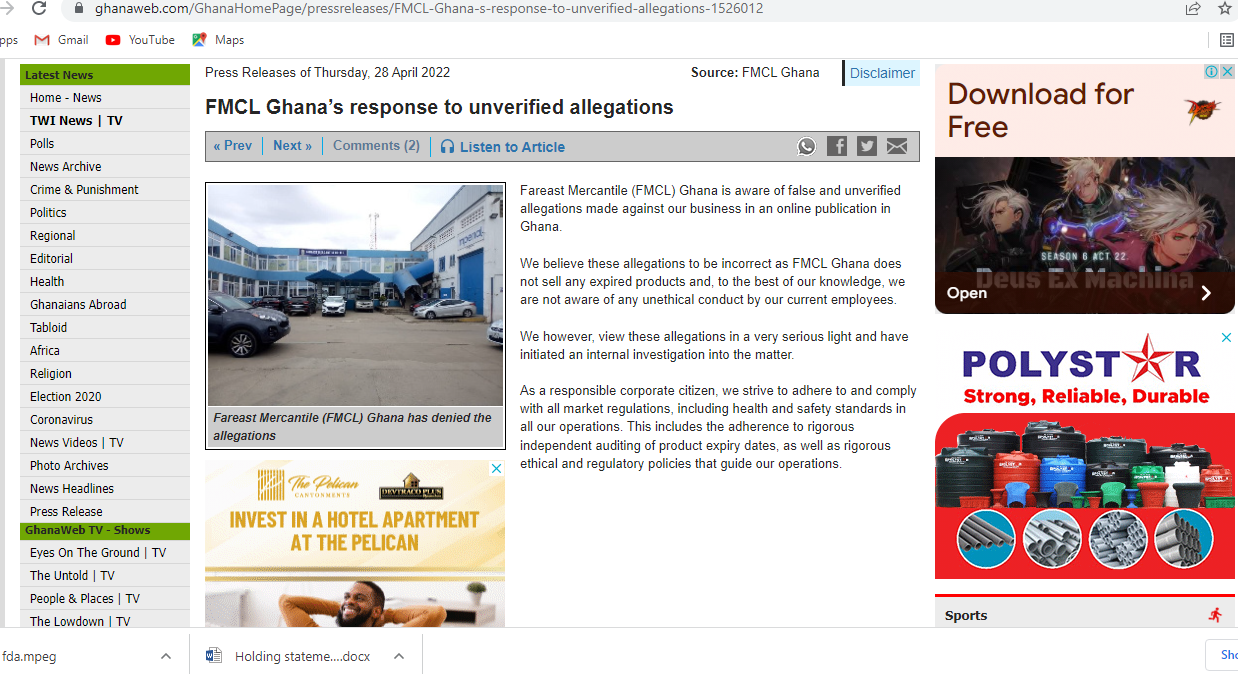
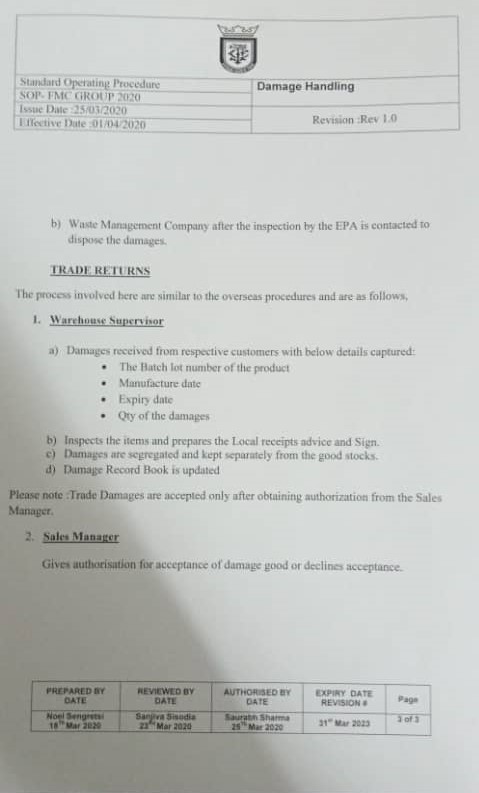
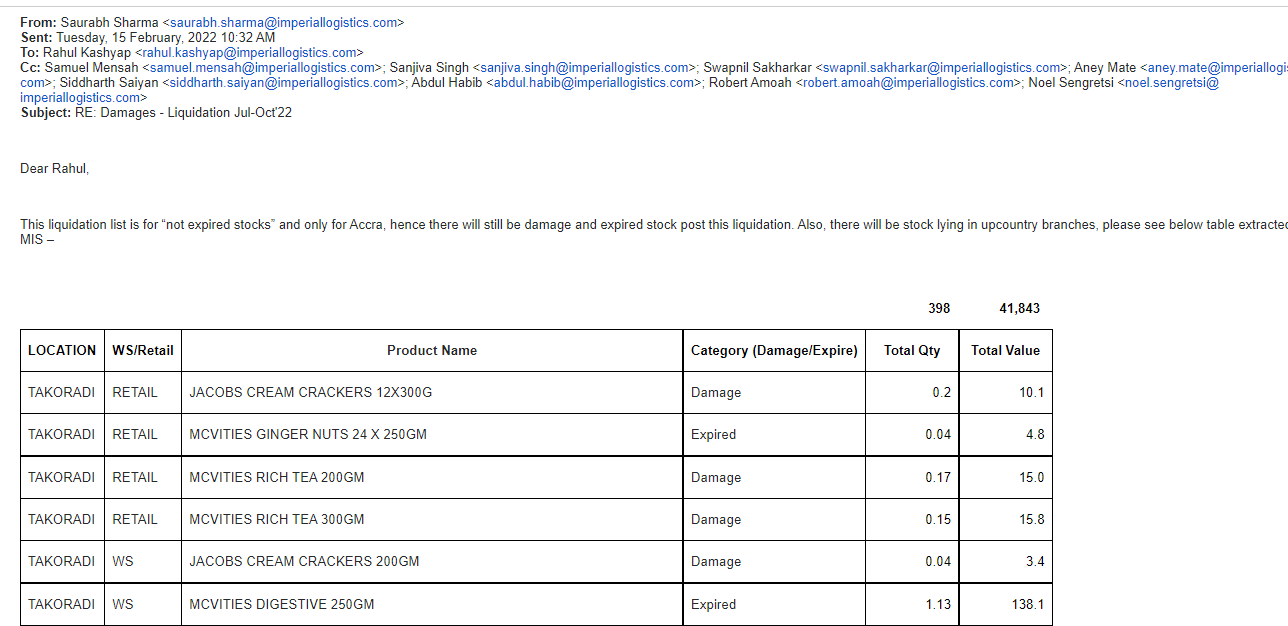
As promised to share in Part One of this investigation, DUBAWA has in its custody a March 2022 email conversation with the subject “Damages-Liquidation Jul-Oct 2022” and what top management members of the company did with those damaged products. DUBAWA also has in its possession portions of Fareast Mercantile’s own Standard Operating Procedures (SOP) issued on March 25, 2020 with effective date being 01/04/2020. The SOP specifies what should be done with damaged products. For the avoidance of doubt, the SOP states that damaged products, like expired products, must be QUARANTINED, and destroyed after alerting the appropriate statutory authorities.
Again, there is also a globally acceptable warehousing principle which frowns on the sale and distribution of products that will expire within six months.
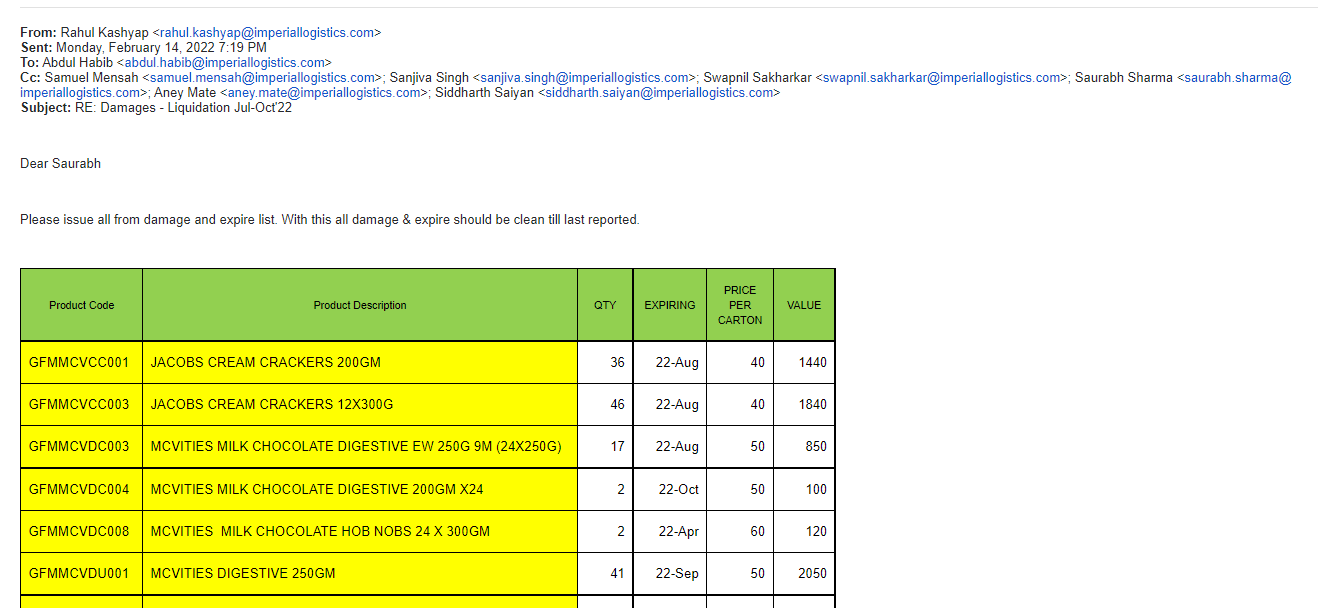
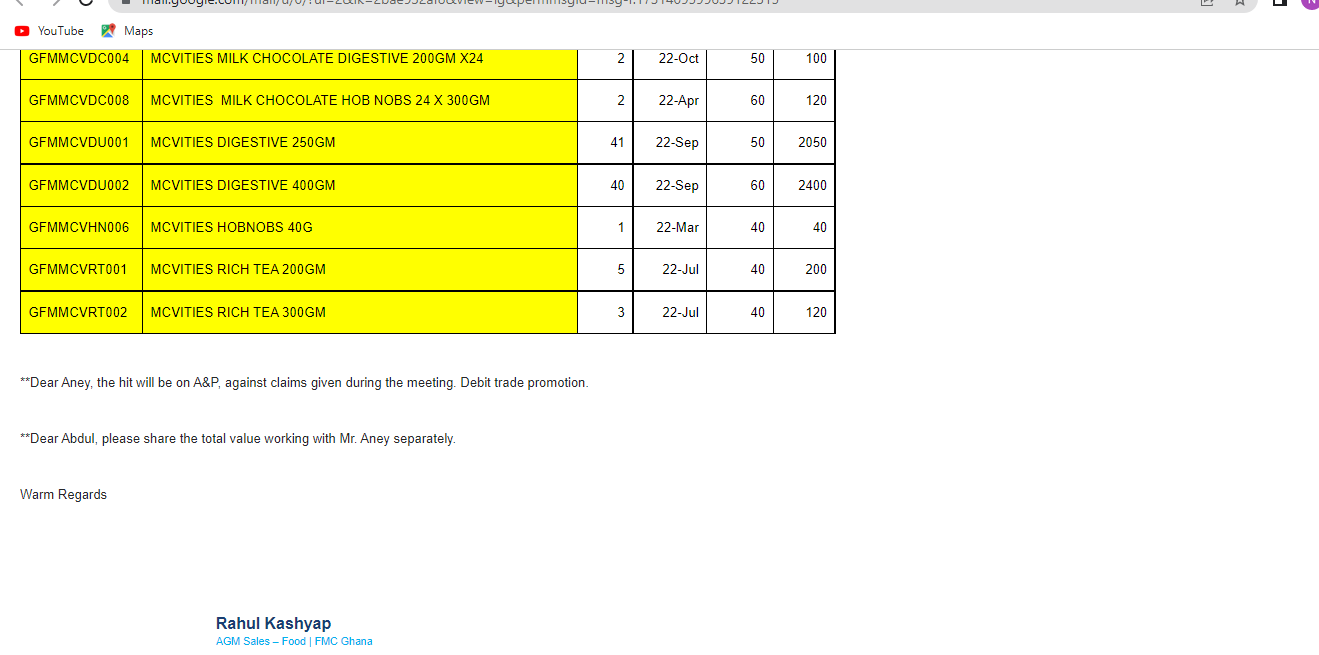
Despite the impressive Fareast SOP on paper, our investigation reveals the company does not observe what is contained in the document. Additional evidence shows that on February 14, 2022, Kashyap, instructed Saurabh to issue some ‘damage and expired list.’
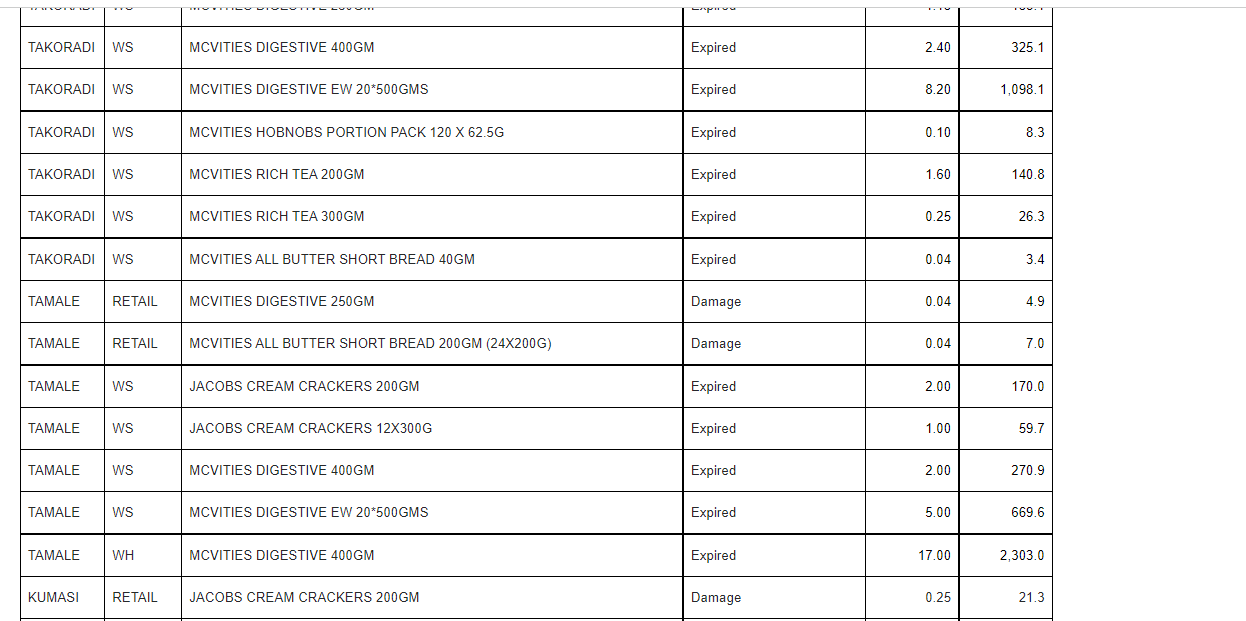
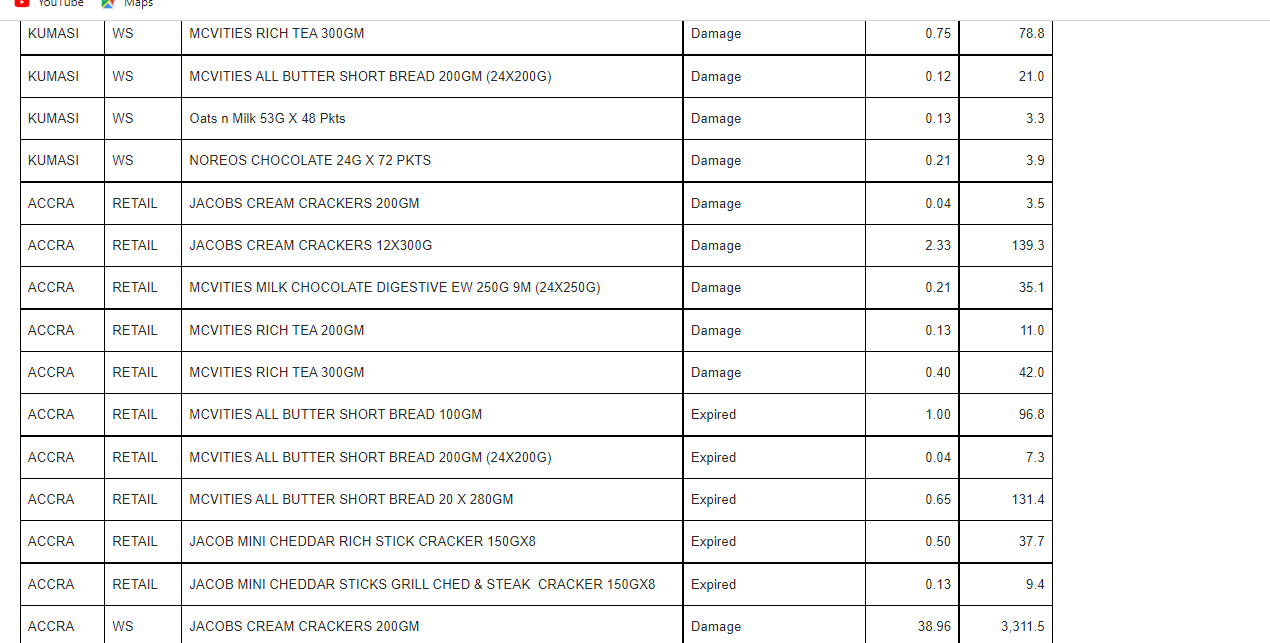
The following day, Saurabh responded with a tall list of damaged and expired goods in all four Fareast warehouses across the regions of Ghana which he said would be “liquidated.”
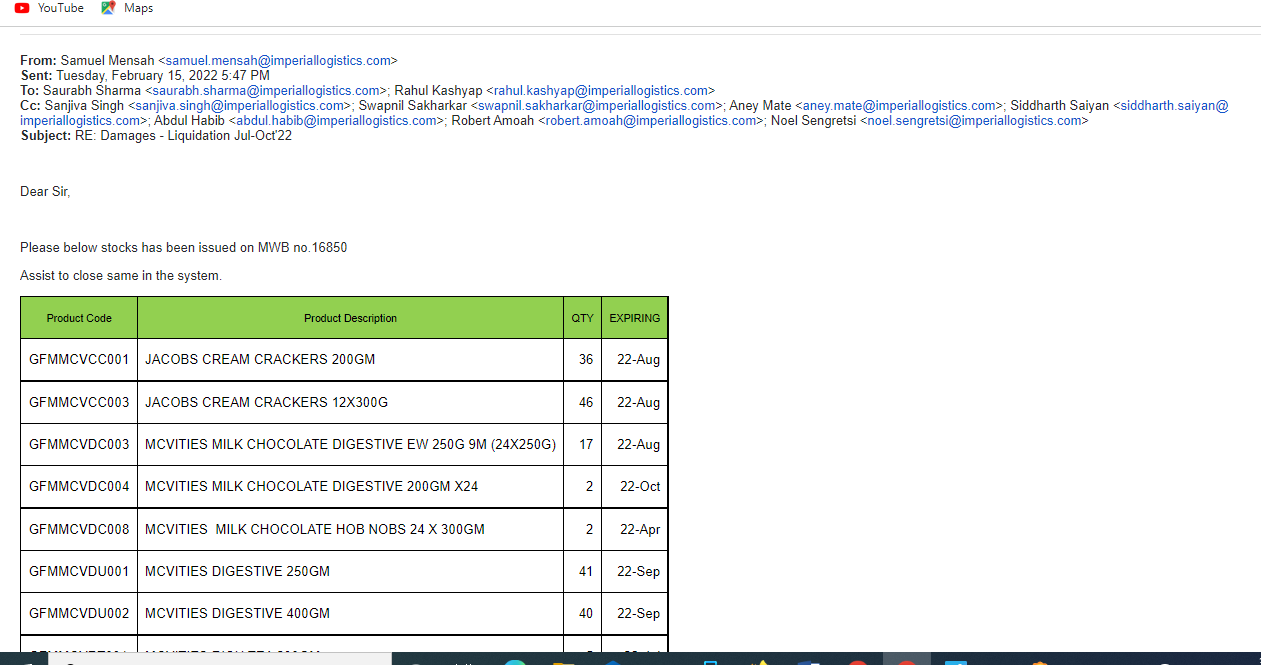
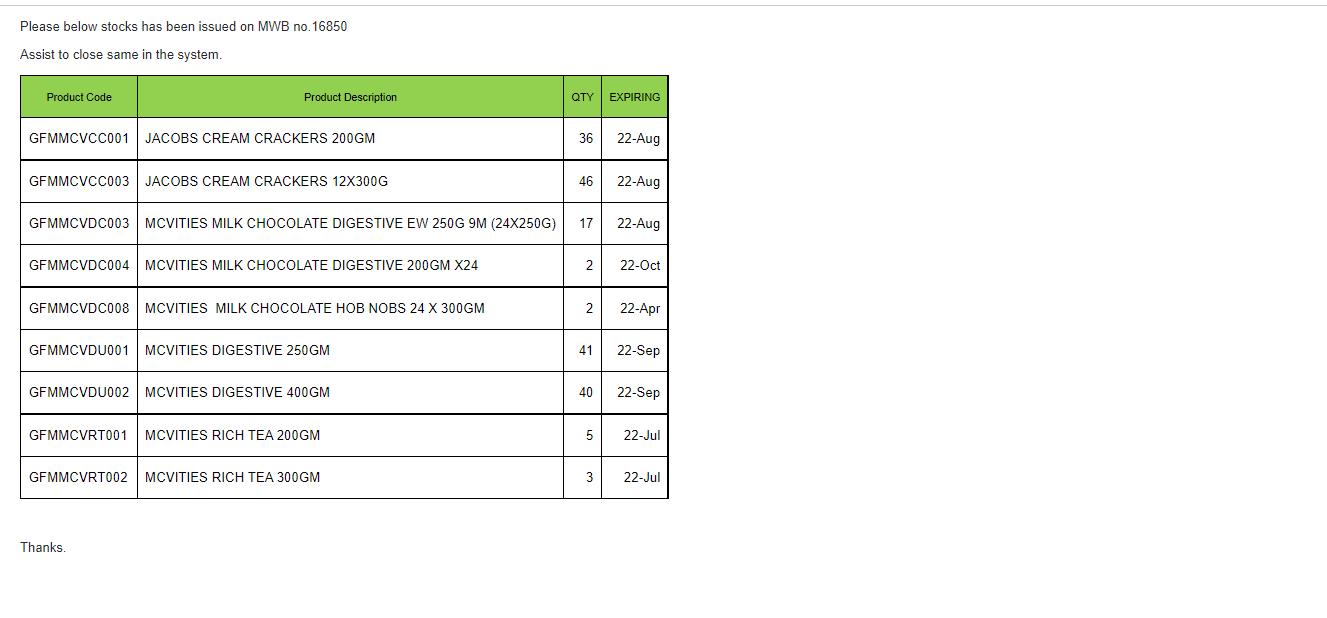
After the long list of damaged and expired goods that should be “liquidated,” Samuel Mensah gave an idea what it means to liquidate damaged and expired goods in his February 15 mail sent to Shaurabh. In that mail, a picture of which is shown below, Mensah said the same stock which Rayuh had described as damaged (a picture of which is shown above in yellow) had been issued on a Manual Way Bill (MWB) No 16850. As we have learnt from part one of this investigation, this MWB is an agent that buys expired goods.
Above is the full list of the products sent by Samuel Mensah all of which have been sold contrary to the company’s own SOP and against the FDA guidelines on dealing with damaged products which would expire within six months.
This evidence and more have all been presented to the FDA for further investigations.
FDA Promise
The FDA in an interview with DUBAWA reiterated its commitment to investigate the matter thoroughly and apply the appropriate sanctions that would protect the interest of consumers.
The Director of Legal and Corporate Affairs at the FDA, Mr Joseph Yaw-Bernie Bennie, stated that an expired product, whether consumable or not, is not fit for purpose and anyone who sells the same, has fallen foul of the law.
“Most products that the FDA regulates might contain chemicals. These chemicals might break down into something else. It is the reason why manufacturers put expiry dates or best before use dates on their products and therefore you cannot guarantee that the health and safety of the consumer can be preserved or not negatively affected by the use of expired products. Whether they are food or not food items, it is expected that once it expires, it should not be used,” he said.
He will not give details of the extent of investigations into the Fareast Mercantile saga, except to say that the FDA by law has the power to prosecute, sanction, fine and withdraw licenses. He insists the FDA will weigh the evidence and provide a commensurate sanction.
He charged Ghanaians to provide information about any wrong doing so that the FDA could timeously act upon the same.
DUBAWA will follow this investigation by the FDA to its logical conclusion in the interest of public health.