Ghana

  • Speaker forces ‘disloyal’  MPs to vacate their seats

    A cloud of uncertainty hangs ominously on the chamber of Parliament after the Speaker of Parliament Alban Bagbin declared four seats of ‘disloyal’ Members of Parliament vacant.

    With two months to the end of the parliamentary cycle, the declaration manifestly alters the sitting positions of Members of Parliament, making the hitherto Minority members, become the Majority.

    But the leader of government business in Parliament Alexander Afenyo Markins is convinced the Speaker’s ruling and declaration on Thursday October 17, is a travesty of justice and cannot stand the test of legal inquest.

    He has filed a suit at the country’s Supreme Court, the highest court of the land in a bid to overturn the Speaker’s ruling

    Background

    The National Democratic Congress (NDC) threatened to  compel  a number of MPs on the majority side to vacate their seats after they announced plans to run as independent candidates in the upcoming 2024 elections.

    The party says it will invoke Article 97(1)(g) of Ghana’s 1992 Constitution, which states: 

    “A member of Parliament shall vacate his seat in Parliament (g) if he leaves the party of which he was a member at the time of his election to Parliament to join another party or seeks to remain in Parliament as an independent member;”

    Haruna Iddrisu, the Member of Parliament for Tamale South, who made the threat, believes this move could shift the current parliamentary dynamics and give the NDC a majority in Parliament.

    “The minority must become the majority for Wednesday next week. I assume this must happen if there is constitutional and legal proprietary law in Ghana.

    “Because any nuanced interpretation of Article 97 provides that if a member of parliament on a political party ticket like NPP defects and files to be independent, that MP ceases to be a member of parliament.”

    On Thursday, the NDC Minority in Parliament brought the issue to the attention of the Speaker for a decision to be made.

    The Speaker obliged, citing the law and precedents and terminating the parliamentary careers of the four MPs, at least for the eighth Parliament of the fourth Republic.

    Alban Bagbin said the decision by the MPs to contest the 2024 elections in December as independent candidates is evidence of disloyalty to their constituents and must vacate their seats.

    The affected MPs are Gender Minister Cynthia Morrison who intends to run independently. The others are the Second Deputy Speaker of Parliament and MP for Fomena, Andrew Asiamah Amoako, Kwadjo Asante of Suhum, and Peter Yaw Kwakye-Ackah, the National Democratic Congress (NDC)’s MP for Amenfi Central.

    Even before a decision will be taken, the matter had already become a subject of interest and conversation

    The Political Context

    The opposition NDC  held  a narrow minority, but the potential disqualification of four MPs running as independents could change this.

    According to Haruna Iddrisu, the Article clearly mandates that MPs who contest elections as independents, after being elected on a party’s ticket, forfeit their parliamentary seats. He argues this would automatically disqualify the MPs in question, including Cynthia Morrison.

    Iddrisu’s interpretation suggests that the MPs’ decision to run as independents signalled their defection from the New Patriotic Party (NPP). Hence, they are no longer recognised under the Constitution.

    “And if an independent member of parliament, by virtue of the provision of Article 97 1(g), an independent joins a political party, that independent loses constitutional recognition and does not belong to parliament. And even if an NDC candidate, MP, defects to become an independent, he ceases to be a member of parliament,” he said.

    Article 97(1)(g) in perspective?

    Article 97(1)(g) of Ghana’s Constitution states that:

    “A member of Parliament shall vacate his seat in Parliament if, having been elected to Parliament as a member of a political party, he leaves that party to join another party or becomes an independent member.”

    This clause provides the constitutional basis for MPs to vacate their seats under two conditions:

    1. If they leave the party under whose ticket they were elected to join another party.

    2. If they become independent after being elected as a party member.

    The article aims to prevent “cross-carpeting” or switching allegiances mid-term, a practice that can disrupt parliamentary stability.

    Constitutional Interpretation and Precedent

    However, there is room for a nuanced interpretation of Article 97(1)(g). Constitutional lawyer Alexander Abban explains that MPs elected on a party’s ticket are only required to vacate their seats if they formally leave the party during the term of the current Parliament. Simply expressing an intention to contest future elections as an independent does not necessarily trigger this clause.

    Cynthia Morrison remains an NPP MP in the current Parliament despite announcing her plans to run independently in 2024. According to Abban, unless Morrison formally declares she has left the NPP, she cannot be forced to vacate her seat. The mandate she received from her constituents in the 2020 elections remains valid until the end of this parliamentary term in January 2025.

    “If Cynthia Morrison were to declare that from today, she is no longer NPP but CPP, then it will kick in immediately because she has declared so,” Abban explained. “But for now, she says she is NPP, but in the ensuing election of 2024, she wants to contest as an independent candidate.”

    Abban further pointed out that an MP’s mandate is for the full parliamentary term, adding that a political party can choose not to enforce its own internal rules against the MP.

    “It would be the responsibility of the political party to oust the person if they choose to enforce their laws,” he added. “But unless the person has formally switched allegiances during this term, Article 97(1)(g) would not automatically take effect.”

    This position is supported by past precedents. For instance, in 2020, the MP for Fomena, Andrew Amoako Asiamah, contested as an independent after being ousted by the NPP. However, he retained his seat until the end of the parliamentary session because he did not formally declare himself independent during the life of the 7th Parliament. The NPP only wrote to the Speaker, triggering Article 97(1)(g) when Asiamah officially defected.

    The NDC’s Strategy: Political or Legal?

    The NDC’s move to invoke Article 97(1)(g) could be seen as both a legal manoeuvre and a political strategy. Legally, the NDC would have to prove that the MPs have officially defected from the NPP. Unless the NPP formally writes to the Speaker indicating that these MPs have left the party, Article 97(1)(g) may not apply.

    Sammy Obeng, Executive Director of Parliamentary Network Africa, explains that the precedent set by the Fomena MP’s case would require the NPP to take formal steps to trigger the MPs’ disqualification.

    “In the case of the Fomena MP, the NPP wrote to the Speaker, indicating that the MP was no longer a member of the party, hence triggering Article 97(1)(g),” Obeng noted. “I’m not too sure if either the NPP or NDC have written yet to the Speaker to indicate that these MPs are no longer members of their party.”

    Obeng also emphasised that if the NPP does not formally declare the MPs as defectors, the NDC may face challenges in enforcing the constitutional provisions.

    “If the precedent is anything to go by, we may now need to hear if the parties have officially communicated to Mr Speaker about these MPs [and why they are] no longer being part of their party,” he added.

    Politically, however, the NDC could use this issue to create uncertainty within the NPP ranks, potentially weakening their hold on Parliament. The NPP may also hesitate to expel the MPs, as doing so could reduce their majority and complicate the government’s legislative agenda two months into the next election.

    Conclusion

    While Article 97(1)(g) provides a clear mechanism for disqualifying MPs who switch allegiances, it remains unclear whether the NDC can force the four MPs to vacate their seats merely based on their intent to run as independents.

    The NPP’s response and whether they formally declare these MPs as defectors will be key in determining the outcome of this issue.

  • False! Bawumia hasn’t said hardship under NPP in 2024 is better than NDC in 2016

    Claim: Multiple accounts on social media have shared a postcard of Vice President and Presidential Candidate of the New Patriotic Party (NPP), Dr Mahamudu Bawumia, claiming ‘hardship’ under ex-President John Dramani Mahama in 2016 was far worse compared to the “hardship in Ghana” presently.


    Verdict: False! DUBAWA’s investigation showed that the Veep, Dr Mahamudu Bawumia, hasn’t made such claims on Kumasi-based Kapital Radio 97.1 FM as the postcard suggests. The radio station manager has maintained that political flyers circulating on social media recently with their tags do not emanate from them.


    Full Text

    Multiple accounts on social media have shared a postcard with a photo of Dr Bawumia asking Ghanaians to accommodate the hardships under his administration.

    Bearing the theme, tags and digital stamps purporting to be that of Kapital Radio 97.1 FM, it read: “The hardship is more bearable than the 2016 hardship. When you check the hardship in terms of percentages, NPP has done better than Dr. Bawumia.”

    DUBAWA’s research, however, revealed that popular social media influencer Annan Perry, popularly known as Kojo Dynamic, with over ­53,000 followers, was the first to put out the postcard on October 3, 2024, at 09:54 PM on X (formerly Twitter).

    With no caption attached to the post, Kojo Dynamic, with the handle @annanperry on X, had reached over 155,800 views, 592 comments, 519 retweets, 74 bookmarks, and 1,400 likes as of October 13, 2024.

    A few moments and days after he shared the post, Kojo Dynamic, who describes himself as a “Youth activist, Socialist, Statistician, and leader,” had others believing his post, and some of them began posting on other platforms, causing the postcard to go viral.

    Reacting to the post, an X user, Raphael Tumy, replied on October 5, 2024:

    “You’re a flag bearer, and you have the nerve to insult Ghanaians like this? Do you think we’re measuring your performance against NDCs’? We’re measuring you based on your promises prior to and after. This is another plain insult to Ghanaians.”

    Nonetheless, Joseph Nyarko, one X user, also had this to comment on October 4, 2024: “Country make hard, so u go make e soft small give we, u come worsen am, den u sana u no go admit say u disappoint we, u rather dey take do comparison. Chale. I have to be rich regardless. Y’all are liars, [SIC].”

    Meanwhile, another X user with 6,095 followers, A-Jay, with the handle @nyavorx, garnered 36,800 views when he shared the same postcard on his X platform with the caption ‘Koo gimmie’. A-Jay’s post on Dr Bawumia’s hardship statement had 138 comments, 205 retweets and 556 likes, carrying enough weight and virality to arrest the attention of DUBAWA.

    The same postcard can be found shared here, here, and here on X. It can also be seen on Threads here.


    Verification


    DUBAWA’s research showed that Dr Mahamudu Bawumia, Vice President and Presidential Candidate of the New Patriotic Party (NPP), has not made any statement comparing hardships under NDC and NPP.

    The media outlet’s Managing Director, Korsi Asiseh, maintained on their website that political stories on flyers purportedly created by them are false.

    DUBAWA also screened every recent social media post on Kapital Radio platforms, but the flier or postcard could not be found on any of their official pages.

    “Beware of fake flyers circulating about our website putting up political stories,” he cautioned the public.

    The findings of DUBAWA’s Google keyword search revealed that no reputable media organisation in the West African country has reported on Dr Bawumia’s alleged comment.

    DUBAWA later contacted three of the X users who shared the flier to find out their source, but they have yet to respond to the inquiry.

    Conclusion

    Vice President and Presidential Candidate of the New Patriotic Party (NPP), Dr Mahamudu Bawumia, has not made any statement comparing “hardship” under the NDC administration in 2016 to that of the NPP government in 2024.

  • Claim NPP government recorded annual electricity increment of 11%, false

    Claim: Dr Ezekiel Agyekum-Obeng, a communications team member of the New Patriotic Party (NPP), has claimed that the NPP government recorded 11% of annual electricity tariffs during its tenure. 

    Did Mahama accuse Akufo-Addo of ethnic bias over Dam spillage?

    Verdict: False. DUBAWA’s checks from the Public Utilities Regulatory Commission (PURC) revealed that the government had never achieved an annual electricity tariff increment of 11%. In July 2019, the government raised tariffs by 11.17%, followed by another increase of 5.94% in October. This is however the lowest throughout the NPP’s tenure in government. Therefore, it is inaccurate to claim that the NPP government had recorded an 11% electricity tariff increment during its tenure in government.

    Full Text 

    In the third quarter of 2024, the Public Utilities Regulatory Commission (PURC) announced a 3.02% increase in electricity tariffs, effective from October 1. This adjustment affects all categories of consumers nationwide.

    In a statement issued on Saturday, September 28, PURC cited several factors driving the hike, including inflation, exchange rate fluctuations, and rising gas prices. The Commission also noted that Ghana’s ongoing economic difficulties and the impact on living standards were carefully weighed in making this decision.

    Following the announcement, a discussion on TV3’s Newday show on October 1, 2024, brought together representatives from the New Patriotic Party (NPP) and the National Democratic Congress (NDC). During the debate, NPP communications team member Dr Ezekiel Agyekum-Obeng defended his government’s handling of the energy sector. He claimed that, despite the sector’s challenges, the NPP should be commended for keeping the lights on since his government has recorded an 11% annual electricity tariff increase during its tenure in government. This, he argued, was lower than what occurred under the NDC.

    In his claim, he said, “If you look at the average yearly increment of electricity, for example, during the NDC, we were not doing less than 50%. With all the increments and all that you have read to us from the start of the show, we are doing 11% annual increments; as I said, even if it is 1%, it is an increment.”

    The show has since garnered over 1,000 views on YouTube. This can be found from the 21 minutes: 05 seconds to the -21 minutes: 26 seconds of the video. 

    Verification 

    DUBAWA’s research was geared towards finding out if the NPP government under President Akufo Addo, during his tenure from 2017 to the present, has increased electricity tariffs by an annual 11%. 

    In our findings, DUBAWA found out that the lowest the NPP government had done was 17.11%, which was in 2019. 

    In 2019, Ghana saw an increase in electricity tariffs, driven by inflation, currency depreciation, and the rising cost of power generation. The Public Utilities Regulatory Commission (PURC) announced two major tariff adjustments that year.

    This marked the first time the Akufo-Addo-led NPP government increased tariffs since coming into office in 2017.

    In fact, there was no tariff increase in 2017. Instead, in March 2018, tariffs were reduced by 17.5% for households, with further reductions applied at varying rates for non-household consumers and special load users.

    SOURCE: PURC

    As a result, DUBAWA decided to use data from its analysis from 2019 and 2023, respectively. This is because aside from 2019 and 2023, there were no other increments.  DUBAWA, however, did not include data from 2024 because the claim was made on October 1, the same day the new tariff was to take effect. 

    In July 2019, the government raised tariffs by 11.17%, followed by another increase of 5.94% in October

    Tariff Increment (2019 & 2023)
    20192023
    11.17% (July)29.96% (Jan.)
    5.94% (Oct.)18.36%  (May)
    4.22%  (Aug.)
    SOURCE: PURC

    In 2023, there were 29.96%, 18.36%, and 4.22% increments, respectively. 

    To ascertain the yearly average increment of the tariff increment, DUBAWA added figures from both 2019 and 2023. The total for 2019 and 2023 is 17.64 and 52.54, respectively. The total figure from these two years is 70.18%. To get the yearly average increment from these figures, DUBAWA divided these figures by two respectively. This gave us 35.09%.

    Conclusion

    In conclusion, DUBAWA used data from 2019 and 2023 to calculate the average annual tariff increment, as no other increments occurred outside these years. Excluding 2024 for consistency as the year has not ended. Our analysis revealed that the yearly average increment within these two years is 35.09%.

  • Debunked 1963 Accra photo circulates again in 2024

    Claim: A Facebook user, Auntie Naa Official, shared a picture on Sept. 27, 2024, which she alleged was taken in Accra in 1963.

    Verdict: False. DUBAWA’s checks showed the picture was taken in Lagos, Nigeria in 1965, not Accra in 1963, as the Facebook user alleged. Data available at Getty Images, a Washington-based visual holding company, revealed the image was that of Lagos, Nigeria, in Oct. 1965. Also, DUBAWA fact-checked a similar post in Nov. 2021 and found it false.

    Full-Text

    A Facebook user, Auntie Naa Official, shared a picture she alleged was taken in Accra in 1963. 

    “Accra 1963, look how everywhere is organised,” the social media user wrote, as seen here, curated using the Wayback Machine.

    The social media platform’s data showed that as of Sept. 29, 2024, the post had over 22,152 likes, 1,442 comments, and 770 shares.

    Reacting to the post, a Facebook user, Ofori Daniel Akwagyan, wrote:

    “Nkrumah was such a very good husband [and] leader of Ama Ghana. Removing him from power was the beginning of our downfall till today. The USA was the main brain behind that coup.”

    Another Facebook user, John Johnson, commented:

    “But now it looks like everything is disorganised. Mmm.”

    For Kofi Dom, the picture could not be taken from Ghana. He quizzed:

    “Are you sure this is Accra? The car number plates don’t look Ghanaian so we might be getting scammed here into believing this was Ghana.”

    DUBAWA’s search showed the same image had been used online to depict scenes in Accra and Lagos, as revealed by image reverse tools TinEye and Google Image Reverse Search. 

    For some usage of the picture, see here, here, here, here, here, here, and here

    DUBAWA decided to probe the claim because of the interest it has generated on Facebook in Ghana.

    Verification

    DUBAWA’s checks showed the picture was taken in Lagos, Nigeria in 1965, not Accra in 1963, as the Facebook user alleged. 

    DUBAWA fact-checked a similar post made by Ghanaian musician, A Plus in Nov. 2021 and found it false. See here for DUBAWA’s verdict.

    Data available at Getty Images, a Washington-based visual holding company, revealed that the image was taken in Lagos, Nigeria, in Oct. 1965. 

    The picture credited to Mondadori Portfolio shows an organised city with road users, pedestrians, and motorists in their designated lanes.

    Getty Images wrote:

    “Wide shot of a road filled with cars in Lagos: each morning, a thousands of cars and bicycles of employees crowd the centre of the city. Lagos (Nigeria), October 1965.”

    According to the British-American company, the image was created on Jan. 10, 1965, and uploaded online on April 22, 2015.

    A screenshot of Getty Images’ data on the photo.

    Also, Bridgeman Images, one of the world’s oldest image licensing companies, has confirmed that the picture was taken in Lagos, Nigeria, in 1965.

    The company, with offices in London, Paris, Berlin, and Bologna, credited the picture to Mondadori Portfolio, Pepi Meriso, and Bridgeman.

    Conclusion

    Getty Images and Bridgeman Images have confirmed that the purported 1963 image of Accra the Facebook user shared was actually of Lagos, Nigeria, in 1965.

  • FALSE! Mining lease of Akonta Mining Ltd was issued under NPP, not NDC

    Claim: Dennis Miracle Aboagye, the Spokesperson of Ghana’s governing New Patriotic Party (NPP) 2024 Campaign, says Akonta Mining Ltd, a company owned by the party’s Ashanti regional chairman, Bernard Antwi Boasiako, was licensed to mine in 2013 under the opposition National Democratic Congress (NDC).

    Verdict: False. DUBAWA’s investigations showed that Akonta Mining Limited was not licensed to mine in 2013, as Mr Aboagye alleged. The Minerals Commission’s data revealed that the small-scale mining company was issued the Reconnaissance License and Prospecting License on June 15, 2011, and Dec. 31, 2012, respectively. However, under the ruling NPP, the company’s two mining leases, Samreboi and Abokoase, were issued on July 23, 2021.

    Full Text

    The destruction of water bodies and forest reserves in Ghana has become a significant topic in the media. Professional groups, including the Ghana Medical Association (GMA), have called on President Nana Akufo-Addo to conduct a nationwide moratorium on mining activities.

    See media reports on the calls for a ban on small-scale mining here, here, and here.

    Akonta Mining Ltd, a small-scale operation owned by the governing New Patriotic Party (NPP)’ Ashanti regional chairman, Bernard Antwi Boasiako, popularly known as Chairman Wontumi, was recently accused of illegal mining in a forest reserve.

    Reacting to the claim on Accra-based Joy News, Dennis Miracle Aboagye, the Spokesperson of NPP’s 2024 Campaign, said there is no evidence that the small-scale mining company is carrying out an illegal operation as alleged.

    “Akonta Mining [Ltd] is a licensed small-scale mining. Since when did small-scale mining become illegal? So, the fact that somebody owns a mining concession does not make it illegal…what the license does is that once you are regulated to mine a safe and appropriate way that does not affect our environment,” Mr Aboagye said.

    The former Akuapem North District Chief Executive (DCE) said Akonta Mining Limited was licensed to mine in 2013 under the opposition National Democratic Congress (NDC) and not the NPP.

    “Unless you have contrary evidence to prove that Akonta mining [is engaging in illegal mining] …Because Akonta Mining didn’t get their license [under] the NPP. They got their license in 2013 under the NDC government and are doing their small-scale mining,” he said.

    See minutes 4:49 to 5:56 of the video for Mr Aboagye’s comment on the operation of Akonta Mining Limited.

    Also, see here a post on the video on X (formerly Twitter).

    The social media platform revealed that as of Sept. 24, 2024, the video shared by Accra-based Joy News had received over 1,277 views within five days.

    The post on X also received over 12,223 views, 79 reposts, 269 likes, 78 bookmarks, and 17 comments.

    DUBAWA decided to probe the claim as part of its campaign against misinformation and disinformation in Ghana.

    Verification

    DUBAWA’s investigations showed that Akonta Mining Ltd was not licensed to mine in 2013 under the opposition National Democratic Congress, as Mr Aboagye alleged.

    The Minerals Commission’s data revealed that the small-scale mining company was issued the Reconnaissance License and Prospecting License on June 15, 2011, and Dec. 31, 2012, respectively.

    There are various mineral rights and license regimes in Ghana, including Reconnaissance Licence (RL), Prospective License (PL), Mining Lease (ML), Restricted Mining Lease (RML), and Small-scale Mining License (for only Ghanaians).

    Of the mineral rights and license types, the Reconnaissance License and Prospective License do not involve the extraction of minerals in the country.

    Ghana’s mining law has disclosed that the reconnaissance license permits the holder to explore for a maximum of 12 months, renewable. However, this license does not involve drilling and excavation activities.

    Also, the Prospective License permits the holder to search for minerals and undertake evaluation activities that do not exceed 750 contiguous blocs within three years. It is renewable with a reduction of the area to not more than half.

    The mining lease and other mineral rights permit the holder to extract minerals from the designated land.

    Touching on Akonta Mining Ltd’s activities, the Minerals Commission noted that the company’s two mining leases, Samreboi and Abokoase, were issued on July 23, 2021, not 2013.

    A screenshot of the Minerals Commission’s statement on Akonta Mining Ltd.
    A screenshot of the Minerals Commission’s statement on Akonta Mining Ltd.

    According to the license type granted to Akonta Mining Ltd. in 2011 and 2012 under the erstwhile NDC government, the company had no right to carry out extractive activities in the country.

    DUBAWA’s visit to the Ghana Mining Repository managed by the Minerals Commission disclosed that Akonta Mining Ltd applied for a mining lease to mine in Samreboe on April 13, 2021, approved within three months on July 23, 2021.

    A screenshot of Akonta Mining Ltd’s Samreboe mining lease.
    A screenshot of Akonta Mining Ltd’s Samreboe mining lease.

    The Minerals Commission has shown that the mining lease on Samreboe will expire on July 22, 2051, and that of Abokoase will expire on July 22, 2031.

    Conclusion

    Akonta Mining Ltd, a company owned by NPP’s Ashanti regional chairman, Bernard Antwi Boasiako, popularly known as Chairman Wontumi, was not licensed to mine in 2013, as Mr. Aboagye alleged.

  • False, NPP did not swap its ballot position with a different candidate

    Claim: Social media users have alleged that the New Patriotic Party’s (NPP) Director of Elections manipulated the party’s ballot position during the presidential election balloting process.

    Did Mahama accuse Akufo-Addo of ethnic bias over Dam spillage?

    Verdict: False. DUBAWA’s analysis revealed that at the time the NPP knew its ballot position, other candidates sitting close to the NPP had not yet opened their ball-like items containing their positions. Additionally, the paper in front of Peter Mac Manu, Head of Electoral Services for Dr. Mahamudu Bawumia’s campaign team, was not the official ballot position paper but rather a paper from an earlier balloting that determined the order in which political parties would select their positions. Furthermore, key political parties, including the National Democratic Congress (NDC), have denied any claims of a ballot position swap.

    Full Text 

    In the lead-up to the general elections, the Electoral Commission (EC) has faced intense scrutiny, with the National Democratic Congress (NDC) raising multiple accusations of alleged irregularities in the voter registration process. Despite this, on Sep. 20, 2024, political parties participated in the balloting process to determine their positions on the ballot paper for the upcoming elections. By the end of the process, the New Patriotic Party (NPP) secured the first spot, while the NDC took the eighth.

    However, following the balloting, a claim went viral suggesting that the NPP had swapped its ballot position with another candidate. The claim was supported by a video showing Evans Nimako, the NPP’s Director of Research and Elections, handing a piece of paper to someone seated next to him. This action led Facebook user Alfred Ogbamey to claim that a ballot swap had occurred, questioning the integrity of the EC by stating, “Why can’t one blindly trust anything organized by the EC without monitoring?”

    The claim was further amplified when NDC Online and Gyabeng Samuel posted about it on Facebook, which has received over 100,000 views. This has sparked widespread condemnation in the comments section, with users labeling the EC and the NPP as corrupt. 

    In response to these allegations, DUBAWA launched an investigation to verify the authenticity of the claim.

    Verification

    First, DUBAWA sought to understand the procedures involved in the ballot-picking process to assess whether any swapping could have occurred. Before the balloting by the various political parties, the Director of Electoral Services at the Electoral Commission (EC), Benjamin Bano-Bioh, outlined a two-stage process. DUBAWA referenced the live feed by Weozor TV, which captured the entire event as published on YouTube.

    According to Benjamin Bano-Bioh, the first stage determined the order in which political parties would select their ballot positions, while the second stage was where they officially picked their positions for the election. Mr. Bano-Bioh explained, “This is the first stage. You are picking for the order. The second stage is when you will pick your position on the ballot. If you pick ‘Number One’ in the first stage, it means you will be the first to choose in the second stage. The number you pick in this stage will be your position on the ballot.” This statement can be verified between 45 minutes 13 seconds and 45 minutes 30 seconds of the video.

    The process was carried out smoothly, with each party receiving a number that determined the order for the final ballot position selection. In the second stage, the ballot papers were placed in a green polythene bag, and parties chose their positions according to the order established in the first stage. This can be seen from 1 hour 46 minutes onward in the video.

    Did the NPP swap its ballot position? 

    DUBAWA first analyzed the viral video that allegedly showed the NPP swapping its ballot position. To gain a clearer perspective, DUBAWA referred to the full live stream of the event, which was captured by Woezor TV. According to the footage, the NPP’s Director of Elections, Dr. Evans Nimako, opened the round ball-like item containing the paper with the party’s ballot position at 1 hour 49 minutes 20 seconds into the live stream.

    After revealing the position, Dr. Nimako immediately passed the paper to the Head of Electoral Services for Dr. Mahamudu Bawumia’s campaign team Peter Mac Manu, who was seated right beside him. Upon receiving it, Mac Manu smiled, and Dr. Nimako stood up, jubilantly holding a book celebrating that the NPP had secured the Number 1 spot on the ballot. This moment matched the exact scenario depicted in the viral video published by Facebook user Alfred Ogbamey, though the angle from behind made it hard to discern the details.

    There were additional claims that the NPP swapped positions with Kofi Akpaloo, the flagbearer of the LPG, who was seated next to Peter Mac Manu. However, DUBAWA’s analysis of the video showed that when Dr. Nimako opened the NPP’s ballot item, Kofi Akpaloo had just taken his seat and had not yet opened his ballot item. This evidence confirmed that no swap occurred between the NPP and any other candidate.

    Reaction from NDC

    It is also important to note that if any such swap had occurred, the NDC would have opposed it and demanded an investigation. However, in response, the NDC’s Director of Elections, Dr. Omane Boamah, refuted the allegations in a Facebook post on Saturday, September 21. He acknowledged the party’s issues with the Electoral Commission but emphasized that they would not engage in baseless accusations for political gain. 

    “There was no swap of ballots between Kofi Akpaloo and the NPP,” he confirmed.

    Conclusion 

    The claim that the New Patriotic Party (NPP) swapped its ballot position during the presidential election balloting process is false. DUBAWA’s investigation revealed that at the time the NPP discovered its position, other candidates, including Kofi Akpaloo of the LPG, had not yet opened their ballot items. Furthermore, the paper seen in front of Peter Mac Manu, a member of the NPP team, was from an earlier round determining the order of selection, not the final ballot position. Key political parties, including the National Democratic Congress (NDC), have also denied the allegations of any ballot position swapping.

  • CALL FOR APPLICATIONS: Combating Election Misinformation and Disinformation in Ghana’s 2024 Elections  

    Did you just get your first voter’s Identification Card, or are you dusting your old card off in anticipation of voting for the first time in Ghana’s 2024 general elections?

    To enhance the election information literacy knowledge of first-time voters in the lead-up to Ghana’s 2024 general elections, Dubawa seeks to equip first-time voters with the skills needed to identify misinformation and disinformation and to fact-check information. This will help sanitise Ghana’s information ecosystem and improve media and information literacy in the country.

    This training will take place in Kumasi, Cape Coast, and Tamale to reach a wide range of first-time voters.

    If you are a first-time voter interested in learning and willing to share your knowledge, this call is for you.

    Eligibility and Expectation

    • Be a resident of Ghana.
    • Be a first-time registered voter.
    • Be willing to undergo a 3-day residential training and follow-up mentorship.
    • Be willing to practise media and information literacy and fact-checking during the 2024 General Elections. 
    • Have good communication skills.

    Click on this form to sign up.

    Programme schedule

    The training is scheduled to run in October 2024. 

    The deadline for applications is 27th September, 2024

    Note: Only selected applicants will be notified and trained.

  • NPP’s manifesto subcommittee chairman on economy makes misleading  claims on budget data

    Claim: Chairman of the New Patriotic Party’s Manifesto Subcommittee on the economy Dr. Mark Assibey-Yeboah, has claimed that the GDP growth and the budget deficit for the first half of 2024 were 4.7% and 2.4%, respectively.

    Verdict: Misleading. While the claim about GDP growth for the first half of 2024 is accurate, the assertion of a 2.4% budget deficit is false. According to the 2024 mid-year budget statement and economic policy, the actual deficit stands at 3.7%.

    Full Text

    The Chairman of the New Patriotic Party’s (NPP) Manifesto Subcommittee on the economy Dr. Mark Assibey-Yeboah, appeares on TV3’s Business Focus on Tuesday, Sep. 17, 2024 to elaborate on the economic promises outlined by the party’s manifesto by its flagbearer, Dr. Mahamudu Bawumia, as the election season draws near. Among the key pledges discussed were the abolition of the e-levy and the introduction of a flat tax rate. However, during the interview, Dr. Assibey-Yeboah made a number of claims, prompting the need for fact-checking. The episode, streamed live on Facebook, garnered nearly 3,500 views by Sep. 17, 2024.

    Claim 1: The first quarter of the Gross Domestic Product (GDP) was 4.7%. (34:58 – 35:01)

    Verdict: True. Data from the 2024 Mid-Year Budget Statement and Economic Policy confirms it.

    Verification  

    The Ghana Statistical Service defines gross domestic product (GDP) growth as the main indicator of economic performance. Gross Domestic Product (GDP) growth is like measuring how much a country’s “money-making machine” gets bigger each year. Imagine a country that is like a big factory, and everything the people in the country make or do is farming, building, or teaching. This work adds to this factory’s production. So when one says the GDP is growing, it means the factory is making more things and providing more services than before. The bigger it grows, the more jobs and money. So with the claim by Dr. Mark Assibey-Yeboah, it means the economy grew in the first quarter of 2024.

    DUBAWA’s research drew on the latest figures from the Ministry of Finance, specifically the 2024 Mid-Year Budget Statement and Economic Policy. This document provides insight into the government’s financial performance for the first quarter of 2024. Our research revealed that the GDP growth rate was 4.7%, as stated on page 3 of the document.  

    “Growth continues to exceed our expectations. The 4.7 percent growth rate reported by the Ghana Statistical Service for the first quarter of 2024 exceeds the 3.1 percent recorded in the same period in 2023.” The budget statement stated.

    Claim 2: The deficit has done 2.4% within the first half of the year. (35:03 – 35:07)

    Did Mahama accuse Akufo-Addo of ethnic bias over Dam spillage?
    Photo Credit: John Mahama

    Verdict: False. Data from the 2024 Mid-Year Budget Statement and Economic Policy reveals that the budget deficit was 3.4%, not 2.4%.

    Verification

    Contrary to claims made by Dr. Assibey, the 2024 Mid-Year Budget Statement and Economic Policy reveal a higher budget deficit than what he claimed. While Dr. Assibey stated it was 2.4%, the actual deficit for the first half of 2024 stands at 3.4%. This discrepancy can be verified on page 11 of the official document.

    “Mr. Speaker, the overall cash budget deficit was GH¢36.1 billion (3.4% of GDP), compared with the deficit target of GH¢35.2 billion (3.3% of GDP). The corresponding primary balance (on cash basis) was a deficit of GH¢17.1 billion (1.6% of GDP), compared with the period target of GH¢8.8 billion (0.8% of GDP).” The document indicated.

    Conclusion

    In conclusion, our fact-checking reveals a mixed outcome regarding the claims made by Dr. Mark Assibey-Yeboah. The claim about GDP growth in the first quarter of 2024 being 4.7% is accurate, as confirmed by the 2024 Mid-Year Budget Statement and Economic Policy. However, the claim regarding the budget deficit being 2.4% in the first half of 2024 is false. The same document shows the actual deficit is 3.4%, a significant difference from what was stated.

  • Misleading! Asphaltic overlays in Hohoe were done in 2020

    Claim: A Facebook user posted images claiming that new roads are being constructed in Hohoe township in the Volta Region.

    Verdict: Misleading. DUBAWA’s findings reveal that the pictures are old and appeared online in August 2020. 

    Full Text

    Infrastructure has been the core of campaign messages ahead of the December elections. Past and present governments have touted infrastructure achievements during their tenure, and roads are not left out in infrastructure-related campaign messages. 

    Recently, a Facebook user, Elikem Sewordor, posted images alleging that road construction is ongoing in Hohoe. Comments on the post had various other users either commending the government for its efforts in road infrastructure or doubting whether these images represented current road construction in the Hohoe township. 

    “You can’t wake someone who is not sleeping up. Journalists are accused of misinformation, but people like you, party executives and sources of news, keep misinforming the public. You got to Hohoe this morning and saw these things going on? Please mention the roads,” Edward Williams asked.

    “What is wrong with you Elikem Sewordor why do you lie through your teeth and think it’s okay to do so? I was part of the advance team who just toured the Volta Region with JM. The whole Hohoe township is full of dust. Not even a kilometre of road has been constructed as being portrayed in these pictures. I dare you to tell us which part of Hohoe this is, you liar. Stop lying, my brother, for it’s a sin to lie,” another user, Kofi Sammy, commented. 

    DUBAWA decided to investigate this post as part of its campaign against misinformation and disinformation in similar forms ahead of Ghana’s elections.

    Verification 

    We reverse-searched the images in the post using Google tools. Our findings revealed that the same pictures first appeared online in August 2020. The photos were posted by New Patriotic Party activists in the months before Ghana’s 2020 election.

    Also, according to paragraph 729 of the 2019 Budget Statement and Economic Policy by the Ministry of Finance, the Hohoe inner city roads were listed among numerous roads being negotiated and worked on. 

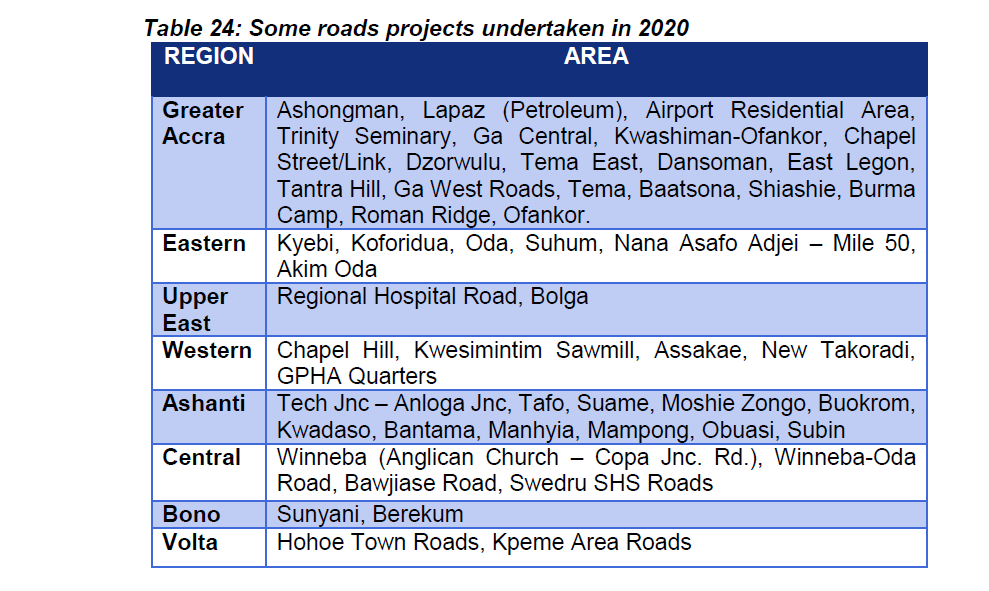
    Further,  the 2021 Budget Statement and Economic Policy confirmed that Hohoe township roads were completed in 2020 under the Urban Roads Asphaltic Overlay Programme. Paragraph 831 of the budget document indicates that the Hohoe Town roads formed part of the “648km of asphalt overlay works” completed in 2020.  

    Table 24 of the 2021 Budget Statement and Economic Policy. Image Source: Ministry of Finance

    Conclusion

    DUBAWA findings indicate that asphaltic overlays in Hohoe were done in 2020. The images in the post portraying the construction of asphaltic overlays in  Hohoe took place in 2020, thus making the claim of a 2024 overlay misleading. 

  • Call for participants: Elections Information Literacy Webinar

    DUBAWA Ghana is holding a sensitisation webinar to empower first-time voters and the general public on elections-related information literacy. This event will focus on educating participants on media literacy, voter registration processes, understanding the electoral system, and the importance of voting, one of their civic rights as Ghanaian citizens. 

    To attend, apply using this link: https://forms.gle/L32N4y25w681vF8K8

    Deadline for applications: 15th August, 2024

    Webinar Dates: 19th August and 20th August, 2024

    Time: 3:30 p.m. to 5:00 p.m.

    Method: Zoom Video Conferencing

    Language: English

    #ElectionLiteracyForAll

Back to top button