Claim: An X user @Joe_Bassey has claimed that Ghana has exited the International Monetary Fund (IMF).
Verdict: False. Although President John Mahama spoke about the IMF during his New Year message on January 1, 2026, he did not announce that Ghana had exited the IMF programme. Instead, he stated that the government was beginning the process of leaving the programme, indicating that Ghana remains under IMF support.
Full Text
An X user, @Joe_Bassey, has claimed that Ghana has exited the International Monetary Fund (IMF). The claim was made alongside a 12-minute video, in which the user stated:
“Ghana officially exits the IMF, sending shockwaves. Every African nation should emulate Ghana.”
A video of John Mahama is attached to the claim.The post has attracted over 400,000 views and over 20,000 likes on X. Exiting an IMF programme is a significant policy decision for any government, including Ghana. However, is the claim true?
Verification
First, DUBAWA accessed the full video to verify claims that President John Mahama had declared that Ghana had exited the IMF programme. Our review indicates that Mr Mahama made the statement during his New Year’s message, which was televised on all major television platforms, including Channel One TV, on January 1, 2026.
After carefully analysing the video, DUBAWA found that the President did not state that Ghana had exited the IMF programme. Rather, Mr Mahama announced the government’s intention and plans to exit the IMF programme.
A section of his address where he made a statement on the IMF stated:
“We are beginning the process of exiting the IMF programme with dignity, not as supplicants, but as partners.” This can be found at 2 minutes 58 seconds of the video.
This statement clearly indicates that Ghana remains under an IMF programme and has not yet exited. Currently, Ghana is participating in an IMF-supported Extended Credit Facility (ECF) programme, which began in May 2023 to support fiscal stabilisation following economic challenges. The programme is subject to periodic reviews by IMF staff and the IMF Executive Board to assess performance and approve the release of funding tranches.
As of late 2025, Ghana had completed several programme reviews, including the fifth review, making the country eligible for additional disbursements under the arrangement. The programme is expected to last until mid-2026.
Other government officials have also stated that Ghana is on track to complete the programme and exit in 2026. The Governor of the Bank of Ghana has indicated that the country is ahead of schedule on most programme targets and expects Ghana to exit the IMF programme within the year.
Therefore, while an exit plan is underway, it has not yet been completed. No official document from either the IMF or Ghana’s Ministry of Finance confirms that the programme has ended or that Ghana has fully exited IMF oversight as of early January 2026. Based on public statements and the IMF’s review timeline, the programme is expected to run until mid-2026.
Conclusion
The claim that Ghana has exited the IMF is false. President John Mahama, in his New Year message on January 1, 2026, did not announce that Ghana had exited the IMF programme. He stated that the government was beginning the process of exiting, which indicates that Ghana remains under IMF support. Ghana is currently participating in an IMF Extended Credit Facility (ECF) programme that commenced in May 2023 and is scheduled to run until mid-2026. There is no official confirmation from the IMF or Ghana’s Ministry of Finance that the programme has ended. Therefore, the claim is misleading and inaccurate.
A quarterly International Monetary Fund (IMF) report has revealed that as of July 31, 2023, Ghana ranks as the highest indebted country in Africa to the IMF.
With an outstanding IMF loan of $2.227 billion, the West African nation has the top spot as the continent’s largest indebted country to the financial agency. Page 40 of the Quarterly Report on IMF Finances for the Quarter Ended July 31, 2023 details this.
The Special Drawing Right (SDR) is an international interest-bearing reserve asset created by the IMF to supplement its member countries’ official reserves. The value of the SDR is based on a basket of five countries – the Chinese renminbi, the euro, the Japanese yen, the British pound, and the US dollar.
Page 21 of the Quarterly Report on IMF Finances for the Quarter Ended July 31, 2023 shows that the exchange rate as of July 31, 2023, SDR 1 is equal to $1.34294.
The NLC, composed of four army officers and four police officers, assumed executive power in the first independent sub-Saharan African country.
From 1966 to 2023, the West African country has benefited from 17 IMF programs between the 57 years. .
A screenshot of the history of Ghana’s loan relationship with the IMF. Photo credit: IMF
Ghana’s rising public debt
Data from the Bank of Ghana shows that Ghana’s public debt, excluding loans of state-owned enterprises, has dropped to GHS 434.6 billion ($40.4 billion) from GHS 575.7 billion cedis in December 2022. It further reveals that the drop represented over GHS 141 billion reduction of the country’s public debt stock, as seen on page 14 of the Summary of Economic and Financial Data for May 2023.
Explaining the factors responsible for the drop in Ghana’s public debt, the Governor of the Bank of Ghana, Dr Ernest Addison said the resurgence of the cedi against the dollar was crucial to the reduction.
Governor of Ghana’s Central Bank, Dr Ernest Addison. Photo credit: Crosscheckghana
Dr. Addison is reported to have stated at the 112th Monetary Policy Committee Press Conference held on May 22, 2023 that “Largely due to the exchange rate appreciation that we saw. You all know what happened at the end of last year [2022]. The very large depreciation of the Cedis was corrected somewhat in the latter part of the year, that helps in terms of the Cedi value of the debt.”
“It has to do with the issue of debt sustainability at the very heart of debt sustainability and the composition of our debts.
So, when half of your total debt stock is dominated in foreign exchange, a slight movement in your exchange rate will, and the sensitivity of your debt to exchange rate movement becomes paramount in the sustainability of that debt,” Ghana’s Central Bank boss added.
The politics of IMF bailout in Ghana
Discussions about an IMF bailout in Ghana have often been met with public denials, particularly by the political class.
Reports (here, here, and here) have shown that no Ghanaian government has publicly admitted going to the IMF for the country’s economic recovery until things got worse.
Some social commentators believe the reason for this development is that a public admission of an IMF support is seen as a sign of poor management of the country’s economy by the government of the day.
Once seen as a shining example of economic strength in the sub-Saharan region, Ghana has been struggling with high inflation since 2014, when the Cedi fell by 40% against the US dollar.
BBC reported that the country’s cedi became the world’s worst-performing currency.
Ex-Ghanaian President John Mahama. Photo credit: JohnMahama.org
“I wish to take this opportunity to state with great emphasis that as President, I have not taken any decision to enter our country into an IMF programme; what we are concentrating on is the preparation of a home-grown strategy of fiscal consolidation,” Mahama said in May 2014.
“It is a tragedy of our very polluted and extremely partisan political environment that such a simple misunderstanding of the relevance of this document should become the basis of a major political player [NPP] to stay away from this important forum,” Mahama added.
However, four months later, reports (here, here, and here) showed that Ghana went to the IMF to seek a bailout to strengthen the West African nation’s currency.
Similarly, other reports (here, here, here, and here) showed that Akufo-Addo’s government denied returning to the IMF for a financial bailout at a time the country’s economy was getting worse by the day.
Ghana’s Finance Minister, Ken Ofori-Atta said in Feb. 2022, the country will not go for a bailout from the IMF, stating that “it is not in [our] plans.”
“We are a proud nation…I can say, we are not going to the IMF. Whatever we do, we are not…
So, let’s think of who we are as strong, proud people, the shining star of Africa, and we have the capacity to do whatever we want to do if we speak one language and ensure that we share the burden in the issues ahead,” the finance minister said.
Ghana’s Finance Minister, Ken Ofori-Atta. Photo credit: Citinewsroom
Also, the Deputy Finance Minister, Dr John Ampontuah Kumah stated that the West African country will not seek any form of support from the global financial agency.
“The NPP [governing New Patriotic Party] government will not go to the IMF as long as we are in charge of the economy of Ghana, we will never go to the IMF,” he said.
However, with rising public debts and the cedi depreciating sharply against many currencies in the world, reports (here, here, here, and here) indicate that Akufo-Addo went to the IMF for support.
“Congratulations to Ghana for a strong program of reforms to revitalize growth and reduce the country’s debt burden. I’m very pleased that the IMF Board has approved… a three-year, $3billion support for this program. We are proud to be partners with Ghana in addressing the difficult economic and financial conditions the country is facing,” she said in the video.
On May 19, 2023, Ken Ofori-Atta confirmed the receipt of the first $600 million tranche of the $3 billion extended credit facility from the IMF.
The race to the top of IMF indebted list
IMF reports from 2022 to July 31, 2023, showed Ghana has continued to occupy the top spot as the top-most African country indebted to the international financial body.
See page 41 of the October 31, 2022 report here and page 40 of the July 31, 2023 report here.
A screenshot of page 40 of the Quarterly Report on IMF Finances for the Quarter Ended July 31, 2023
IMF data has shown that as of July 31, 2023, Ghana’s outstanding loan to the international body represents 10% of the total loan owed by African countries.
A screenshot of page 40 of the Quarterly Report on IMF Finances for the Quarter Ended July 31, 2023
However, the IMF data revealed that the West African nation has repaid SDR 8 million, equivalent to $10.55 million of its outstanding loan to the IMF, the IMF data has revealed.
Directly following Ghana as the largest indebted countries in Africa are Democratic Republic of Congo, Kenya, Uganda, and Sudan occupying the 2nd, 3rd, 4th, and the 5th positions respectively.
The rest of Africa is indebted to the IMF to the tune of SDR 11.32 billion, the report has revealed.
Conclusion:
Ghana currently tops Africa as the largest indebted country to the IMF as revealed by the international body’s July 31, 2023 report.
However, with the West African country determined to honour its commitments to the IMF under the three-year Extended Credit Facility (ECF), there are chances it might drop as the largest indebted African nation in the coming months.
The next quarterly financial report of the international financial agency is expected to be published on October 31, 2023.
Social media users claim the Akufo-Addo government has led Ghana into the group of Heavily Indebted Poor Countries (HIPC).
Ghana’s listing on the World Bank website as a Heavily Indebted Poor Country (HIPC) dates back to 2002 and has remained so to date. Ghana completed the HIPC process in 2004 and according to the IMF, cannot reapply to the initiative.
Full text
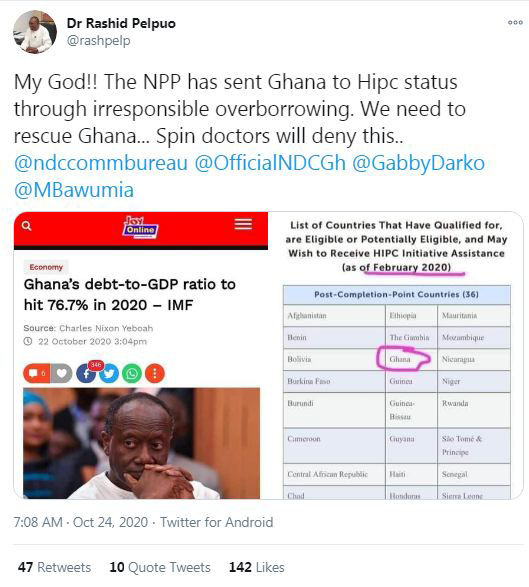
Several members of the opposition National Democratic Congress (NDC) have made social media posts to the effect that the New Patriotic Party (NPP) government, led by President Akufo-Addo, has led Ghana into the being recognized as a Heavily Indebted Poor Country (HIPC).
Former President John Mahama reiterated the claim on Monday, October 26, 2020, while engaging some professionals ahead of the December 7 elections at the La Palm Royal Beach Hotelsaying, “Ghana is back to HIPC status under Nana Akufo-Addo and Ken Ofori-Atta administration.”
One of the viral tweets making the claim is a tweet by the Member of Parliament for Wa Central and former Minister for Youth and Sports, Rashid Pelpuo.
“My God!! The NPP has sent Ghana to HIPC status through irresponsible overborrowing. We need to rescue Ghana… Spin doctors will deny this..,” his tweet reads.
What is HIPC?
According to a factsheet by the International Monetary Fund (IMF), Heavily Indebted Poor Country (HIPC) is a debt relief initiative launched in 1996 by the IMF and World Bank, with the aim of ensuring that no poor country faces a debt burden it cannot manage.
The initiative reduces the debt of countries that meet the strict criteria for such classification.
1.Face sustainable debt situation after the full application of the traditional debt relief mechanisms (such as the application of Naples terms under the Paris Club agreement).
2. Be eligible for highly concessional assistance from the International Development Association (IDA) and for the IMF’s Poverty Reduction and Growth Trust (PGRT).
3. Have established a track record of reform and sound policies through IMF and World Bank-supported programs.
4 Establish a track record of reform and develop a Poverty Reduction Strategy Paper (PRSP) that involves civil society participation.
Ghana’s history with HIPC
Ghana has a known history with HIPC. In 2002 during the John Agyekum Kufuor led NPP administration, Ghana was listed as a HIPC and subsequently benefited from a comprehensive debt reduction package from the World Bank and the IMF.
The IMF announced in 2002 in a press release that Ghana was due to get $3.7 billion in debt relief through the HIPC initiative.
Being classified as a heavily indebted poor country to most opposition parties in Ghana is an indication of mismanagement of the local economy and extreme levels of government borrowing.
This may explain the virality of the recent claims but how true it is in the first place that the Akufo-Addo government has led Ghana into HIPC.
Verification
The World Bank’s data portal which is referenced in the claim lists 39 countries including Ghana as Heavily Indebted Poor Countries (HIPC).
But is this enough to prove that the Akufo-Addo government has led Ghana into HIPC?
Following an email we sent to the IMF with regards to the claim, a Senior Communications Officer, Gediminas Vilkas responded that Ghana has not made any new application to the HIPC initiative and indeed “cannot apply again” since it has already completed the process.
Further, through the Wayback machine which helps to track changes on websites by archiving its pages, we found that Ghana, even as at August 11, 2016, was listed on the World Bank’s data portal as being amongst HIPCs.
In the December 2014 update of the IMF on HIPC (Page 6), Ghana remained among the list of HIPCs when the NDC led by John Mahama was in power.
The World Bank’s most recent update, which was in August 2019 again included Ghana among the list of highly indebted poor countries and as recent as the IMF’s March 25, 2020 fact sheet, Ghana was still a part of the HIPC initiative.
It is important to note that the World Bank and IMF have in all their other reports on the initiative mentioned Ghana among the 39 countries identified as beneficiaries from the HIPC initiatives.
Chad is the latest country to have completed the initiative, in 2015, but it still remains in the list.
In other reports, Ghana is said to have its debts at high levels but there is no formal indication that the debts are at an unsustainable level after the full application of the traditional debt relief mechanisms required in addition to the other requirements for the HIPC initiative.
Conclusion
Although Ghana is duly captured on the World Bank’s data portal amongst HIPCs, that does not prove that the country has opted again to go into the HIPC initiative, in fact, that is impossible. Ghana and the other 38 countries that have gone through (including those still in the process of) the HIPC initiative have consistently featured on the World Bank data portal as HIPCs.
Ghana has featured since 2002 when it joined the program under former President Kufuor through the period of President Atta-Mills, President Mahama and now President Akufo-Addo.
…….
The reporter, Jonas Nyabor, produced this fact-check under the auspices of the Dubawa 2020 Fellowship in partnership with Citinewsroom to facilitate the ethos of “truth” in journalism and to enhance media literacy in the country.
Ahead of the 2020 elections in December, the National Democratic Congress (NDC) launched their manifesto, the ‘People’s Manifesto’ on Monday, 7 September 2020.
At the launch, the presidential candidate of the party, John Dramani Mahama, in his introductory speech (1:59:22- 2:06:45 of the recorded Facebook live video) was heard making a number of claims centred mainly on the economic state of Ghana and on a government’s COVID-19 management.
A transcript of Mahama’s speech which captures the context in which the identified claims were made reads:
“…In many cases, countries considered relatively less advanced with smaller economies are emerging more resilient and less affected by the global shocks than some countries that are considered advanced. The case of Vietnam, a relatively smaller country bordering China, and therefore closer to the original source of the Coronavirus pandemic has survived much better with relatively less infections and deaths than known global superpowers...Excessive borrowing over the last four years has placed Ghana in a high debt risk category, with absolutely nothing to show for it…”
Consequently, Dubawa accessed the available facts concerning some identified claims, in producing its attendant verdicts.
Claim 1:Vietnam has survived the Coronavirus pandemic much better with relatively lesser infections and deaths than known global superpowers
Verdict: Reports from the WHO, CDC, COVID-19 data sites andmedia show that Vietnam has recorded relatively lesser infections and deaths compared to the known global superpowers.
The countries largely referred to as the global superpowers are the five permanent members of the UN Security Council namely the United States of America (US), the United Kingdom (UK), Russian Federation, China and France.
Dubawa accessed the statistics for the population, confirmed cases/infections and deaths as at 7 September 2020, recorded for Vietnam, US, UK, Russian Federation, China and France tabulated below:
Source: Population: Worldometer Confirmed case & deaths: WHO
Comparatively, from the tabulated statistics, Vietnam, which has a population higher than the UK and France, has recorded smaller rates of infection and death than the two countries.
Moreso, the Vietnam Coronavirus tracker also reveals that out of the 1,059 confirmed cases, there have been 902 Covid-19 recoveries in Vietnam, with no critical cases treated in Intensive Care Unit and an 84% recovery rate of the total cases.
In June 2020, the Centre for Disease Control (CDC) described Vietnam’s response to controlling the pandemic as an excellent credit to the country’s leadership strategies.
“Vietnam has excelled in controlling COVID-19 through strong leadership and coordination, rapid case detection and isolation, aggressive contact tracing, and strict quarantine measures,” the CDC said.
Media sites such as the BBC, the Star and publications such as the Policy Forum have also reported on Vietnam’s proven effective response to the pandemic.
Claim 2: Excessive borrowing over the last four years has placed Ghana in a high debt risk category
Verdict: Even though Ghana is in high-risk debt distress category due to excessive borrowing, it is not as a result of events of the last four years. Ghana has been in this category since 2015 when an IMF and World Bank report published in April 2015 concluded Ghana to be so on account of breaches in the debt-service to revenue ratio.
Two documents were accessed to ascertain this claim.
The first document titled Joint Ghana World Bank-IMF Debt Sustainability Analysis document dated December 2019, an analysis of Ghana’s joint bank-fund sustainability, shows that Ghana’s risk of external debt distress and overall risk of debt distress were truly both high.
“External and overall debt are at high risk of debt distress… Nonetheless, debt is assessed as sustainable thanks to favourable market access, the authorities’ commitment to macroeconomic stability and fiscal discipline, and the potential for steeper than assumed fiscal consolidation. In the short term, fiscal discipline is necessary to ensure debt sustainability and maintain market confidence, but external factors, including worsening global risk sentiment, still pose significant risks,” the IMF document reads.
However, Mahama’s assertion that this is a result of excessive borrowing specifically from over the last four years is inaccurate as we found Ghana’s categorisation by the IMF was since 2015.
An IMF Ghana report on the ‘Request For A Three-Year Arrangement Under The Extended Credit Facility’ (pg13&14) published in April 2015 also judged Ghana’s debt at a high risk distress.
“The Debt Sustainability Analysis (DSA) concludes that Ghana is at a high risk of debt distress, on account of breaches in the debt-service to revenue ratio over 2015–17 and after 2021. The authorities are committed to limit their borrowing plans to loans with a minimum grant element of 35 per cent, with possible exceptions in line with the debt limits policy… Bank of Ghana gross financing to the budget in 2015 will be limited to 5 per cent of previous year’s revenue, using only marketable financial instruments”, the report read.
In 2015, the IMF stated in the report that Ghana’s public debt continued to rise at an unsustainable pace, however, in the 2019 report, the IMF judged Ghana’s debt as sustainable.
Another document titled, The fall and rise of Ghana’s debt jointly published by the Integrated Social Development Centre Ghana, Jubilee Debt Campaign UK, SEND Ghana, VAZOBA Ghana, All-Afrikan Networking Community Link for International Development, Kilombo Ghana and Abibimman Foundation Ghana in October 2016 was accessed to verify the claim.
The document, in analysing how Ghana had at the time, ‘fallen in a new debt trap’, also shows that Ghana was categorised as a high risk of debt distress by the World Bank in 2015.
“In April 2014 Ghana was assessed as at moderate risk of debt distress but ‘approaching high-risk levels’. At the next review in March 2015 this changed to being confirmed as at “high risk of debt distress”. Yet, seven months later in October 2015, the World Bank broke its own rules based on its own assessment by giving a guarantee for (high-cost) bonds for a country rated as at high risk of debt distress,” the document reads.
Therefore, even though Ghana is in a high risk of debt distress category due to excessive borrowing, it is not a matter of the last four years as Mahama claimed. Ghana has been in this category since 2015 when an IMF and World Bank report published in April 2015 concluded Ghana to be so on account of breaches in the debt-service to revenue ratio.
Conclusion
Conclusively, from the claims identified in Mahama’s introductory speech at the NDC Manifesto launch 2020, one was true and another was false.