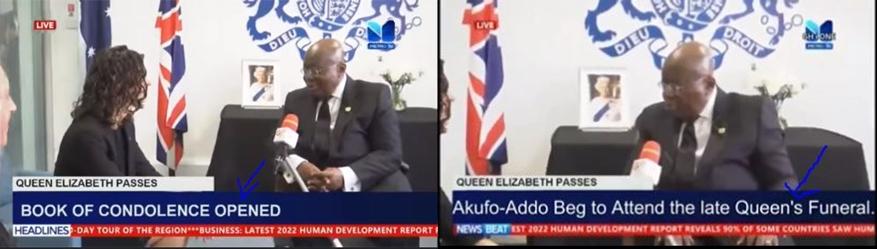
Claim: A Twitter user claims Akufo Addo begged to attend late Queen Elizabeth’s funeral.
False. After assessing the video, DUBAWA found out that the video had been tampered with. President Akufo Addo only declared his intention to attend the late Queen Elizabeth’s funeral.
This claim was made on Twitter on September 18, 2022, at 7:16 pm when he posted a video purportedly from Metro TV, a Ghanaian television station. The claim is sighted in a headline of a purported news story by the station.
The headline of the purported news story is captioned “Akufo Addo begs to attend the late Queen’s funeral.” His post has received over 3,000 views. In the video, President Akufo Addo and the British High Commissioner for Ghana Harriet Thompson are seen engaging in an interaction.
Some users in the comment section have also shared varied views on the video criticizing the president, with others questioning the authenticity of the video.
Source: Twitter
This has become necessary to look into due to some countries being invited only at the ambassadorial level. As an independent verification organization, we decided to bring clarity to the matter.
Verification
The video is 39 seconds long. First, DUBAWA decided to transcribe the video to make it easier to understand the interactions between the two.
Akufo Addo: I intend to go to London for the funeral and I want to know whether you have anything, in particular, to tell me about that.
Harriet Thompson: The invitations have been sent, so they will be with your High Commission in London. They were sent over the weekend, and we’ll make sure the arrangements work smoothly between your team there and our team here.
Clearly, from the conversation above, there is no proof that the president begged to attend the late Queen’s funeral. The president only declared his intention and further asked for updates on his quest to go to the funeral in London.
After further assessment of the video purported to be from Metro TV, we found out that the video had been tampered with. The slug has been edited. DUBAWA observed various news bulletins of the television station, and we found out that the slugs of their news bulletins are written in capital letters, not small letters.
Further checks on the Facebook page of Metro TV revealed that the original slug of the video published on Monday, September 12, 2022, at 1:25 pm was “BOOK OF CONDOLENCE OPENED” and not “Akufo Addo beg to attend the late Queen’s funeral.”
Original Fake
Further investigation using Fotoforensics, a digital picture analysis tool, suggests that the image has had some edits done to it. The JPEG% in the Fotoforensics tool also shows a mass repetition of numbers. This is a red flag. This suggests that the image has been opened, layered and closed, possibly multiple times.
Conclusion
False, after assessing the video, DUBAWA found out that the video had been tampered with. President Akufo Addo only declared his intention to attend the late Queen Elizabeth’s funeral. Additionally, the video being circulated indicating that the president did beg has its slug manipulated as well. The original video published by Metro TV had “BOOK OF CONDOLENCE OPENED” and not “Akufo Addo begs to attend the late Queen’s funeral” as purported in the video.
Claim: President Akufo-Addo has said in a radio interview that he wants to marry a woman from the Volta Region.
Misleading! The president talked about being a persistent suitor that keeps knocking on the door of the Volta Region to get the region to ditch the NDC and vote for the NPP. His comment did not in any way communicate his interest to marry a woman from the Volta Region.
Full Text
Several news reports, including those from GhanaWeb, Peacefmonline and GhPage, claim that President Akufo-Addo has declared his intention to marry a woman from the Volta Region of Ghana.
The publications have elicited several reactions on social media with many wondering why the president would, make such a declaration on a public platform, given the fact that he is already in an ordinance marriage with Rebecca Akufo-Addo.
Verification
After obtaining a copy of the interview, DUBAWA subjected it to careful scrutiny to confirm the utterances of the president.
Host: Welcome once again to the Volta Region. We know you’ve made countless visits to the Volta Region.
Akufo-Addo: According to the regional minister, since I came to power, it’s been 10 trips so far. We are not finished yet.
Host: More, more should come.
Akufo-Addo: Absolutely!
Host: I hope you are enjoying your stay here in the Volta Region.
Akufo-Addo: I am but you know my basic position that I have taken. And seeing you, of course, it has heightened it; my determination to marry the Volta Region. I’m like a suitor who keeps knocking on the door.
Host: Somebody has got me blushing.
Akufo-Addo: I am waiting for the day the door will be opened and I will keep on until the door is opened.
Given the context within which the conversation was had, it comes out clearly that the president’s statement was within the context of political acceptance by the Volta Region, which has been very loyal to his political opponents, the National Democratic Congress (NDC) in every election since 1992.
This isn’t the first time the president has made such a statement.
For instance, in February 2020, ahead of the general elections, Akufo-Addo responded to comments by an opposition party executive about why he was frequenting the region, saying “I think that the spokesperson doesn’t know about a man who is determined to marry a woman. You will continue to go to the house and you go and go and go. So that is what I am determined to do. I am determined to marry the people of the Volta Region and I am going to come here as often as is necessary until I get them.” He said this at Adaklu and the report was captured by Starrfmonline.
In August 2020, while addressing the chiefs of South Tongu to cut the sod for an €85 million Keta Water Supply rehabilitation and expansion project at Agordome, the President said he was aware of the region’s loyalty to the NDC and that he was determined to win it over for the NPP.
“I’m like the suitor who is bent on marrying a beautiful woman, and I’ll keep on knocking at the door until it is open to me,” he stated. The report was copied from the Ghana News Agency and published on Myjoyonline.
As far back as December 2016, the president is captured in this Daily Guide publication saying that his New Patriotic Party will continue to woo the region “until we marry the bride.”
In September 2021, Nana Akufo-Addo again said in a VOV Radio interview that, “I am a very persistent suitor. So when I talk about marrying the Volta region. I mean it. When I set my eyes or myself on a particular target, unless it’s God, I do not give up.” This report was captured by the Daily Guide newspaper.
Why would the president be talking about marriage to the Volta region?
The context in which he has consistently made the statements, dwelling on marriage analogy, has been to express his desire and hope that the Volta region, which is the NDC’s stronghold, will jump ship and accept the NPP as a political party of choice.
Since the beginning of Ghana’s fourth republic in 1992, the Volta Region has consistently voted massively for the NDC in all elections.
The NPP has previously had no parliamentary representative in the Volta Region. John Peter Amewu, representing the Hohoe constituency, is currently the only NPP legislator in the region.
Conclusion
President Akufo-Addo has not declared his intention to marry a woman or take a wife from the Volta Region as is being peddled in various news publications.
Claim: Social media users claim this fleet of Mercedes-Benz S550 (2022 Model) was purchased by the government to be used as President Akufo-Addo’s convoy.
False! The photo used to make the claim was taken several years ago outside Ghana and Mercedes-Benz has confirmed that it has no 2022 Model for its S550 vehicle.
Full Text
A viral image circulating on Facebook and Twitter claims to show new vehicles that have been procured by President Akufo-Addo’s government for the presidential convoy.
The claim has been circulating since August 30 and has garnered thousands of reactions and shared widely on both platforms like this, this and that.
“The Ghanaian economy is in a very serious crisis, yet our president @NAkufoAddo wants to live in a grandstyle. The cars you are seeing below are Mercedes S550-2022. Your new presidential convoy,” one of the claimants said in a Tweet.
Is it true that a new fleet of Mercedes-Benz S550 (2022 model) cars has been procured for President Akufo-Addo’s convoy? The Director of Communications at the Jubilee House, Eugene Arhin, responded “No,” when asked.
Dubawa Ghana’s independent fact-checking revealed the following.
Verification
A series of reverse image searches revealed that the image used in the claim has been uploaded and used many times across different online platforms like this long before 2022. Hence, it cannot be a fleet of new vehicles procured by the government for its presidential convoy.
Following a message to one of Mercedes-Benz’s public contacts, Mercedes-Benz Careers, on Facebook, it was also confirmed that the brand had no 2022 model of its Mercedes Benz S550 vehicle.
Mercedes-Benz also indicated that it discontinued production of the S550 vehicle in 2017.
“There is no 2022 model available… The Mercedes-Benz S550 was discontinued following the release of the 2017 model,” the outlet wrote in response.
The response, therefore, confirmed that the government couldn’t have purchased any 2022 model of Mercedes-Benz S550.
Conclusion
While we couldn’t find adequate evidence to prove that any procurement was made, we are able to confirm that the image used in the claim was not taken in 2022 and, therefore cannot be an image of new vehicles procured by the government for President Akufo-Addo’s convoy. In addition, there is no vehicle as Mercedes-Benz S550 (2022 Model).
The words International Monetary Fund have been three buzzwords in Ghana in the past few weeks. The International Monetary Fund (IMF) became the major talking point after the Akufo Addo-led Government of Ghana, on Wednesday, July 1, 2022, announced its intention to seek a bailout from the Bretton Wood institution, following the much-touted government-engineered “Ghana Beyond Aid” slogan.
Shortly after the announcement, there has been a controversy about whether the government was justified in going for a bail-out. Even the number of times Ghana has gone to the IMF has also been a subject of debate. Instead of the 17th time, some news reports have suggested that Ghana was going to the IMF for the 18th time as can be seen here.
Another major TV station in Ghana, TV3, also reported as follows as can be seen in the following screenshot.
Therefore, DUBAWA decided to do an in-depth report on Ghana’s entanglement with the IMF over the last couple of decades.
What is the IMF?
The IMF is a global network of 190 countries, which have come together to build a framework for international economic cooperation. Among other things, the Fund provides loans to its member countries experiencing or having the potential to experience balance of payment problems.
Ghana’s announcement of intention to apply for an IMF bailout was preceded by a series of demonstrations over the free fall of the Ghana cedi, relative to the major trading currencies; high and increasing cost of fuel and its attendant high cost of living; high and rising rate of unemployment, culminating in low standard of living; alleged misappropriation of public funds; and claims of poor economic management. Since the July 1 announcement, representatives from the Fund, led by its mission chief, Carlo Sdralevich, have arrived in the country and begun talks with the Ghana government in order to satisfy themselves with Ghana’s ability to commit to financial obligations and to determine the kind and form of support the country would qualify for. If successful, this will not be the first time Ghana would benefit from the Fund–but the 17th time.
Under seven different heads of state/president, and dating back from 1966, Ghana has already entered into 16 separate but similar forms of loan arrangements with the Fund, particularly Stand-By Arrangements (SBAs) and Extended Credit Facility (ECF). This means that statistically, the country seeks a bailout from the Fund every three and one-half years. The following are the specific years Ghana has reached out for IMF bailouts and the leaders under whom these arrangements occured: 1966, 1967, and 1968 under Joseph Arthur Ankrah (head of state); 1969 under Akwasi Amankwa Afrifa (head of state); 1979 under Frederick William Kwasi Akuffo (head of state); 1983, 1984, 1986, 1987, 1987, and 1988 under Jerry John Rawlings (head of state); 1995 and 1999 under Jerry John Rawlings (president); 2003 under John Agyekum Kufuor (president); 2009 under John Evans Atta Mills (president); and 2015 under John Dramani Mahama (president). Below are the details:
IMF under Ankrah (1966, 1967, 1968)
Ghana first reached out for IMF support on May 17, 1966, a couple of months after the National Liberation Council (NLC), led by Major Joseph Arthur Ankrah toppled Nkrumah’s government in a military coup d’etat. Even though he considered the prospect, Nkrumah never took Ghana to the IMF, contrary to claims by proponents of the present administration. After Nkrumah’s overthrow, however, the new military regime invited the IMF together with the World Bank to come and help it to effectively manage its economy. The Ankrah-led government went into a Stand-By Arrangement with the Fund. According to the terms of the agreement and under the direction and supervision of the Fund, thus, Ghana privatised a number of state-owned corporations that were deemed unprofitable. The programme, which came with a 36,400 dollar injection, ended on May 16, 1967 but was renewed effective May 25, 1967 up until May 24, 1968 with an amount of 25, 000 dollars. Again on May 28, 1968 till May 27, 1969, Ghana again benefitted from the IMF with an amount worth 12, 000 dollars, injected into the economy. It was the last arrangement Ankrah went into with the IMF, but the deal would outlive his reign: he had resigned on April 2, 1969.
IMF under Afrifa (1969)
Major Akwasi Amankwa Afrifa took over the reins of the NLC-led government on April 2, 1969, after Major Ankrah’s forced resignation, following a bribery allegation against him. Two days after the expiration of the last Ankrah-initiated IMF programme on May 27, 1969, Afrifa renewed it for a-5,000-dollar support on May 29, 1969, and agreed to run for a year. It expired on May 28, 1970, but he would not be at the helm of affairs to witness the end of what he had started. Afrifa, on October 1, 1969, handed over to a democratically elected Progress Party government, led by Kofi Abrefa Busia as prime minister and, later on August 31 1970, joined by Edward Akufo Addo as ceremonial president, both of whose reign ended abruptly on January 13, 1972, after a military coup d’etat by the Supreme Military Council (I), led by Lt. Col. Ignatius Kutu Acheampong. In both regimes, Ghana did not go to the IMF. Indeed, Acheampong opted for local solutions to Ghana’s problems and thus was in the process of instituting a number of home-grown programmes. A couple of weeks into his government, which had begun on January 13, 1972, Acheampong was instituting a domestication agenda, which, for example, birthed the popular local agricultural policy, “Operation Feed Yourself,” when, Akuffo, who hitherto was his deputy, toppled his government on July 5, 1978 to form the new Supreme Military Council (II) government.
IMF under Akuffo (1979)
Nearly 10 years after exiting the first IMF programme on May 28, 1970, Ghana, under Lt Gen. Frederick William Kwasi Akuffo, who had been head of state for six months, ran back to the Fund on January 10, 1979. This was largely because the agricultural and other home-grown programmes instituted by Lt Col Ignatius Kutu Acheampong did not fare well and was reported to have worsened Ghana’s economic woes: corruption and economic mismanagement were still implicated. Thus, prices of commodities such as soap and cloth, mainly imported, were increasing at astronomical levels. Indeed, inflation was said to have been so high that even toilet paper was worth more than gold. Akuffo did not only depose his boss; he also opposed his predecessor’s local policies, hence he took Ghana back again to the IMF for a one-year Stand-By Arrangements support of 53,000 dollars, spanning January 10, 1979 to January 9, 1980.
As nature would have it, Gen. Akuffo’s reign was also short-lived; thus, it did not last to witness the expiration of the IMF programme on January 9, 1980. He had been overthrown on June 4, 1979 by a group of 15 junior officers, known as the Armed Forces Revolutionary Council (AFRC), led by Flt. Lt Jerry John Rawlings, after a botched attempt a couple of weeks earlier on May 15.
IMF under Rawlings (1983, 1984, 1986, 1987, 1987, 1988, 1995, 1999)
Though he handed power to a civilian government after his first coup of June 4, 1979, Jerry John Rawlings, on the wings of his Provisional National Defence Council (PNDC), staged a comeback coup on December 31, 1981, two-and-a-half years after the first. The economic downturn the country experienced earlier was still lingering and had even been exacerbated by the ravages of climate change, causing an intense food shortage and hunger crisis. Although the country was then living off food donations from global charities, the new-Rawlings regime did not immediately go to the IMF in 1982. It, however, did so for 238, 500 dollars on August 3, 1983 when the country recorded its harshest economic crisis even in contemporary history. When it ended on August 2, 1984, this arrangement was renewed multiple times: from August 27, 1984 to December 31, 1985 for a Stand-By Arrangement of 180,000 dollars; from October 15, 1986 to October 14, 1987 for a Stand-By Arrangement of 81,000 dollars; from November 6, 1987 to November 9, 1988 for an Extended Fund Facility of 245, 400 and for a Structural Adjustment Facility of 129,858, running concurrently; and from November 9, 1988 to March 5, 1992 for an Extended Credit Facility of 338,550. Under the new-IMF’s (SAP), the status quo of the state-controlled economy was abandoned to give way for a market-oriented economy to take over. This paradigm shift resulted in the stabilisation of the economy, very significantly reducing inflation from 142 percent at the start of the IMF programme in 1983 to 10 percent by the end of 1991.
Ghana did not wean itself from support from the Bretton Wood institution with its transition from military rule to a republican country for the 4th time, following its first general election in 1992. Neither did it change its leader who transitioned from being a military head of state to a democratically elected president, having won the 1992 election with his then newly formed National Democratically Congress (NDC) political party. With Rawlings still at the helm of affairs, Ghana went back to the IMF again for an Extended Credit Facility of 164,000 dollars from June 30, 1995 to May 2, 1999, which facility was again renewed at the value of 228,800 dollars for another three years, effective May 3, 1999 through to November 30, 2002, almost two years into the reign of John Agyekum Kufuor.
IMF under Kufuor (2003)
As the second president of the fourth republic, John Agyekum Kufuor of New Patriotic Party took over from Jerry Rawlings on January 7, 2001. Though Ghana was still under IMF for almost the entire first two years of his reign, he did not oversee that arrangement: it was a legacy he had inherited from his predecessor, which arrangement elapsed in November 30, 2002. However, six months after shepherding Ghana out of the IMF programme, the Kufuor administration started another Extended Credit Facility on May 9, 2003, which spanned through to October 31, 2006 and was worth 184,500 dollars. The only unique thing was that Ghana had gone into the new arrangement as a highly indebted poor country (HIPC) for debt cancellation, a programme that the IMF had initiated in the mid 1990s, which aimed to bring debt relief to self-acclaimed very poor countries. By 2006, and under this new agreement, Ghana had reduced his debt stock from 66 billion to 23 billion dollars. Under the direction of the IMF, Ghana injected the money it otherwise would have used to repay the Fund, in such sectors of the economy as education, health, and policies aimed at ensuring good governance and accountability. Thus, these policies brought some development to the country and some relief to the citizenry by its expiration on October 31, 2006 before John Kufuor would hand over power to John Mills on January 7, 2009.
IMF under Mills (2009)
Six months after he took over the helm of affairs at the presidency with NDC, John Evans Atta Mills, on July 15, 2009 supervised Ghana’s return to the IMF for a 387,450-dollar Extended Credit Facility scheduled to end on July 23, 2012.
IMF under Mahama (2015)
After serving the remnant of the tenure of his former boss for five months as caretaker president from July 24, 2012 to January 6, 2013, John Dramani Mahama became the fourth elected president of the fourth republican Ghana from January 7, 2013 to January 6, 2017. Not only is Mahama the only president to serve only one term, as far as the fourth republic is concerned; he is also the president who took the longest time to enter into another IMF programme at the elapse of the previous one initiated by his predecessor, as far as the history of the fourth republican Ghana’s relationship with the IMF is concerned. Mahama’s four-year presidency was characterised by protracted power outages, nicknamed in local parlance as ‘dumsor’. This development plunged the country into serious economic challenges, necessitating a return to the IMF for a four-year-long Extended Credit Facility of 918 million dollars to support job creation, stabilise the struggling cedi, revive the ailing economy, and facilitate fast growth while also protecting social spending. This arrangement spanned from April 3, 2015 to April 2, 2019 for an Extended Credit Facility worth 664,200 dollars.
John Mahama would later lose the next presidential election on December 7, 2016 to his closest and second-time contender, Nana Addo Danquah Akufo Addo.
The table below shows the summary of Ghana’s IMF lending history, sourced from the website of the IMF:
Facility
Date ofArrangement
ExpirationDate 4/
AmountAgreed
AmountDrawn
AmountOutstanding
Extended Credit Facility
Apr 03, 2015
Apr 02, 2019
664,200
531,360
531,360
Extended Credit Facility
Jul 15, 2009
Jul 23, 2012
387,450
387,450
180,151
Extended Credit Facility
May 09, 2003
Oct 31, 2006
184,500
184,500
0
Extended Credit Facility
May 03, 1999
Nov 30, 2002
228,800
176,218
0
Extended Credit Facility
Jun 30, 1995
May 02, 1999
164,400
137,000
0
Extended Credit Facility
Nov 09, 1988
Mar 05, 1992
388,550
388,550
0
Extended Fund Facility
Nov 06, 1987
Nov 09, 1988
245,400
97,550
0
Structural Adjustment Facility Commitment
Nov 06, 1987
Nov 09, 1988
129,858
40,900
0
Standby Arrangement
Oct 15, 1986
Oct 14, 1987
81,800
81,800
0
Standby Arrangement
Aug 27, 1984
Dec 31, 1985
180,000
180,000
0
Standby Arrangement
Aug 03, 1983
Aug 02, 1984
238,500
238,500
0
Standby Arrangement
Jan 10, 1979
Jan 09, 1980
53,000
32,000
0
Standby Arrangement
May 29, 1969
May 28, 1970
5,000
5,000
0
Standby Arrangement
May 28, 1968
May 27, 1969
12,000
12,000
0
Standby Arrangement
May 25, 1967
May 24, 1968
25,000
25,000
0
Standby Arrangement
May 17, 1966
May 16, 1967
36,400
31,400
0
Total
3,024,858
2,549,228
711,511
IMF under Akufo Addo (Expected 2023)
After forming the fifth government of the fourth republican Ghana, the Akufo-Addo-led administration could not wait to get out of the existing IMF programme, which he had inherited from his predecessor. Its finance minister, Ken Ofori-Atta, led the government not only to exit the IMF programme but also to throw a kenkey party to, inter alia, celebrate the exit in 2019. The impression was that the present government was never going into an IMF programme for any programme whatsoever. Indeed, Ken Ofori Atta, the finance minister; John Kumah, one of his deputies; Kwaku Kwarteng, chair of the parliamentary select committee on finance; a host of other highly placed government officials; and even the president himself literally swore the NPP-formed government would not have anything to do with the Bretton Wood entity. In spite of all of the opposition, the president is reported to have called the Fund’s country representative on Friday, July 1 to announce his government’s intention and readiness to talk to the Fund for support. The justification since the announcement has unsurprisingly been the rippling effect of the Covid-19 pandemic and Russia-Ukraine war.
Claim: General Secretary of the New Patriotic Party, John Boadu, has claimed that about 90% of ruling governments lost their incumbency in 2020.
False. Checks by DUBAWA indicate that as many as 30 Presidential elections were held in 2020 globally. Out of these elections, 20 representing 66.6% of winners were candidates from the ruling party.
Full story
General Secretary of the ruling New Patriotic Party, John Boadu, has said that his party is among a few to have been re-elected in presidential elections in the heat of the COVID 19 pandemic.
According to him, about 90 percent of ruling parties suffered defeat in their respective countries when elections were held in the year 2020, the year of the COVID-19 pandemic.
Speaking on Accra-based Peace FM Akan language, the politician said that the re-election of the New Patriotic Party in 2020 was a testament to President Akufo-Addo’s efficient management of the economy in the midst of the pandemic.
“All political parties in the world, almost about 90 percent of them, in the year of COVID, when they contested, they lost it. Look at [Donald] Trump, before COVID did you see the things he was doing? But the management of COVID did not help him and so he lost. Look at Angela Merkel’s party, they lost it. I can cite a lot of examples. The same thing happened in India. [For] Ghana, because of what President Akufo-Addo did, because of his management of the economy, in the year of elections, during COVID, we won our election,” John Boadu said in Akan which has been translated into english..
His claim can be found between minutes 1:22 to 2:22 of a video uploaded on the Despite Media channel on Youtube.
The video, uploaded on April 21, has since attracted over 500 views and a number of comments.
Article 56 of India’s constitution (Page 58) states that “the President shall hold office for a term of five years from the date on which he enters upon his office”
This means that India is expected to go to the polls again in 2022 to elect a new President.
In view of this, John Boadu is wrong to cite India among countries where the ruling party lost an election during the year of COVID. The country’s last election was held in 2017, which is about two years before the outbreak of COVID-19.
Again, DUBAWA came across 30 countries, including Ghana, that held elections to elect a leader for their respective governments in 2020.
Relying on reports from credible media organizations, DUBAWA noticed that, like Ghana, 20 countries out of the 30 identified, had the ruling party retaining power.
It cannot, therefore, be said that 90% of incumbent governments lost power in the heat of the global pandemic in 2020.
Conclusion
John Boadu’s claim that as many as 90% of ruling parties across the globe lost in their re-election bid to lead their respective countries is false.
Out of 30 countries where presidential elections were held, DUBAWA confirmed that the ruling party secured re-election victory in 20 of those elections.
Claim: North Tongu MP, Okudzeto Ablakwa, says that Ghana recorded the biggest budget deficit in the world, due to COVID-19 expenditure
The 15.2% of GDP quoted by Mr. Ablakwa as Ghana’s budget deficit for 2020 is lower, compared to some countries, including Oman and Kuwait. The two countries recorded a budget deficit of 19.3% of GDP and 15.4% of GDP respectively in 2020.
Full Text
Member of Parliament for North Tongu, Samuel Okudzeto Ablakwa, has claimed that Ghana recorded the biggest budget deficit in the world in the heat of the Covid19 pandemic.
He says that this was a result of the government’s COVID-19 expenditure.
Mr. Ablakwa made the claim during an engagement on Newsfile, a socio-political news analysis show that airs on JoyNews.
“Why is it that the Ghanaian Parliament alone cannot have a special committee to look into COVID-19 expenditure which runs into billions? Because of COVID-19 expenditure, we recorded the biggest budget deficit in the world – 15.2%,” the lawmaker said.
In effect, the MP is claiming that the gap between expenditure and income for the Government of Ghana is the widest when it is compared to that of other countries across the world during the pandemic.
Therefore, to authenticate the claim by the lawmaker, DUBAWA will check the data from these institutions and compare them to that of other countries.
Last year, the IMF released its Fiscal Monitor Report which is a detailed overview of countries’ fiscal actions in response to COVID-19.
In the report, Ghana was classified as a Low-Income Developing Country, alongside the likes of Nigeria, Côte d’Ivoire, and Togo.
According to the report, the average deficits as a share of GDP in 2020 reached 11.7 percent for advanced economies, 9.8 percent for emerging market economies, and 5.5 percent for low-income developing countries.
The report noted that the rise in deficits in low-income developing countries, such as Ghana, “stemmed primarily from the collapse in revenues caused by the economic downturn.”
What was Ghana’s General Government Overall Balance for 2020?
Although the IMF did not use the term “budget deficit” in its data presentation, it explains in a publication on its website that overall balance “measures the difference between revenues and grants, and expenditure and net lending.”
The IMF April 2021 Report indicated that Ghana’s General Government Overall Balance was 16.0% of its GDP in 2020.
“The fiscal deficit including energy and financial sector costs worsened to 15.2 percent of GDP, with a further 2.1 percent of GDP in additional spending financed through the accumulation of domestic arrears.”
The World Bank’s October 2021 update on Ghana’s Economic Outlook also mentioned that the country’s fiscal deficit was 15.2% of GDP for 2020.
However, figures from the Ministry of Finance are different from what the two authorities quote.
“The overall budget deficit on a cash basis was 11.7 percent of GDP against a revised target of 11.4 percent of GDP,” the 2021 budget indicated.
Clearly, there is some disagreement amongst the data sources on what Ghana’s budget deficit is for 2020.
Since Mr. Ablakwa quoted Ghana’s 2020 budget deficit to be 15.2%, it is very likely that he was using World Bank/IMF figures for Ghana.
What’s the budget deficit situation like for other countries?
Ghana is not the only country with different authorities publishing different figures regarding their budget deficit.
A December 2021 publication in the UK House of Commons Library indicated that the country’s budget deficit was equal to 15.1% of GDP.
“In 2020/21 government revenue – from taxes and other receipts – was £792 billion while government spending was £1,115 billion (£1.1 trillion). The deficit was therefore £323 billion, equivalent to 15.1% of GDP, which is a peacetime record. As we discuss below, the budget deficit ballooned because of the coronavirus pandemic,” parts of the publication read.
However, the IMF April 2021 Report indicated that the UK’s General Government Overall Balance was 13.4% of its GDP.
German database organization, Statista, also quotes the UK’s budget balance, also known as budget deficit, for 2020 as 12.53% of GDP.
These contradictions were the same in the case of the United States of America. Whilst the IMF Report indicated that the US budget deficit was 15.8% of its GDP, statista mentioned 14.85%.
How does Ghana’s 2020 budget deficit stand against others?
If the figure from the Finance Ministry (11.7% of GDP) is used against others, it will be false to claim that Ghana recorded the biggest budget deficit in the world in 2020 due to COVID-19, as the likes of the US and UK recorded higher figures, according to figures from their local authorities.
Again, if the 15.2% of GDP figure quoted by the World Bank/IMF is used, it will also be lower if compared to countries such as Oman.
Kuwait, a country in the Middle East, also recorded a relatively higher budget deficit – 15.4% of GDP (including investment income)
Conclusion
Whilst there are not many countries that recorded higher budget deficits as Ghana did, it is not true that Ghana’s 15.2% of GDP budget deficit is the highest in the world in 2020. At least, Oman and Kuwait recorded higher budget deficits – 19.3% of GDP and 15.4% of GDP respectively.
Claim: President Akufo-Addo says that Ghana’s COVID-19 death rate is one of the lowest in the world.
Verdict: Dubawa has analyzed data from the World Health Organization and Johns Hopkins University and has found the claim by the President to be largely true.
Full Text
Ghana’s president, Nana Addo Dankwa Akufo-Addo has said that Ghana’s COVID-19 death rate is one of the lowest in the world.
The President said this on Tuesday, January 25, 2022 at the opening of the 73rd Annual New Year School and Conference, organized by the School of Continuing and Distance Education, College of Education, University of Ghana.
“COVID-19 has wreaked havoc on the lives and livelihoods of hundreds and hundreds of millions of people across the globe and it has led to the deaths of some 5 million and 600 thousand people worldwide. Mercifully, God being so good, Ghana has recorded one of the lowest death rates in the world, numbering in total 1,379 so far,” the President said.
The World Health Organization and Johns Hopkins University have also reported that the country has recorded a total of 1,370 COVID-19 deaths.
The last updates by the WHO and the JHU, at the time of this report, was on January 24, 2022.
The two institutions use the Case Fatality Rate (CFR) as well as the Cumulative death per 100,000 population to measure the severity of the pandemic in a country or region.
According to the WHO, CFR estimates the proportion of deaths among identified confirmed cases as was contained in its August 4, 2020 publication.
Out of the eight, the most fit is the cause-specific mortality rate. The cause-specific mortality rate is the mortality rate from a specified cause (in this case COVID-19) for a population. This is measured per 100,000 of the population.
The WHO and JHU both provide the CFR and deaths per 100,000 population in their COVID-19 data.
In several publications that analyzed Africa’s COVID-19 mortality rate, references were made to the continent’s CFR and deaths per 100,000 population, or in some instances deaths per a million of the population.
Ghana’s case-fatality rate is 0.9% whereas the cumulative death per 100,000 population is 4.50, according to Johns Hopkins University.
Out of over 184 countries/areas/territories, whose data is available on JHU, Ghana’s case-fatality rate is only higher than that of 46 other countries/areas/territories.
If the countries/areas/territories whose data is captured by Johns Hopkins University are to be ranked according to their respective case-fatality rate, Ghana will be placed 138th out of 184.
Ghana placing 138 out of 184 countries/areas/territories can largely be accepted as very low.
Source: John Hopkins University (Arranging countries/areas/territories according to case-fatality rate)
Apart from the CFR, Dubawa considered Ghana’s deaths per 100,000 population (Deaths/100K Pop.) as against other countries/areas/territories in verifying the president’s claim
Data from the World Health Organization indicated that Ghana’s Deaths/100K Pop. is 4.41 after recording 1,370 total deaths.
Source: World Health Organization
Ghana’s 4.41 Deaths/100K Pop. is only higher than 43 countries/areas/territories out of the 237 captured in WHO’s database.
From JHU’s data, the country’s Deaths/100K Pop. is 4.50 after recording 1,370 total deaths. Ghana’s 4.50 is only higher than that of 22 other countries/areas/territories.
If the countries whose data is captured by Johns Hopkins University are to be ranked according to their respective deaths/100K pop Ghana will be placed 162nd out of 184 countries/areas/territories.
Source: John Hopkins University (Arranging countries according to Deaths/100K population)
It is worth noting that some countries/areas/territories with a lower death rate per 100K population had recorded no cases of COVID-19.
Some of these are Turkmenistan, Tuvalu and Democratic People’s Republic of Korea.
Burundi’s death per 100K population is currently 0.118 and could be mentioned as the country with the lowest COVID-19 death rate.
The Eastern African country has recorded 37,170 cases and has recorded 14 deaths, according to WHO figures.
Ghana’s case fatality rate on www.ourworldindata.org is 0.88% after recording 1,370 cases. The website also indicated that the country’s new COVID-19 deaths per million of population is 0.12.
Worldmeters has the COVID-19 data of 225 countries. It has quoted 1,370 as Ghana’s total death toll. It has indicated that the country’s death per 1million population is 43.
If these 225 countries are ranked according to their deaths per 1 million population, Ghana will be placed 185, using data from Worldmeters.
Source: Worldometers.info
Global COVID-19 outlook
According to the World Health Organization, globally, as of 5:06 PM CET, 24 January 2022, there have been 349,641,119 confirmed cases of COVID-19, including 5,592,266 deaths. As of 24 January 2022, a total of 9,620,105,525 vaccine doses have been administered.
Conclusion
Having analyzed data from the World Health Organization and Johns Hopkins University, Dubawa has rated the claim to be largely true.
This report was produced under the Dubawa Student Fact-checking Project aimed at offering students in tertiary schools aspiring to take up roles in the profession the opportunity to acquire real-world experience through verification and fact-checking.
President Nana Akufo-Addo says that the country’s economic growth rate in 2016 was its lowest in over 20 years.
Ghana’s 2016 economic growth rate was an improvement of what was recorded in 2014 and 2015, according to figures from the Bank of Ghana, the World Bank and the IMF.
Full Text
President Nana Addo Dankwa Akufo-Addo says that the country’s economic growth rate, recorded in 2016, was its lowest in 20 years.
He was speaking at Accra-based Peace FM as part of his tour in the Greater Accra Region on Thursday October 21, 2021.
“When I came in 2017, the last year of the predecessor government, the rate of growth of the economy, 3.4 percent – the lowest in over 20 years. In our first year, the rate of growth was over 8 per cent; the second year, 7 per cent; the third year, 6 point something. On average. The growth rate of the economy between 2017 and 2020 on the onset of COVID was 7 per cent. The 7 per cent economic growth that made us one of the fastest-growing economies in the world,” the President said.
However, the matter under contention is his statement that the growth rate of the last year of the previous government is the country’s lowest in over 20 years (2000-2020).
Evidently, Ghana’s 3.4 percent economic growth recorded in 2016 was higher than what was recorded in 2015 and 2014, highlighted in yellow above.
Conclusion
It is not true that Ghana’s economic rate in 2016 is the country’s lowest in over 20 years. The economic growth rate for 2016 is higher than what was recorded in 2014 and 2015, according to figures from the Bank of Ghana, the World Bank and the IMF.
This report was produced under the Dubawa Student Fact-checking Project aimed at offering students in tertiary schools aspiring to take up roles in the profession the opportunity to acquire real-world experience through verification and fact-checking.
Claim: A Facebook user, Evangelist Adda Emmanuel, has alleged that Akufo-Addo has ordered for the immediate arrest of military men in Guinea because they attempted to assassinate him.
Akufo-Addo has not reported on the arrest of military men in Guinea nor on military men attempting to assassinate him in his address to the UN General Assembly.
Full Text
In his capacity as the chairperson of the Economic Community of West African States (ECOWAS) Authority, the President of Ghana, Nana Addo Danquah Akufo-Addo went to Guinea on 17 September 2021 to have ECOWAS-delegated discussions with Guinea’s military leadership led by Colonel Mamadi Doumbouya which included the immediate release of President Alpha Conde and for elections to be held within six months.
Following this event, a Facebook user, Evangelist Adda Emmanuel, on 19 September 2021, announced in what he claims to be breaking news that Akufo-Addo has ordered for the immediate arrest of military men in Guinea because they attempted to assassinate him.
The post shows below:
Verification
Decisions the ECOWAS Authority agreed on concerning Guinea
On 16 September 2021, a day prior to the ECOWAS delegation to Guinea, the Authority of Heads of States and Governments of ECOWAS chaired by Akufo-Addo, held an “Extraordinary Session” in Accra, Ghana, to review the political developments in the Republic of Guinea. The session’s communique indicated the decisions of the Authority and none included the Chair’s purported order of the arrest of military men in Guinea.
The decisions were as follows:
To uphold the suspension of Guinea from all ECOWAS governing bodies until the restoration of constitutional order
To ensure the conduct of presidential and legislative elections within six months in order to restore constitutional rule in the Republic of Guinea
To impose sanctions, in accordance with extant ECOWAS Protocols, of travel bans on the members of the National Committee for Reconciliation and Development (CNRD) and their family members and of freeze of their financial assets
To call on the African Union, the European Union, the United Nations, and other multilateral and bilateral partners to support the implementation of these sanctions
To ensure that no member of the CNRD is allowed to contest in the presidential election
To accompany Guinea in the swift resolution of the crisis and in the preparations for the elections.
In his address to the United Nations (UN) General Assembly at the 76th Session, on 22 September in New York, Akufo-Addo did not report on any alleged threats of assassination on him while in Guinea to provoke an order from him to arrest any such military men. Rather, he reported that the military leaders communicated a willingness to release Guinea’s President Alpha Conde and he was expecting to hear of that outcome.
“ECOWAS, the regional body whose Authority I have the honour to be the current Chair, is unreservedly committed to maintaining democratic governance in the ECOWAS Community. That is why both Guinea and Mali, foundation members of the Community, have been suspended from its organisation, pending the restoration of democratic governance. We welcome the support of the United Nations for the measures taken. ECOWAS has given Guinea six months to do so, and requested the immediate release of President Alpha Conde. On my visit to Conakry last Friday, the military leaders indicated their willingness to see to his imminent release, and it is our hope that they will keep to their word,” Akufo-Addo said.
Photos of the meeting in Guinea also shared the reception of Akufo-Addo and the delegation by Colonel Mamady Doumbaya, with no reference to any tension between Akufo-Addo and Guinean soldiers.
The spokesperson for the Guinea National Rally and Development Committee, Colonel Amara Camara mentioned that:
Alpha Conde will remain in Guinea at a location determined by the CNRD and will not be exiled. However, Camara assured that Conde was safe and his physical and moral integrity would be ensured.
Plans are underway to return Guinea under constitutional rule where only the sovereign people of Guinea will decide their destiny.
Concerning the sanctions, they did not need to travel and there was nothing in their accounts.
History of the disinformer
Dubawa observed activities on Evangelist Addai Emmanuel’s Facebook page and noticed the user’s tendency of spreading misinformation concerning Akufo-Addo and the Guinea coup-related events and commenting and jesting on current affairs through video and text posts. The page has a community of followers (128,073 followers and 82,134 likes) who commend the user for his videos, find his video commentaries on issues humorous and that need assistance from him, as he appears to be an influencer of some sort. Meanwhile, the page which was created on 16 April 2012, does not indicate that it is a satirical page. It only states that,
“The purpose of this channel will change in the New year into teaching Mathematics, Science, Technology into creativity to help the Ghanaian People.”
This assertion of the Guinea coup being fake is false as the Guinea Coup was reported on 5 September 2021, and there is evidence of the ousting of President Alpha Conde and the military take over led by Colonel Mamady Doumbouya.
Conclusion
The claim by a Facebook user that Akufo-Addo has ordered the immediate arrest of military men in Guinea because they attempted to assassinate him is false. Akufo-Addo has neither reported on the arrest of military men in Guinea nor did military men in Guinea attempt to assassinate him on any occasion.
Like several infrastructure projects in Ghana, there is always the “we did it” fight among the two major political parties in Ghana, the National Democratic Congress (NDC) and the New Patriotic Party (NPP). The new Pokuase interchange yet to be launched somewhere at the end of July has not been left out of this “claim game”.
The Pokuase interchange is Ghana’s first four-tier interchange. Ever since the project took shape, there have been several claims on when it started, whose project it is, the amount of money involved and others. To help settle the debate and put some clarity on issues raised, Dubawa Ghana in this report presents the facts surrounding the project.
How Did it All Begin?
The Government of Ghana signed a loan agreement with the African Development Bank on the 17th of November, 2016, to provide 83 million US Dollars for the construction of the Pokuase interchange. The total cost of the project was supposed to be 94 million US Dollars. The Government of Ghana was to provide 11 million dollars to supplement the loan.
The Pokuase Interchange was initially planned as a three-tier interchange under the John Dramani Mahama administration. The project comprised the construction of a five-kilometre Awoshie-Pokuase road, a three-tier interchange at Pokuase ACP Junction, a two-kilometre Accra-Nsawam Highway, a two-kilometre Kwabenya road and a 10-kilometre local roads.
The interchange was scheduled to commence in the first quarter of the next year, that is, between January and March 2017. It was scheduled to be completed after 36 months. However, construction did not start until July 2018, more than a year after the Akufo-Addo led administration took over in 2017.
The project is being undertaken by Messrs China Zhongmei Engineering Company Limited and forms part of the Accra Urban Transport Projects. The objective of the project is to promote sustainable economic growth, enhanced inclusive urban development and reduced poverty as well as promote affordable transport services.
Artistic impression of the initial three -tier interchange.
Redesigning into a 4-Tier Interchange
Almost a year after work began on the project, it was converted into a 4-tier interchange. According to a news report by the Ghanaian Times the contractor proposed to construct a 4-tier Stack Interchange after undertaking a value engineering assessment which was approved by the Ministry for Roads and Highways.
The cost for the project was not affected by the new design. Additionally, the new design is to help improve the efficiency of the project and allow the free flow of vehicles.
Per facts above, the planning of the Pokuase interchange began in 2016. In fact, according to the data portal of the African Development Bank Group, the appraisal of the project was done in 2016. This indicates that preparations for construction of the interchange including the signing of the loan had been made during John Mahama administration. The execution of the project started under the Akufo-Addo administration. Although with the same loan agreement, the NPP government negotiated and changed the plan of the project from a 3-tier to a 4-tier interchange.