Coronavirus

  • No, Italians Are Not Throwing Away Money

    Frustrated Italians are throwing away their money – Facebook Users

    The viral images have nothing to do with Italy. They have been around since March 2019, long before the outbreak of the coronavirus pandemic. An article explains that the images were taken after hooded men robbed a bank in Venezuela and littered the streets with old currencies.

    FULL TEXT

    As Italy reports more deaths and cases related to the global pandemic, COVID-19, viral social media images showing currency notes littered all around claim that Italians are throwing their money on the streets. The reason? Money is useless to them now.

    A Ghanaian reporter with the ghanapublisher.com, A SP Sampene, shared the post on his Facebook wall. 

    Another Facebook user “Juan Manche” also shared the images but captioned it differently.

    Going through the comments, some Facebook users, but for the closure of the Kotoka International Airport, would have been on the next flight to Italy. Others also called them out for sharing fake news and not doing due diligence.

    Collectively, the posts have been viewed over 43,000 times by April 1, 2020.

    The two posts were flagged to Dubawa by Facebook as part of its Third-Party Fact-checking Partnership with the company.

    VERIFICATION

    DUBAWA did a reverse image search of both images and found that the images have nothing to do with Italy. They have been around since 2019, long before the pandemic and before Italy reported its first case of the novel coronavirus.

    Our search led us to an article by a local Venezuelan news outlet called Maduradas, published on March 12, 2019. The article spoke of hooded vandals ransacking a bank in the Venezuelan town of Merida, and scattering old currency notes which were demonetized in 2018. 

    Additionally, the news outlet also showed several tweets and photographs of the incident.

    CONCLUSION

    The novel Coronavirus has undoubtedly affected the lives of Italians with the death toll rising to 13,915. However, it can be confirmed that the pictures going viral on social media have nothing to do with Italy nor the COVID-19 outbreak in the country.

  • President Trump Has Not Announced A New Vaccine!

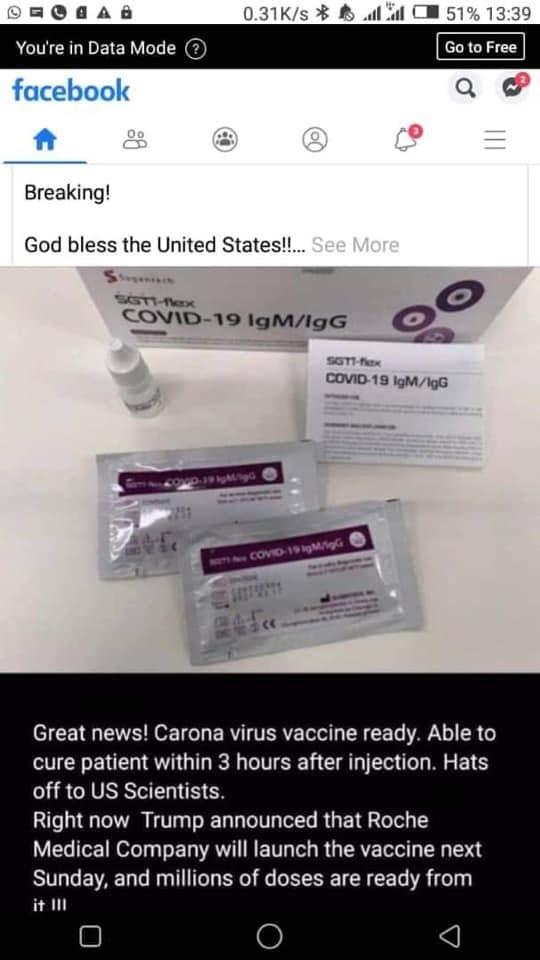
    America’s President, Donald Trump, has announced a vaccine for COVID-19 – Facebook User

    The President of America, Donald Trump, has not announced the launch of a covid-19 vaccine. The photo attached to the text is not a vaccine, but a COVID-19 test kit manufactured by Sugentech in South Korea. There is no known vaccine yet for the COVID-19 virus.

    Full text: 

    The novel Coronavirus, COVID-19, has necessitated the search for a vaccine by scientists all over the world. In the meantime, there has been a myriad of information circulating, asserting the discovery of vaccines for the virus. Among them is a Facebook post on 25 March 2020, which stated that scientists in America had discovered a vaccine that was able to ‘cure’ a coronavirus patient within 3 hours after injection.

    The post generated 38 interactions, 22 comments and 54 shares. While some user comments showed an appreciation for the discovery, other user comments interrogated how a vaccine ‘cures’ the virus instead of preventing the virus. 

    The post read: 

    Good News from President Trump of America*
    A COVID-19 Vaccine made by America now ready. Able to cure a corona virus patient within 3 hours after injection.
    Kudos to USA Scientists.
    Right now president Trump has announced that Roche Medical Company will launch the vaccine next Sunday, and millions of doses are ready for distribution to other part of the world.
    Congratulations to the world over this success news…

    The post also included the photo below:

    C:\Users\Maxine Gloria\Downloads\90595118_2794545770663278_6828803954017566720_n.jpg

    Verification: 

    Dubawa ran a Google reverse image search on the photo. We found that photo purported to be a vaccine is a COVID-19 test kit with a full name ‘SGTI-flex COVID-19 IgM/IgG’. Additionally, the search showed that contrary to the claim, the COVID-19 IgM/IgG test kit is not a product of Roche Diagnostics. The test kit was manufactured by Sugentech Inc., a company in South Korea that develops in-vitro diagnostic systems and products based on BT-IT-NT convergence technology. 

    Verifying from Sugentech’s website, Dubawa found the description of the COVID-19 IgM/IgG as “a kit for the qualitative test of COVID-19 antibody by immunochromatography’’. The website further advised that “as there is no medicine or vaccine, the best way to combat this infection is isolation”. 

    Did President Trump Announce A New Vaccine?

    Dubawa also investigated the claim that President Trump has announced that Roche Diagnostics was to launch the ‘vaccine’ on Sunday and that millions of doses were ready to be distributed to other parts of the world.

    The claim was traced to be associated with a viral video of the CEO of Roche Diagnostics, Matt Sause. In the video, Mr Sause was seen showing appreciation for the approval of new tests kits for the virus. Dubawa found that the video is an extract from an hour-long news conference held by President Trump at the White House on 13 March 2020.

    In his address, President Trump commended Roche Diagnostics for their work, as they had been given an unusually quick approval by the Food and Drug Administration (FDA) for new tests for the virus, and not for vaccines as purported. 

    “We, therefore, expect up to half a million additional tests available early next week. We’ll be announcing location probably on Sunday night,” President Trump said at the press conference (06:40 -7:26 of the video).

    The World Health Organisation has stated that there is no known vaccine for COVID-19 yet. However, possible vaccines are still under investigation.

    During the verification process, Dubawa also identified that the claim has popped up in other parts of the world and has been debunked by fact-checkers.  

    Conclusion

    The President of America, Donald Trump has not announced the launch of a vaccine. He announced the availability of new tests by Roche Diagnostics. Furthermore, the photo attached to the text is not a vaccine. It is a picture of a test kit for COVID-19 manufactured by Sugentech in South Korea. There is no known vaccine yet for the COVID-19 virus.

  • Is MTN Ghana Giving Free Data to Subscribers in Lockdown Areas?

    MTN to give free internet data to people living in lockdown areas – thebbcghana.com

    MTN Ghana is not giving free internet data to its subscribers in the locked-down communities. The message based on which the story was written is from MTN Nigeria and meant for subscribers in that country.

    Full Text:

    An article by thebbcghana.com says that one of Ghana’s leading telecommunication companies, MTN, is giving out free internet data to its subscribers living in areas affected by the lockdown. The areas are Accra, Tema and Kumasi.

    This move, according to the story, is to keep MTN subscribers in the areas updated on the latest happenings concerning the coronavirus pandemic.

    “In the same bid to keep its subscribers abreast of the latest update on the spread of the virus with in the country, MTN Ghana is offering its customers free internet data to help them get daily information about the global pandemic,” it said.

    “….this MTN free internet data is a welcome development as this will allow especially people living in the lockdown areas ( Accra, Kumasi, and Tema.) to know more about the prevention of the virus,” it continues.

    Ghana’s President, Nana Addo Dankwa Akufo-Addo last week announced a two-week restriction on movement in some parts of the country. It took effect 1 a.m. yesterday March 30th. He said a lockdown has become necessary to help curb the spread of coronavirus and also to fast-track contact tracing.

    Verification:

    Dubawa spoke to Efua Falconer, Corporate Communications Manager at MTN Ghana. She told Dubawa that the information is untrue.

    “It’s fake news”, Efua Falconer said. 

    Additional checks were conducted on MTN Ghana’s website and verified twitter page. Unsurprisingly, we found no mention of free internet data to subscribers in the said communities or any part of the country on either platform.

    Message from MTN Nigeria to Nigeria Customers

    Further research conducted by Dubawa found that the news portal misrepresented information from MTN Nigeria.

    On March 26, 2020, MTN Nigeria through their Twitter page announced that its subscribers can access information about the coronavirus pandemic on the network without data.

    Source: Twitter (MTN Nigeria)

    As seen in the image above, the post is specific to MTN Nigeria to its subscribers in Nigeria. The tweet contains a link that leads to a page on the MTN Nigeria website. On the website, three hyperlinks are shared: the World Health Organisation, the Nigerian NCDC and the Federal Ministry of Health websites. These websites are the information portals that MTN Nigeria has allowed data-free access to. Also on the page are five (5) tips for coronavirus prevention.

    Conclusion:

    MTN Ghana is not giving free internet data to subscribers in the locked-down communities in Ghana. It is rather MTN-Nigeria that is allowing free access to information on specific websites for its subscribers in Nigeria.

  • Did President John Mahama say he will not donate towards the Covid-19 fight?

    President Mahama says he will not donate his money to support Covid-19 fight – Facebook post.

    Former President John Dramani Mahama has NOT said he will not donate towards the fight against coronavirus. On the contrary, he has already made donations to the Greater Accra Regional Hospital (GARH) to help fight COVID-19. 

    Full Text:

    A Facebook post flagged to fact-checkers by Facebook claims Former President John Dramani Mahama has said he will not donate his money towards the fight against Covid-19. The post was accompanied by a picture of the Former President having a meal – jollof rice- at a dining table. 

    “I will not donate money meant for my future campaigns to support convid 19..there was no virus in my time so why must I donate my money to nana addo….mahama says,” the post reads.

    It has generated 41 shares, 57 likes and over 19 comments. Views shared on the post were varied with some proclaiming disdain at the former president while others say it is untrue. They say it is just concocted to discredit the former president.

    Verification:

    Dubawa spoke to Mr Stan Xoese Dogbe, an aide to Former President John Dramani Mahama, to ascertain the truth behind this post. Mr Dogbe said the claim is untrue.

    “That’s a false post attributed to John Mahama. Mahama has already made a donation to the Ridge Hospital in Accra. His Parliamentary candidates and MP’s are all over the country and are supporting mitigation efforts in their communities and constituencies. And he will continue to support, himself, many other institutions are working to fight COVID-19,” Mr Dogbe said.

    Various media houses and news portals have reported on the donations made by the former president to the Greater Accra Regional Hospital. See here and here.

    Coronavirus: John Mahama donates PPEs to Ridge Hospital health workers
    John Mahama presenting his donation

    The items presented by Mr Mahama included 100 full sets of Personal Protective Equipment (PPEs), 100 gumboots, 120 doctors’ scrubs, 50 patient gowns, 30 theatre gowns and 400 packs of bottled drinking water.


  • Ghana has not recorded 1,500 Coronavirus cases

    Ghana has recorded 1,500 cases of coronavirus” – Facebook post

    Ghana has not recorded 1,500 coronavirus cases. A total of 137 cases had been confirmed as at the time the claim was made – March 27, 2020. The country currently has 152 confirmed cases of coronavirus.

    Full text

    A Facebook post on 27th March 2020 at 11:31 am GMT, claimed Ghana had recorded over 1000 coronavirus cases. It has generated 300 comments, 21 shares and 306 interactions.

    “Breaking News. Ghana has recorded 1,500 cases of coronavirus,”

    the post reads.

    Although some comments blamed the incumbent government for the sudden rise of the cases, most of them showed disbelief. Some users asked for the source of information while others outrightly dismissed it as fake news. 

    The post was flagged to Dubawa as part of its Third Party Fact-checking partnership with Facebook.

    Verification

    Our verification started at the Ghana Health Service dedicated website for information on the coronavirus. According to the Ministry of Information, the  website is the only accredited website dedicated to the update of coronavirus in Ghana. It is also the official source of information and data on coronavirus in Ghana. 

    Contrary to the claim, Dubawa found that Ghana’s confirmed coronavirus cases have so far not exceeded three digits. As of the time this fact-check was being written, a total of 152 cases have been reported.

    On 27th March 2020, when the claim was made, there were two updates on the website. The first, at 9.15 am GMT, revealed that the country had recorded 136 confirmed cases – 58 from routine surveillance and 78 from travellers who have been mandatorily quarantined. The second update was at 7 pm GMT. It showed a total of 137 confirmed cases. Of the number, 59 were from routine surveillance and 78, travellers who have been mandatorily quarantined.

    This was confirmed by the John Hopkins University and Medicine which has been monitoring and updating coronavirus figures across the world – it also reported 137 cases on March 27, 2020.

    Conclusion

    Ghana has not recorded 1,500 COVID-19 cases. A total of 137 cases were confirmed on March 27, when the claim was made. There are currently 152 confirmed cases as at 30 March 2020, 8.30 am GMT.

  • Parts of Ghana To Be “Locked Down”

    The government of Ghana has imposed restrictions on movement in some major parts of the country for two weeks effective 1 a.m. Monday, 31 March 2020.

    Addressing the nation Friday evening, President Nana Addo Dankwa Akufo-Addo said stricter measures needed to be implemented to help curb the spread of coronavirus.

    “However, prevailing circumstances mean stricter measures need to be put in place to stop the spread of the virus in-country in Accra, Tema, Kasoa and Kumasi which have been identified by the Ghana Health Service as the “hotspots” of the infections,” he said.

    The President’s decision is backed by the new Imposition of Restrictions Act, 2020 (Act 1012) passed by Parliament last week despite opposition from the main opposition political party, the National Democratic Congress. The bill gives legal backings to the president’s directives as the country deals with the spread coronavirus in the country. 

    “Effective 1 am Monday 30th March, some 48 hours from now, I have imposed, pursuant to the powers granted the President of the Republic, under the Imposition of Restrictions Act, 2020 (Act 1012), restrictions on the movement of persons in the Greater Accra Metropolitan Area ( GAMA, which includes Awutu Senya East) and the Greater Kumasi Metropolitan Area and contiguous districts, for a period of two weeks, subject to review,” he said.  

    Essential service providers are exempted from the lockdown. This includes members of the Executive, Legislature and Judiciary, journalists, members of the security service assigned lawful duties, producers, distributors and marketers of food and beverages and fuel station staff.

    President Akufo-Addo also announced a COVID-19 Fund to receive contributions and donations to assist the poor and needy. He said he is donating his April, May and June salaries to the fund as seed capital.

    “I am announcing tonight the establishment of a COVID-19 Fund, to be managed by an independent board of trustees, and chaired by former Chief Justice, Sophia Akuffo, to receive contributions and donations from the public to assist in the welfare of the needy and the vulnerable. I have directed the Controller and Accountant General to pay my next three months’ salary, that is April, May and June, into this Fund,” he said.

    The country as of March 27 has recorded 137 cases of Covid-19. The majority of cases, 78, are travellers who have been mandatorily quarantined and tested following a directive by the president last week. A total of four deaths and two recoveries have so far been recorded. 

    Calls for a Lock Down

    Calls for a lockdown of the country, especially the epicentres of the disease, Accra and Kumasi, have been deafening following an exponential increase in the number of confirmed cases on Tuesday, March 24. The number of confirmed cases jumped from 27 to 53.

    The Ghana Health Service (GHS) at the time indicated the increase was as a result of tests performed on travellers who had been mandatorily quarantined following a directive by the President.

    “The sudden spike in case incidence is as a result of the mandatory quarantine and compulsory testing for all travellers entering Ghana, as directed by the president,” information on the GHS Covid-19 dedicated website explained.

    The Ghana Medical Association (GMA) lent its voice to the calls on Wednesday noting that a restriction on movement is in the country’s best interest.

    “The Lockdown though not a comfortable decision for leadership and citizens alike is a proven option backed by science and along with the other measures will ultimately be in our best interest,” the GMA said in a press statement.

    The Minister of Information, Kojo Oppong Nkrumah, had said the government was considering all available options.

    “All options are on the table. Government continues to receive advice which is subjected to analysis by experts. The decision to lockdown is not one that is taken lightly or because we’ve seen other persons doing it. Experts continue to provide advice to decision-makers,” he said at a Press Briefing on Tuesday.

  • Coronavirus: Fake Cures To Ignore

    A respiratory disease belonging to the coronavirus family, COVID-19, which started in Wuhan, China has as of March 24, 2020, spread to 195 countries.

    The disease has affected over 375,498 people and claimed over 16,362 lives globally. The hardest-hit countries have been China, Italy, United States of America, Spain and Germany.

    Ghana’s index cases of the COVID-19 were announced on March 12, 2020, and has since risen to 68. Two deaths have been recorded.

    In the wake of the fast-spreading Covid-19, a lot of misinformation about the disease is being bandied around, particularly on social media platforms such as WhatsApp, Facebook and Twitter. One central area of misinformation has been on a cure for the coronavirus.

    The World Health Organisation (WHO) says there is currently no specific treatment, drug or vaccine for the COVID-19. Patients are treated based on signs and symptoms exhibited. This has however not prevented the spread of misinformation around cures or treatment.

    DUBAWA and fact-checkers around the world have looked into hundreds of these claims and found most of them to be false.

    Here is an overview of some of the most popular coronavirus cures in Ghana.

    Chloroquine and Hydroxyl chloroquine are Covid-19 cures

    Chloroquine and its counterpart, hydroxyl chloroquine, has been all the rage following reports that it has shown some promise in curing the coronavirus. The position of the United States’ President, Donald Trump, that the drugs have shown “tremendous promise” and could be a “game-changer” has sent many stocking up on the drugs. Media reports indicate people have overdosed on the drugs and have had to receive medical treatment following these claims.

    Contrarily, there is no definitive proof that the drugs can cure or are effective against Covid-19.

    Indeed, there have been studies which suggest the drugs are ‘potential’ cures. However, these studies are not conclusive – they have drawbacks. One such research by the Méditerranée Infection University Hospital Institute in Marseille admits that their study’s limitation includes “a small sample size, limited long-term outcome follow-up, and drop out of six patients from the study.”

    On Mr Trump’s validation of chloroquine, he had said the Food and Drugs Administration (FDA) has approved the drug to treat coronavirus. The FDA said it has not. The authority issued a statement saying it is still studying its effectiveness against the disease.

    Dettol is effective against the Covid-19

    This claim has been shared extensively on social media platforms such as WhatsApp, not just in Ghana but in other parts of the world.

    It came with an image of a Dettol bottle with the word ‘coronavirus’ circled; emphasising the antiseptic’s ability to deal with Covid-19.

    The manufacturer of the Dettol,  Reckitt Benckiser Group plc(RB), says it has not yet tested its products on the novel coronavirus. Therefore, it could not confirm whether Dettol is effective against the new coronavirus strain.

    “Our products have been tested against other coronaviruses (such as MERS-CoV and SARS-CoV) and have been found to kill those. Although 2019-nCoV is a new strain, this virus is very similar to other coronaviruses. We continue to work with our partners to ensure that we have the latest understanding of the virus, route of transmission and will test our product range once health authorities make the strain available,” the producers of Dettol said.

    Garlic prevents coronavirus

    WhatsApp and Facebook have been awashed with this claim.

    There is no scientific evidence to suggest that garlic can cure or prevent Covid-19. Although garlic has shown potential benefits in treating certain conditions, it is categorised by health experts as a food supplement and not medicine. Misuse of garlic would rather result in health complications ranging from bad odour to heartburns.

    Drinking alcohol e.g. akpeteshie kills the virus; also a good substitute for hand sanitisers

    Following a shortage of hand sanitizers around the world, people are devising alternative ways of disinfection and sterilisation. Some have claimed that alcoholic bitters or spirits, in Ghana, the popular ‘akpeteshie’ can serve as a good substitute for hand sanitisers.

    This claim has been debunked by health experts. Alcoholic bitters and spirits on the market have between 40 – 50 per cent alcohol content. This is according to the WHO and the Centre for Plant Medicine Research. An effective hand sanitiser must have 60-70 per cent alcohol content.

    Also, drinking alcohol will not kill the virus. Mr Roger Ahiable, a Deputy Director of Pharmaceutical Services, Korle-Bu Teaching Hospital, tells Dubawa: “Consumption of alcohol by mouth cannot disinfect viral colonies in the respiratory system,” he said.

    “We shouldn’t cause other systematic damages by alcohol consumption while trying to prevent infection. It is not wise. It will eventually damage the immune strength of the consumer,” he adds.

    Gargling with saline solution can eliminate the coronavirus

    A viral image shared on Facebook claimed gargling with saline solution or vinegar solution will eliminate the coronavirus.

    This has been debunked by fact-checkers. Gargling with saline solution may be helpful in soothing sore throat, one of the symptoms of the coronavirus. In fact, NHS recommends gargling with warm saline water for adults suffering from sore throats. However, there is no evidence that it kills the virus.

    Indeed, the WHO, in its Q&A about coronavirus on twitter debunked a similar question of whether gargling mouthwash can protect one from COVID-19.

    Used clothes can transmit coronavirus

    “It would be better now and for your safety and that of your children to avoid the use of newly acquired used clothing.” This quote is an excerpt from a viral WhatsApp message. The text warns readers to be cautious when shopping for clothes, and not get used garments amid the pandemic. The author believes that clothes of index victims are being discarded and sold to Africans.

    There is no sufficient evidence to support this claim. While health experts have not ascertained the exact length of time COVID-19 stays active on fabrics, the WHO suggests a low probability of infection via package delivery. This rationale holds as studies show environmental changes and time affect the activeness of COVID-19; all of which are present in shipping clothing from another country.

    Adutwumwaa Bitters cure for Coronavirus

    This claim was shared mainly on Twitter.

    For some who may have seen this claim, it was a joke and not worth the time of fact-checkers. However, in an era where there is a lot of uncertainty, claims or jokes like this may be taken out of context.

    Producers of the medicine, Adumtwumwaa Herbal Industries Limited, have emphatically stated that their product cannot and does not cure the deadly virus.

    A simple guide to help you sort fact from fiction

    1. Pause and reflect before forwarding or sharing a message especially if it makes you scared, anxious or angry.  Fake news creators often want traffic to their sites and they know they can get you to help if they play on your emotions.
    2. Look out for the source of information. Ask whoever sent you the message, ‘where is this from?’ if a source is not cited. If it is, is it a credible, authoritative source?
    3. Verify or crosscheck with credible sources. Note that if it is true, it is likely to be reported by credible media outfits. For information on coronavirus, your best bet is the World Health Organisation, Ghana Health Service, reputable media outfits and fact-checkers.

    For more on coronavirus, visit https://ghana.dubawa.org/tag/coronavirus/


  • Am I At Risk of COVID-19 From Purchasing Second-hand Clothing?

    Viral WhatsApp message advises against purchasing used clothing as they expose buyers to COVID-19.

    While health experts have not ascertained the exact length of time COVID-19 stays active on fabrics, the WHO suggests a low probability of infection via package delivery. This rationale holds as studies show environmental changes and time affect the activeness of COVID-19; all of which are present in shipping clothing from another country. Furthermore, the assertion is not feasible as most countries with index cases have placed forms of travel and trade restriction.

    Full Text

    “It would be better now and for your safety and that of your children to avoid the use of newly acquired used clothing.” The quote mentioned above is an excerpt from a WhatsApp message we received last week. The text warns readers to be cautious when shopping for clothes; to get new and not used garments amid the pandemic. The author believes that clothes of index victims are being discarded and sold to Africans.

    WhatsApp Message

    It further advises readers to share the message as much as possible to get to other people. While this message seems almost logical, a sceptical mind wonders how reasonable its inferences are. Let’s move away from speculations and find out what the facts hold.

    Verification

    Firstly, the World Health Organization (WHO) states that a carrier of COVID-19 can infect another person through droplets from either sneezing or coughing; the other is at risk if said droplets touch eyes, nose or mouth.

    From this, we understand that a person can not contract COVID-19 by merely touching infected surfaces and objects, but by putting the contaminated hand in his mouth, nose or eyes.

    How long does the virus stay on surfaces and the objects they infect?

    The next logical verification step is ascertaining the viruses “shelf life” on surfaces. For this, several pieces of research surmise different durations ranging from hours to days. Further, the WHO suggests COVID-19 behaves similar to other coronaviruses in that factors like the type of surface, temperature and humidity play a role in the duration of its viability, post transmission.

    A BBC publication spoke to this fact. The report referenced studies which show that SARS, MERS, and other coronaviruses without disinfection, can survive on metal, glass and plastic for as long as nine days. The article further added that in low temperatures, some of the viruses could remain for 28 days.

    The column also refers to a study in the New England Journal of Medicine which compares the stability of SARS-COV-1 and SARS-COV-2 in five environmental conditions (aerosols, plastic, stainless steel, copper, and cardboard).

    From the research work, BBC deduced that COVID-19 could survive in droplets for up to three hours after being coughed out into the air but goes extinct on copper after four hours. The virus can live longer on cardboard – up to 24 hours – and up to 2-3 days on plastic and stainless-steel surfaces.

    Unanswered questions and WHO’s Advice

    As established in the preceding, research is still ongoing, and no research pieces are explaining how long the infection stays on clothing. 

    Nonetheless, the WHO already issued advice for this sort of situation.

    ‘If you think a surface may be infected, clean it with simple disinfectant to kill the virus and protect yourself and others. Clean your hands with an alcohol-based hand rub or wash them with soap and water. Avoid touching your eyes, mouth, or nose.’

    World Health Organisation

    Inference and “common sense.”

    Furthermore, the WHO suggests a low probability of infection via package delivery from an infected area. This assertion sits right within such parameters.  

    ‘The likelihood of an infected person contaminating commercial goods is low, and the risk of catching the virus that causes COVID-19 from a package that has been moved, travelled, and exposed to different conditions and temperature is also low.’

    World Health Organisation

    Going by this, the risk if any of COVID-19 transmission from these clothes is low; seeing as their transport would involve different weather conditions and environments, not to mention a length of time. 

    More so, the fact that many affected countries have closed their borders rules out this possibility. Nigeria for one had imposed travel bans and suspended international flights from its Lagos and Abuja international airports. 

    Last Resort

    Let’s assume for a second that these infected clothes still make their way to a customer, what then? The consensus for second-hand clothing is to wash before use. This rationale holds for the average Nigerian. Following the WHO’s advice on disinfecting surfaces and regular handwashing as safety methods, one can easily infer washing clothes could eliminate the risk just as well. Still, this is all inference and logic. Going by facts, the probability of this is slim to none.

    Regardless, best practices regarding personal hygiene have never been more imperative. Regular hand washing and clothes washing; leaving in a clean environment via disinfection; all go a long way to keeping you and your family safe during this pandemic.

  • Coronavirus: Ghana’s Case Count Rises To 52

    Ghana’s coronavirus case count has risen to from 27 to 52. This was disclosed by the country’s Minister for Health, Mr Kwaku Agyemang-Manu, at a press briefing Tuesday morning.

    The 25 new cases were confirmed after respiratory residue samples taken from travellers who have been mandatorily quarantined tested positive. 

    According to Mr Agyemang-Manu, 1030 travellers had been mandatorily quarantined since Sunday. Out of the number, residue samples have been taken from 611. After completing testing on 185, about 14 per cent, 25, tested positive.

    “Out of the 185 test results received, we have 25 of those quarantined tested positive. If we add on to the earlier number of 27, it means we have 52 people testing positive in our country at the moment,” Mr Agyemang-Manu said.

    The Minister for Information, Mr Kojo Oppong Nkrumah, said testing is still ongoing for travellers who have been quarantined.

    Ghana’s index cases of the novel coronavirus, Covid-19, was announced on March 12, 2020. Subsequent to that, two deaths have been recorded. 

    Mandatory Quarantine and Border closure

    Ghana’s President, Nana Addo Dankwa Akufo-Addo had on Saturday, March 21, 2020, directed a total closure of all its borders to human traffic with effect from Sunday, March 22, 2020. The president said the move was to aid prevent the spread of the Covid-19.

    “All our borders, that is, by land, sea and air, will be closed to human traffic for the next two weeks beginning midnight on Sunday,” he said.

    Travellers who arrive before the directive took effect were to undergo mandatory quarantine and Covid-19 testing.

  • Video of Zimbabwe Police Brutality not Related to Coronavirus

    Zimbabwe Police Use force to Dispel Recalcitrant Churches – Viral Whatsapp messages

    False; the video is neither related to the coronavirus nor church activities. It is a November 2019 video of Zimbabwean police dispersing supporters of the main opposition political party.

    Full Text

    A video circulating on social media shows Police officers chasing and beating up men and women with batons. 

    “Zimbabwe Police dealing with the church that refused to take instructions of closing for Corona virus (Koro),” the caption of the video on Whatsapp reads.

    For a section of Ghanaians, churches who flout President Akufo-Addo’s directives on mass gatherings should suffer the same punishment.

    The President last week banned public gatherings and suspended schools in a bid to stem the spread of the novel coronavirus, Covid-19.

    The video has been shared on several WhatsApp pages, on Instagram and on Twitter. Whatsapp users who shared it with Dubawa say it was also part of a news item by a popular television station.  

    Verification

    Yes, the video was taken in Zimbabwe. And yes, it shows Police using force and brutality against members of the public.

    However, it is neither related to the coronavirus nor to any religious activity or group. 

    A 2019 news report by Reuters explains that the incident occurred on November 20, 2019, and shows brutality meted on supporters of Zimbabwe’s main opposition political party, Movement for Democratic Change (MDC). The supporters had gathered at their party headquarters to listen to a speech by their leader Nelson Chamisa on November 20, 2019.

    Additionally, news organisations including the Guardian news and Aljazeera also carried the story last year.

    To further verify, DUBAWA contacted Zimfact, a fact-checking platform in Zimbabwe. 

    “This was police breaking up opposition supporters, Nov 20, 2019,” Zimfact said.

Back to top button