The parliamentary election for the Kpandai Constituency, like all the other constituencies, was held on December 7, 2024. According to the Electoral Commission (EC), the results showed that Matthew Nyindam of the New Patriotic Party, NPP, won with 27,947 votes while Daniel Nsala Wakpal of the National Democratic Congress, NDC, had 24,213 votes.
However, Mr Wakpal challenged the results at the Tamale High Court. He alleged serious irregularities in the conduct, collation, and documentation of the election. Central to his case was that in 41 out of the 152 polling stations, the official “pink sheets” contained inconsistencies and irregularities, breaches of electoral laws.
Moreover, Mr Wakpal’s petition accused the EC of moving the constituency collation centre without notifying candidates or agents, meaning he was deprived of the right to observe collation, challenge anomalies, or request recounts as provided under law.
The irregularities cited included mismatches in voter accountings, missing or unsigned forms, and missing vote totals, among others, all of which, the petitioner argued, undermined the integrity and fairness of the election in Kpandai.
Court’s Decision: What the Judgement Was
On November 24, 2025, the Tamale High Court, led by Justice Emmanuel Brew Plange, delivered its judgment. The Court concluded that the irregularities and non-compliance with electoral regulations, especially in the 41 polling stations challenged, were serious enough to affect the outcome.
As a result, the Court nullified the entire 2024 parliamentary election results for Kpandai. It ordered a fresh parliamentary election rerun in the constituency, instructing the EC to hold the new poll within 30 days.
Meanwhile, the Parliament of Ghana has been unable to declare the Kpandai seat vacant because, under the Court of Appeal rules, there is a statutory automatic 7-day stay of execution once a High Court ruling is appealed. This was highlighted by the Speaker of Parliament, Alban Bagbin, in a Facebook post.
Since Matthew Nyindam has appealed the case to the Supreme Court, the Kpandai seat can’t be declared vacant until the Supreme Court concludes the matter. Meanwhile, the Supreme Court is expected to hear the matter on Tuesday, December 16, 2025.
Reactions from Political Actors
The NDC has welcomed the ruling, saying it exposed “crooked electoral officers” and vindicated calls for electoral accountability.
By contrast, the NPP has condemned the decision. They argue that only 41 out of 152 polling stations were challenged, making a complete rerun of the entire constituency inconsistent and an affront to voters’ will.
Conclusion
The High Court’s ruling to annul the entire parliamentary result and order a rerun has sparked sharp political disagreement. As the case moves to the Supreme Court, the outcome will not only determine who represents Kpandai in Parliament but will also set a significant precedent for how electoral irregularities are addressed in Ghana’s democracy.
Claim: Multiple social media users shared a video in which John Mahama reiterated that stopping “galamsey” will affect gold exports and unemployment.
Verdict: True. DUBAWA’s findings reveal that Mahama made these comments at a campaign outing on Sept. 9, 2024 before the election.
Full Text
Illegal mining, locally known as galamsey, has become a national threat in Ghana. Environmental activists have warned of its dire consequences on our water bodies and forest reserves. Multiple protests have been staged to pressure the government to declare an emergency. Many believe a state of emergency in areas where illegal mining is thriving will at least halt its devastating effect.
Amidst national discussions on galamsey, multiple social media users shared a video of Mahama saying that stopping galamsey will affect gold exports and employment generation.
An X user, @_Fiifi_Sage, shared the video in a post with the caption, “Y’all listen to John Mahama and tell me if he has any interest in ending Galamsey.”
On Facebook, Enoch Kofi Nyarkoh shared the same video with the caption, “Why are people ‘moaning’ about this statement Mahama made:
‘If it’s from illegal sources or it is from legal sources, at least it is our land that is being destroyed, so let us get the benefit of it instead of foreign traders.’
Even before he assumed office officially, he told you that fighting galamsey was going to cost the country gold purchases and employment.”
At a time when distress calls are annoying for the government to implement emergency measures to curb the menace, some social media users have expressed shock at the comments made in the video. Some think the video has been manipulated, whilst others believe it to be true and have used that as basis to criticise the government’s commitment to fighting galamsey
Did Mahama make these comments? If true, when did he make such comments? These questions and many more prompted DUBAWA to probe the veracity of the video.
Verification
DUBAWA, using InVidWeVerify, conducted keyframe analysis of the video trending on social media with Mahama making the galamsey comments. Reverse image searches with the keyframes revealed that the video is from a Mahama campaign outing on Sep. 9, 2024.
Like the recent trending video with GhOneTV’s stamp, the video was uploaded to the media outlet’s YouTube page and on X. The video was captioned “We must sacrifice in the fight against galamsey- Mahama” and “we must be prepared to sacrifice in the fight against galamsey- John Dramani Mahama (NDC flagbearer)” on YouTube and X, respectively.
For avoidance of doubt, this is the translation of what Mahama said in Akan:
“It is a brutal fight, I won’t lie. But it needs bravery, because just like I reiterated, 1. Gold is the one holding Ghana now. And it is because of galamsay that we moved from 80 tonnes per year to 135 tonnes this year. The additional tonnes, a lot of which come from Galamsey. So we must be prepared to sacrifice in the fight against galamsey and expect production to come down. It means that exports will “reduce.”
And then also, the issue of employment. It is because of unemployment that the majority of the youth are involved in galamsey. The fight against galamsey will result in a lot of young people who currently are surviving with galamsey will also get unemployed. Those are two consequences I am putting on the table before we start the fight. We should all accept that the risks are worth the effort.”
He added the need to secure and restore the nation’s depleted forest reserves and water bodies.
Conclusion
The claim that Mahama said the fight against galamsey would affect gold exports and unemployment is true. The video circulating on social media is not manipulated but from a campaign outing in Sept. 2024.
Claim: A Facebook user shared a flyer alleging that Shamima Muslim has asked that people stop calling on President John Mahama to stop “galamsay.”
Verdict: False. The flyer is fabricated, and the claim is false, as Shamima and NewsAfrika have denied the claim and the flyer.
Full Text
A Facebook user, Jennifer Oforiwaah Queen, shared a flyer in a post suggesting that Shamima Muslim has called on people to stop pressuring the president to stop illegal mining when there are state agencies responsible for that.
The Facebook user captioned the post “Just imagine.”
A screenshot of the flyer.
As of Sep. 20, 2025, the post had garnered 411 reactions, 878 comments, and 61 shares, with several others vilifying the governing National Democratic Congress (NDC)’s communications team member.
DUBAWA decided to investigate the flyer because it could influence conversation about the trending illegal mining issue, locally known as “galamsay” in Ghana.
Verification
DUBAWA conducted a Google keyword search to ascertain whether there had been any publications on the issue.
Seeing that the flyer cited NewsAfrika as its source, DUBAWA thoroughly checked all NewsAfrika pages on social media for the flyer dated “26th February, 2025,” but found none.
We further contacted NewsAfrika to ascertain if the flyer emanated from their outlet. Evans Oppong, the owner of NewsAfrika, confirmed that the flyer did not emanate from him.
“This is not from NewsAfrika,” he stated in his response to the researcher.
We also found that Shamima Muslim, the current government spokesperson, in a Facebook post described the viral flyer as fake and asked her followers to disregard it.
“The NPP hatchet conveyers of fake news have started again,” she stated, tagging the flyer as “fake.”
As of the time of this publication, no major news outlet had reported on Shamima making such comments.
Conclusion
The flyer alleging that Shamima has urged people to call on state agencies to stop “galamsay” rather than the President is fabricated.
Claim: The National Vice Chairperson of the National Democratic Congress (NDC), Sofo Azorka, has claimed that the Ghana Police Service did not invite Minority Leader Alexander Afenyo-Markin after he allegedly slapped a police officer during a confrontation.
Verdict: False. Contrary to Sofo Azorka’s claim, the police did, in fact, invite Alexander Afenyo-Markin to assist with investigations into the alleged incident.
Full Text
NDC Vice Chairperson Sofo Azorka has alleged that the Ghana Police Service failed to invite Majority Leader Alexander Afenyo-Markin after he allegedly slapped a police officer during a May 2025 protest in Accra.
In a viral video, Azorka said: “Afenyo Markin slapped a security officer on duty as Majority Leader, but wasn’t invited. A civilian has slapped another civilian, and you’re inviting them. What is all this? It doesn’t make sense.” The video, shared by Facebook users including Ajavuuk Ayan and Newsfluence, has attracted over 30,000 views and hundreds of interactions.
Azorka’s claim, however, emerged amid heightened political tensions, including an earlier confrontation in Akwatia during a September 2 by-election, where one of his escorts allegedly slapped NPP Vice Chairperson Alhaji Osman Masawudu. Though Azorka was not the one who slapped him, calls mounted for the police to question him as the leader of the group.
Verification
DUBAWA’s checks show that the claim by the NDC’s National Vice Chairperson, Alhaji Sofo Azorka, is false. The Ghana Police Service, in a statement published on its official Facebook page on May 5, 2025, confirmed that Majority Leader Alexander Afenyo-Markin had been formally invited to assist with the investigations.
The statement directly addressed the incident, noting that Afenyo-Markin had been questioned as part of the investigative process. Multiple credible outlets, including Graphic Online,3news, and Citinewsroom, also reported on the police invitation. These reports clearly contradict Azorka’s claim.
Conclusion
Sofo Azorka’s claim that the police failed to invite Alexander Afenyo-Markin after allegedly slapping a police officer is false. Official police communication and media reporting confirm that the Majority Leader was invited as part of the investigative process.
Ghana’s 9th Parliament has suffered two significant losses since its inauguration on January 7, 2025, barely eight months after the December 7, 2024, General Election.
The then-ruling New Patriotic Party (NPP), which lost the presidential election, also saw its parliamentary strength shrink from 137 lawmakers to 88 – a net loss of 49 seats.
Meanwhile, the opposition National Democratic Congress (NDC), buoyed by the country’s economic challenges, won the presidency with John Dramani Mahama and secured 184 out of the 276 parliamentary seats, giving it a comfortable majority.
Death of two Ghanaian lawmakers within the 2025 3rd Quarter
The third quarter of 2025 has been particularly tragic for Parliament, with the deaths of two sitting MPs, forcing the country into two by-elections in less than a year.
On July 7, 2025, Ernest Yaw Kumi, the 41-year-old MP for Akwatia, died suddenly of suspected cardiac arrest. A first-time legislator, he was among the 88 NPP MPs in the current Parliament.
The Electoral Commission has scheduled a by-election for September 2, 2025, with the NPP and NDC fielding candidates.
Less than a month later, tragedy struck again on August 6, 2025. Ibrahim Murtala Mohammed, MP for Tamale Central and Minister for Environment, Science and Technology, died in a military helicopter crash in the Ashanti Region alongside eight others. They included Defence Minister Dr. Edward Omane-Boamah, Deputy National Security Coordinator Alhaji Muniru Mohammed, former Minister Dr. Samuel Sarpong, politician Samuel Aboagye, and three members of the Ghana Armed Forces.
Although the Electoral Commission has yet to set the date for the Tamale Central by-election, the NPP has already announced its withdrawal.
What Ghana’s 1992 Constitution says about vacancies in Parliament
Article 97 of Ghana’s 1992 Constitution lists the circumstances under which a parliamentary seat becomes vacant. These include:
If the MP is elected Speaker of Parliament.
If the MP is absent for fifteen sitting days without written permission from the Speaker.
If the MP resigns or crosses the floor to another party.
If the MP is found guilty of an offence punishable by death or imprisonment for at least ten years.
If the MP is expelled from Parliament for contempt.
If any circumstances arise that would disqualify him if he were not an MP.
And, as in the current cases, if the MP dies in office.
Article 112(5) further mandates that:
“Whenever a vacancy occurs in Parliament, the Clerk to Parliament shall notify the Electoral Commission in writing within seven days after the vacancy occurred, and a by-election shall be held within thirty days after the vacancy occurred.”
However, Article 112(6) makes an exception: no by-election shall be held within three months before a general election.
Whose duty is it to declare a vacancy in Ghana’s Parliament?
The issue of which institution has the authority to declare a parliamentary seat vacant became controversial in late 2024.
The then-Speaker Alban Bagbin declared four seats vacant after their occupants filed to contest the elections as independent candidates. However, the Supreme Court overturned his decision after then-Majority Leader (now Minority Leader) Alexander Afenyo-Markin challenged it. Mr Bagbin is currently heading the 9th Parliament.
Under Article 99(1), the High Court is empowered to determine the validity of a parliamentary election and whether a seat has become vacant. This provision generally applies to contentious vacancies, such as when an MP resigns from their party or caucus.
The process is more straightforward in non-contentious cases, such as death. Parliament, through the Clerk, must notify the Electoral Commission within seven days to organise a by-election.
Conclusion
It has now been 21 days since the tragic death of Ibrahim Murtala Mohammed. What remains unclear is whether the Clerk to Parliament has formally notified the Electoral Commission of the vacancy, as required by law, to pave the way for a by-election in Tamale Central.
Ghana’s 1992 constitution stipulates that the Electoral Commission (EC) holds a by-election when a seat becomes vacant due to the unfortunate demise of a sitting Member of Parliament (MP). Ernest Yaw Kumi, MP for Akwatia, died on July 7, 2025. Per Article 112 (5) of Ghana’s constitution, the EC will hold a by-election on September 2, 2025.
Presenting the constituency’s history highlights, electoral facts, and information will help prevent misinformation and disinformation.
Electoral History of Akwatia
Akwatia is in the Denkyembour district in the Eastern Region of Ghana. It is one of the constituencies represented in the Parliament of Ghana. The political records indicate that the New Patriotic Party (NPP) and the National Democratic Congress (NDC) have dominated parliamentary seats since it was created in 1992. Several notorious instances of electoral violence have marked the intense competition between the two parties. Elections in the constituency have seen scenes of persistent intolerance by the two major parties.
MPs so far
Since the inception of Ghana’s fourth republic, electorates in the constituency have been represented by different members of parliament. From 1992 to the present, Akwatia has been represented by four MPs from both parties.
Duration
Member of Parliament
Political Party
1992 – 1996
Gilbert Kwasi Agyei
NDC
1996 – 2000
Alhaji Mohammed Erzuah Siam
NDC
2000 – 2004
Kinston Akomeng Kissi
NPP
2004 – 2008
Kinston Akomeng Kissi
NPP
2008 – 2012
Kofi Asare
NPP
2012 – 2016
Baba Jamal Mohammed Ahmed
NDC
2016 – 2020
Mercy Adu-Gyamfi
NPP
2020 – 2024
Henry Boakye Yiadom
NDC
Table Source: DUBAWA
The 2024 parliamentary election in Akwatia was keenly contested, with Ernest Yaw Kumi emerging as the winner. However, his victory was challenged in court amidst other legal issues, including a conviction for contempt delivered by the Koforidua High Court in February 2025. The Supreme Court of Ghana overturned his conviction for contempt on June 11, 2025. Unfortunately, he died on July 7, 2025.
Akwatia’s Parliamentary facts and figures
According to data from the EC, the Akwatia Constituency had 52,328 registered voters as of Dec. 2024. Of those, 19,269, representing 52.83%, voted for the NPP parliamentary candidate, while 17,206, representing 47.17%, voted for the NDC candidate. Previous parliamentary candidates have won with 49%, 52%, 50%, 57%, and 52% in 2000, 2004, 2012, 2016, and 2020, respectively.
Table source: DUBAWA
History of violence at Akwatia
In 2008, a keenly contested parliamentary election in Akwatia resulted in violence. The contest was between the then Baba Jamal Mohammed Ahmed and Kofi Asare. Violence erupted during the Dec. 7, 2008, elections with “macho men” tampering with ballot boxes of parliamentary polls. The EC was unable to declare parliamentary results for the constituency. The Supreme Court ordered the EC to conduct the election for six affected polling stations on August 18, 2009.
With recent electoral violence during the Ablekuma North rerun, several key political figures have made comments suggesting violence at the Akwatia by-election.
Moments after presenting a petition to the president, John Ntim Fordjour made remarks on electoral violence and how there could be “bloodshed” at Akwatia if care is not taken.
“We want to send a strong signal that if the president wants to continue his inaction in bringing the perpetrators to book, arresting them, persecuting them, there’s going to be bloodshed in Akwatia and future elections,” he said in an interview.
Measures to curb violence at Akwatia
Isaac Tetteh Yorhunu, Inspector General of the Ghana Police Service, has promised maximum security ahead of the September 2 by-elections.
“Our eyes are red for Akwatia; nobody should think of coming to cause trouble. No political party should mobilise men to come and foment trouble. And nobody should have in mind the intention of snatching a ballot box. We have prepared our men adequately to handle the situation,” he said in an interview.
The police have deployed a 600-man advanced team to Akwatia to gather intelligence to ensure that the by-election is free, fair, and free of violence.
Conclusion
As the Akwatia by-election approaches, staying upbeat with electoral facts is key to curbing electoral misinformation and disinformation.
Claim: A former Kumasi Metropolitan Chief Executive, Samuel Pyne, has claimed that since 1992, no National Democratic Congress (NDC) government has started and completed a project in the Ashanti Region.
Verdict: False. Internet search results show several projects initiated and completed under previous NDC administrations.
Full Text
A former Kumasi Metropolitan Chief Executive, Samuel Pyne, has claimed that no NDC government has started and completed a project in the Ashanti Region since 1992.
The New Patriotic Party (NPP) and the National Democratic Congress (NDC) have argued over which party has outperformed the other in terms of infrastructure development in the Ashanti Region.
The two major political parties have made claims here, here, here, and here, either accusing each other of neglecting the NPP stronghold or asserting a superior infrastructure record.
During his recent Thank You Tour of the region, President John Dramani Mahama promised to complete stalled projects, including Phase II of the Kejetia Market and the Suame interchange.
In a discussion on Asempa FM’s Ekosiisen program, Mr Sam Pyne, as he is popularly called, challenged the NDC’s infrastructure record in the Ashanti Region and dared the party to name a single project it started and completed since 1992.
“They didn’t complete the Kumasi Kejetia phase one project. It was Akufo-Addo’s time that we completed it. The market was commissioned in 2019 to become operational. If you had completed it, do you think NPP would have closed it for two years before making it operational?”
“When they (NDC) came to power, they said they would construct hospitals; ask them to mention one single hospital they completed in the Ashanti Region. When you’re travelling by air and you get to Asokore Mampong, the standard of skyscrapers you see there, whose handiwork is it? Under Dr Addo Kufuor, the NPP started it and came back to complete it. What has the NDC started and ever completed in the Ashanti Region? From 1992 to date, NDC has not started a project and completed it. Not a single project. I dare them to give me one single project,” Sam Pyne stated at 4:05 minutes of the video.
The claim was posted on Asempa FM’s social media platforms here and here and was also shared by social media users here, here, and here.
Due to the claim’s potential to mislead the Ghanaian public and the individual behind it, DUBAWA decided to investigate it.
Verification
To verify the claim, DUBAWA conducted thorough internet searches for projects in the Ashanti Region and their commencement, completion, and/or inauguration periods.
The search results display publications related to the inauguration of projects by the previous NDC administration.
For instance, on May 4, 2014, President Mahama inaugurated a $21.6 million Water Supply Rehabilitation and Expansion Project in Mampong, Ashanti Region. According to media reports, this project was initially established in 1961 to serve a population of approximately 20,000.
The project began in 2011 during the late President Mills’ NDC administration and was completed in 2014 under the first term of President Mahama.
In addition, in the run-up to the 2012 elections, the NDC promised to build 200 community day Senior High Schools across the country. In 2014, President Mahama broke ground for the project. The search results indicate that several E-Blocks, as they came to be known, were inaugurated at Pakoso in the Asokore-Mampong municipality, Adugyama in the Ahafo-Ano South District, and Adobewora in the Atwima Mponua District of the Ashanti Region, as reported here, here, and here.
Conclusion
Based on the above, it is clear that the NDC has initiated and completed projects in the Ashanti Region. Therefore, the claim is false.
Former Deputy Finance Minister Dr. Stephen Amoah has sparked a conversation with a bold comparison of Ghana’s economic performance under the NPP in the last quarter of 2024 and that of the NDC in the final stretch of 2016.
In a video published by TV3 on his reaction ahead of the mid-year budget review, Dr. Amoah claimed the NPP’s Q4 2024 economic indicators were not just good but better than what the NDC recorded in 2016.
He said, “In the 2024 last quarter macroeconomic indicators, Ato Forson came and presented the macroeconomic indicators, and about 80 to 90 per cent of them showed we were doing better than the NDC in 2016. GDP, primary balance… even inflation was reduced from 54.1% to about 23%. That’s way higher than the 15.4% we inherited in 2016. Even if inflation had been 54% and we’ve been able to reduce it to 23%, it means that they inherited a situation that had already taken shape.”
The statement has since been published on Facebook, attracting over 200 reactions and more than 4,000 views as of the time of writing this report. But how valid is this claim? DUBAWA decided to verify it by using official data from the Ghana Statistical Service to examine two key indicators: GDP, primary balance, and inflation.
Claim 1: Inflation dropped from 54.1% to 23% under NPP
Verdict: True. Inflation data from the Ghana Statistical Service shows that the inflation rate stood at 54.1% in December 2022 and was reduced to 23.8% in December 2022.
Indeed, inflation did drop by more than half within that period, as Dr. Amoah had suggested. However, the 15.4% inflation rate the NPP inherited in 2016 was much lower. So, while the drop was impressive, the final rate was still higher than what the NPP inherited from the NDC in 2016.
Claim 2: GDP growth was stronger in the fourth quarter of 2024 than in 2016
Verdict: False.Quarterly data on GDP growth from 2013 to 2025, as reported by the Ghana Statistical Service, showed that the last quarters of 2016 and 2024 experienced GDP growth rates of 5.4% and 3.6%, respectively.
Verification
GDP growth is one of the most important indicators of economic health, and here’s what the data from the Ghana Statistical Service shows.
In the fourth quarter of 2016, the NDC’s GDP growth was 5.4%.
Source: GSS
In the same period of 2024, under the NPP, it was 3.6%.
On page 15 of the document, quarterly data on GDP growth from 2013 to 2025 have been made public, with data for 2016 and 2024 indicated. So, contrary to the claim, the economy grew faster in the last quarter of the NDC administration in 2016 than during the NPP’s previous quarter in 2024.
Conclusion
While Dr. Stephen Amoah’s assertion on inflation decline under the NPP is largely accurate, his broader comparison of Ghana’s macroeconomic performance between Q4 2024 and Q4 2016 is misleading. Official data from the Ghana Statistical Service reveals that, although inflation fell significantly under the NPP, it remained higher than what the NDC handed over in 2016. More critically, GDP growth, a central measure of economic strength, was stronger in the final quarter of the NDC administration than in the NPP’s.
The Akwatia Constituency remains one of Ghana’s most hotly contested swing seats, with the New Patriotic Party (NPP) and the National Democratic Congress (NDC) alternating victories over the years. Following the sudden death of MP Ernest Yaw Kumi, the question that arises is, what is next? What happens to his seat, and what does the constitution say regarding that?
Who is Ernest Yaw Kumi?
Ernest Kumi, the late Member of Parliament for the Akwatia Constituency, passed away on July 7, 2024, after a short illness. He was born on Wednesday, December 5, 1984. Before entering Parliament, he served on the Eastern Regional Finance Committee and was active within the NPP’s communications machinery.
What the constitution says
When a sitting Member of Parliament (MP) dies in Ghana, the Speaker of Parliament officially declares the parliamentary seat vacant, by Article 112(5) of the 1992 Constitution. Following this, the Clerk of Parliament notifies the Electoral Commission (EC) in writing, prompting the Commission to initiate preparations for a by-election. As the Constitution stipulates, the Clerk of Parliament must notify the EC within seven days of the vacancy, and a by-election must be held within thirty days.
The Electoral Commission then announces the date for the by-election, opens nominations for prospective candidates, and oversees the entire electoral process, including campaigning, voting, counting, and the declaration of results. Once a winner is determined, the elected individual is sworn in as a Member of Parliament to serve the remainder of the term.
However, if the vacancy occurs less than three months before a general election, no by-election is conducted, to avoid logistical and financial constraints so close to national polls.
“Whenever a vacancy occurs in Parliament, the Clerk to Parliament shall notify the Electoral Commission in writing within seven days after the vacancy occurred, and a by-election shall be held within thirty days after the vacancy occurred. Notwithstanding clause (5) of this article, a by-election shall not be held within three months before the holding of a general election,” Article 112(5) of the 1992 Constitution states.
Political History
In 1992, the NDC’s Gilbert Kwasi Agyei won the seat unopposed due to a boycott by the NPP. Four years later, the NDC retained it with Mohammed Erzuah Siam, who polled 52.9% of the vote.
But 2000 marked a significant shift. The NPP, riding a nationwide victory wave, flipped the seat with Kiston Akomea Kissi, who held on through the 2004 polls.
Tragically, Ernest Kumi’s tenure was cut short just months into office by his sudden death, triggering the constitutional process for a by-election.
Conclusion
The passing of Ernest Yaw Kumi now leaves the seat vacant once again, setting the stage for another politically charged by-election. The NPP and NDC will likely throw their full weight behind the contest. In a constituency where allegiances shift, local dynamics matter, and every vote counts, Akwatia remains not just a mining town but a political jewel, unpredictable, fiercely contested, and forever pivotal.
When President John Dramani Mahama was sworn into office on January 7, 2025, he promised a responsive, accountable, and progressive government. However, six months into his administration, a troubling loophole exposed Ghanaians to outdated or misleading information.
An Open Source Intelligence (OSINT) investigation conducted by DUBAWA revealed a disturbing pattern: websites belonging to key government bodies are outdated, under maintenance, or broken, and in some cases, misinform the public with obsolete data.
The findings point to a systemic failure to maintain accurate and up-to-date digital channels, which risks compromising transparency and citizen access to information.
DUBAWA audited dozens of government portals. What we found wasn’t silence but active misinformation: outdated maps, images, names of old ministers, dead links, and even domain hijacks.
One of the most striking examples of misinformation through neglect is on TouringGhana.com, a public-facing website managed by the Ghana Museums and Monuments Board (GMMB), under the Ministry of Tourism, Culture, and Creative Arts.
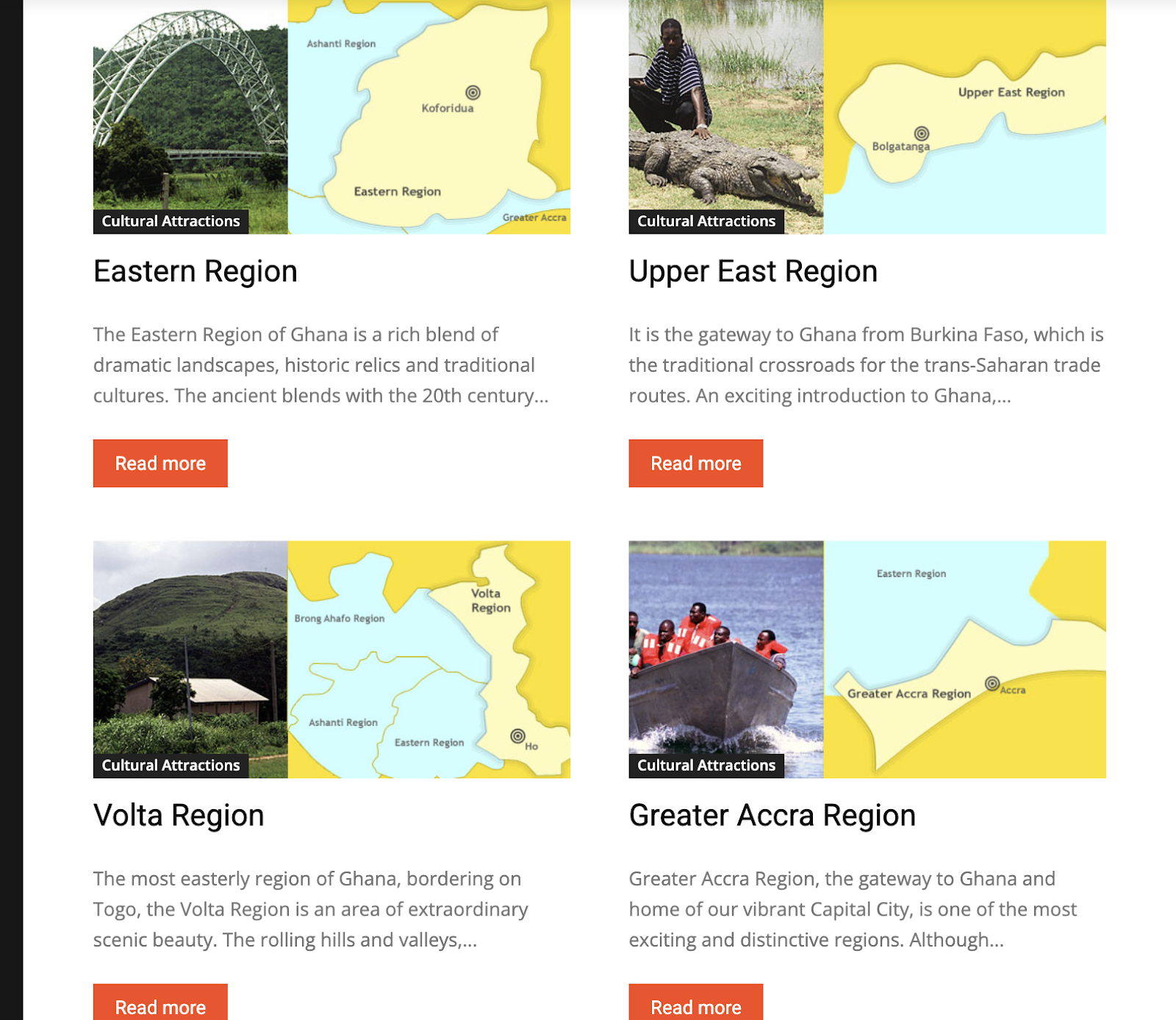
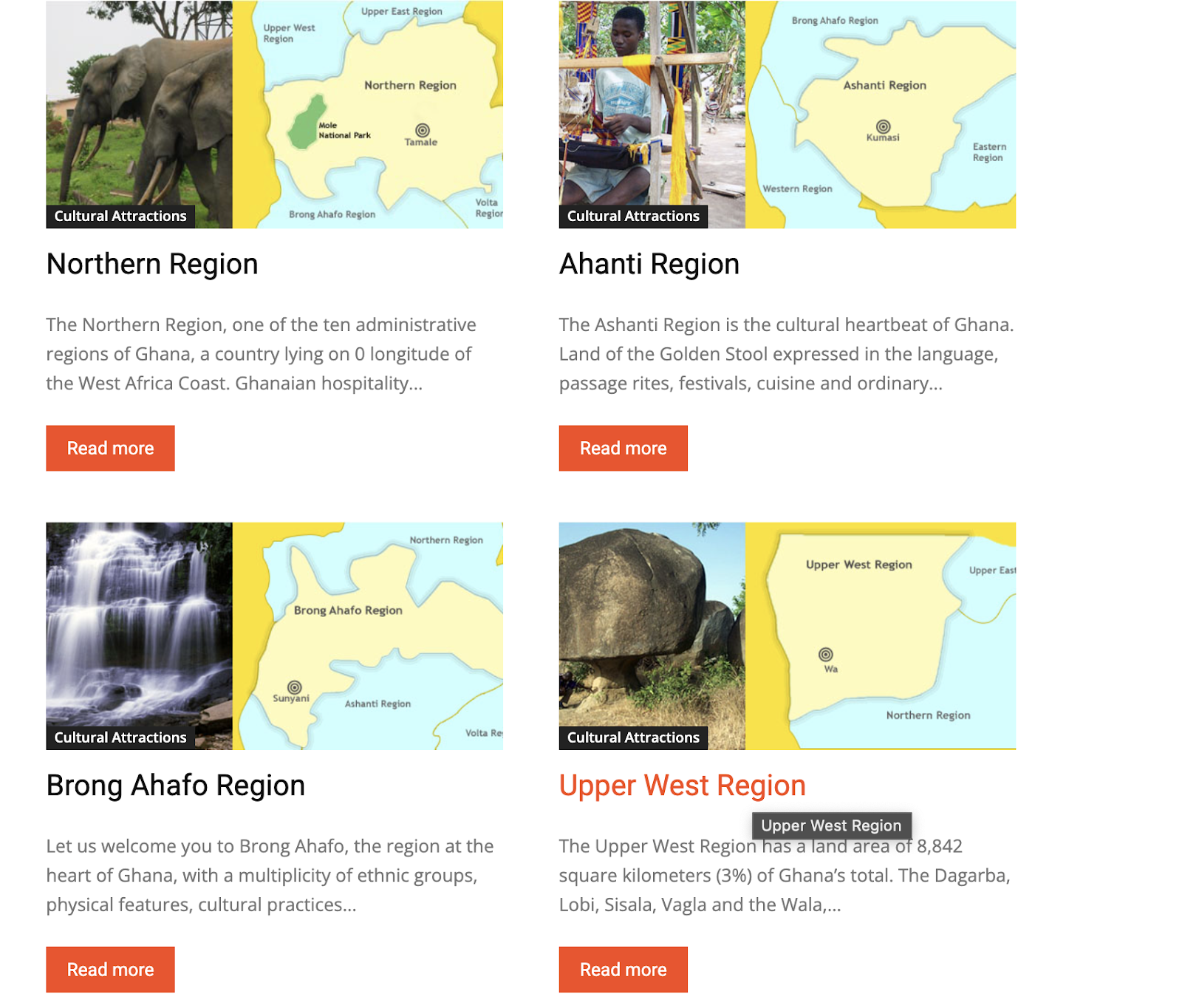
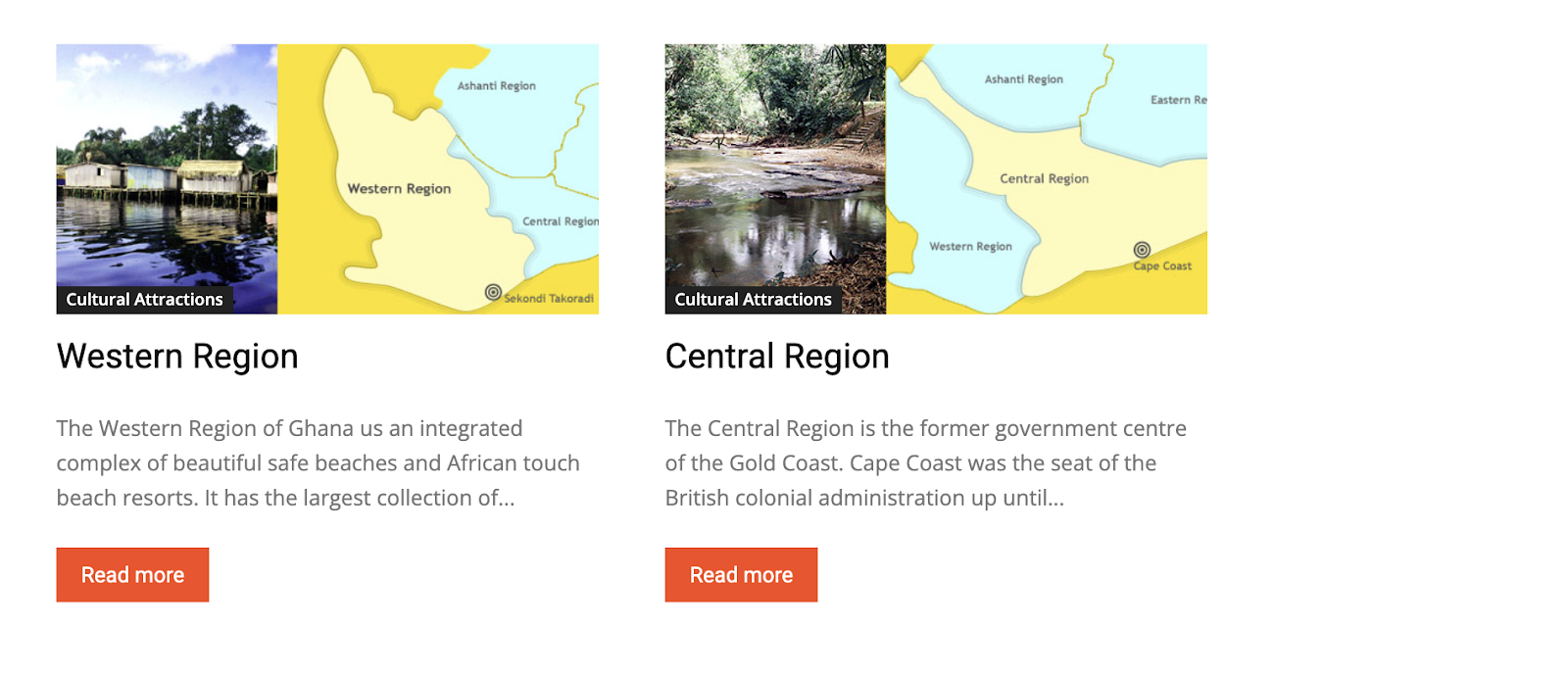
On its “Highlights by Region” page, the site still lists only 10 regions, a glaring inaccuracy, considering Ghana officially expanded to 16 Regions in 2019.
Screenshots of the 10 regions
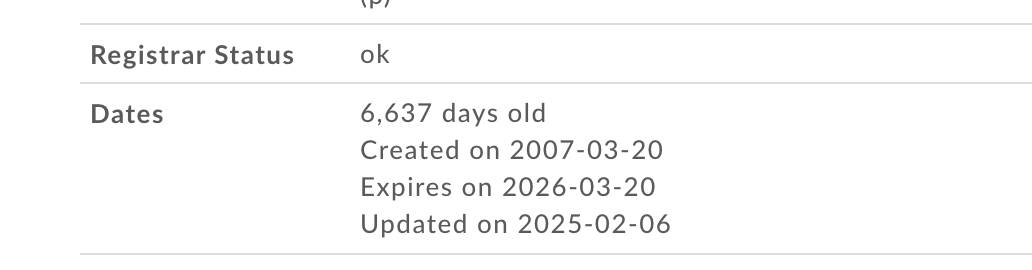
The domain details indicate that the website’s domain name was recently updated in February, but the content has not been updated yet.
This outdated geographic information can mislead a wide range of users.
Tourists planning their travel routes often rely on official government information and may miss entire regions that are not listed.
Students, researchers, and journalists relying on the site for factual reference may unknowingly perpetuate false narratives. Even development workers and NGOs, whose programmes are frequently based on administrative boundaries, risk misallocating resources due to incomplete data.
Vanessa Mensah, a travel blogger based in Accra, was a victim of this stale information. She shares how relying on the outdated information led to an embarrassing professional error:
“I was compiling a Ghana travel guide for my readers abroad. I went to the official ‘Touring Ghana’ site, and it listed just 10 regions. So I wrote a whole itinerary that completely missed newer regions like Ahafo and Oti. One of my readers called it out after arriving. I was shocked the government hadn’t updated such basic but important info. It felt embarrassing. I relied on a government source, thinking it was accurate.”
Ministry and Agency Websites Under Maintenance or Inaccessible
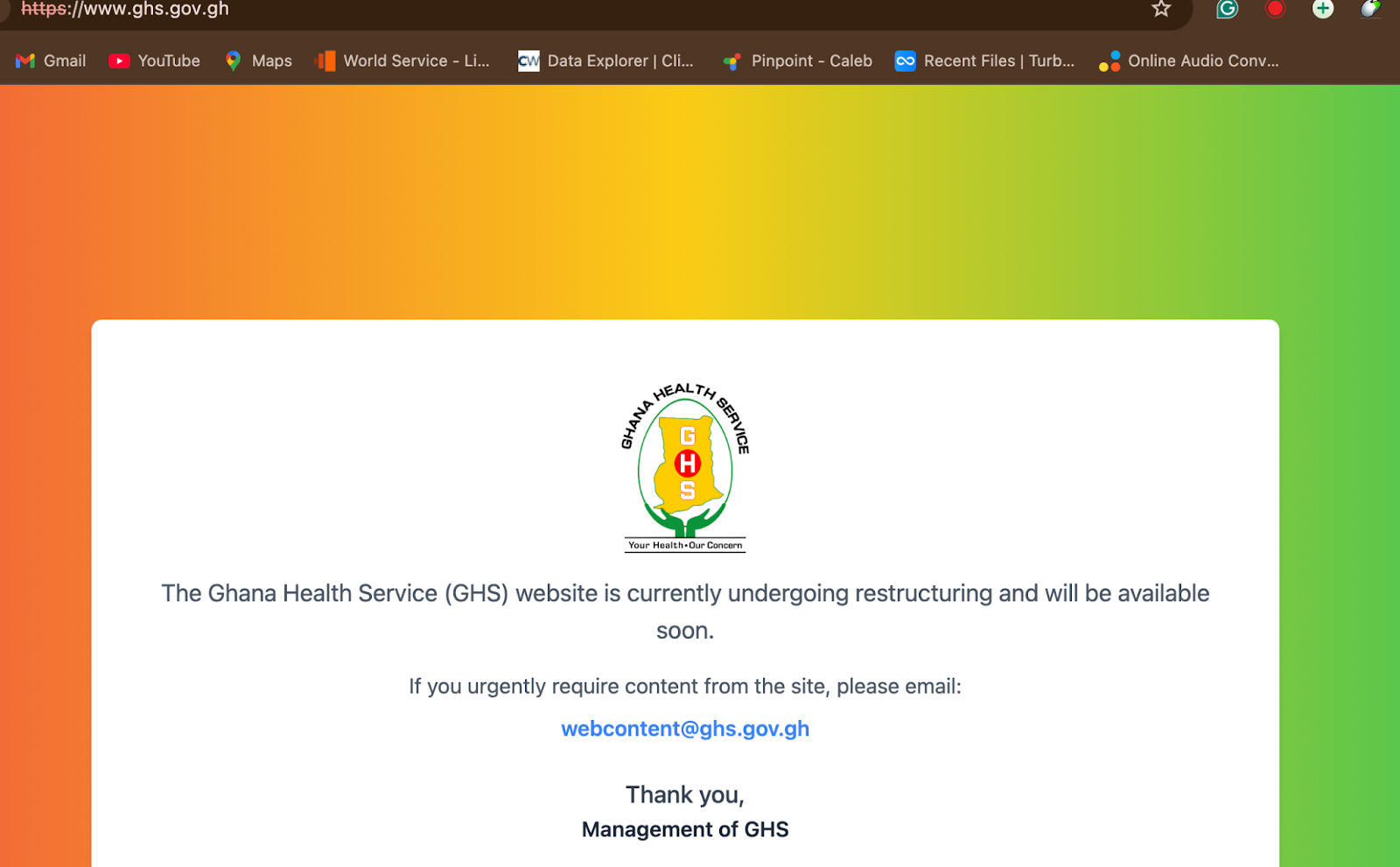
The Ghana Health Service (GHS) website is currently marked “under maintenance,” cutting off public access to crucial health information as the country grapples with an outbreak of Mpox.
While the service’s social media platforms continue to post regular updates, the official website remains inactive, raising concerns about accessibility for individuals who rely on it for verified information.
A screenshot of the site under maintenance.
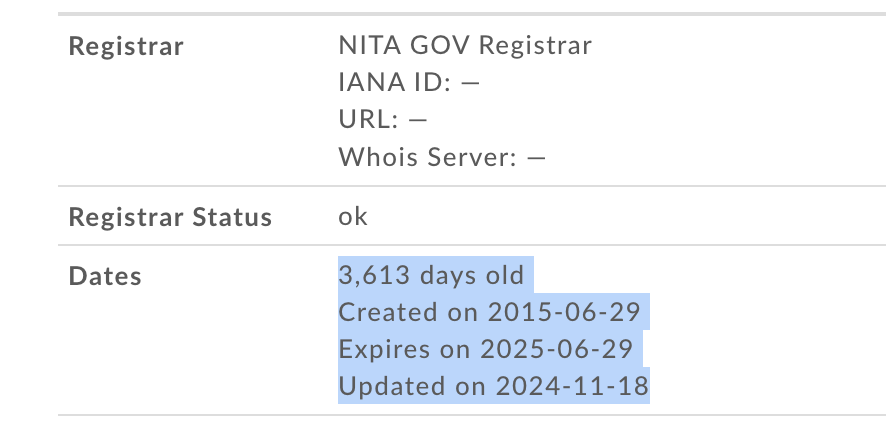
Looking it up on WHOIS, a publicly accessible internet database that provides establishment and ownership details of website owners, the Ghana Health Service domain is also close to expiration on June 29, 2025.
If not renewed, it may enter a grace period or become available for registration by others.
For a public health institution, lacking a functional and updated web portal during a health crisis limits access to preventive guidelines and could fuel misinformation.
Ministry of Defence
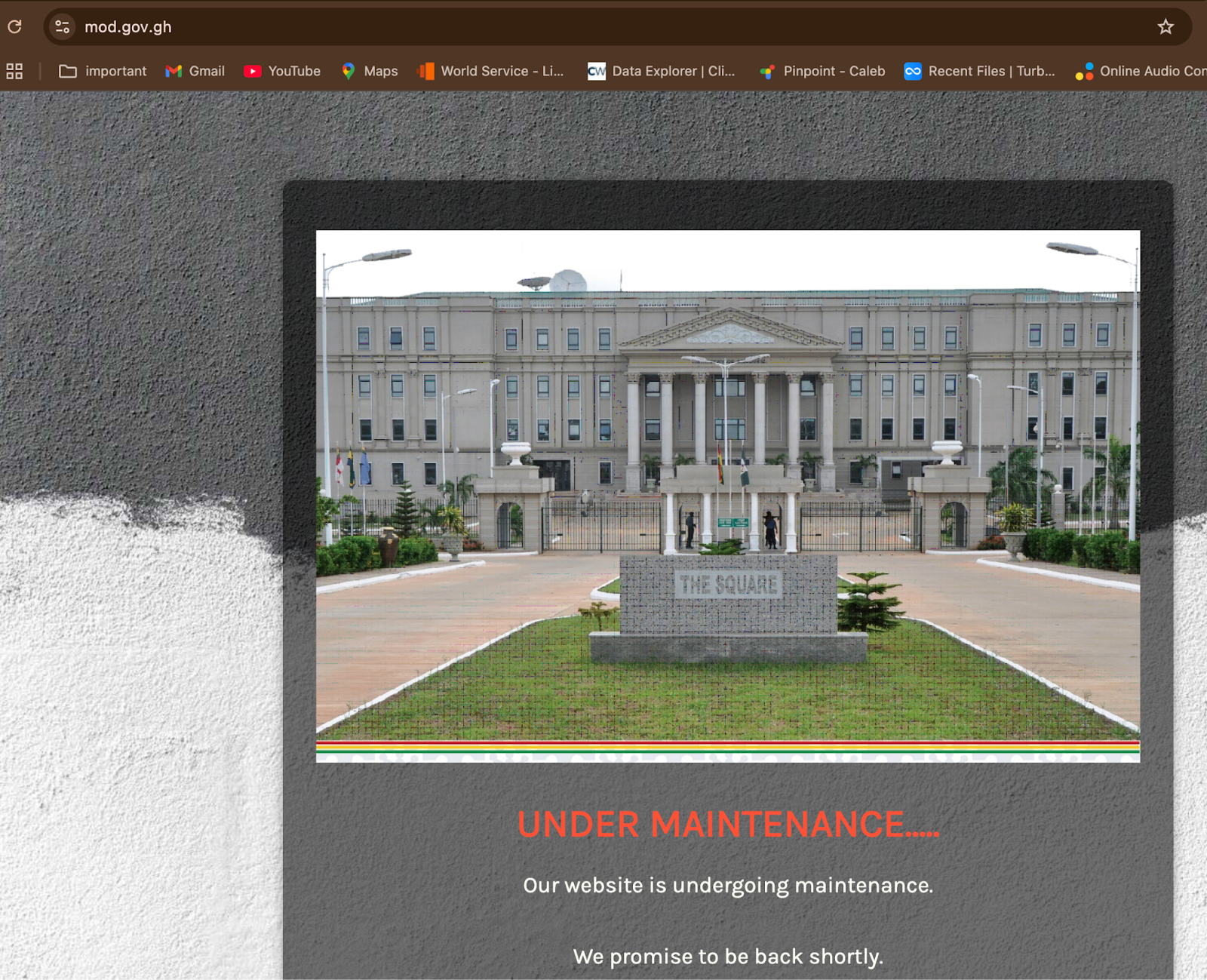
Like the health ministry, Ghana’s defence ministry website is “under maintenance,” with no clear timeline for restoration or alternative access points provided.
DUBAWA attempted to reach the ministry regarding the website’s inability to display the needed information, but all attempts have yielded no results.
A screenshot of what pops up after clicking the website belonging to the defence ministry
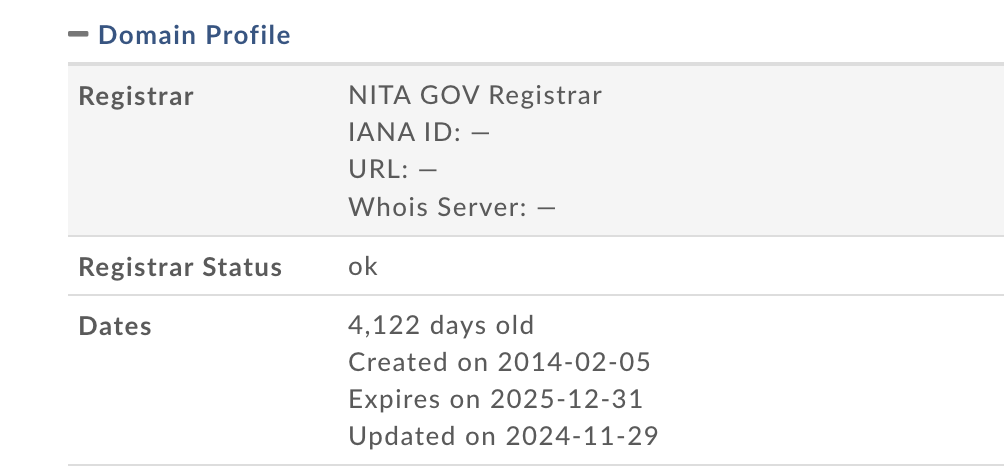
The domain profile on WHOIS also shows that the domain has yet to be renewed, as it is set to expire by the end of the year.
Youth Employment Agency
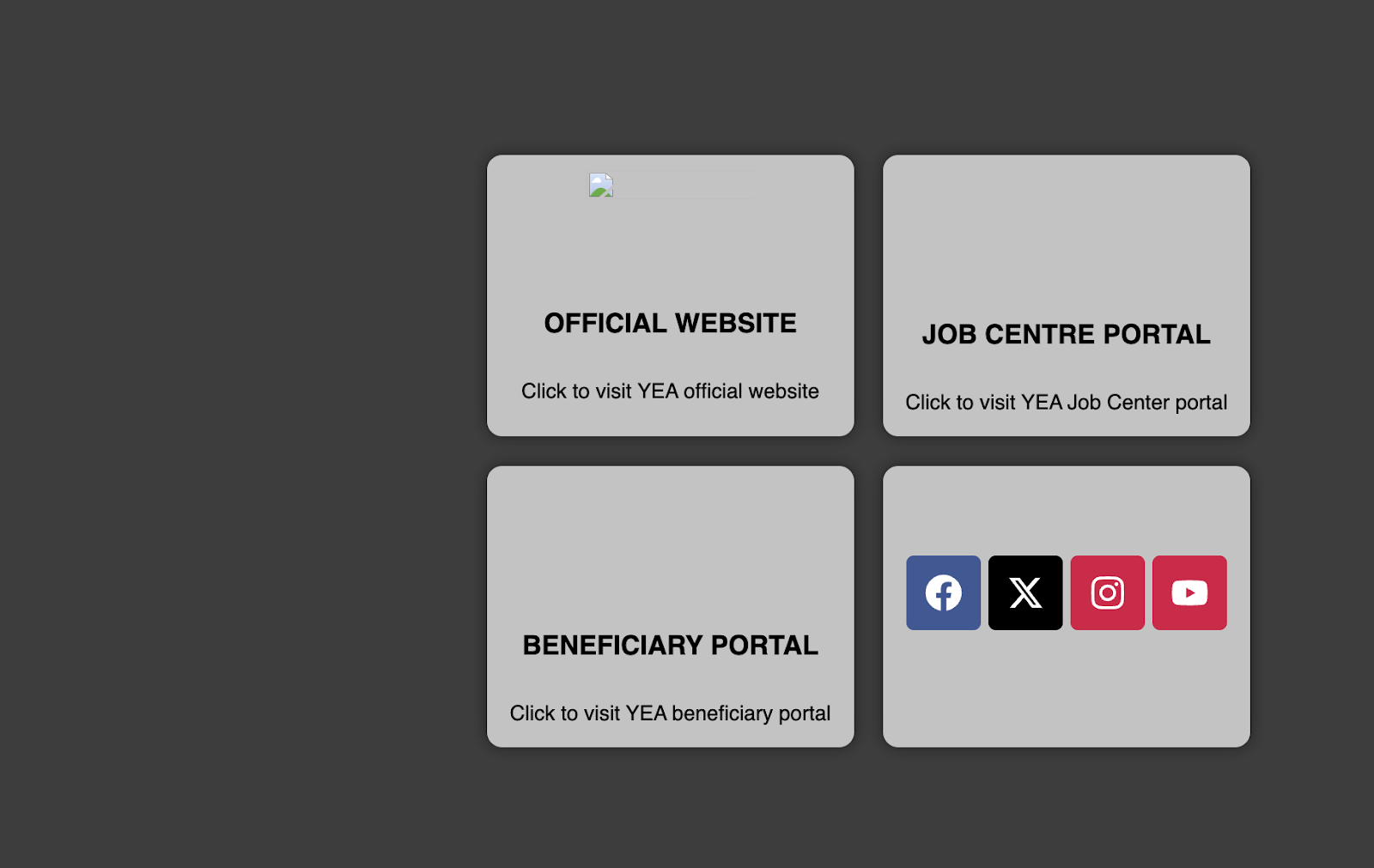
Ghana’s Youth Employment Agency (YEA) site also fails to load entirely, preventing Ghanaian youth and job seekers from accessing vital employment initiatives.
Screenshot of what appears after clicking the site.
Unfortunately, the tab that says “Click to visit YEA’s official website” doesn’t even react to a click or a subtle touch of the cursor.
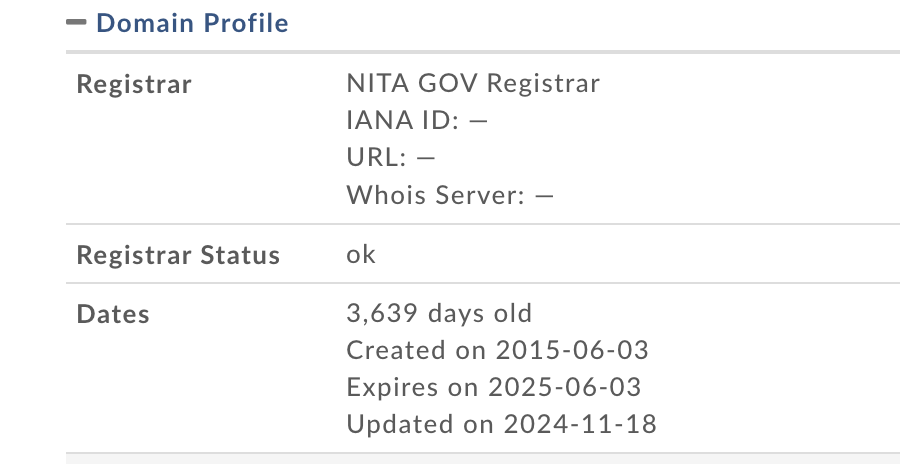
The domain name may have become available on June 3, 2025.
Creative Arts Agency
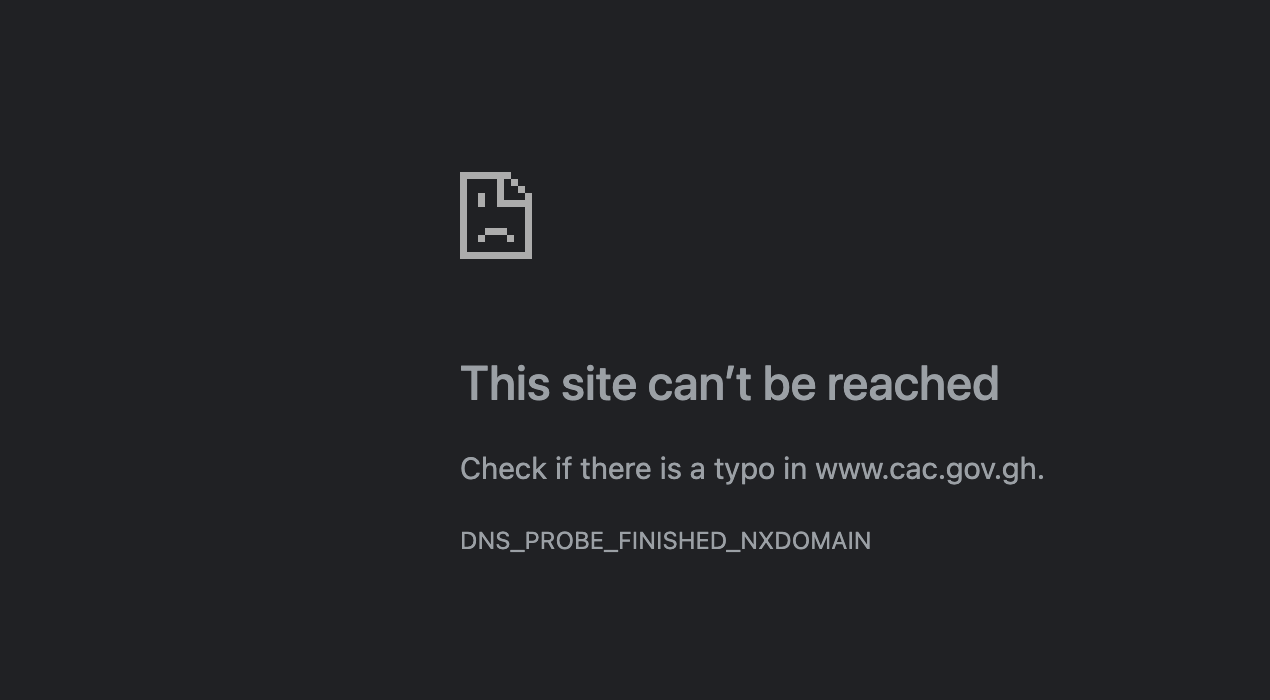
When DUBAWA tried to interact with Ghana’s creative arts agency website, it was completely unreachable, despite being an essential institution under the Ministry of Tourism, Culture, and the Creative Arts.
A screenshot of an inaccessible site of the creative arts agency.
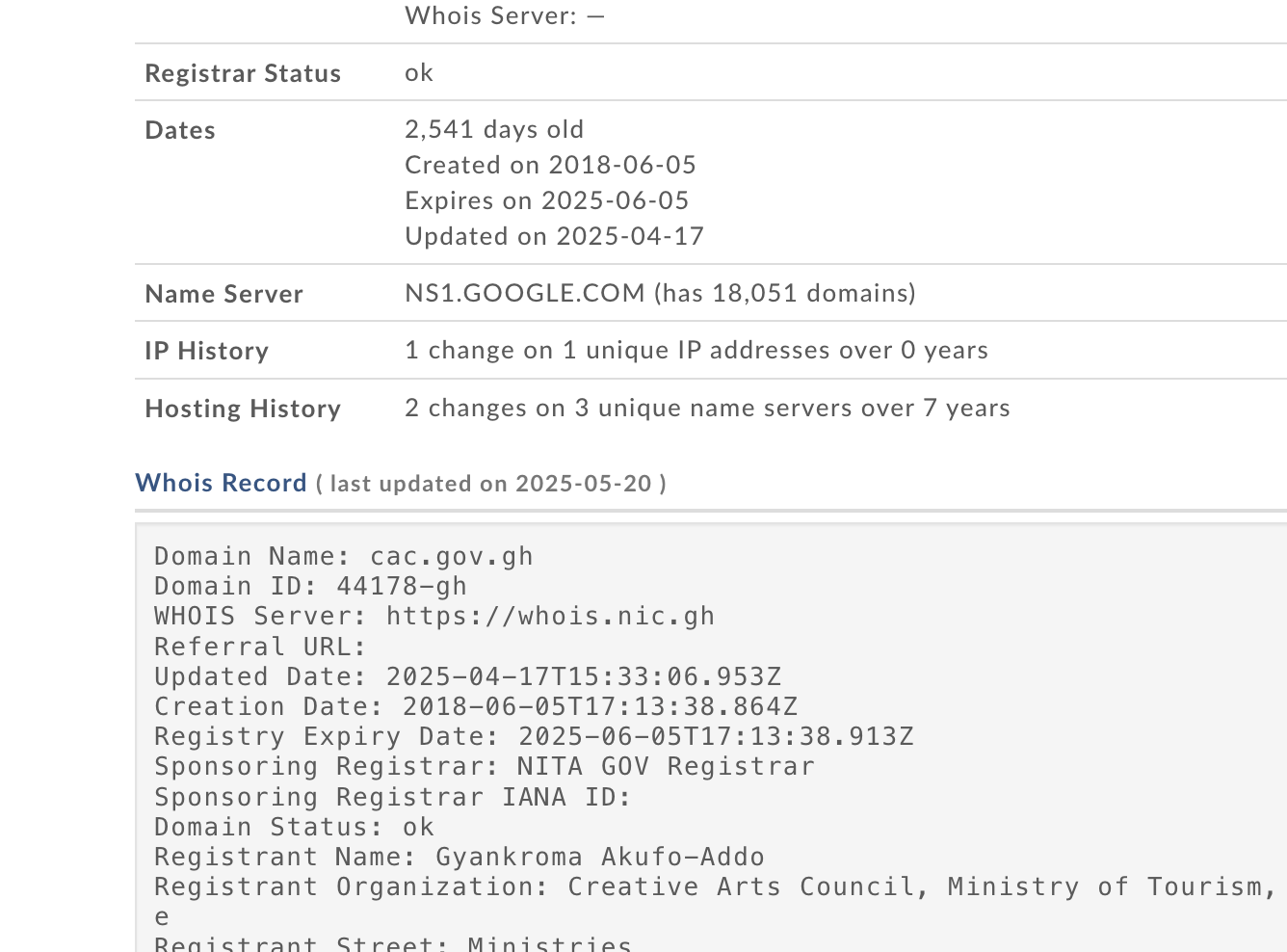
However, the screenshot shows that the domain had not expired as of the last check, which could indicate that the servers were down.
The screenshot also reveals that the domain is registered under Gyankroma Akufo-Addo, daughter of former President Akufo-Addo, who previously served as the agency’s Executive Secretary.
What should be a Pan-African cultural hub? https://panafricanwritersassociation.com/ redirects users to an Indonesian commercial site, which has an alarming breach that raises significant cybersecurity concerns.
A screenshot of the redirected link that opens after clicking the original link provided
The platform currently features outdated media content, several non-functional or broken navigation tabs, and lacks comprehensive, up-to-date details about ongoing projects.
None of these tabs in the screenshot above react to a click.
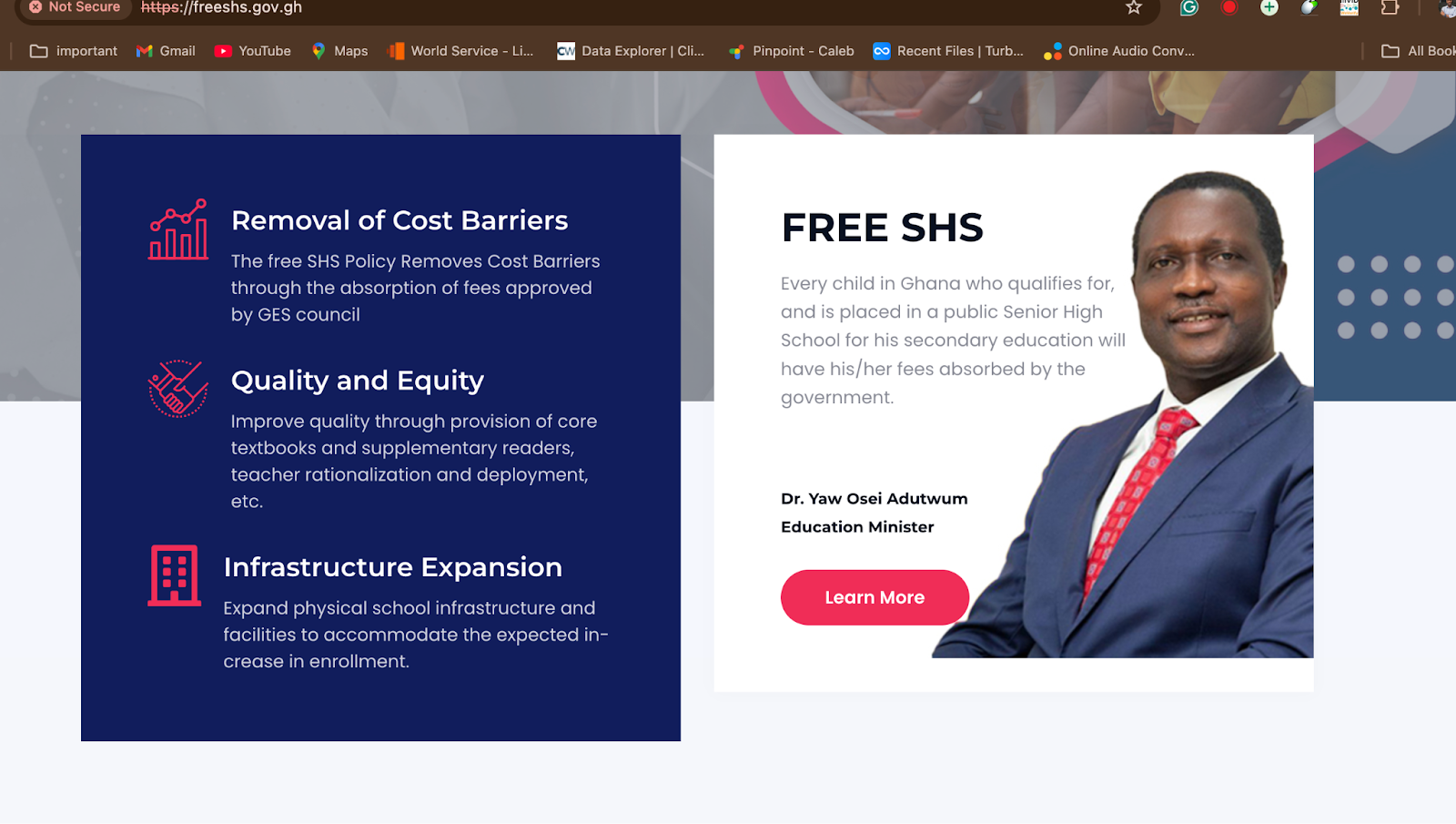
During the eight-year tenure of former President Akufo-Addo, the Ministry of Justice’s website stood out as a reliable and frequently updated hub for official legal information, public statements, policy briefs, and updates on ongoing reforms.
It was widely regarded as a go-to digital destination for journalists, researchers, civil society actors, and ordinary citizens seeking timely and credible data from one of the government’s most critical institutions.
However, digital reliability has deteriorated sharply. Now, just six months into the tenure of the new administration and its cabinet, the Ministry of Justice’s website is riddled with outdated content, some of which dates back to the final months of the previous government.
Key sections, such as press releases, ongoing reform programs, and legislative updates, have not been updated to reflect the current administration’s agenda.
This lapse raises concerns about the government’s commitment to transparency and proactive digital governance.
At a time when access to up-to-date information is crucial for accountability and public trust, the ministry’s digital stagnation sends the wrong message, suggesting either administrative inertia, a lack of strategic communication, or a fundamental undervaluing of digital engagement in this new era.
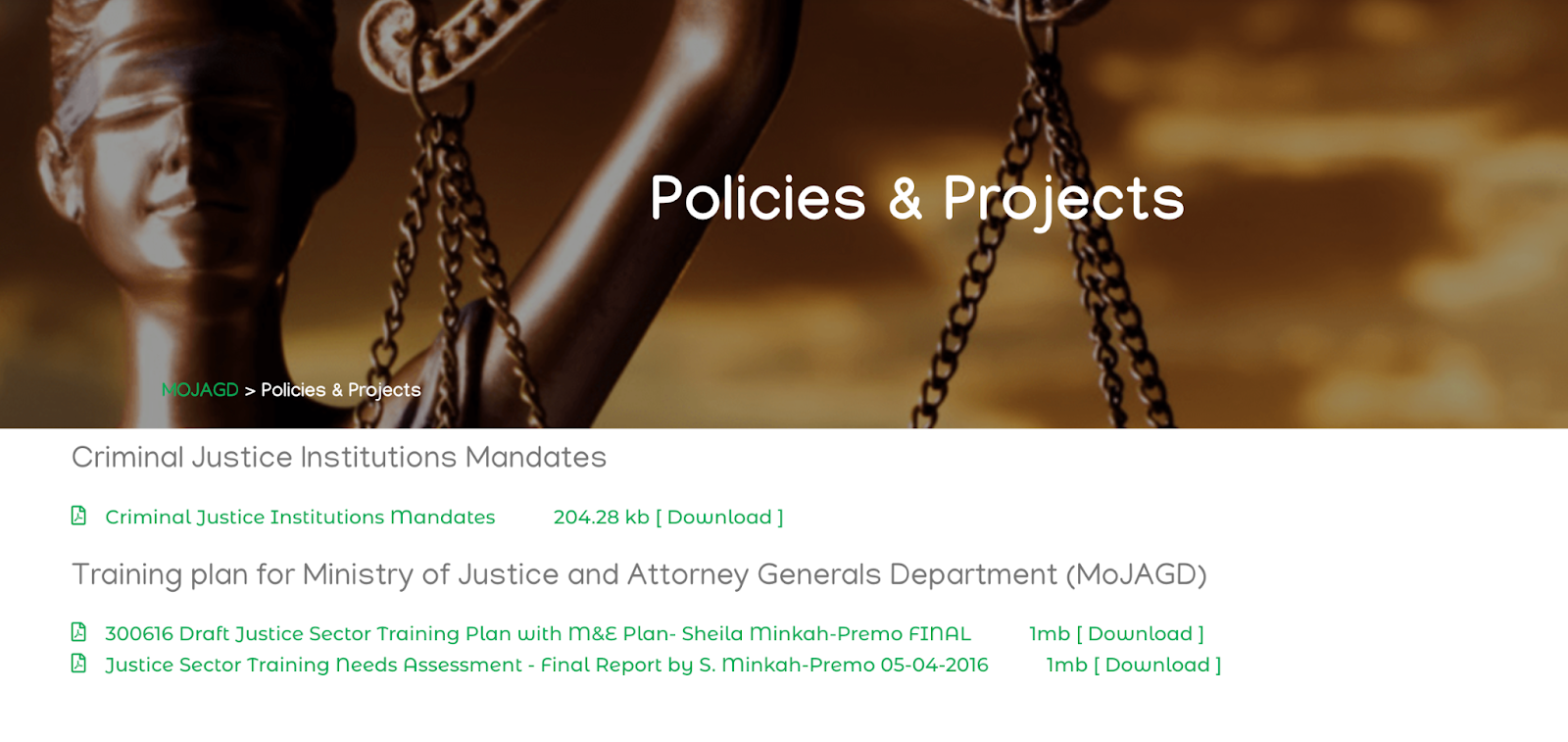
The website highlights leadership and policies from the previous administration, with minimal references to the current leadership’s vision, priorities, or ongoing justice sector reforms.
This lack of updated content creates a disconnect between the platform and the present-day justice agenda, limiting its relevance to stakeholders seeking information on recent initiatives, institutional changes, or progress in legal and judicial reforms.
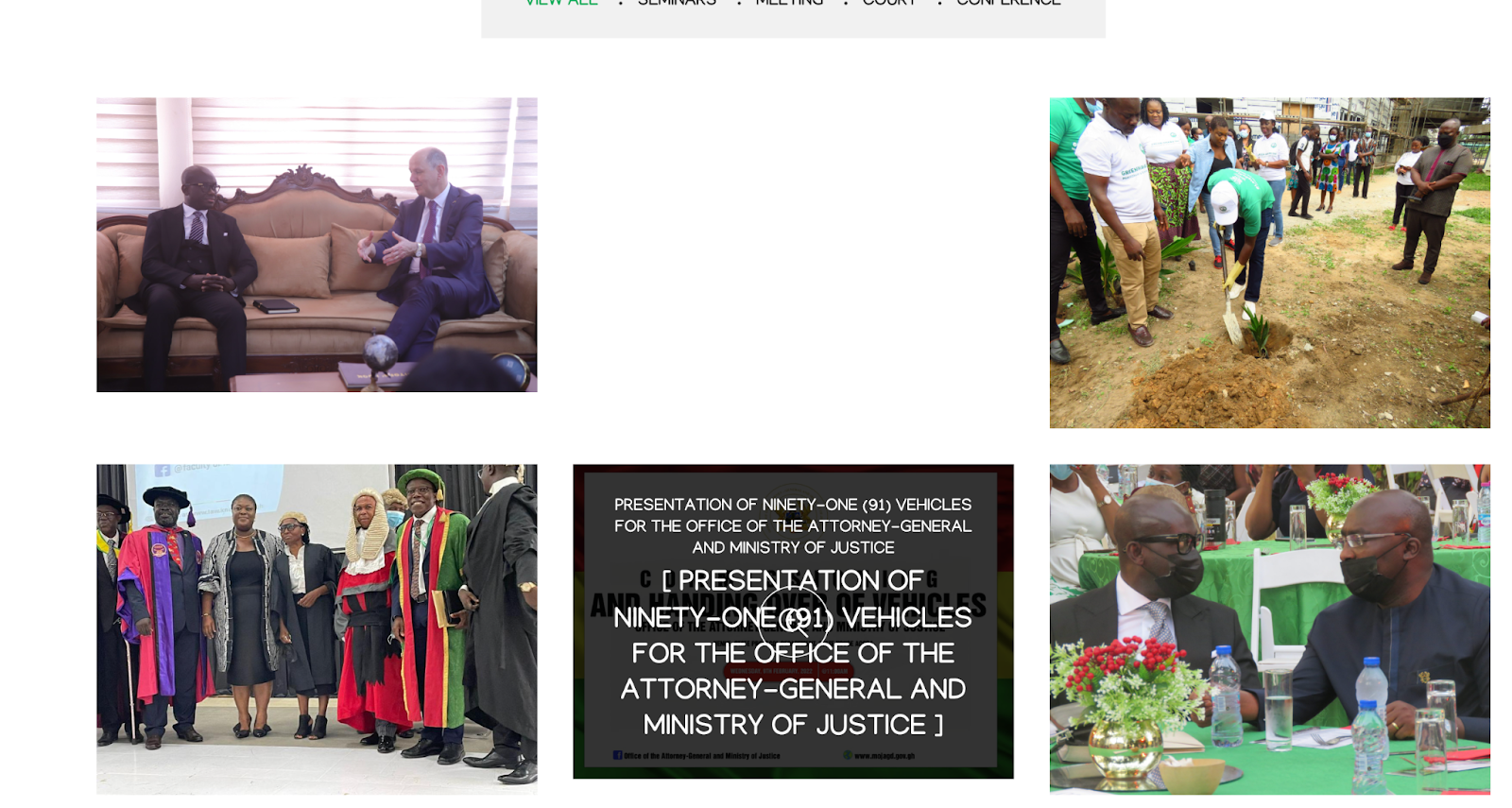
A screenshot of the media column, which contains old media elements from the past government
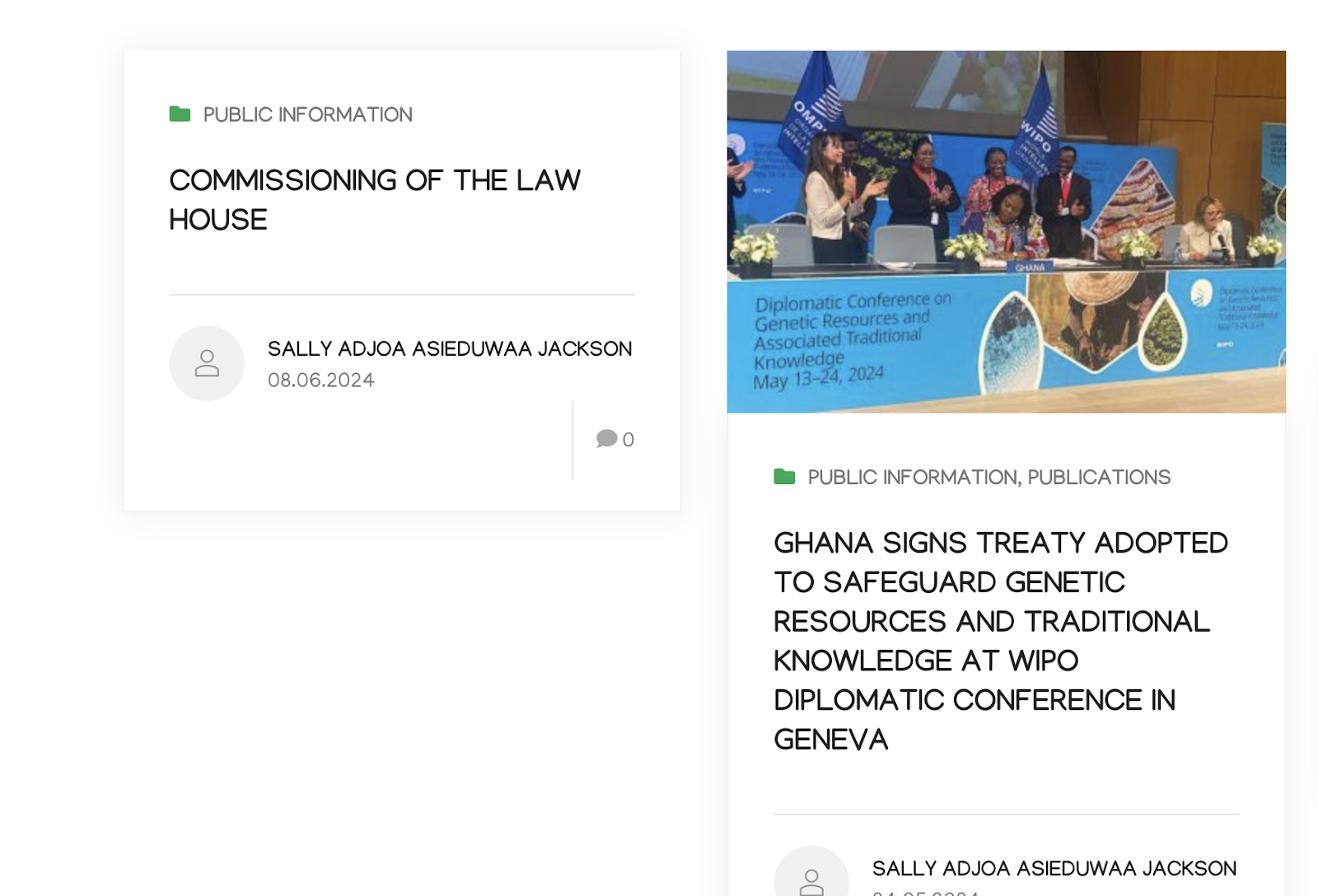
Screenshots of old policies and projects, including news story publications from 2024
Although the ministry has been rebranded to the Ministry of Sports and Recreation, the old website still displays outdated cabinet details and no updates about the new structure. Still, it displays current news story reports on the ministry.
Screenshot of the list of ministers for this ministry with no mention of the current structure
Ministry of Local Government, Chieftaincy and Religious Affairs
Citizens must navigate between conflicting and duplicative sources to access fragmented information.
An assessment of Ghana’s government web infrastructure reveals significant lapses in content management, cybersecurity, and digital visibility. Many agency websites remain outdated, with some last updated as far back as 2018. The absence of a centralised update schedule indicates institutional inertia and poor digital governance practices, undermining transparency and access to current public information.
Broken links, inactive navigation tabs, and non-functional forms are prevalent across multiple platforms, disregarding basic web functionality and user experience design. These issues diminish public trust and frustrate citizens seeking services or policy updates.
Security vulnerabilities compound the problem
In one instance, a redirect from panafricanwritersassociation.com leads users to an unrelated Indonesian domain, suggesting possible domain hijacking or administrative failure. Such misconfigurations expose users to phishing threats and data interception risks, reflecting a failure in domain management and cybersecurity protocols.
Moreover, there is a structural fragmentation in how digital presence is assigned to newer ministries. For example, the Ministry of Youth Development and Empowerment lacks a standalone web presence, relying instead on secondary mentions across subsidiary agency pages, resulting in limited discoverability and ineffective public engagement.
Despite a GH¢364.5 million allocation in the 2025 budget to the Ministry of Communications, Digital Technology, and Innovations, under which these digital assets fall, no dedicated line item exists for government website maintenance, upgrade, or cybersecurity. Maintenance costs are buried within broader ICT spending, making monitoring and accountability nearly impossible.
DUBAWA contacted three government spokespersons for a response on the matter. These included Rashid Tanko Computer of the Ghana Investment Fund for Electronic Communications (GIFEC), Shamima Muslim, a spokesperson at the Presidency, and Schandorf Ayirebi Acquah, a party communicator. However, only Schandorf Ayirebi Acquah acknowledged the request, stating he was still gathering information. The other two did not respond.


 Table source: DUBAWA