With a mission to institute a culture of truth and verification in public discourse and journalism, DUBAWA is excited to announce a partnership with TikTok, a leading social media platform with millions of Ghanaian users, to combat misinformation and disinformation surrounding Ghana’s December 7 general elections. This innovative collaboration leverages TikTok’s expansive platform and DUBAWA’s media and information literacy expertise to empower Ghanaians with the needed knowledge and tools to discern credible information in the digital space.
With a strong track record in promoting media literacy and fact-checking across the country, DUBAWA, through the Ghana Election Hub and Media Literacy Campaign, underscores its commitment to empowering communities with knowledge and tools to combat the spread of false information during critical national events.
TikTok has also welcomed and is ready to champion measures against misinformation. These include partnerships with fact-checking organisations and in-app reporting options for election-related falsehoods. By working with trusted partners like DUBAWA Ghana, TikTok strengthens its efforts to create a safer digital environment for civic engagement in Ghana and beyond.
Project details
TikTok has launched an in-app Election Centre, a dedicated hub available in English, where users gain access to information from reliable election information sources. The rationale is to direct people to trusted information and invest in Media Literacy.
Image: Screenshot of Election Hub Interface
Additionally, the project will help the TikTok community separate fact from fiction by investing in media literacy campaigns. “Ahead of the Ghana elections, we launched media literacy resources in collaboration with DUBAWA, which include educational videos and fact-checking skills. Local creators have contributed videos in English and Twi, ensuring accessibility and engagement across our community. These videos seek to equip the TikTok community with properly identifying potential misinformation online, encouraging them to “stop. think.” before sharing,” Fortune Mgwili-Sibanda, Government Relations & Public Policy, Sub-Saharan Africa.
Akintunde Babatunde, Director of Programmes, Centre for Journalism Innovation and Development (DUBAWA) said,
“Over the years, DUBAWA has tackled election-related disinformation on social media in Nigeria, Ghana, Liberia, Sierra Leone, The Gambia, and Senegal. We are excited to partner with TikTok on the launch of the Ghana election hub & media literacy campaign.
TikTok is a key platform for advancing fact-checking and media literacy campaigns during the election. We are excited about this opportunity to collaborate with TikTok on the Ghana Election Hub and Media Literacy Campaign. This partnership helps ensure that voters have access to reliable information, fostering a more informed and engaged electorate. Together, we are making a transformative impact on Ghana’s information ecosystem and contributing to the strengthening of democracy.”
This initiative will train top Ghanaian TikTok influencers and Creators on media and information literacy concepts, including understanding information disorder and identifying misinformation patterns. These influencers will collaborate with DUBAWA to create engaging, educational content for TikTok, addressing the unique challenges posed by misinformation during the election period.
This partnership is a significant step toward enhancing media information literacy among Ghanaian voters and ensuring a more informed electorate as the nation heads to the polls.
About DUBAWA:
DUBAWA was launched in 2018 as a distinct unit within the Centre for Journalism Innovation and Development (CJID), a premier African media think tank committed to strengthening journalism and fostering a free, independent media ecosystem through digital innovation, investigative reporting, combating disinformation, and championing media freedom to uphold democracy and promote inclusive development.
DUBAWA was established to reinforce the factual basis of journalism by integrating fact-checking protocols into the news reporting culture. In 2019, it expanded into Ghana and subsequently set up offices in other English-speaking West African countries, including Sierra Leone, Liberia, and The Gambia. By 2023, CJID had opened a Senegalese office to oversee DUBAWA and its Elections programmes. By 2024, DUBAWA further extended its reach with operations in Ivory Coast, employing full-time fact-checkers dedicated to combating disinformation and advancing media and information literacy.
DUBAWA is a signatory to the International Fact-Checking Network, a member of Meta’s Third-Party Fact-Checking Programme, a partner in the NDI Integrity Network, and an active member of the WHO Infodemic Alliance.
Ghana’s voters will elect a new president in less than 16 days. Campaigns have intensified, with many political bigwigs taking every opportunity to sell their mandates and visions ahead of Dec. 7, 2024.
According to Nana Akomea, if the New Patriotic Party (NPP) secures 75% of the votes in the Ashanti Region, they will win the 2024 presidential election.
However, is this claim valid, or does historical data present a more complex picture?
The Ashanti Region: A key stronghold for the NPP
The Ashanti Region is widely regarded as the NPP’s traditional stronghold, with a long history of overwhelming support for the party in presidential elections.
This region is crucial to the NPP’s electoral strategy, contributing significantly to their national vote tally.
Given its size and political importance, a strong performance in Ashanti is often seen as a major factor in securing victory at the national level.
The 75% Target: Fact or fiction?
Nana Akomea’s statement implies that achieving 75% of the vote in Ashanti guarantees a national win for the NPP.
This assertion may seem plausible on the surface, especially given the NPP’s history of strong performance in the region.
However, a closer look at the historical data reveals a more nuanced reality.
A Review of NPP’s Performance in Ashanti from 1992 to 2020
To assess the claim’s validity, it is important to analyse voting patterns in the Ashanti Region over the years and how they correspond with national election outcomes.
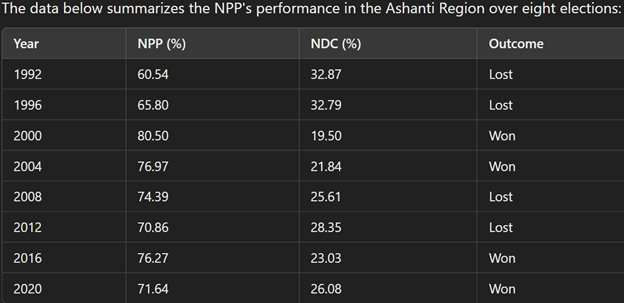
Here’s a summary of the NPP’s vote share in Ashanti during presidential elections from 1992 to 2020:
2008 Election: In this election, Nana Akufo-Addo of the NPP won 74.39% of the votes in Ashanti but lost the national election to John Atta Mills of the NDC. The NPP’s performance in other regions, such as Greater Accra and the Volta Region, was much weaker, contributing to their loss.
2020 Election: In the most recent election, Akufo-Addo secured 71.64% of the votes in Ashanti and still won the national election against John Mahama, illustrating that other regions played a significant role in securing victory.
Data source: Peacefmonline election database
Key observations made by DUBAWA
From the historical data, DUBAWA made the following key observations about the NPP’s performance in Ashanti and its correlation with national outcomes:
When the NPP secured over 75% in Ashanti: In the years 2000, 2004, and 2016, the NPP won more than 75% of the votes in Ashanti, and in all three cases, they won the national election.
This trend suggests that a strong performance in Ashanti can be a strong foundation for an NPP victory.
When the NPP secured less than 75% in Ashanti: In 1992, 1996, 2012, and 2020, the NPP did not secure the national election because the support, though significant, was less than 75% in Ashanti.
This shows that securing a high percentage of votes in Ashanti alone does not guarantee a national win if the NPP performs poorly in other regions.
Despite this strong showing in Ashanti, the NPP lost the national election, largely due to weak performance in other key regions like Greater Accra and Volta, which were strongholds for the NDC.
The Importance of Other Regions: The 2020 election provides further evidence that winning Ashanti by a large margin does not automatically ensure victory.
While securing 75% of the vote in the Ashanti Region greatly increases the NPP’s chances of winning the national election, it is not guaranteed.
Historical evidence suggests that the party’s performance in other regions, particularly in swing areas like Greater Accra and Central Region is in determining the overall winner.
The 2008 election serves as a cautionary tale, where even a high percentage of votes in Ashanti could not overcome losses in other regions.
Similarly, the 2020 election demonstrated that the NPP could still win without reaching 75% in Ashanti, provided they performed well in other key regions.
In conclusion, while a 75% vote share in Ashanti strengthens the NPP’s position, it does not automatically result in a national win.
To secure victory in 2024, the NPP will need to perform well in Ashanti and other critical regions across the country.
Verdict: False! Dr Matthew Opoku Prempeh has not made such a statement. An advanced Google image search by DUBAWA shows no credible media outlet has reported on this claim. Furthermore, Media General’s TV3 Network, whose logo appeared on the fact card, has publicly debunked the circulating image as fake.
Enokay’s post, shared on X (formerly Twitter), included a laughing emoji and has garnered significant engagement, with over 108,000 views, 116 comments, 290 retweets, 3,400 likes, and some bookmarks as of Nov. 24, 2024.
Furthermore, popular Ghanaian broadcaster Kevin Taylor shared the same fact card with over 60,000 followers. With a caption as simple as “ok,” Mr Taylor attained over 26,000 views with 70 retweets as of Nov. 24, 2024, at 02:17 p.m.
Meanwhile, the fact card carried the logo of Media General’s TV3 Network and a background image of Napo, which gave it a stamp of credibility.
Several X users shared reactions on the X digital platform on Nov. 24 after chancing on the flyer:
X user, Big Homi Flee, @Homibwoy1, reacted by saying,
“Dem Dey throw jabs at each other. Chale Mahama win am already.”
Another user, Blaugrana, @blaugrana1803, wrote: “NPP will get their worst-ever election defeat on Dec 7. Bookmark this.”
I’m Success (@CFCsayuti) also commented: “NAPO can actually say this. That man is sensible when he’s quiet.”
Lastly, NKOJ, @nanaossei_, remarked,
“He’s basically confirmed that he’s the running mate ONLY because he’s from Ashanti Region. And it’s obvious to any sensible person that had it been based on intelligence, he certainly wouldn’t be the one to partner @MBawumia.”
Interestingly, DUBAWA also spotted the fact card circulating on WhatsApp statuses, spreading misinformation. Given its potential to mislead voters as the election nears, DUBAWA decided to investigate.
Verification
DUBAWA’s investigation revealed that Dr Matthew Opoku Prempeh had not made the alleged statement during his campaign tours or in any other context.
A Google keyword and image search showed no reports by reputable media outlets confirming the claim.
Additionally, Media General, owners of TV3 Network, issued a public disclaimer shortly after Enokay’s post, stating:
“This artwork currently circulating is FAKE and was not created by Media General. Please don’t share or engage with it.”
Meanwhile, some pro-NPP platforms debunked the fact card by splashing ‘Fake’ tags over it. Some of them can be seen here, here and here.
Conclusion
Matthew Opoku Prempeh’s claim that Vice President Mahamudu Bawumia cannot secure 50% of votes in the Ashanti Region without him is false. The fact card is a fabrication, as Media General’s disclaimer confirmed.
Months of surgical open-source investigations by DUBAWA and DAIDAC, both arms of the Centre for Journalism Innovation and Development (CJID), have uncovered patterns and actors behind the viral and mysterious Agyapadie document making rounds in Ghana’s political space months before the country’s general elections.
The document, first published in 2020 on platforms connected to the National Democratic Congress, is a new version of an existing political playbook that emerged just before and after the 2016 elections. It went viral on social media in 2024, seething into mainstream media and attracting reactions from top government officials, opposition members, and influential traditional leaders.
The investigation traces the long history of this politico-ethnic document and connects the dots, the network behind a campaign in which a faction or, rather, a family in the current New Patriotic Party government is accused of plotting a massive state capture for themselves and their king in Akyem Abuakwa.
The actors in this political jigsaw appear to have capitalised on the deep political and ethnic cracks within the governing New Patriotic Party and employed, to perfection, a popular disinformation strategy that uses events in a political ecosystem as raw materials with a deadly spin that makes it difficult to doubt and almost impossible to ignore. The end game is to erode the trust of state institutions and completely put democracy at high risk.
But when there are avoidable cases of corruption, illegal mining, nepotism, and conflict of interest situations perpetrated by the government in power, whose key actors are accused of being behind this mysterious document to capture critical assets of the state, then the challenge of exposing who the real masterminds of the document are, becomes even more daunting. How do you convince the ordinary Ghanaian this document is a masterpiece of fabrication when they are reminded daily that the corruption they see and hear were all documented in a book long before they happened?
So, for over seven months, DUBAWA and DAIDAC have been on the hunt, tracing the original source of the document, using open-source investigative tools, digging into websites and social media pages, and monitoring radio and TV conversations of individuals, groups, and political parties in an attempt to find the brains behind the mysterious document, who authored it, when it was authored, how it was and is still being used, and for what purpose.
The findings are elaborate. A step-by-step approach is needed to break down the history and the myth surrounding this massive politico-ethnic campaign and how it has manifested throughout the election cycles.
Background and Context
To understand the book’s content, it is important to appreciate the political context and the events that have happened in Ghana’s political landscape over time. Ghana’s Fourth Republic has been dominated by two political parties, the New Patriotic Party (NPP) and the National Democratic Congress (NDC), both of which have had 16 years in government from 1992 to date. While the NDC is considered a broad-based party, the NPP has most of its support in two regions: the Eastern Region and the Ashanti Region. So whether it is an internal party primary in the NPP or national elections, the issue of ethnic factions between the Ashantis and Akyems in the NPP always comes into play. The 2024 elections will be the first time an NPP candidate has been selected from the North, outside the Akyem and the Ashanti factions in the fourth Republic. Ex-president Kufour, who ruled Ghana from 2001 to 2008 on the NPP ticket, was from the Ashanti Region. The current president, an Akyem from the Eastern Region, will complete his second tenure in December after being elected in 2016. Having understood the context, let’s delve into the details of the Agyapadie document
About Agyapadie
Cover of mysterious Agyapadie document
The explosive 38-page document titled Agyapadie, the Akan word for inheritance, is a political playbook with no known author except a name, Ofori Atta, the supposed writer of the document’s foreword. Promoters of the document, who are largely members of the NDC and some aggrieved members of the NPP who have defected from the party, alleged the forward was the handiwork of the immediate past Finance Minister Ken Ofori Atta, who is an Akyem. The mysterious book has the pensive-looking picture of the Okyenhene, (King of Akyem Abuakwa) Amoatia Ofori Panin on the cover with pictures of the current president Nana Akufo-Addo, JB Danquah, a member of the Big Six who founded the UGCC, the first political party in Ghana.
The book’s content captures plans by influential persons allegedly connected to the seat of government, who are also from Akyem in the Eastern Region, plotting to capture key state assets, i.e. banks, mineral resources, telecommunication, oil, and gas, to make themselves wealthy. The ethnic dimension is even more concerning. According to the authors of the book, Amoatia Ofori Panin, the king in Akyem, should be made more powerful and influential than the Asantehene Otumfuo Osei Tutu II. It also captures a plan to decimate, not just the powerful and wealthy members of the opposition parties but even members of the government who are of Ashanti descent.
For the state capture mantra to be truly successful, the book plots how the media, judiciary, and security forces will all become appendages of this powerful family so that even in the likely event the party loses power, they still will remain powerful, calling the shots through the appointees they promote into these institutions.
The promoters of the document have cited the president, Nana Akufo-Addo, former Finance Minister, Ken Ofori Atta, Gabby Asare Okyere Darko, who is not in government, but a relative to the president and deemed to be hugely influential in government, Press Secretary to the President Nana Bediatuo as the key masterminds behind the mysterious document, whose content, some of which have played out exactly as it was written in the book.
The opening paragraph of the book’s Forward reads: To our future, made up of the present, and the unborn, for whom this ‘Will’ of a nation is being prepared. To our foremost king, Ofori Panin, the progenies spread across this world for whom, and to whom alone, this sacred document is prepared…
We were nobody’s subjects, and yet, after 1957, we were made to live in the shadows of the descendants of people, who never defeated us in war while the Asante Kingdom was uplifted to put us in shade….
Currently, with Nana in total control of the whole entity of Ghana, we have a duty to ensure that we take over the commanding heights of the essential fabric of the country, in order that even in the event, that Nana leaves the scene after the mandatory eight years, the sons and daughters of Okyeman would be firmly secured and such control, both financially and economically, that we can no longer be ignored in the battle to control the destiny of Ghana.
Twists and turns
Marie Amoakwa-Boadu; Facebook
In the changing scenes of this politico-ethnic drama, Marie Amoakwa-Boadu, said to be the niece of President Nana Akufo-Addo, has been a key actor. She vouches for the authenticity of the document, claiming it is the handiwork of her selfish and corrupt uncles in power who crafted and put the document together.
There is also a former New Patriotic Party member, Hopeson Adorye, who has fallen out with the NPP and has since been criticising the party. He has on multiple occasions and on different platforms given testimony of how the “Akyem mafia” are the main actors behind the book, plotting its execution to the letter. He has since been sued by the Secretary of the Okyenhene over the claims he made in respect of the Agyapadie document.
Then there is also a radio presenter, a fiercest critic of the government, Captain Smart, who has been unequivocal in his accusation that persons in the Akyem-led NPP were the brains behind the document.
Apart from the direct accusations by these three and many others, a new document, an addendum to the Agyapadie document has popped up from nowhere and has gone viral too. It announced the progress report about which state assets have already been captured by the “Akyem mafia’.
So, has the Akyem-led-Akufo-Addo-controlled New Patriotic Party produced a family manual that will guide an egregious state capture?
To successfully investigate the claim, DUBAWA and DAIDAC adopted two approaches.
First, a valid assumption that the book was indeed written by elements of the Akyem-led NPP who are indeed capturing assets of the state and are daring enough to document the same in a book.
Secondly, a possibility that it was written by elements of the opposition NDC who are capitalising on the factions between the Ashanti and Akyems in the NPP as well events that may have happened already in Ghana’s politics which they have smartly smuggled into a book.
Agyapadie, an NDC plot?
Let’s start from the bottom up by considering the second possibility first and use a simple ABC of Information Operations Investigative Strategy by identifying the
Using metadata2go.com, the researchers found that two Agyapadie PDF documents which have gone viral since 2020 were created at two-minute intervals, 10:34 PM and 10:36 PM all on Nov. 30, 2020, six days before the December 2020 elections.
Even though the documents were created the same night, the metadata on them showed some differences. One of the documents with the Awakenewsroom watermark printed all over it was heavier at 9.57 MB the other, poorly put together with some of the pages turned sideways, was also 2.7 MB. A finger of an unidentified person can be seen holding the pages of the document. Even though the images used in the documents were the same in content, the texture, and font type were markedly different, showing 98 to 99% changes in the metadata of the two documents compared.
Except for the date and time of creation and some details about the gadgets used in creating the document, the metadata will not show who exactly created the document. So who put out the document first?
Actors and Dates
There are conflicting reports as to who was the first to put the document into the public domain and how it was put out. Marie Amoakwa Buadu, in a recent interview on Accra Radio, with Kwabena Bobie Ansah, said emphatically and with a stamp of authority that she was the first to break the mysterious document in a live video she did on Facebook on Dec. 1, 2020. Her exact comments can be heard from 6:11:35 of the interview, which had over 2k views on YouTube. The host Bobie Ansah is a known critic of the government and was recently appointed National Patron of the NDC disability desk. In the interview, Marie Abuakwa Boadu told listeners that she got the Agyapadie document from an unnamed person who was sent by Lady Julia, the wife of the Asantehene, Otumfuo Osei Tutu II to give the document to her because she was the only trusted person to bring the document out to the public. She went further to explain that when she broke the scandal, no one took her seriously. But now people are beginning to see the truth in what she said after Hopeson Adorye also came out to confirm the authenticity of the document. DUBAWA attempted to get a response from Manhyia and Lady Julia but the Palace will not comment. Kwame Aboagye who is believed to speak on behalf of the Palace told DUBAWA that Manhyia will not comment on this. “It is a political season, and everyone is entitled to say anything,” he said.
Despite the silence from the Manhyia Palace, the account by Marie Boadu and other key actors on how this document came into the public domain has been nothing but a lame tale of contradictions. In this video, posted on Aug. 7, 2024, Hopeson Adorye claimed that there was only one copy of the Agyapadie document which was printed from London but had always been locked up in a safe box and removed only when there was a family meeting. According to him, in one of those meetings members of the ‘Akyem mafia’ forgot to put the book back into the safe and an intruder had access to it and decided to photocopy and leak the document.
On the other hand, Captain Smart, in yet another video, also made an incredible revelation. He claimed the woman who typed the document attended the University of Cape Coast and that the man who received the final document accidentally sent it to another person and that is how the document was leaked. His comment can be found from 9:54 in this link. There were no further details about the identities of the woman who typed the document or the man who leaked it. He went ahead with more tales.
In light of these contradictions, DUBAWA can establish the following incontrovertible facts.
November 30
Using a Facebook tool, WhoPostedWhat, to track who first shared the narrative on Facebook, results show that the first publication was on Nov. 30, 2020, by Efo Korsi Senyo, an Admin for the “Action for Mahama” Facebook group. The researchers took a screenshot of the page showing clearly a link to an Awakenewsroom.com made on November 30, 2020 as can be seen below.
However, a few weeks ago when DUBAWA visited the same page, the date of the publication had been altered to read November 29, 2020, as can be seen below, instead of November 30, 2020, as originally published.
The Facebook link on the Action for Mahama page, took the researchers to Awakenewsroom.com where the story had also been published by Efo Korsi Senyo who doubles as the Executive Editor of the platform.
The documents published on Facebook and on the Awakenewsroom.com were the same documents created at 10:34 PM on the night of November 30, 2020. The publication on Awakenewsroom.com came with the headline, “Agyapadie Secret Book: Akufo-Addo, Akyem NPP’s grand scheme to capture Ghana.” The lead to the story was: “In what can best be described as a shocking revelation, Awake News has uncovered a secret book forwarded by Ghana’s Finance Minister, Ken Ofori Attah in which some Akyem elements in the ruling New Patriotic Party (NPP) have developed a grand scheme to capture the state of Ghana by taking control over key sectors including the finance, energy, water, mineral resources among others.” He gave no details about how he uncovered the book.
Efo Korsi Senyo, Facebook
Several other publications followed on November 30, as can be seen here,here, and here, some of which are connected to the NDC.
December 1, 2020
On Dec. 1, 2020, five days before the elections, more platforms and individuals linked to the NDC published the document’s content. Key amongst them was the NDC TV page on Facebook, which published a summary of the document and gave credit for the publication to Alliance for Social Equity and Public Accountability (ASEPA), an NDC-aligned Civil Society Organisation led by Mensah Thompson as Executive Director.
The researchers dug into Mensah Thompson’s Facebook page and found the summary exactly as attributed by the NDC platform. The date for the publication was December 1, 2020. Thompson wrote: *SUMMARY OF THE AGYAPADE3 SECRET DOCUMENT FOR THE AKYEMS*
Folks in case the AGYAPADE3 document by the Akyem Mafias is quite bulky for you… here’s a quick summary of what the Akyem Mafias plan to do in the second term of an Akufo-Addo Government. Please read the foreword carefully before you read the summary, the foreword was not summarised and was left just as it is in the secret document. The rest was summarised for a convenient reading…” For a mysterious book to be expertly summarised the way it was, it could only take someone with superior knowledge of the book’s content.
Still, on December 1, 2020, the researchers tried to find the video of Marie Boadu, who claimed to be the first to have published the document. All the searches on December 1 proved futile; however, excerpts of the video were found posted on the Facebook page of the NDC National Organiser, Joseph Yammin, on December 3, 2020, four days before that particular election. The video was done with the NDC campaign flier boldly pasted in the top right corner of the footage, as can be seen below. Such fliers are mostly used on officially sanctioned NDC ads.
In the video, Marie claimed she had been given a document called Agyapadie, an explosive document whose content she could only give to the ex-president John Mahama and Jane Naana Opoku Agyeman, the vice presidential candidate. She begged the viewers of her video to give her contact to John Mahama and Jane Naana Opoku Agyemang or Sammy Gyamfi so she could hand over the mysterious document to them. According to her, given the document’s content, only Ex-president John Mahama could investigate it. She blamed the media for being quiet on the matter. She went ahead to read the document forward and continuously sighed and cursed her uncles who she accused of authoring the document and plotting to capture state assets.
December 2
Curiously, DUBAWA again found a video of Marie, posted on December 2, on a Facebook page of Onelife Ghana Investrips, a platform that circulates NDC campaign materials, some of which include mis/disinformation materials. In this video, the niece of the president said for personal reasons, she deleted the video she recorded the night before about the Agyapadie document. According to her, whilst recording that video, she was alerted that a young man had posted a link to the Agyapadie document onto her chat section. And when they clicked on the link, they saw the full version of the document published on a website. She did not name the website or the young man. But it is clear from the DUBAWA finding that it was only Efo Korsi Senyo of the Awakenewsroom and the Action for Mahama Facebook page that had published the document late that night.
A deeper dive into the activities of Marie in the days leading up to the election in 2020 suggests she was not a passive, random niece to the president who was given a random document to leak but an active campaigner towards the cause of the NDC. She had consistently posted videos vehemently campaigning for the NDC and John Mahama. Her videos came with NDC fliers and paraphernalia at all times and were shared by top NDC members and platforms. It is, therefore, surprising that she would be begging for the contacts of ex-president John Mahama and Jane Naana Opoku Agyemang when it was obvious she already had links and contacts to top NDC members. On November 30, 2020, a night before she did the Agyapadie expose, a livid Marie Boadu posted a video in which she expressed absolute outrage about an audio of a family member accusing her of being a traitor. She played the audio and threatened to be the traitor they accused her of being. Three days earlier, she was in a buoyant mood, singing and dancing to a ‘Mahama Afa’ (Mahama has won) song she posted on Nov. 27, 2020. She was back in a livid mood again, accusing her uncle of being the mother serpent of corruption when the Agyapa gold royalty scandal broke in 2020, months before the election.
December 3
With just four days to the 2020 election, platforms associated with the NDC continued serialising different aspects of the book. Whatsupp News published aspects of the book under the headline “John Boadu Kennedy Agyapong and Sammy Awuku set for dismissal.”
The Genesis with Boutrous Andy
Whilst the Agyapadie document published in November 30, 2020 was synonymous to Efo Korsi Senyo, ASEPA, Mensah Thompson, Yammin, Marie Boadu, Bobie Ansah and a plethora of other well known NDC members, executives or sympathisers, another set of NDC kingpins were quite as prominent and synonymous to the first edition of a similar document first publishedin December 2016 by one Boutrous Andy Kwaku Yirenkyi under a code name the “The GREAT PLAN.” Yirenkyi, who identifies himself as a “political strategist,” “communications specialist,” and a Deputy Director for Communications and Press Relations at NDC, posted multiple content under this “GREAT PLAN.”
On Nov. 23, 2016, the “strategist” made a post under the headline “AKUFO ADDO, THE GREAT TRIBALIST OF OUR TIME*” It is important to state that this was an opinion piece he wrote in the heat of the 2016 campaign, but it is similar in character, words, and content to the first version of the mysterious document that went viral all through the latter part of 2016-2019 until it metamorphosed into the Agyapadie document.
In that post, Boutrous Andy accused then-candidate Akufo-Addo of being “Violent, Divisive, Corrupt and a Judgement Debt-Loving, Ethnocentric Akyem Nationalist. His father was a ceremonial President, and he has always wanted to be President since to finish a plan to make AKYEM ABWAKWA & OFOROPANIN GREAT AGAIN. The Akyem elite and family members who Akufo Addo surrounds himself with have hijacked the NPP, on the verge of hijacking the Chieftaincy of Ghana and ultimately hijacking the Presidency to make AKYEM ABWAKWA & OFORIPANIN GREAT AGAIN.”
He went on further by saying *Akufo Addo’s Akyem Agenda is expected to see him elevate his Akyem Abuakwahene to the role of King of Kings.* adding, “If Akufo Addo’s village chief is successful in becoming the Primus intra Pares, then Akufo Addo’s lifelong plan of *MAKING AKYEM GREAT AGAIN* as captured in the book he launched on 16th January, 2008 against then President Kufuor’s angry express objection would be well on course.
A few days after the November 23 Facebook post and obviously after the 2016 elections, Boutrous published what appears to be the first version of the mysterious book that would later metamorphose into the Agyapadie book. However, it came with a different title and content but still heavy on ethnic divisions.
On Dec. 16 2016, the NDC Deputy Director of Communications posted what he claimed to be a leaked document under the title “THE WAY FORWARD AFTER NANA AKUFO ADDO IS SWORN IN AS PRESIDENT OF GHANA.” The document, like the Agyapadie one, came into the public domain without an author, except it was championed and amplified by persons connected to the NDC, as was the case in the Agyapadie document.
The document was in three parts, each with a subtitle. The first part came with the title: (GAINING GROUNDS IN GOVERNMENT / SUSTAINING OUR CONTROL OF NPP). It states in part, “At all cost, Ken Ofori Atta, Nana Asante Bediatuo, and Gabby Otchere Darko shall build a financial empire by giving them absolute control over all significant government contracts. They will again be responsible for investigating and re-awarding all existing contracts.” These three names we are told are writers of the book, yet in this paragraph, the authors said, “THEIR financial empires will be built by giving THEM government contracts.”
In this same document, the alleged plan by the ‘Akyem mafia’ to decimate businesses aligned with the Ashantis and the NDC was allegedly hatched. It said:
“It is of extreme importance that we put Papa Kwesi Ndum and Kwabena Duffour in continuous check and control their financial growth. The records and evidence show that Ndum and Duffour would rather side with others and not Nana Akufo Addo, hence, the need to cut their business down to size while we prepare our own to overtake them in financial growth.”
The second part of the document follows with a subtitle: “CHECKING THE RISE OF ASHANTI,” and it states: “ Our number one pursuit to cut the forever-growing wings of the so-called Asantehene, Osei Tutu 11, has been a very long struggle. We cannot be satisfied with the little done against him, and we cannot end here. We thus must resource our agents in Kumasi, especially those at the central market, to keep up their work of creating hatred between the people of the Ashanti region and their so-called King.”
The third part, titled (PROJECT / PROTECT OKYEMAN), also played up the need for the Okyenhene to be elevated over and above all traditional leaders in Ghana including the Asantehene.
“The first and most important objective of the Akufo Addo government, as agreed upon, is to project and protect Okyeman and make our prestigious and present Okyehene the most powerful and mighty King of the nation Ghana,” the book said.
Besides the December 16 publication, Boutrous repeatedly shared the post on many other occasions to deepen animosity between Ashantis and Akyems and between the two traditional leaders.
On Jan. 14, 2017, seven days after Akufo-Addo was sworn into the presidency, Boutrous posted the document, which he repeated on December 21, 2017. Anytime there was any controversy or corruption-related matter, including the Banking sector crisis that the NPP inherited from the John Mahama administration, Boutros posted the document, as can be seen here and here.
When DUBAWA compared the content of the document posted in December 2016 to the one posted in May 2019, it showed no edits, contrary to claims that the document was edited at every stage depending on new developments.
If for any reason you still have doubts about how this Agyapadie strategy has been executed and which people are behind it, check how a similar technique was deployed by Boutrous Andy, the political strategist of the NDC. On December 21, 2016 he posted a content with the headline: “NPP Exposed…. Their evil Plans” the content in part read; “It wasn’t easy to stay in opposition for 8 good years. Now that we have won power, we need to be extra careful so that we don’t go back to the opposition again.” The content concluded; “NPP must remain strong and remain in power forever. We must kill their surrogates emotionally and spiritually. The name ndc must be erased from the Ghanaian politics. Most of their regional communication officers are poor but very good, let’s treat them with care in order to win them to our side. Perhaps, they could join us and help us to do the damage. Politics is about numbers. Don’t let’s us rush now. Every member will have his/her share of the national cake. That’s is exactly what capitalism is all about. Any attempt to let them know our intentions now, could possibly spell doom for us. This action plan could start in the next few months after the swearing in of our president. Kukrudu! We’re back forever!”
On December 23, 2016, Boutros needed credibility for the content he published two days earlier so adopted a disinformation strategy called imposter content by associating his earlier content to a group, the NPP National Executive Council. So he republished the same content but with a different headline. “COPIED FROM NPP NEC PLATFORM. THE EVIL THAT MEN DO……..” While this content targeted the larger NPP party, the Agyapadie document was to target the Akyem members of the NPP and pitch them against the Ashantis in the NPP.
Interestingly, Boutros was not alone in this enterprise. Other NDC kingpins and sympathizers, including Alex Kwaku Asafo Adjei who was the Ashanti Regional Deputy Communications Officer, Kanewu Katawere, were serial posters of this mysterious document that would later become the Agyapadie document.
It is important to state that this document remained within the few NDC circles who kept republishing, hoping it would gain traction and seep into mainstream media discussion. It has now, but not in the same form. The Agyapa gold scandal, which rocked the Akufo-Addo government in 2020, gave a fresh new impetus to an old document by providing it with a new title— Agyapadie, which was put together in 2020.
The Agyapa Scandal
The Agyapa Gold Royalty deal was described by the government as an “innovative financing solution that employs the structure of a gold royalty company to offer financing to gold mining companies..” On August 29, 2020, the then Finance Ken Ofori Atta held a press conference describing the Agyapa Royalty as the best deal for Ghana’s gold. The company was to be “listed on the London and Ghana Stock Exchanges owned entirely by the Government of Ghana, and once listed, Government of Ghana through the Mineral Income Investment Fund (MIIF) would be the majority shareholder with at least 51% of the shares.”
Even though this transaction was similar to the Ghana Gold Company mooted by the NDC in 2010 and sent to Parliament in 2011, the Agyapa Gold Royalty was shrouded in a lot of controversy. There were palpable cases of conflict of interest and nepotism, which led to a huge stand-off among the NDC members in Parliament and civil society organisations, who described the deal as scandalous. The last nail to that Agyapa coffin was the Agyapa corruption risk assessment report written by the then Independent Special Prosecutor Martin Amidu. The report made adverse findings against the government and raised conflict of interest allegations against the then Finance Minister Ken Ofori Atta. In his commentary after that report, Amidu described the president as the mother Serpent of Corruption and later resigned on November 16, 2020.
The government also decided to withdraw the controversial Agyapa transaction from Parliament, which led to the abortion of the Agyapa deal but gave birth to the Agyapadie mysterious document published for the first time on November 30, 2020 by Efo Korsi Senyo.
Actors and Behaviour
In information operations, patterns can be used as a strategy to understand the behaviour of a bad actor. The relationships, content type, and time or period they share can provide useful information during the investigation. So, how have the suspected actors surrounding this Agyapadie document been acting to date?
Mensah Thompson
The connection between the NDC and the Executive Director of the Alliance for Social Equity and Public Accountability (ASEPA), Mensah Thompson, is never in doubt. DUBAWA has already established that he provided an erudite summary of the Agyapadie document on Dec. 1, 2020, just hours after the document was created and published on the Awakenewsroom.
On Aug. 2, 2024, when the Agyapadie document had taken on a life of its own with discussions on air, online, and offline, Mensah Thompson made a post on Facebook suggesting he, rather than Marie Boadu, or Efo Korsi Senyo, or Captain Smart, was the one who made the Agyapadie document public. According to him, the document was out in 2018. He mentioned actors, Listowell Nana Kusi-Poku and Kwabena Bobie Ansah as witnesses to the revelation.
But his claim cannot be accurate. As has already been established, the first time the Agyapadie document was indexed and published was on November 30, 2020, and it was published on the Action for Mahama Facebook page and the Awakenewsroom.
DUBAWA did not find any reference to the Agyapadie document by Mensah Thompson throughout 2018. Except for a few statements and a campaign for the conservation of the Atiwa forest, the Mensah Thompson page was largely docile in 2018, with several months of inactivity.
However, during election periods, Mensah Thompson’s behaviour cannot go unnoticed and dovetails into the Agyapadie campaign strategy. This trend, which started in December 2016, is a mixture of toxic, ethnocentric, divisive publications set to pitch Akyems and Ashanti youth in NPP against each other.
Dec. 2, 2016
With just five days to go for the 2016 elections, Mensah Thompson published a release with the headline *AKUFO ADDO HAS CHOSEN AKYEM YOUTH OVER US-ASHANTI YOUTH IN KUMASI AND THE DIASPORA(AYKaD)*
Purporting to speak for Ashanti youth, Thompson said: “If in opposition he has surrounded himself with people of Akyem root and has sidelined all the able-bodied Ashanti guys around him, then how sure are we that he will make any room for us, the youth of Ashanti descent, in his government?
“We, therefore, call on the flag bearer to come out and explain to us as a matter of urgency why he has sidelined all the Ashanti guys around him when, in fact, he is expecting to get our maximum support to win the upcoming elections.
“We advise all young people of Ashanti descent both in and around Kumasi and the diaspora to desist from voting for Nana Addo in this year’s elections until he comes out to give tangible explanations on this injustice towards Ashanti youths.”
Dec. 5, 2016
Two days before the 2016 election, Mensah Thompson again released another statement under the umbrella of the Ashanti Youth in Kumasi and the Diaspora. On this occasion, he berated the Ashanti Regional Chair of the NPP, Mr Antwi Boasiako, popularly called Chairman Wuntumi, accusing him of fomenting trouble in the region. In September 2019, he published an opinion piece on the Awakenewsroom titled: The paradox of ethnicity of wealth in Ghana- an Akufo-Addo legacy? “What has actually broken the camel’s back under President Akufo Addo’s tenure is not only the deliberate attempt to raise his tribesmen financially over everyone but also the attempt to crush the financial dynasties of everyone who is not part of his tribesmen or close circus to the ground. This has been done not only through the so-called banking sector clean up but also the deliberate cancellation of all government contracts signed by the previous government and re-awarding same.”
The above captures a key part of what the Agyapadie document is about and with the partnership consolidated with the Awakenewsroom.com it was only a matter of time to strike.
2020 Elections
Fast forward to the 2020 elections, The ASEPA boss, apart from churning out false and toxic ethnic content, also joined an army of NDC members and sympathisers to share disinformation materials. As a prelude to his publication of the summary of the Agyapadie document on December 1, 2020, Thompson published a doctored fact card in which Gabby Asare Okyere Darko was begging voters to retain his uncle in government because he had made billions of cedis. He published this on November 24, 2020. This fact card again summarises the content of the Agyapadie document.
He did not stop there. He jumped onto the campaign on a doctored video that accused the president of taking a $40,000 bribe. So on Dec. 3, 2020, Thompson, under ASEPA, dragged the president, Nana Akufo-Addo, before the Commission on Human Rights and Administrative Justice over the doctored video accusing the president of collecting bribes. DUBAWA investigated that same video and found that it had been doctored for purposes of political campaign. The video was rated and flagged as doctored under the third-party fact-checking arrangement DUBAWA has with Meta. Several NDC platforms and sympathisers published the videos from December 1-7, 2020, as part of their 2020 campaign towards the election on December 7.. There was even a bribe challenge campaign mounted with the supporters of the NDC sharing videos and mimicking the collection of bribes. Evidence of such posts can be found here, here, here,here, here, here,
On December 1, he also published the content of the Agyapadie document, which was shared by some NDC platforms just before the election that year.
Mensah Thompson’s notoriety for publishing doctored, divisive ethnic narratives between the Akyems and Ashantis was never in doubt.
Kumasimail, HisJerryship and Agyapadie Project Analysis
Just when discussions on the viral Agyapadie document had risen to a crescendo, another leak came. A document purporting to be the Agyapadie progress of work report emerged. The document was published on Kumasimail.com, a website that is heavy in publishing content about Agyapadie as can be seen here and here. The document contained a table of the projects in the November 30, 2020, Agyapadie document and the progress made so far in capturing state assets for the president and Akyem Family. If the Akyem family wrote the first two documents, it did not look like they had learnt any lesson. They again wrote a third with a table of the successes chalked, and assets grabbed and gave the status for each. Somehow, they were again careless, and the document went into the hands of the same people who had access to the first and second documents. Curiously, the pattern surrounding the release of the Agyapadie progress report was very similar to the release of the Agyapadie document itself.
The new document’s metadata showed that it was created on July 5, 2024, as can be seen in the screenshot below.
Shortly after the creation of this document, a number of things happened including the registration of the Kumasimail website. When DUBAWA checked on whoxy.com an OSINT tool that provides details about websites, it found that Kumasimail.com was created on 23rd July 2024, the same month the Agyapadie project update was created. For a website promising to provide news content to readers, transparency should not be negotiated. However, there are no details found on who registered Kumasimail.com. The name of the registrant of the website has been redacted. There are also no details about the company that registered the website or contact to the company as can be seen below.
In addition to this, an avalanche of Agyapadie campaign activities was reignited on Facebook shortly after the document was published. On July 29, 2024, Captain Smart began serializing details of the Agyapadie project update which he said had been leaked.
The day after, which was July 30, 2024, Hisjerryship, a popular NDC sympathiser and an admin of an NDC Facebook Group, also posted details of the document on his personal Facebook page with the following caption. “This is what the Okyehene says we should rubbish. These are a group of evil-minded people, and unfortunately, they have the power to carry out all of these evil ideas!” Several personalities including Dr Grace Ayensu Danquah, an NDC Parliamentary candidate for Essikado Ketan shared details of this document as can be found here, here, here.
Marie’s Profound U-turn
In August 2024, Dr Ohene Agyekum, an avowed Agyapadie campaigner and a key architect in promoting and sustaining the narrative in the Agyapadie document, held a press conference reiterating the point that the Agyapadie document is authentic. He attributed the publishing of the Agyapadie document to Marie Boadu, the president’s niece on November 29, 2020 and went ahead to say that Marie Boadu in that video had requested for the contacts of the ex-president John Mahama, and his vice presidential candidate Jane Naana Opoku Agyemang so she could make the Agyapadie document to them. These comments by Dr Ohene Agyekum did not go down well with Marie Amoakwa-Boadu. In a video that could potentially end the circus, Marie Boadu denied ever soliciting help from her viewers for the contacts of the ex-president John Mahama and his running mate Jane Naana Opoku Agyemang on the night she broke the Agyapadie scandal on December 1, 2020. Marie Boadu said she could not have asked for the contacts of the ex-president in that video because she already had links to the ex-president and even called ace journalist Randy Abbey who had become one of the key media managers of the ex-president that night. So, it was inaccurate for Dr Ohene Agyakum to say at a press conference several years later that she had asked for contacts that very night. She also corrected the fact that she published the document in a video recording on December 1, 2020 and not November 29, 2020 as claimed by Dr Agyekum.
Even though Marie had deleted the video she did on Dec. 1, 2020, DUBAWA still has remnants of the video sighted and downloaded from pages of NDC executives, and party footsoldiers, and it is clear without any equivocation that she indeed begged for contacts of John Mahama and Jane Naana Opoku Agyeman as can be seen and heard in the link above. She even begged for the contact of Sammy Gyamfi, the Senior Information Officer of the NDC..
So what does this mean?
This U-turn appears to be an afterthought, giving the plot further away. It did not make sense on the night of December 1, 2020, for Marie to announce the discovery of a mysterious state capture document and beg her followers to link her to ex-president John Mahama and his vice presidential candidate when it was apparent that she was already campaigning for Mahama and had access to him through the top executives and members of the NDC. But she did. She cannot deny uttering those words when video evidence suggests she did. This explains why she deleted the December 1, 2020 video.
Plagiarism, grammatical errors
Spelling mistakes and grammatical errors are major red flags in telling if a piece of information is genuine or the handiwork of bad actors. The Agyapadie document contains an abundance of errors in pictures, including spelling mistakes of names. For instance, there is one picture on the cover page of the Agyapadie document that the promoters of the book say is one of the past kings of Akyem Abuakwa.
However, when DUBAWA used the reverse image search tools, the picture of Nana Prempeh I, King of the Ashanti Region, popped up. For a book that purports to lift the Okyenhene over and above the Asantehene, Otumfuo Osei Tutu, its alleged publishers, some of whom are sub-chiefs in Akyem, would have been very dumb in selecting to honour a king from Ashanti Region with a front page cover appearance as can be seen below.
On the issue of plagiarism, DUBAWA set off the content analysis with a plagiarism check of excerpts of the document and found multiple cases of plagiarism in which the supposed author or authors pieced together pieces of articles in the media, i.e., reports of press conferences, official statements between 2017 and 2020, as can be seen in the plagiarism report here.
Excerpts from page 35 of the document under the subtitle The Judiciary and Governance in Ghana were put in a plagiarism detector, and it brought paragraphs of links to online stories, including a speech given by Prof Kwaku Asare at a CDD event in March 2020. There were also minimal cases of plagiarism on June 20 of a Ghanaweb report about the killing of three justices and one army officer.
So why will the Akyem Mafias, as they are referred to, plagiarise stories and speeches for this explosive book, and for what purpose?
Effect
Using Ben Nimmo’s breakout scale of influence operations’ impact, the Agyapadie document campaign is above category 5 and has the veritable potential to ignite ethnic tension in Ghana. Facebook also has a strict policy regarding speech that targets ethnic or tribal groups: “We define hate speech as direct attacks against people — rather than concepts or institutions — based on what we call protected characteristics (PCs): race, ethnicity, national origin, disability, religious affiliation, caste, sexual orientation, sex, gender identity, and serious disease.”
Ahead of the 2020 election, the youth in Akyem went on a protest against the leader of the NDC flagbearer, John Dramani Mahama, who had shared a fact card by the NDC Member of Parliament for Bolgatanga Central Adongo Isaac Adongo, who had called the president and his ministers as an “Akyem Sakawa boys.” The term Sakawa is a local pejorative term for fraud and 419. The Akyem youth were up in arms over the decision by Mahama to share the fact card and threatened to lynch him if he stepped foot in Akyem. The Agyapadie campaign is an ethnocentric agenda to pitch Akyems against Ashantis and it started as far back as 2008.
Agyapadie documents a family manual?
DUBAWA also decided to explore the second assumption that the document was written by members of the Akufo-Addo family. Indeed, the flagbearer of the Opposition NDC, John Dramani Mahama, in a reaction to the Agyapadie document, said, “If the document is fabricated, its implementation is not fabricated.” The chairman of his party, Johnson Asiedu Nketia, in comparing the Agyapadie document to the bible, asked; “The Bible is believed because everything in there is happening. So if you have another document and everything is happening, why do you waste your time contesting the authorship?”
So, is the Agyapadie document a prophecy come true? Is it truly a prediction of events that have come to pass? Is it a family manual by the Akyem elites?
To answer this, the researchers had to adopt a content analysis of the book published in 2020 and benchmark it with events in the political landscape. They also looked at specific claims by the book’s promoters and did a similar benchmark with events and dates that those events happened.
Content analysis was the best method because the persons accused of authoring the document have all publicly denied it, beginning with the president, the Okyehene, Gabby Asare Okyere Darko, and many others. If it is indeed a family manual, most of the things contained in the book should have preceded reality. Only then can it be said that the book is a prophecy.
The Agyapadie document is divided into Phase One and Phase Two, both of which talk about financial control through the Financial sector cleanup. The document states:
“The first phase of the Economic & Financial Sector control was to be implemented in Nana’s first term of office. As we get closer to the end of the first term, we have set the ball rolling regarding the objectives set out in our first document. It added further, “Changes in the leaderships of most supervisory institutions, particularly the Central Bank and Securities and Exchange Commission (SEC), has allowed for other blueprints to be implemented. For example, the financial sector “cleanup” successfully eliminated most banks with hostile ownerships.”
So the question is, when did the banking crisis and its resultant financial clean-up end, and who were some of the persons affected?
In August 2018, the Bank of Ghana officially announced the revocation of banks, including Unibank, Capital Bank, Royal Bank Beige Bank, and Sovereign Bank. The assets of these banks were consolidated into a new universal bank called Consolidated Bank of Ghana (CBG).
The Bank of Ghana followed with a March 2019 report announcing the completion of the financial sector cleanup. “This report covers developments in Ghana’s banking sector during the first two months of 2019 compared with the same period last year. Following the completion of the recent reforms and recapitalisation exercise, the industry currently comprises twenty-three (23) banks, fourteen (14) of which are foreign-controlled with the remaining nine (9) being domestically-controlled.” This means that in November 2020, when the book was published, all the events in the financial sector had happened already and could, therefore, not have been a prophecy of things that had been predicted to happen eventually.
However, Page 3 of the Agyapadie document refers to a “first document,” presumably the one that Boutrous Andy leaked. The document published on December 16, 2016, reads: “It is of extreme importance that we put Papa Kwesi Ndum and Kwabena Duffour in continuous check and control their financial growth.” The content of this first document preceded events of the Financial sector clean-up but it is essential to state that the financial sector was already in crisis when the Boutros document was leaked.
In 2015, the Bank of Ghana undertook a Quality Asset Review to assess how robust the banks and financial sector were. The report found ten banks undercapitalised with generally poor corporate governance practices. Unibank, owned by Dr Kwabena Duffor, and Dr Nduom’s GN Bank were found to be in the red at the time. Ex-president John Mahama himself acknowledged the crisis in 2016 and blamed the Bank of Ghana for it. To address the rot in the Banking sector and penalize the banks that flout the banking regulations, Parliament under President John Mahama passed the Specialized Deposit-Taking Institutions Law Act 930, 2016. Section 16 of the Act talks about Revocation of License and it states in part;
16 (1) The Bank of Ghana may revoke a licence issued under section 12, where;
(d) the bank or specialised deposit-taking institution carries on business in a manner which is contrary or detrimental to the interests of depositors or the public;
(f) In the judgment of the Bank of Ghana, the bank or specialised deposit-taking institution engages in unsafe or unsound practices;
or (g) the bank or specialised deposit-taking institution persistently contravenes this Act, the Regulations, directives or orders made under this Act.
So in 2017, when the Akufo-Addo-led government won power, it was already saddled with the Banking sector crisis. Opinions about how the government ought to have addressed the crisis varied. In the end, a financial sector clean-up was adopted, which involved the revocation of licenses for some of the violations listed above. The revocation affected many, including Dr Nduom, Dr Duffuor, and Pastor Mensa Otabil, who was the Board chair of the Capital Bank. Otabil is named in the same Agyapadie document as a pastor affiliated with the NPP. The NPP’s own Deputy Information Minister at the time, Kojo Oppong Nkrumah was affected because his Oval Micro Finance Ltd was shut down and the licence revoked.
Phase Two of Agyapadie document
The second phase of the Agyapadie document discusses a plan to adopt a three-tier strategy of taking control of the financial sector—banking and insurance—by appointing persons to head the Bank of Ghana, described in the book as “mother. ” Local banks are referred to as “biological children,” and foreign banks are referred to as “adopted children.”
At the time of publishing the Agyapadie document in November 2020, all the Governor and Deputy Governor appointments at the Bank of Ghana had been made as can be seen here.
In taking control over the “adopted children’ ie, foreign banks, the document predicted:
“We have two routes of entry into this institution. First is through SSNIT, which has a seat on the Board of Ecobank Ghana by virtue of its shareholding. That seat is occupied by the Director General of SSNIT. In Phase 2 of our agenda, Kofi Bosompem Osafo Maafo, who is a Deputy Director General of SSNIT, should be made the DG to give him a seat on the Ecobank (Ghana) Board. Secondly, the wife of Ace-Ankomah is the Group Head of Commercial Banking and a member of the Executive Management of the Ecobank Group. Our intelligence is that both the roles of Group CEO and Managing Director of Ecobank Ghana will become vacant in the next two to three years. Nana has been advised to use all diplomatic avenues to support Ace-Ankomah’s wife in filling one of these impending vacancies.”
Mr Kofi Bosompem Osafo Maafo, who is the son of former Senior Minister Osafo Maafo and who was accused of being a member of the ‘Akyem mafia’ was elevated and made Director General in April 2024, as was predicted in the book. However, when DUBAWA checked the board of Ecobank, his name was missing from the 14-member board of Ecobank, as can be seen here.
Meanwhile, the leadership at the Securities and Exchange Commission has not changed since 2017, when the appointments were made. Rev Daniel Ogbarmey Tetteh was appointed in September 2017 and has since remained in post.
On Page 8, under the sub-heading Capital Market, the book states: “Papa Kwesi Ndoom’s Blackshield Capital is causing a few troubles, but he can easily be dealt with using our numerical advantage in the judiciary or even his dodgy relationship with the CIA.”
It is instructive to state that Dr Papa Kwesi Nduom had the licenses of GN banks and Black Shield capital revoked as part of the financial cleanup between 2017 and 2019. He is in court (judiciary) with the government over the matter, but the process started long before November 2020 when the Agyapadie book was published.
On page 19, the book says, “The Minerals Commission will be pushed to issue licenses and good concessions to these companies.” While it is true that many licenses were issued under the Nana Akufo-Addo administration, most were issued in 2020 before the Agyapadie book was published, as can be seen here and in the diagram below.
The Chairman of the NDC, Asiedu Nketiah, in his vehement defense of the book as the handiwork of the ‘Akyem mafia’ stated in an interview with Joy News’ Evans Mensah that as part of the plot to retain the NPP in power, the Akufo-Addo led government conspired with the Electoral Commission and Supreme Court to cancel the use of birth certificates in the voter’s registration exercise to give the NPP an undue advantage. When the host asked him for evidence of his serious allegation, he quickly cited the Agyapadie book. He said the plot was spelled out in the Agyapadie document and executed perfectly in the 2020 election. The video has over 10,000 views and over 250 engagements. Listen from 1:30 of the conversation.
Indeed, the claim made by Mr Nketia can be found on Page 35 of the Agyapadie document under the sub-heading Judiciary and Governance in Ghana. It stated:
“The recent decision to exclude the use of birth certificates to prove one’s citizenship during the 2020 Voter Registration exercise is a clear example of the agenda to prevent so many people from registering for this year’s election, especially in our opponent strongholds. We had statistics to suggest the negative impact it would have had on us had we allowed it. All this was done to pave the way for a resounding victory for the NPP and Nana in the 2020 elections.”
Interestingly, the voter registration exercise for the 2020 general elections started on June 30, 2020, as can be seen here. The Electoral Commission had to take prospective voters through a whole Covid protocol to be able to register. And all these happened before November 30, 2020, when the Agyapadie book was published. So, it couldn’t have been the case that the book predicted a plot between the NPP, the Supreme Court, and the Electoral Commission, and it happened.
Hopeson Adorye, in a similar interview on Onua TV, a local TV station under the Media General, made several claims from the Agyapadie document. Even though the year 2020 has boldly been written behind the document as the year of publication, Adorye, in this interview, claims that the book was published in 2019 and prophesied things that would later happen in and after the 2020 general election.
He cited excerpts from page 20, which talks about a plot to cripple Telecommunications giant MTN and sell it off to cronies of the Akyem Mafia. To avoid doubt, the page reads: “Our sister in charge of the ministry responsible for this sector is doing remarkably well especially her confrontations with MTN Ghana resulting in administrative measures aimed at curtailing the business of MTN. From 2021, legislation will need to be introduced to break up the business of MTN using national security and anti-trust reasons as justification. Our loyal allies will then be able to occupy the spaces ceded by MTN.
On Sept. 3, 2020, an Accra High Court threw out a case brought before it by the MTN against the NCA and, by implication, the Ministry of Communication over issues concerning Significant Market Power (SMP) in Ghana. Details of the case suggest that the NCA in 2015 consulted MTN over fears of SMP and the possibility of a monopoly in the sector. This led to research in 2016 and a report submitted, which pointed to an SMP with about 46% market share, which has since increased to 58% and 68% for voice and data markets, respectively, in 2020. All these happened before the Agyapadie book was published on Nov. 30, 2020. There was nothing prophetic about it, as Hopeson suggested.
Were Ashantis bypassed for a northerner in NPP?
Hopeson Adorye read the Forward of the book with a focused attention on the following sentence; “Although the Asante group within the current NPP is gearing itself to take over the party after Nana’s tenure in 2024, it would be ideal if we could work to by-pass them in 2024. With hard work, we could work to pass the mantle over to a non-Akan person, preferably from the North, under whose Presidency we could secure the maturity of our take-over project.”
The NPP held a presidential primary in November 2023, which eventually elected Vice President Dr Mahamaudu Bawumia as flagbearer for the party in the 2024 election. Bawumia’s victory, according to Hopeson Adorye, is a fulfillment of the Agyapadie document, which meant the tall list of NPP’s presidential candidates of Akan descent, including Alan Kyeremanten, Kwabena Agyapong, was overlooked because of the strategy to impose Bawumia as heir to Akufo-Addo.
The rise of Dr Mahamudu Bawumia into elite politics in Ghana has been meteoric. He was plucked from obscurity as a Deputy Governor of the Bank of Ghana and was made vice presidential candidate in 2008. Not many people expected him to rise to become the flagbearer of an Akan dominated party. Indeed, in the Boutros document leaked in 2016, the authors of the book actually predicted that the Finance Minister Ken Ofori Atta was supposed to takeover over from Akufo-Addo as flagebearer. Excerpts of that document stated: “As for Alan Kyerematen, his popularity, once more, has surged up both within the party and the country. In all honesty, he has made so much gains for Nana Akufo Addo and our 2016 campaign so we must be careful dealing with him. In spite of the good works by Alan, he remains the number one threat with the potential to stand in the way of Ken Offori Atta becoming President after Nana Addo.” However, the popularity of Dr Mahamudu Bawumia surged so quickly among the NPP especially after the 2016 elections, that it became obvious to any political pundit that he was the man to beat in the NPP presidential primary. It is therefore not surprising that the writers of the Agyapadie document will swap Dr Mahamudu Bawumia for Ken Ofori Atta as the heir to Nana Akufo-Addo.
Conclusion
Over an eight-year period, three different documents but similar content, the Boutros ‘accord’, the real Agyapadie document, and the Agyapadie progress report—have emerged without a known author, but the persons who first sighted, published, and promoted these mysterious documents have all been from one source—the NDC. The period during which these documents appeared, how they appeared, and how they are used during elections have always been the same. It cannot be a mere coincidence. In the study of disinformation, patterns matter, and the pattern behind these divisive, ethnic-centered documents are all too glaring to ignore. While the afrobarometer report points to poor performance in the fight against corruption under the NPP, amidst veritable traces of conflict of interest and nepotism in the Akufo-Addo-led government, the Agyapadie document in all its forms appears to be more a masterclass of information manipulation, a make-believe campaign that used corruption cases, within the political ecosystem with well-calculated pieces of political predictions, some of which eventually came to pass.
NB: DUBAWA has archived all the pieces of evidence presented in this investigation and downloaded all the videos as well as for back up. Any attempt to alter or delete any publication will be of no use.
As Africa continues to navigate the complexities of democratic governance, the integrity of information during elections has emerged as a critical concern.
At the 2024 Media and Development Conference, organised by The Centre for Journalism Innovation and Development (CJID) in Abuja, Nigeria, experts and stakeholders gathered to address the pressing challenges of managing election-related information in the digital age.
Speaking on the topic, “Safeguarding information integrity during elections in Africa,” Dr Imurana Mohammed, Director of Programmes at the National Commission on Civic Education (NCCE), emphasised the pivotal role of journalism ethics in safeguarding electoral integrity.
Describing 2024 as the year of democracy, with more than half of the global population participating in one kind of election or another, DrImurana said Ghana will end the year with a crucial election that will consolidate the country’s democracy.
However, the drive for consolidation is at risk due to the activities of bad actors who churn out misinformation daily that potentially erodes integrity in the election process.
The fight against election disinformation is a balancing act between protecting free speech rights and holding citizens accountable for their freedom of expression. Dr Imurana Mohammed said a robust legal framework exists in Ghana to protect information rights, including the Constitution, which guarantees freedom of information and the Right to Information Act. He also cited the Cyber Security Act, which aims to combat the threats posed by the digital landscape.
However, as Mr Mohammed points out, the effectiveness of these laws hinges on citizens’ behaviour in upholding these rights and the diligence and professionalism of the institutions responsible for enforcing them.
He said the rapid rise of social media has created an environment where misinformation can spread quickly and widely, complicating the task of monitoring and accountability.
“Things are so fluid that you could hardly track and punish,” Mr Mohammed lamented, highlighting the challenges that arise when false narratives gain traction in the digital space. This fluidity underscores the urgent need for journalists to act as the vanguards of truth and integrity in electoral processes.
Mr Mohammed advocates for a recommitment to professional ethics and standards within journalism. He asserts that journalists must prioritise accuracy and accountability, especially in an era where sensationalism can easily overshadow factual reporting.
“We should uphold seriously professional ethics and standards,” he urged, recognising that the media holds significant power in shaping public perception and influencing electoral outcomes.
Dr Imurana Mohammed noted that the stakes are high, and the consequences of misinformation can be dire. As the continent prepares for upcoming elections, the role of journalists becomes even more critical.
“They are not merely observers but active participants in the democratic process. By adhering to ethical standards and fact-checking rigorously, journalists can help to foster an informed electorate and protect the democratic ideals that underpin electoral systems,” he stated.
Other key speakers on the panel were Hamadou Tidiane Sy, Founder and Director, E-jicom, Samuel Folorunsho, Information Technology Manager, YIAGA Africa, Rachelle Faust, Programme Officer, Democracy and Technology, National Democratic Institute (NDI), Barrister Festus Okoye, former National Commissioner and Chairperson, Information and Voter Education Committee (INEC).
The session was moderated by Ajibola Amzat, Africa Editor, Centre for Collaborative Investigative Journalism.
The call to action is clear: to safeguard the integrity of information during elections, journalists must commit to upholding the highest standards of professionalism and ethics, ensuring that the truth prevails in the face of misinformation.
The panel discussion also highlighted the importance of legal frameworks and the role of long-term observation in improving electoral reporting.
Barrister Festus Okoye, former National Commissioner and Chairman, Information and Voter Education Committee INEC, shared that because those on social media break news so fast, the mainstream media now rush to break news without verifying things first.
Also, on his part, Samuel Folorunsho of Yiaga Africa said,
“We’re now slowly starting to conduct elections just for conducting elections sake.”
The Media and Development Conference 2024 presents a vital opportunity for stakeholders to engage in meaningful discussions on enhancing information integrity during elections. As participants gather in Abuja from Nov. 25 to 26, the insights shared by the seasoned panels will serve as a guiding light for journalists across Africa.
Claim: Social media users have shared viral videos that allegedly show the New Patriotic Party (NPP) and the National Democratic Congress (NDC) mocking voters and promoting violence.
Verdict: False.The audio accompanying the New Patriotic Party (NPP) campaign videos and the National Democratic Congress (NDC) are not genuine representations of the parties’ messaging. DUBAWA’s checks revealed that the audios were not affiliated with either political party. Instead, they were traced to videos Ghanaian actor Kwaku Manu created, which were shared on his TikTok account, kwakumanubob.
Full Text
Two videos, purportedly from the New Patriotic Party (NPP) and the National Democratic Congress (NDC) campaign trails, are trending on social media. Both videos feature campaign trucks with the same attached audio, allegedly making fun of voters and promoting violence.
The videos have gained significant attention and have been widely shared. Alfred Ogbamey shared footage featuring an NPP campaign truck on Facebook, while George Kwarteng Adenta published another showing an NDC campaign truck on Facebook. Social media users who viewed the videos have criticised the parties for disrespecting citizens.
With the elections just days away and the potential for these videos to harm the reputation of either party, DUBAWA has decided to investigate the claims.
Verification
DUBAWA first transcribed the audio from Twi to English to understand the context. The transcription reads: “We are still campaigning. To be honest, if you choose to vote for us, it’s your decision. However, if you decide not to, take your ‘stupidity’ away.”
The fact-check aims to determine whether the audio in the videos is genuine and to find its original source.
Our checks revealed that the videos of the two political parties are not linked to the audio attached to them. Further checks confirmed that the audio originates from a popular Ghanaian actor, Kwaku Manu. It can be found on his TikTok account, kwakumanubob. The original version of the video is an extended clip lasting one minute and three seconds.
A similar video has been spotted on jeneral_ntatia‘s TikTok account. In it, he is also seen using the same megaphone and making remarks similar to those made by Kwaku Manu.
Conclusion
DUBAWA’s checks revealed that the audio attached to the NPP and NDC campaign videos does not authentically represent either party’s messaging. Instead, the audio was traced to a video created by popular Ghanaian actor Kwaku Manu, with the original video available on his TikTok account, kwakumanubob.
MFWA, DUBAWA and Ghana Fact establish Ghana Fact-checking Coalition ahead of December elections
The Media Foundation for West Africa (MFWA), DUBAWA, FactSpace West Africa and other civil society organisations working on information hygiene, integrity and resilience in Ghana have formed the Ghana Fact-Checking Coalition.
The Coalition has been convened ahead of Ghana’s 2024 Presidential and Parliamentary elections to mount a joint, collaborative and coordinated effort to mitigate the menacing threat misinformation and disinformation pose to the country’s peace, stability and democratic consolidation.
The 2024 Global Risk Report identified misinformation and disinformation as the key critical risks anticipated to unfold in numerous countries across the world over the next two years. The report emphasised that the spread of misinformation and disinformation, especially during elections, could significantly disrupt the genuine and perceived legitimacy of newly elected governments, potentially leading to political turmoil, violence, terrorism, and a gradual deterioration of democratic procedures in the long run.
Activities and processes around the 2024 general elections in Ghana have so far generated enormous false and polarising narratives that can influence the peaceful outcomes of the polls.
The Coalition is, therefore, harnessing the capacities, strength and resources of the members while leveraging their credibility to produce timely, relevant and well-researched fact-check reports during the periods of the 2024 elections.
Organisations in the Ghana Fact-Checking Coalition
The Ghana Fact-Checking Coalition primarily comprises Ghana’s three main fact-checking organisations that are signatories with the International Fact-checking Network: Fact-Check Ghana (Media Foundation for West Africa), DUBAWA GHANA (Centre for Journalism Innovation and Development) and Ghana Fact (FactSpace West Africa). The Coalition is also working with many prominent civil society organisations including Africa Check, Ghana Centre for Democratic Development (CDD-Ghana), Penplusbyte, West Africa Network for Peacebuilding (WANEP) and Digital Africa Research Lab.
From December 4-11, 2024, the Ghana Fact-checking Coalition will run Media Situation Rooms in Accra and Tamale dedicated to spotting and debunking misinformation disinformation and other harmful narratives related to the elections that may emerge on both online and offline platforms across the country.
The Coalition is also working with about 50 journalists and over 100 media houses across the country who broadcast or publish in about 45 Ghanaian languages. These journalists and media houses will serve as partners who will republish reports produced by the Media Situation Room and as well verify information about the election activities in their regions and communities.
“We are excited to kick off this coalition after many months of discussions. This is the best time for us to come together and collaborate to push back against mis/disinformation and polarising narratives that portend danger for Ghana’s democracy. We are hoping our collective work can contribute to a peaceful and credible election,” said Kwaku Krobea Asante, Lead Fact-checker and Senior Programme Officer at the MFWA.
“Creating a united front among fact-checkers, the media and civil society groups like this is one of the best ways to counter the threats from disinformation purveyors and people with malign interests who want to use information to disrupt the credibility of Ghana’s election and democracy. We are happy this has come off,” said Rabiu Alhassan, Director of FactSpace West Africa.
“Building from our expertise and insights gained from participating in and observing successful coalitions across West Africa, we are very delighted that we have been able to come together to form this coalition. Our collective goal is to make a meaningful impact on the elections, promoting a peaceful and credible process that fosters a more inclusive democratic process,” said Roselena Ahiable, Programme Manager of DUBAWA West Africa.
The Ghana Fact-Checking Coalition has been convened with funding support from the US Embassy in Ghana and Google News Initiative. UK-based Full Fact has also provided access to its Full Fact AI platform to assist members of the Coalition to monitor and counter disinformation.
In Ghana’s vibrant political landscape, elections are often characterised by intense campaigning, public engagement, and a palpable sense of anticipation. However, the unexpected death of a flagbearer just days before an election can send shockwaves through the political arena, affecting not only the party involved but also the broader electoral process and the sentiments of the electorate.
Akua Donkor, a presidential candidate for the Ghana Freedom Party (GFP), passed away on Tuesday, Oct. 29, 2024, just 39 days before Ghana’s 2024 general elections. This rare situation raises complex legal and procedural questions for election management.
DUBAWA seeks to inform the public with a breakdown of what happens under Ghana’s legal framework when a presidential candidate dies close to the election date.
If a candidate dies after nominations have closed but before election day, the electoral body, the Electoral Commission (EC), must allow a further period of 10 days for the deceased candidate’s party to nominate a replacement.
If the death occurs within 25 days of the election, the law mandates a 21-day postponement of the election in the affected constituency or electoral unit.
The provision of clause 4 of Article 50 of the 1992 Constitution of Ghana has been re-echoed in sub-regulations 4 and 5 of Regulation 13 of the Public Elections Regulations, 2020 (C.I 127).
Since Ms Donkor’s passing occurred more than 25 days before election day, the first provision has been triggered. This allows her party, the Ghana Freedom Party (GFP), 10 days to present a new candidate, who will then take Ms Donkor’s place on the ballot.
Gideon Tettey Tetteh, a constitutional lawyer, added that while Akua Donkor is no longer with us, her party is still alive.
“Well, the balloting will not change. Another point is that even though Akua Donkor has passed on, her party has not passed on.
“So it also means that they have the time to, that period, that 10 days period, to at least get a replacement. From where I sit, I’ve been hinted that her running mate will replace her to contest the position, and that is why there is no cause for alarm.”
Why this clause matters
The death of a presidential candidate significantly disrupts the electoral process. Ghana’s Constitution anticipated this, hence the provisions in Article 50. By offering the party a 10-day window to re-nominate a new candidate, the law ensures that the electoral process remains fair and allows voters to vote for their preferred party despite losing their original candidate.
What happens next?
1. Re-nomination Process: The Ghana Freedom Party has 10 days to choose and nominate a new presidential candidate. They will also need to select a new running mate if applicable.
2. Updating the Ballot: The Electoral Commission (EC) has requested that the Ghana Freedom Party (GFP) nominate a new presidential candidate within 10 days of flagbearer Madam Akua Donkor’s passing.
In light of this development, the EC has temporarily halted printing presidential ballot papers for the election completion.
In a statement issued on Oct 29, 2024, the EC said,
“The Commission has since informed the GFP to make arrangements to nominate a new Candidate and inform the Commission accordingly. In the meantime, the Commission has suspended the printing of Presidential Ballot Papers, which was nearly completed.”
In Ghana’s vibrant political landscape, elections are often characterised by intense campaigning, public engagement, and a palpable sense of anticipation. However, the unexpected death of a flagbearer just days before an election can send shockwaves through the political arena, affecting not only the party involved but also the broader electoral process and the sentiments of the electorate.
Akua Donkor, a presidential candidate for the Ghana Freedom Party (GFP), passed away on Tuesday, Oct. 29, 2024, just 39 days before Ghana’s 2024 general elections. This rare situation raises complex legal and procedural questions for election management.
DUBAWA seeks to inform the public with a breakdown of what happens under Ghana’s legal framework when a presidential candidate dies close to the election date.
If a candidate dies after nominations have closed but before election day, the electoral body, the Electoral Commission (EC), must allow a further period of 10 days for the deceased candidate’s party to nominate a replacement.
If the death occurs within 25 days of the election, the law mandates a 21-day postponement of the election in the affected constituency or electoral unit.
The provision of clause 4 of Article 50 of the 1992 Constitution of Ghana has been re-echoed in sub-regulations 4 and 5 of Regulation 13 of the Public Elections Regulations, 2020 (C.I 127).
Since Ms Donkor’s passing occurred more than 25 days before election day, the first provision has been triggered. This allows her party, the Ghana Freedom Party (GFP), 10 days to present a new candidate, who will then take Ms Donkor’s place on the ballot.
Gideon Tettey Tetteh, a constitutional lawyer, added that while Akua Donkor is no longer with us, her party is still alive.
“Well, the balloting will not change. Another point is that even though Akua Donkor has passed on, her party has not passed on.
“So it also means that they have the time to, that period, that 10 days period, to at least get a replacement. From where I sit, I’ve been hinted that her running mate will replace her to contest the position, and that is why there is no cause for alarm.”
Why this clause matters
The death of a presidential candidate significantly disrupts the electoral process. Ghana’s Constitution anticipated this, hence the provisions in Article 50. By offering the party a 10-day window to re-nominate a new candidate, the law ensures that the electoral process remains fair and allows voters to vote for their preferred party despite losing their original candidate.
What happens next?
1. Re-nomination Process: The Ghana Freedom Party has 10 days to choose and nominate a new presidential candidate. They will also need to select a new running mate if applicable.
2. Updating the Ballot: The Electoral Commission (EC) has requested that the Ghana Freedom Party (GFP) nominate a new presidential candidate within 10 days of flagbearer Madam Akua Donkor’s passing.
In light of this development, the EC has temporarily halted printing presidential ballot papers for the election completion.
In a statement issued on Oct 29, 2024, the EC said,
“The Commission has since informed the GFP to make arrangements to nominate a new Candidate and inform the Commission accordingly. In the meantime, the Commission has suspended the printing of Presidential Ballot Papers, which was nearly completed.”
Statement from EC
3. Implications since printing had started: With ballot printing already underway, it would add complexity and cost, as the EC would need to reprint to include the new GFP nominee.
The lawyer, however, clarified that no political party will allow the EC to change its balloting number because someone has passed away.
“Even if GFP withdraws from the race, the balloting will remain unchanged because everyone is running with that number.
“So there is no way that a political party will agree for it to be done. Basically, all parties will be made to stick to whoever they are. It will not change anything at all.”
What would happen if an independent candidate died?
The situation would be different if the deceased candidate were an independent one. Since there is no party apparatus to nominate a replacement, there is no clear pathway for substitution on the ballot. Therefore, the race would proceed without that candidate.
Political and logistical dynamics
The passing of a candidate introduces unique dynamics, especially if it involves a prominent candidate from one of the major political parties. The law provides a 10-day re-nomination period in such cases, but the political implications could be considerable. Fortunately, this protocol ensures continuity, even amid the unexpected.
Lawyer Tetteh added that the Electoral Commission will not call on political parties to change positions.
“I mean, number three can always be left blank while the other parties campaign. And don’t forget that posters, banners, and all have been printed with that number. And so there’s no way to avoid any confusion.
“All political parties, even the Electoral Commission in its wisdom, will not venture to call on political parties to change positions. No, it will never happen. They will not want to put themselves in a situation where it will cause a lot of problems.”
Conclusion
Ms Donkor’s unfortunate demise has deservedly brought attention to Ghana’s electoral system. However, the constitutional provisions reflect foresight to handle such exceptional cases and ensure that voters retain their full rights to participate in a fair and representative election. The GFP now has 10 days to put forward a new candidate while the Electoral Commission remains responsible for maintaining the integrity of the election process, with updated ballots reflecting the revised slate of candidates for Election 2024.
Claim: A Facebook user shares an image that suggests that the Electoral Commission of Ghana (EC) has released a modified version of the ballot paper hours after the demise of Akua Donkor.
Verdict: False. By law, the EC gives the party that has lost its candidate 10 days to present a new candidate. As a result, the EC can’t release a new ballot paper hours after a candidate’s demise.
Full Text
Amidst the politically charged atmosphere heading into the Dec. 7 polls, Ghanaians woke up to the sad news of the death of Madam Akua Donkor, presidential candidate for the Ghana Freedom Party (GFP), on Tuesday, Oct. 29, 2024.
With barely 38 days to the elections, Madam Akua Donkor’s demise has left many people wondering what will happen next, especially after nominations have been accepted and announced and slots on the ballot paper have already been allocated.
A Facebook user, Ibrahim Habib, shared an image in a post that suggested the EC had released a new version of the ballot paper hours after news broke about the demise of the GFP presidential candidate.
Purported new ballot paper, which was posted hours after the sad demise. Source: Facebook
“Interestingly interesting,” the post was captioned.
If the Facebook user’s post is anything to go by, the NDC flagbearer position on the ballot box has been changed from slot eight to seven which may have repercussions on the NDC’s voter education strategy.
DUBAWA decided to investigate this claim to ascertain the veracity of this image. Again, the post has the potential to misinform or disinform ahead of the polls.
Verification
To verify this claim, DUBAWA had to establish what the electoral laws posit when a presidential candidate dies days before an election.
Article 50, clause 4 of the 1992 constitution of Ghana states that:
“Where at the close of nominations, but before the election, one of the candidates dies, a further period of ten days shall be allowed for nominations; and where the death occurs at any time within twenty-five days before the election, the election in that constituency or unit shall be postponed for twenty-one days.”
The 1992 constitution thereby imposes a mandatory obligation on the EC to give the demised candidate’s party ten days to nominate a new candidate.
“Where at the close of nominations, but before the election, one of the candidates dies, a further period of ten days shall be allowed for nominations,” sub-regulation 3 of Regulation 13 of Public Elections Regulations, 2020 (C.I 127) states.
Further, in an official EC presser issued on Oct. 29, 2024, the constitutionally mandated institution in charge of elections and electoral affairs reiterated that the GFP had been asked to present a new candidate. The EC added that the printing of electoral materials had been paused.
Also, DUBAWA contacted Mr Benjamin Bano-Bio, director of electoral services at the Electoral Commission of Ghana, who stated that the modified ballot paper did not emanate from them.
Conclusion
Article 50 (4) of the 1992 constitution of Ghana provides that the EC “shall” notify a political party to present a new candidate in ten days if a candidate dies after nominations have been accepted. The image of a new ballot paper hours after Akua Donkor’s demise is false.
A cloud of uncertainty hangs ominously on the chamber of Parliament after the Speaker of Parliament Alban Bagbin declared four seats of ‘disloyal’ Members of Parliament vacant.
With two months to the end of the parliamentary cycle, the declaration manifestly alters the sitting positions of Members of Parliament, making the hitherto Minority members, become the Majority.
But the leader of government business in Parliament Alexander Afenyo Markins is convinced the Speaker’s ruling and declaration on Thursday October 17, is a travesty of justice and cannot stand the test of legal inquest.
He has filed a suit at the country’s Supreme Court, the highest court of the land in a bid to overturn the Speaker’s ruling
Background
The National Democratic Congress (NDC) threatened to compel a number of MPs on the majority side to vacate their seats after they announced plans to run as independent candidates in the upcoming 2024 elections.
The party says it will invoke Article 97(1)(g) of Ghana’s 1992 Constitution, which states:
“A member of Parliament shall vacate his seat in Parliament (g) if he leaves the party of which he was a member at the time of his election to Parliament to join another party or seeks to remain in Parliament as an independent member;”
Haruna Iddrisu, the Member of Parliament for Tamale South, who made the threat, believes this move could shift the current parliamentary dynamics and give the NDC a majority in Parliament.
“The minority must become the majority for Wednesday next week. I assume this must happen if there is constitutional and legal proprietary law in Ghana.
“Because any nuanced interpretation of Article 97 provides that if a member of parliament on a political party ticket like NPP defects and files to be independent, that MP ceases to be a member of parliament.”
On Thursday, the NDC Minority in Parliament brought the issue to the attention of the Speaker for a decision to be made.
The Speaker obliged, citing the law and precedents and terminating the parliamentary careers of the four MPs, at least for the eighth Parliament of the fourth Republic.
Alban Bagbin said the decision by the MPs to contest the 2024 elections in December as independent candidates is evidence of disloyalty to their constituents and must vacate their seats.
The affected MPs are Gender Minister Cynthia Morrison who intends to run independently. The others are the Second Deputy Speaker of Parliament and MP for Fomena, Andrew Asiamah Amoako, Kwadjo Asante of Suhum, and Peter Yaw Kwakye-Ackah, the National Democratic Congress (NDC)’s MP for Amenfi Central.
Even before a decision will be taken, the matter had already become a subject of interest and conversation
The Political Context
The opposition NDC held a narrow minority, but the potential disqualification of four MPs running as independents could change this.
According to Haruna Iddrisu, the Article clearly mandates that MPs who contest elections as independents, after being elected on a party’s ticket, forfeit their parliamentary seats. He argues this would automatically disqualify the MPs in question, including Cynthia Morrison.
Iddrisu’s interpretation suggests that the MPs’ decision to run as independents signalled their defection from the New Patriotic Party (NPP). Hence, they are no longer recognised under the Constitution.
“And if an independent member of parliament, by virtue of the provision of Article 97 1(g), an independent joins a political party, that independent loses constitutional recognition and does not belong to parliament. And even if an NDC candidate, MP, defects to become an independent, he ceases to be a member of parliament,” he said.
Article 97(1)(g) in perspective?
Article 97(1)(g) of Ghana’s Constitution states that:
“A member of Parliament shall vacate his seat in Parliament if, having been elected to Parliament as a member of a political party, he leaves that party to join another party or becomes an independent member.”
This clause provides the constitutional basis for MPs to vacate their seats under two conditions:
1. If they leave the party under whose ticket they were elected to join another party.
2. If they become independent after being elected as a party member.
The article aims to prevent “cross-carpeting” or switching allegiances mid-term, a practice that can disrupt parliamentary stability.
Constitutional Interpretation and Precedent
However, there is room for a nuanced interpretation of Article 97(1)(g). Constitutional lawyer Alexander Abban explains that MPs elected on a party’s ticket are only required to vacate their seats if they formally leave the party during the term of the current Parliament. Simply expressing an intention to contest future elections as an independent does not necessarily trigger this clause.
Cynthia Morrison remains an NPP MP in the current Parliament despite announcing her plans to run independently in 2024. According to Abban, unless Morrison formally declares she has left the NPP, she cannot be forced to vacate her seat. The mandate she received from her constituents in the 2020 elections remains valid until the end of this parliamentary term in January 2025.
“If Cynthia Morrison were to declare that from today, she is no longer NPP but CPP, then it will kick in immediately because she has declared so,” Abban explained. “But for now, she says she is NPP, but in the ensuing election of 2024, she wants to contest as an independent candidate.”
Abban further pointed out that an MP’s mandate is for the full parliamentary term, adding that a political party can choose not to enforce its own internal rules against the MP.
“It would be the responsibility of the political party to oust the person if they choose to enforce their laws,” he added. “But unless the person has formally switched allegiances during this term, Article 97(1)(g) would not automatically take effect.”
This position is supported by past precedents. For instance, in 2020, the MP for Fomena, Andrew Amoako Asiamah, contested as an independent after being ousted by the NPP. However, he retained his seat until the end of the parliamentary session because he did not formally declare himself independent during the life of the 7th Parliament. The NPP only wrote to the Speaker, triggering Article 97(1)(g) when Asiamah officially defected.
The NDC’s Strategy: Political or Legal?
The NDC’s move to invoke Article 97(1)(g) could be seen as both a legal manoeuvre and a political strategy. Legally, the NDC would have to prove that the MPs have officially defected from the NPP. Unless the NPP formally writes to the Speaker indicating that these MPs have left the party, Article 97(1)(g) may not apply.
Sammy Obeng, Executive Director of Parliamentary Network Africa, explains that the precedent set by the Fomena MP’s case would require the NPP to take formal steps to trigger the MPs’ disqualification.
“In the case of the Fomena MP, the NPP wrote to the Speaker, indicating that the MP was no longer a member of the party, hence triggering Article 97(1)(g),” Obeng noted. “I’m not too sure if either the NPP or NDC have written yet to the Speaker to indicate that these MPs are no longer members of their party.”
Obeng also emphasised that if the NPP does not formally declare the MPs as defectors, the NDC may face challenges in enforcing the constitutional provisions.
“If the precedent is anything to go by, we may now need to hear if the parties have officially communicated to Mr Speaker about these MPs [and why they are] no longer being part of their party,” he added.
Politically, however, the NDC could use this issue to create uncertainty within the NPP ranks, potentially weakening their hold on Parliament. The NPP may also hesitate to expel the MPs, as doing so could reduce their majority and complicate the government’s legislative agenda two months into the next election.
Conclusion
While Article 97(1)(g) provides a clear mechanism for disqualifying MPs who switch allegiances, it remains unclear whether the NDC can force the four MPs to vacate their seats merely based on their intent to run as independents.
The NPP’s response and whether they formally declare these MPs as defectors will be key in determining the outcome of this issue.