National Council for Curriculum and Assessment (NaCCA)

  • UPDATED: False: NaCCA has not approved Golden Publication’s English for Basic 4, and other controversial textbooks for distribution or use

    NaCCA has approved textbooks fostering association of Ewes with the use of juju and denigrating some tribes in Ghana

    False. NaCCA has not approved the Golden English or Basic 4 textbook and some other Golden Publication books.

    Full Text

    Some Twitter users have been discussing an alleged text book that is said to have been approved by Ghana Education Service (GES) and National Council for Curriculum and Assessment (NaCCA) for teaching Basic school pupils.  

    A portion of the book, as shown below, is said to be promoting the association and stereotype of Ewes to the use of juju.

    Image source: Twitter

    The book, published by Golden Publications for Basic 4 English, is written by Alexander Baafi Okyere and has a stamp claiming approval from the NaCCA for use for the new syllabus.

    Image source: Twitter

    The post has drawn the attention of many people who have called for the removal of the book from the syllabus .

    Image source: Twitter

    The news, containing the image has been recirculated and published on some online platforms

    Ghanaian celebrity Ayigbe Edem has called-out the book’s author, asking for the book to be revised.

    “Okyere Baafi….It would be good to put respect on my people and revise your book….All narratives like this, make us deepen the crack on issues surrounding us….#Gbevunation #Gogetem.”

    Some other textbooks, History of Ghana textbook 3 by Badu Nkansah Publication and History for Basic 6 by Golden publications, have also come into the limelight with many people including Abla Dzifa Gomashie, Member of Parliament for Ketu South, calling out the Ministry of Education, Ghana Education Service and the NaCCA.

    “…As a proud Ewe, I would never see myself in the light you seek to portray me in with these warped and extremely insensitive descriptions. This is the height of “racist” comments meant to look down and denigrate a hardworking, friendly and affable group of people. Perhaps you have gone this far because we have tolerated this absolutely foolish condescending and totally unacceptable behaviour from some Ghanaians and now you have the effrontery and audacity to publish it. It is no more funny…”

    Image source: Facebook

    Dubawa set out to find out if this book is a part of the approved books for the new syllabus.

    Verification

    According to officials at the Basic Unit of the Ghana Education Service, the textbook in question is not part of the list of recommended textbooks released by the Service.

    The NaCCA on 14 May, 2020 released the first batch of recommended textbooks for Kindergarten to Basic 6. This batch listed 187 textbooks that passed assessment for use for Kindergarten to Basic 6 pupils.

    A few days later, on 18 May 2020, a second batch, comprising 96 recommended textbooks were also released.

    The third batch, released June 11th, 2020 also contains 202 recommended textbooks.

    Dubawa assessed all three released lists and found that the book in question, Golden English for Basic 4, was not listed among the recommended books.

    Mr. John Anang, Acting Director General, NaCCA, disclosed that the book in question, Golden English for Basic 4 and some others have not been approved by NaCCA. 

    He went on to clarify that the textbooks that have been published are not recommended, as stated in the official letters attached to the list of textbooks, but rather, approved by NaCCA.

    “Our mandate is not to recommend but to assess and approve books based on the intended curriculum to see whether it is in sync with the letter and spirit of what the curriculum intends to achieve.”

    He added that once the book is not in the three batches of textbooks approved and published by NaCCA, it has not been submitted to the institution for approval.

    “By our provisions and guidelines, nobody is supposed to put on their textbook or whatever that it has been approved by NaCCa. Nobody is supposed to do that. We have not even seen it. There is a similar issue with another History book which with the help of Facebook, we were able to identify them and invite them for a meeting and they came… What happened is that these people, once the new syllabus was released, commissioned writers, when they got the books, they started catching up with the September market,  forgetting that they must go through NaCCA before hitting the market.”

    A press release was issued on March 6th, 2021 on the NaCCA Facebook page cautioning parents against the purchase and use of unapproved textbooks. The press release mentioned History textbook for Basic 6 pupils from the same publishers, Golden publications, being unapproved for use or distribution.

    Image source: NaCCA Facebook page

    Today, March 15th, 2021, the NaCCA has published a sequel to their March 6th press release stating that the three textbooks making rounds on social media have not been approved by the institution:

    • History of Ghana for Basic 6 (Golden Publications)
    • History of Ghana Textbook 3 (Badu Nkansah Publications)
    • Golden English Basic 4 (Golden Publications)
    Image source: NaCCA Facebook Page

    As NaCCA is not mandated to arrest publishers of these books which have infiltrated the market, it has cautioned them through the use of dialogue that all their materials should be brought to the institution for assessment and possible approval. 

    Mr. Anang added that they have advised the publishers of the controversial textbook to apologize to Ghanaians on radio and newspapers.

    Meanwhile Badu Nkansah Publication has issued an apology to the public for the ‘offensive publication’.
  • Social Media Users Make False Claims About New GES Education Reforms

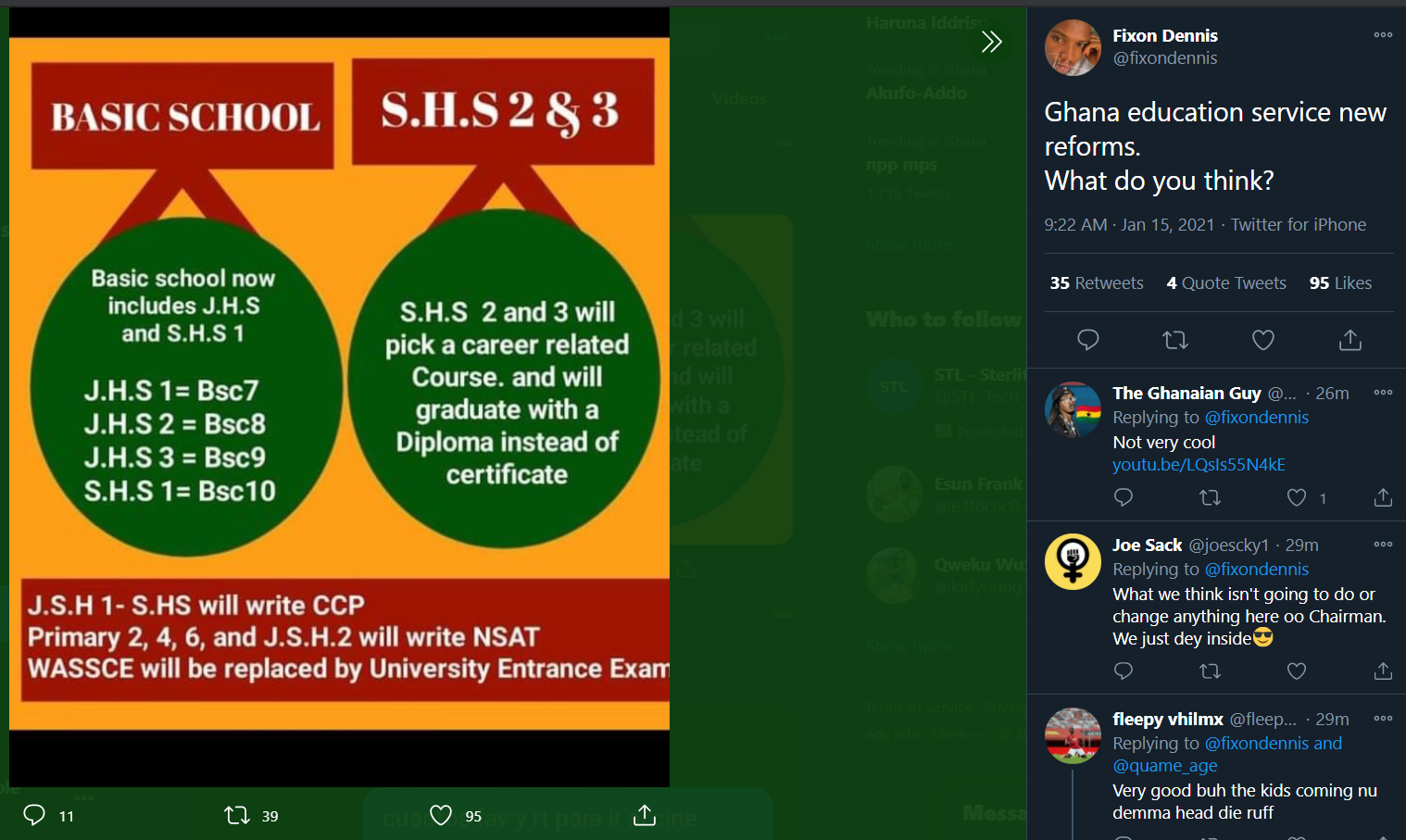
    Social media users suggest that a new educational reform has been rolled out by the Ghana Education Service (GES) which includes some changes in the state of the Basic Education system and other aspects of the system as is being run currently in the country. An image, which contains the claims,  has been in circulation on social media applications like Twitter and has generated some conversation on the medium with some users indicating excitement at the change  and others being indifferent and skeptical about the implementation processes to be involved.

    Image source: Twitter

    Dubawa set out to find out what truths exist or otherwise in the image and posts being circulated.

    Claim 1: Basic schools in Ghana now include JHS and SHS 1.

    True. However,  the basic school system does not end at SHS 1 but rather at SHS 3. 

    Verification: According to the National Council for Curriculum and Assessment (NaCCA), basic education has been redefined as a concept to include Senior High School as opposed to just Kindergarten to Junior High School 3 as had previously existed. The system has further been divided into five key phases:

    Key Phase 1: Foundation level which comprises Kindergarten 1 and 2

    Key Phase 2: Lower Primary level which comprises basic/class 1 to 3

    Key Phase 3: Upper Primary level which comprises basic/class 4 to 5

    Key Phase 4: Junior High School level 1 to 3

    Key Phase 5: Senior High School level 1 to 3

    Claim 2: SHS 2 and 3 will pick a career related course and will graduate with a Diploma instead of certificate.

    False.  Decisions have not been taken on the type of examinations that will be written at the end of the Senior High School Year yet.

    Verification: According to Mr John Mensah Anang, acting Director General of NaCCA, there are two  pathways from which students will choose– career pathway and academic pathway. The academic pathway encompasses the sciences and the humanities while the career pathway will be the vocational and the technical courses. 

    “The type of exams they will write, the decision has not been taken so there is nothing like Diploma or certificate. That thing was somebody’s suggestion when we were meeting stakeholders. A series of suggestions have been made but we are not yet there because the students who will write or enter into those places are currently in JHS 1 so it will take four years before they will get there. By that time, we might have discussed thoroughly and convincingly and as a nation, come out with what type of exams they should write at the ending point of Senior High. So as at now, no decision has been made,” Mr. Anang said.

    This was also confirmed by Cassandra Twum Ampofo, Public Relations Officer at the Ghana Education Service, who stated that after being taken through the Common Core Programme from JHS to SHS 1, students will be allowed to choose their electives which will be specific and help chart their career paths.

    Claim 3: JHS 1 to SHS will write Common Core Programme (CCP).

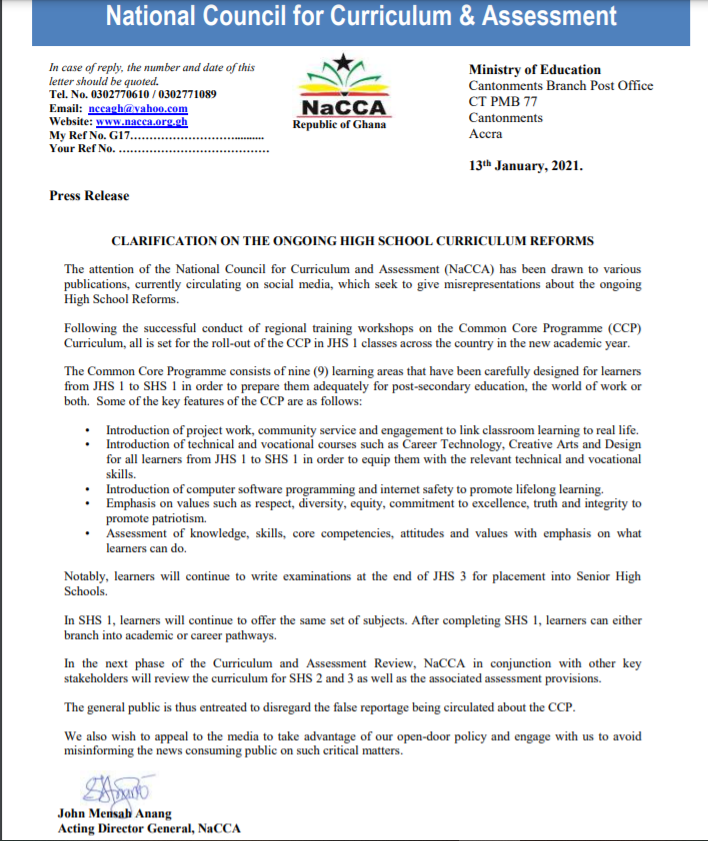
    False. The CCP is a four year programme designed to lead students to choose a pathway in their second year in Senior high school. It is not some form of exam to be written.

    Verification: From JHS 1 to SHS1, GES is rolling out a course called Common Core Programme (CCP). 

    “This just means that the subjects that are done in JHS 1 will be done till SHS 1 and this is what is supposed to predispose the learner into the two pathways– the career pathway and the academic pathway. So it is a four year program,” Mr. Anang, Acting Director General of the NaCCA clarified.

    The CCP will comprise nine subjects —Mathematics, Languages, Science, Religious and Moral Education, Physical and Health Education, Career Technology, Social Studies, Computing, Creative Arts and Design.6.

    The press release above, issued by the Acting Director General of NaCCA, John Mensah Anang, provides more detail on the Core Curriculum Programme. 

    See also, National Pre-tertiary Education Curriculum Framework for developing subject curricula  for more information.

    Claim 4: Primary 2, 4, 6 and JHS 2 will write NSAT.

    True. However, SHS 2 was left out of the stages that the NSAT will be written.

    Verification: The National Standard Assessment Test( NSAT) will be written in Primary 2, 4, 6, JHS 2 and SHS 2, according to Mr. Anang.

    “This is supposed to be conducted by NaCCA at all these levels to assess the quality of teaching and the quality of learning that has gone on. Then the interventions that will be needed where the gaps that are identified will be instituted at the next level to help the child,” he added.

    By testing the students at all these levels, there is an expectation that shortcomings will be identified and also the progress and achievement of each learner can and will be tracked in order to know which interventions to put in place to help the child adjust.

    According to the PRO of GES, Cassandra Twum Ampofo, the implementation started in September 2019 where the Service announced that there would be a national assessment to ascertain the core competence that learners have acquired. 

    Claim 5: WASSCE will be replaced by University Entrance Exams.

    False. WASSCE will not be replaced by the University Entrance Examination.

    Verification:  According to Mr. Anang, this was someone’s suggestion during the Covid-19 period when SHS 3 students were unable to go to school and write their exams. The suggestion was however rejected for various reasons of which he mentioned two.

    First, Mr. Anang stated that doing so would rob people who cannot further their education of certificates which they could use to apply for jobs that may accept Senior High School Certificates for employment.

    Secondly, he stated that the Universities cannot take on all SHS leavers.

    “This is a figment of someone’s imagination. It is not true”, Mr Anang stated.

    About Ghana Education Service

    The Ghana Education Service (GES) was established, as part of the Public Service of Ghana, in 1974. The GES is tasked with the duty to create an enabling environment in all educational institutions and also manage the positions that facilitate effective teaching, learning and efficiency in the management for the attainment of the service’s goals. The GES also has the responsibility of ensuring that all Ghanaian children of school-going age are provided with inclusive and equitable quality formal education and training through effective and efficient management of resources.

    The GES is also responsible for the implementation of approved national pre-tertiary educational policies and programs to ensure that all Ghanaian children of school-going age are provided with inclusive, equitable and quality formal education.

    There are four (4) main programmes under the GES:

    • Pre-tertiary education management including Headquarters Divisions, Regional and District directorates
    • Basic Education, comprising Kindergarten, Primary and Junior High Schools
    • Secondary Education comprising Senior high School (SHS) and Technical and Vocational Education Training (TVET)
    • Special and Inclusive Education

    About the National Council for Curriculum and Assessment(NaCCA)

    The NaCCA was established as an Advisory Board to the Curriculum Research and Development Division of the Ghana Education Service. The goal was to manage and implement the Curriculum Policy of the Ministry of Education towards the attainment of educational objectives and educational goals in Ghana. NaCCA had its first set of council members inaugurated in 2011. It is presently governed by a 21-member Governing Council which is made up of representatives from different institutions.

    Conclusion:

    The claims being circulated about a new educational reform in Ghana constitute a mix of half-baked truths and untruths.

Back to top button