NPP

  • Explainer: Does winning 75% of Ashanti Region guarantee NPP victory in 2024?

    Ghana’s voters will elect a new president in less than 16 days. Campaigns have intensified, with many political bigwigs taking every opportunity to sell their mandates and visions ahead of Dec. 7, 2024.

    On the road to elections, on Nov. 13, 2024, Nana Akomea, Vice Chairman of Dr Mahamudu Bawumia’s campaign team, appeared on GH Today on GHOne TV and made a claim that sparked much debate.

    According to Nana Akomea, if the New Patriotic Party (NPP) secures 75% of the votes in the Ashanti Region, they will win the 2024 presidential election.

    However, is this claim valid, or does historical data present a more complex picture?

    The Ashanti Region: A key stronghold for the NPP

    The Ashanti Region is widely regarded as the NPP’s traditional stronghold, with a long history of overwhelming support for the party in presidential elections.

    This region is crucial to the NPP’s electoral strategy, contributing significantly to their national vote tally.

    Given its size and political importance, a strong performance in Ashanti is often seen as a major factor in securing victory at the national level.

    The 75% Target: Fact or fiction?

    Nana Akomea’s statement implies that achieving 75% of the vote in Ashanti guarantees a national win for the NPP.

    This assertion may seem plausible on the surface, especially given the NPP’s history of strong performance in the region.

    However, a closer look at the historical data reveals a more nuanced reality.

    A Review of NPP’s Performance in Ashanti from 1992 to 2020

    To assess the claim’s validity, it is important to analyse voting patterns in the Ashanti Region over the years and how they correspond with national election outcomes.

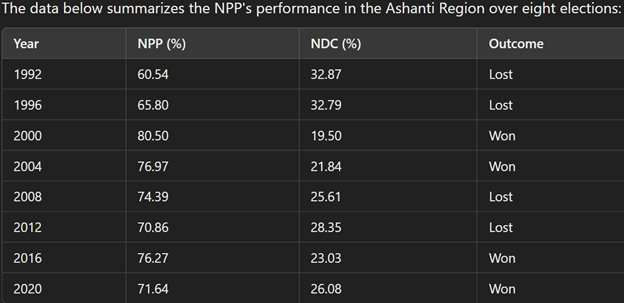
    Here’s a summary of the NPP’s vote share in Ashanti during presidential elections from 1992 to 2020:

    Data source: Peacefmonline election database

    Key observations made by DUBAWA

    From the historical data, DUBAWA made the following key observations about the NPP’s performance in Ashanti and its correlation with national outcomes:

    1. When the NPP secured over 75% in Ashanti: In the years 2000, 2004, and 2016, the NPP won more than 75% of the votes in Ashanti, and in all three cases, they won the national election.

    This trend suggests that a strong performance in Ashanti can be a strong foundation for an NPP victory.

    1. When the NPP secured less than 75% in Ashanti: In 1992, 1996, 2012, and 2020, the NPP did not secure the national election because the support, though significant, was less than 75%  in Ashanti.

    This shows that securing a high percentage of votes in Ashanti alone does not guarantee a national win if the NPP performs poorly in other regions.

    1. 2008 election: The 2008 election is a notable outlier. In this election, Nana Akufo-Addo secured 74.39% of the votes in Ashanti, a figure close to the 75% threshold.

      Despite this strong showing in Ashanti, the NPP lost the national election, largely due to weak performance in other key regions like Greater Accra and Volta, which were strongholds for the NDC.

    2. The Importance of Other Regions: The 2020 election provides further evidence that winning Ashanti by a large margin does not automatically ensure victory.

      Despite securing 71.64% of the votes in Ashanti, Akufo-Addo’s victory was secured through strong support in other regions, particularly Greater Accra, which played a decisive role in his win.

    Conclusion

    While securing 75% of the vote in the Ashanti Region greatly increases the NPP’s chances of winning the national election, it is not guaranteed.

    Historical evidence suggests that the party’s performance in other regions, particularly in swing areas like Greater Accra and Central Region is in determining the overall winner.

    The 2008 election serves as a cautionary tale, where even a high percentage of votes in Ashanti could not overcome losses in other regions.

    Similarly, the 2020 election demonstrated that the NPP could still win without reaching 75% in Ashanti, provided they performed well in other key regions.

    In conclusion, while a 75% vote share in Ashanti strengthens the NPP’s position, it does not automatically result in a national win.

    To secure victory in 2024, the NPP will need to perform well in Ashanti and other critical regions across the country.

  • Fact card of NAPO saying without him, Bawumia cannot get 50% votes in Ashanti Region, false!

    Claim: Popular Ghanaian influencer Enokay and broadcaster Kevin Taylor shared a fact card allegedly quoting former Energy Minister and New Patriotic Party (NPP) running mate, Dr Matthew Opoku Prempeh, aka Napo, as saying that without him, Vice President Dr Mahamudu Bawumia cannot secure 50% of votes in the Ashanti Region in the upcoming December 7 elections.

    Verdict: False! Dr Matthew Opoku Prempeh has not made such a statement. An advanced Google image search by DUBAWA shows no credible media outlet has reported on this claim. Furthermore, Media General’s TV3 Network, whose logo appeared on the fact card, has publicly debunked the circulating image as fake.

    Full Text

    Popular football and betting influencer Enokay 69, with over 600,000 followers, shared a fact card featuring Matthew Opoku Prempeh (Napo), suggesting that Vice President Dr Mahamudu Bawumia cannot attain 50% of the votes in the Ashanti Region.

    Enokay’s post, shared on X (formerly Twitter), included a laughing emoji and has garnered significant engagement, with over 108,000 views, 116 comments, 290 retweets, 3,400 likes, and some bookmarks as of Nov. 24, 2024.

    Furthermore, popular Ghanaian broadcaster Kevin Taylor shared the same fact card with over 60,000 followers. With a caption as simple as “ok,” Mr Taylor attained over 26,000 views with 70 retweets as of Nov. 24, 2024, at 02:17 p.m.

    Meanwhile, the fact card carried the logo of Media General’s TV3 Network and a background image of Napo, which gave it a stamp of credibility.

    Several X users shared reactions on the X digital platform on Nov. 24 after chancing on the flyer:

    X user, Big Homi Flee, @Homibwoy1, reacted by saying,

    “Dem Dey throw jabs at each other. Chale Mahama win am already.”

    Another user, Blaugrana, @blaugrana1803, wrote: “NPP will get their worst-ever election defeat on Dec 7. Bookmark this.”

    I’m Success (@CFCsayuti) also commented: “NAPO can actually say this. That man is sensible when he’s quiet.”

    Lastly, NKOJ, @nanaossei_, remarked,

    “He’s basically confirmed that he’s the running mate ONLY because he’s from Ashanti Region. And it’s obvious to any sensible person that had it been based on intelligence, he certainly wouldn’t be the one to partner @MBawumia.”

    Interestingly, DUBAWA also spotted the fact card circulating on WhatsApp statuses, spreading misinformation. Given its potential to mislead voters as the election nears, DUBAWA decided to investigate.

    Verification

    DUBAWA’s investigation revealed that Dr Matthew Opoku Prempeh had not made the alleged statement during his campaign tours or in any other context.

    A Google keyword and image search showed no reports by reputable media outlets confirming the claim.

    Additionally, Media General, owners of TV3 Network, issued a public disclaimer shortly after Enokay’s post, stating:

    “This artwork currently circulating is FAKE and was not created by Media General. Please don’t share or engage with it.”

    Meanwhile, some pro-NPP platforms debunked the fact card by splashing ‘Fake’ tags over it. Some of them can be seen here, here and here.

    Conclusion

    Matthew Opoku Prempeh’s claim that Vice President Mahamudu Bawumia cannot secure 50% of votes in the Ashanti Region without him is false. The fact card is a fabrication, as Media General’s disclaimer confirmed.

  • Freddie Blay’s claim country’s inflation rate stands at 14%, false

    Claim: Freddie Blay, the former national chairman of the New Patriotic Party (NPP), has claimed that the county’s inflation rate currently stands at 14%.

    Verdict: False. The latest data from the Ghana Statistical Service show that the year-on-year inflation rate for October is 22%.

    Full Text

    Various political parties are intensifying their campaigns ahead of the upcoming elections. The New Patriotic Party (NPP) and the National Democratic Congress (NDC) have ramped up efforts to rally support from their electorates, each hoping to secure votes with their respective messages.

    The economy remains a pressing issue for many Ghanaians. In light of this, the National Chairman of the New Patriotic Party (NPP), Freddie Blay, urged the public to vote for the NPP, touting the government’s efforts to stabilise the economy. He claimed the government had reduced the inflation rate from 54% to 14%. This claim was made during an interview on Citi FM’s Eyewitness News on Friday, Nov. 23, 2024, streamed live on the station’s YouTube channel and can be found from 18 minutes: 43 seconds to 19 minutes: 04 seconds. He said, “To me and you now, the economy is picking up. The GDP growth now is about 6.5%. If I am wrong, correct me. Inflation is going down. It is from 50 something, and it is now 14%.”

    Due to Citi FM’s reach, DUBAWA investigated the assertion to determine its accuracy.

    Verification

    The Ghana Statistical Service (GSS), the authority responsible for collecting, analysing, and disseminating statistical data in Ghana, publishes monthly updates on key economic indicators, including inflation and GDP. Is Ghana’s inflation rate 14%? In simpler terms, when inflation occurs, the cost of living rises, meaning people need more money to buy the same goods and services they previously could afford at a lower price. According to the most recent data released by the GSS for October 2024, the inflation rate stands at 22%, significantly higher than the 14% claimed by Mr Blay.

    Below is a summary of inflation rates published by the GSS from January to October 2024.

    INFLATION RATE: JAN-OCT
    January23.5%
    February23.2%
    March25.8%
    April25%
    May23.1%
    June22.8%
    July20.9%
    August20.4%
    September21.5%
    October22.1%
    Source: Ghana Statistical Service

    Source: Ghana Statistical Service

    It is also worth noting that throughout the year (2024), the country’s inflation rate has never been reduced to 14%, so the claim by the NPP’s former chairman is false.

    Conclusion

    Freddie Blay’s claim that the former National Chairman of the NPP, that the government reduced Ghana’s inflation rate from 54% to 14% is not supported by the available data from the Ghana Statistical Service (GSS). According to GSS, the inflation rate for October 2024 is 22%, and it has never dropped to 14%.

  • True, NAPO mentioned John Mahama’s name instead of Dr Bawumia during address at UPSA

    Claim: Social media users have shared a video of  Dr. Matthew Opoku Prempeh (NAPO), the running mate of the New Patriotic Party (NPP), urging voters to support John Mahama. However,  in another video of him from the same event, NAPO is heard calling for support for Dr Mahamudu Bawumia instead.

    Verdict: True.The claim that Dr Matthew Opoku Prempeh (NAPO) urged voters to support “John Mahama” in a viral video is accurate. While Dr Opoku Prempeh did initially mention “Mahama” by mistake, a review of the original JoyNews video confirms that this was a slip of the tongue. He quickly corrected himself, clarifying that he meant “Mahamudu Bawumia.” However, the second video, which claims to show NAPO saying “Bawumia nie” without the prior error, has been manipulated.

    Full Text

    Two videos about the running mate of the New Patriotic Party (NPP), Dr Matthew Opoku Prempeh, known as NAPO, are circulating on social media. One video shows him urging voters to support Mahama, while the other depicts him calling on voters to support Bawumia.

    A similar situation occurred during the lead-up to the 2020 elections when President Akufo-Addo mistakenly mentioned Okoe Vanderpuije of the NDC instead of Okoe Bannerman of the NPP.

    The video of Dr. Matthew Opoku Prempeh (NAPO) urging voters to support “Mahama” has been widely circulated by members of the opposition National Democratic Congress (NDC), including their National Communications Officer, Sammy Gyamfi, who shared it on his X account. While this could pose a significant challenge to the NPP, another video version, in which NAPO mentions “Bawumia,” has also gained attention.

    So, which version is authentic? DUBAWA analysed both videos.

    Verification

    The 12-second clip shows NAPO mentioning “Mahama,” and the 9-second clip shows him mentioning “Bawumia.” To verify their authenticity, DUBAWA transcribed both videos to make a detailed comparison.

    First Video: “When you are going to vote, ‘John Mahama nie,’ ‘Lomotey nie.’ ‘Mahama nie.’”

    Second Video: “When you are going to vote, ‘Bawumia nie,’ ‘Lomotey nie.’”

    Did Dr Matthew Opoku Prempeh Say ‘John Mahama’ or ‘Bawumia’?

    DUBAWA’s findings confirm that Dr Matthew Opoku Prempeh initially mentioned “Mahama” by mistake, not “Bawumia.”

    A detailed assessment of the original video, published by JoyNews on YouTube, compared with the viral clip claiming he said “Bawumia nie,” reveals clear discrepancies. The portion where “Bawumia nie” appears in the viral video was spliced into the segment where Dr. Opoku Prempeh mistakenly said “Mahama.” This manipulation and a cutaway shot created a false impression of continuity.

    The extended video from JoyNews provides clarity. It shows that Dr Opoku Prempeh did say “Mahama” twice. Recognising his error, he corrected himself and mentioned “Bawumia.” Later, he explicitly clarified that he meant “Mahamudu Bawumia” and not just “Mahama.” This can be found from “00:58 onwards in the video.

    Body language in the original clip also supports the claim of an unintended error, as it visibly reflects his realisation of the mistake.

    DUBAWA spoke to the Social Media Manager of the Joy News cluster, Kweku Kyei, who confirmed that a reporter was present at the event and captured the video of NAPO saying “Mahama nie.”

    Conclusion

    The analysis reveals that the video showing Dr Matthew Opoku Prempeh (NAPO) urging voters to support “John Mahama” is authentic but reflects a genuine slip of the tongue. He quickly corrected himself and clarified his intended message, emphasising support for Dr Mahamudu Bawumia. The second video, which claims he consistently said “Bawumia nie” without error, is manipulated.

  • False: Viral campaign videos allegedly depicting violence not from NPP or NDC

    Claim: Social media users have shared viral videos that allegedly show the New Patriotic Party (NPP) and the National Democratic Congress (NDC) mocking voters and promoting violence.

    Verdict: False.The audio accompanying the New Patriotic Party (NPP) campaign videos and the National Democratic Congress (NDC) are not genuine representations of the parties’ messaging. DUBAWA’s checks revealed that the audios were not affiliated with either political party. Instead, they were traced to videos Ghanaian actor Kwaku Manu created, which were shared on his TikTok account, kwakumanubob.

    Full Text

    Two videos, purportedly from the New Patriotic Party (NPP) and the National Democratic Congress (NDC) campaign trails, are trending on social media. Both videos feature campaign trucks with the same attached audio, allegedly making fun of voters and promoting violence.

    The videos have gained significant attention and have been widely shared. Alfred Ogbamey shared footage featuring an NPP campaign truck on Facebook, while George Kwarteng Adenta published another showing an NDC campaign truck on Facebook. Social media users who viewed the videos have criticised the parties for disrespecting citizens.

    With the elections just days away and the potential for these videos to harm the reputation of either party, DUBAWA has decided to investigate the claims.

    Verification

    DUBAWA first transcribed the audio from Twi to English to understand the context. The transcription reads: “We are still campaigning. To be honest, if you choose to vote for us, it’s your decision. However, if you decide not to, take your ‘stupidity’ away.”

    The fact-check aims to determine whether the audio in the videos is genuine and to find its original source.

    Our checks revealed that the videos of the two political parties are not linked to the audio attached to them. Further checks confirmed that the audio originates from a popular Ghanaian actor, Kwaku Manu. It can be found on his TikTok account, kwakumanubob. The original version of the video is an extended clip lasting one minute and three seconds.

    A similar video has been spotted on jeneral_ntatia‘s TikTok account. In it, he is also seen using the same megaphone and making remarks similar to those made by Kwaku Manu.

    Conclusion

    DUBAWA’s checks revealed that the audio attached to the NPP and NDC campaign videos does not authentically represent either party’s messaging. Instead, the audio was traced to a video created by popular Ghanaian actor Kwaku Manu, with the original video available on his TikTok account, kwakumanubob.

  • Kufuor’s wheelchair comment falsely attributed to NDC’s Sammy Gyamfi

    Claim: Multiple sources claimed Sammy Gyamfi, the National Communication Officer of Ghana’s opposition NDC, has asked the country’s ex-President John Kufuor to “shut up” after he encouraged Ghanaians to vote for Dr Mahamudu Bawumia, the ruling NPP’s 2024 flagbearer.

    Verdict: False. DUBAWA’s investigation showed Sammy Gyamfi did not make the alleged comment. Reacting to the claim on X on Nov. 14, 2024, the private legal practitioner described it as “fake.” Also, Accra-based Class FM, the alleged originator of the claim on the flyer, has disputed it.

    Full Text

    Multiple sources claimed Sammy Gyamfi, the National Communication Officer of Ghana’s opposition National Democratic Congress (NDC), has asked the country’s ex-President John Kufuor to “shut up” after he encouraged Ghanaians to vote for Dr Mahamudu Bawumia, the ruling New Patriotic Party (NPP)’s 2024 flagbearer.

    Mr Kufuor told Accra-based Asempa FM that Ghana needs a leader who understands technology and how it drives economic growth.

    The ex-Ghanaian leader believes the Presidential candidate who towers over the pack in this area is Dr Bawumia, the ruling NPP’s 2024 flagbearer.

    “We need somebody like him [Dr Bawumia] who understands modern trends in global affairs, as well as technology and digitalisation. These are the trends in developed countries like America and others,” Mr Kufuor said.

    See the news report on the interview here, here, and here.

    A screenshot of the flyer making the rounds on social media in Ghana

    Less than 24 hours after the interview’s broadcast, Sammy Gyamfi, the opposition NDC National Communication Officer, reportedly called out Mr Kufuor for his comments.

    “Shut up in your wheelchair. You will go to jail when Mahama is sworn in,” Mr Gyamfi reportedly told the ex-Ghanaian leader.

    The claim was on a flyer with the logo of Accra-based Class FM.

    See the flyer here, here, and here.

    Reacting to the claim, an X user, Akaglo Wisdom, wrote on Nov. 14, 2024, said,

    “Ashantis [residents of Ashanti] must punish John Mahama for this.”

    The social media platform said that as of Nov. 15, 2024, the X user’s post had received over 161,945 views, 482 comments, 156 reposts, 1,943 likes, and 39 bookmarks.

    Also, reacting to the claim on X (formerly Twitter), Samuel Koku Anyidoho, a suspended NDC member, wrote on Nov. 15, 2024, said,

    “Such impetuous abrasive arrogance and disrespect!!! Is this what they want power for??? Father, forgive them for they know not what they are saying.”

    The social media data revealed Mr Anyidoho’s post on X had, as of Nov. 15, 2024, received over 216,934 views, 219 reposts, 2,432 likes, 561 comments, and 56 bookmarks.

    DUBAWA decided to probe the claim due to its virality in the West African country.

    Verification

    DUBAWA’s investigation showed Sammy Gyamfi, the opposition NDC’s Communication Officer, did not make the alleged comment.

    Commenting on the widely circulated claim on X on Nov. 14, 2024, Mr Gyamfi described it as “fake.”

    The private legal practitioner later reacted to Mr Anyidoho’s X post on Nov. 15, 2024, claiming he had not “made any such comment anywhere.”

    He replied,

    “I didn’t know that you were this naive not [to] know fake news when you see one. Clearly, your bitterness against the NDC and people like me has blinded you to the truth. For your information, I have not made any such comment anywhere. Do your checks and spare yourself this embarrassment. Conveyor of FAKE NEWS. Disgraceful!”

    Also, Accra-based Class FM, the alleged originator of the claim on the flyer, has disputed it.

    The media outlet told DUBAWA it did not create the fact card that has gone viral on social media in the country.

    Similarly, DUBAWA’s Google keyword search revealed that no credible media outlet in Ghana has reported on the claim.

    With less than 22 days to the general election in Ghana, the alleged claim would have dominated discussions and headlines in the country if Mr Gyamfi had said it.

    However, no such data supports the claim that Mr Gyamfi had asked the country’s second President in the Fourth Republic, Mr Kufuor, to “shut up” and reserve his comments about the nation’s governance to himself.

    Conclusion

    Sammy Gyamfi, the opposition NDC’s Communication Officer, has not told the country’s ex-president, John Kufuor, to “shut up” after openly endorsing the ruling NPP’s 2024 candidate, Dr Mahamudu Bawumia.

  • False! GMX, launched by Dr Bawumia, not Ghanaian first music streaming platform

    Claim: Attractive Mustapha, president of the Ghana Bloggers Association, has shared a video claiming that the local music streaming platform GMX, launched by Vice President Dr Mahamudu Bawumia on Oct 30, 2024, at De Icon Centre, is the first Ghanaian music streaming platform.

    Verdict: False! Checks by DUBAWA confirmed a local streaming platform such as Aftown, a Ghana-based digital service provider backed by its experience in distribution and support for artists officially, since Oct.21, 2016. The co-founder of Aftown has equally debunked the said claim.

    Full Text

    Ghana’s Vice President and presidential Candidate, Mahamudu Bawumia, has long emphasised the need to digitise Ghana’s economy.

    He has led several digital initiatives, the most recent of which is the Ghana Music Xperience (GMX) app, a local music streaming app platform launched on Oct. 30, 2024, at De Icon Centre to empower musicians.

    During the launch, Dr Bawumia described the GMX app as “a Ghanaian-built music streaming platform designed to connect Ghanaian music with audiences locally and globally. The vast fan base of every Ghanaian musician is Ghanaian, yet they do not make enough money from this strong fan base at home because of piracy and foreign streaming services, which do not promote and pay them adequately. I am very confident that with the support of all of us, through the patronage of the GMX, the game will now change for our musicians and industry to get their deserved compensation.”

    Many commented on social media or dropped their opinions concerning the app. In monitoring, DUBAWA noticed that the President of Ghana Bloggers Association, Andre Mustapha Nii Okai Inusah, popularly known as Attractive Mustapha, has shared a video of the launching event on YouTube to his over 45,500 subscribers, with the caption:

    “Dr Bawumia Makes History with Launch of Ghana’s First Music Streaming App for Local Artists.”

    The 14:12 seconds video on YouTube had garnered 66 views as of Nov. 1, 2024, at 2:49 am, with the comment sections turned off.

    Meanwhile, the idea of the app being the first had already caused a debate in the entertainment sphere and on Facebook, so DUBAWA decided to investigate further.

    Verification

    DUBAWA’s advanced Google keyword verification showed that Aftown had operated since Oct. 21, 2016. Also, DUBAWA noticed that Aftown was developed by Technation Ghana Company and BBnZ Live and is dedicated to African music. The app, free to download on the App Store and Google Play Store, generates revenue through premium subscriptions and adverts for free users. Circa 2019, the company partnered with telecoms giant MTN to allow payment via mobile money. DUBAWA checked the website of aftown, which described the app as “based in Accra- Ghana.” Aftown exists to connect artists to their fan base all over the world. The website then directed readers to get more information on the wiki. The researcher followed the content on wiki and the following;

    Screenshot of Aftown’s profile on Wikipedia

    Additionally, DUBAWA  found an article by broadcaster and co-founder of the music streaming service Aftown, Mr Antoine Mensah, who has equally dispelled the notion that GMX is the first Ghanaian music streaming platform.

    “I saw the tagline of GMX being promoted as the very first from our end. Like I said in the beginning, there is nothing wrong with new ones coming into the market, but tagging it as the first, I personally felt like it was not the right tag. They need to rephrase that. So internally, between me and my partners, we were like, ‘really?’ If you are bringing a new platform, there is nothing wrong with that, but let’s tag it right,” he said on Hitz FM.

    Conclusion

    Launched in October 2016 in Accra by Ghanaian owners, Aftown has two main platforms: streaming and downloads. Hence, Attractive Mustapha’s caption on YouTube, “Dr Bawumia Makes History with Launch of Ghana’s First Music Streaming App for Local Artists,” is false.

  • Mahama makes a false claim about Ghana’s 54% inflation being the highest in the 4th Republic

    Claim: Former President John Mahama and current flagbearer of the National Democratic Congress has claimed that in the 4th Republic, Ghana’s highest inflation was recorded during the tenure of Dr Mahamadu Bawumia.

    Verdict: This is false. Data from the Bank of Ghana shows that in 1995 and 1996, the country recorded higher inflation rates than the 54%  recorded in December 2022.

    Full Text

    Former President and flagbearer of the National Democratic Congress John Mahama has asked Vice President Dr Mahamudu Bawumia five questions, who is also contesting for president in the 2024 elections.

    John Mahama asked the Vice President and the head of the government’s Economic Management Team, why the country’s inflation rate rose to 54%.

    “Why did inflation rise to its highest in the 4th Republic of 54% under your watch as EMT chair,” he queried.

    Source: John Mahama (X) \ A graphic showing the questions posed by John Mahama to Vice-President Dr Bawumia.

    Indeed, in December 2022, Ghana’s inflation rose to 54.1%. However, is that the highest in the fourth republic?

    Verification

    The Bank of Ghana provides historical data on Ghana’s inflation. Since the fourth republic was born in 1993, we have monitored Ghana’s inflation rate.

    DUBAWA Ghana observed that in May 1995, Ghana’s inflation hit 56.12%. The rate continued going up for the rest of the year, peaking at 70.82% in December before falling slightly to 69.20% in January 1996.

    It was not until June 1996 that Ghana’s inflation dropped to 48.42%, lower than the 54.1% inflation recorded in December 2022.

    Below is the Bank of Ghana data showing inflation rates between 1992 and 1996.

    Source: Bank of Ghana | Figures in the red rectangular box showing inflation rates higher than the 54.1% recorded in 2022.

    The International Monetary Fund also provides historical data about Ghana’s inflation trend. Their data is an annual average instead of the month-by-month presentation by the Bank of Ghana. According to their data, Ghana’s inflation increased by 59.3% on average in 1995, which is also higher than the 54.1% recorded in 2022.

    Source: IMF

    Conclusion

    Ghana’s December 2022 inflation of 54.1% is not the highest in the fourth republic. Between May 1995 and May 1996, Ghana recorded inflation rates higher than the 54.1% attained in December 2022.

  • Speaker forces ‘disloyal’  MPs to vacate their seats

    A cloud of uncertainty hangs ominously on the chamber of Parliament after the Speaker of Parliament Alban Bagbin declared four seats of ‘disloyal’ Members of Parliament vacant.

    With two months to the end of the parliamentary cycle, the declaration manifestly alters the sitting positions of Members of Parliament, making the hitherto Minority members, become the Majority.

    But the leader of government business in Parliament Alexander Afenyo Markins is convinced the Speaker’s ruling and declaration on Thursday October 17, is a travesty of justice and cannot stand the test of legal inquest.

    He has filed a suit at the country’s Supreme Court, the highest court of the land in a bid to overturn the Speaker’s ruling

    Background

    The National Democratic Congress (NDC) threatened to  compel  a number of MPs on the majority side to vacate their seats after they announced plans to run as independent candidates in the upcoming 2024 elections.

    The party says it will invoke Article 97(1)(g) of Ghana’s 1992 Constitution, which states: 

    “A member of Parliament shall vacate his seat in Parliament (g) if he leaves the party of which he was a member at the time of his election to Parliament to join another party or seeks to remain in Parliament as an independent member;”

    Haruna Iddrisu, the Member of Parliament for Tamale South, who made the threat, believes this move could shift the current parliamentary dynamics and give the NDC a majority in Parliament.

    “The minority must become the majority for Wednesday next week. I assume this must happen if there is constitutional and legal proprietary law in Ghana.

    “Because any nuanced interpretation of Article 97 provides that if a member of parliament on a political party ticket like NPP defects and files to be independent, that MP ceases to be a member of parliament.”

    On Thursday, the NDC Minority in Parliament brought the issue to the attention of the Speaker for a decision to be made.

    The Speaker obliged, citing the law and precedents and terminating the parliamentary careers of the four MPs, at least for the eighth Parliament of the fourth Republic.

    Alban Bagbin said the decision by the MPs to contest the 2024 elections in December as independent candidates is evidence of disloyalty to their constituents and must vacate their seats.

    The affected MPs are Gender Minister Cynthia Morrison who intends to run independently. The others are the Second Deputy Speaker of Parliament and MP for Fomena, Andrew Asiamah Amoako, Kwadjo Asante of Suhum, and Peter Yaw Kwakye-Ackah, the National Democratic Congress (NDC)’s MP for Amenfi Central.

    Even before a decision will be taken, the matter had already become a subject of interest and conversation

    The Political Context

    The opposition NDC  held  a narrow minority, but the potential disqualification of four MPs running as independents could change this.

    According to Haruna Iddrisu, the Article clearly mandates that MPs who contest elections as independents, after being elected on a party’s ticket, forfeit their parliamentary seats. He argues this would automatically disqualify the MPs in question, including Cynthia Morrison.

    Iddrisu’s interpretation suggests that the MPs’ decision to run as independents signalled their defection from the New Patriotic Party (NPP). Hence, they are no longer recognised under the Constitution.

    “And if an independent member of parliament, by virtue of the provision of Article 97 1(g), an independent joins a political party, that independent loses constitutional recognition and does not belong to parliament. And even if an NDC candidate, MP, defects to become an independent, he ceases to be a member of parliament,” he said.

    Article 97(1)(g) in perspective?

    Article 97(1)(g) of Ghana’s Constitution states that:

    “A member of Parliament shall vacate his seat in Parliament if, having been elected to Parliament as a member of a political party, he leaves that party to join another party or becomes an independent member.”

    This clause provides the constitutional basis for MPs to vacate their seats under two conditions:

    1. If they leave the party under whose ticket they were elected to join another party.

    2. If they become independent after being elected as a party member.

    The article aims to prevent “cross-carpeting” or switching allegiances mid-term, a practice that can disrupt parliamentary stability.

    Constitutional Interpretation and Precedent

    However, there is room for a nuanced interpretation of Article 97(1)(g). Constitutional lawyer Alexander Abban explains that MPs elected on a party’s ticket are only required to vacate their seats if they formally leave the party during the term of the current Parliament. Simply expressing an intention to contest future elections as an independent does not necessarily trigger this clause.

    Cynthia Morrison remains an NPP MP in the current Parliament despite announcing her plans to run independently in 2024. According to Abban, unless Morrison formally declares she has left the NPP, she cannot be forced to vacate her seat. The mandate she received from her constituents in the 2020 elections remains valid until the end of this parliamentary term in January 2025.

    “If Cynthia Morrison were to declare that from today, she is no longer NPP but CPP, then it will kick in immediately because she has declared so,” Abban explained. “But for now, she says she is NPP, but in the ensuing election of 2024, she wants to contest as an independent candidate.”

    Abban further pointed out that an MP’s mandate is for the full parliamentary term, adding that a political party can choose not to enforce its own internal rules against the MP.

    “It would be the responsibility of the political party to oust the person if they choose to enforce their laws,” he added. “But unless the person has formally switched allegiances during this term, Article 97(1)(g) would not automatically take effect.”

    This position is supported by past precedents. For instance, in 2020, the MP for Fomena, Andrew Amoako Asiamah, contested as an independent after being ousted by the NPP. However, he retained his seat until the end of the parliamentary session because he did not formally declare himself independent during the life of the 7th Parliament. The NPP only wrote to the Speaker, triggering Article 97(1)(g) when Asiamah officially defected.

    The NDC’s Strategy: Political or Legal?

    The NDC’s move to invoke Article 97(1)(g) could be seen as both a legal manoeuvre and a political strategy. Legally, the NDC would have to prove that the MPs have officially defected from the NPP. Unless the NPP formally writes to the Speaker indicating that these MPs have left the party, Article 97(1)(g) may not apply.

    Sammy Obeng, Executive Director of Parliamentary Network Africa, explains that the precedent set by the Fomena MP’s case would require the NPP to take formal steps to trigger the MPs’ disqualification.

    “In the case of the Fomena MP, the NPP wrote to the Speaker, indicating that the MP was no longer a member of the party, hence triggering Article 97(1)(g),” Obeng noted. “I’m not too sure if either the NPP or NDC have written yet to the Speaker to indicate that these MPs are no longer members of their party.”

    Obeng also emphasised that if the NPP does not formally declare the MPs as defectors, the NDC may face challenges in enforcing the constitutional provisions.

    “If the precedent is anything to go by, we may now need to hear if the parties have officially communicated to Mr Speaker about these MPs [and why they are] no longer being part of their party,” he added.

    Politically, however, the NDC could use this issue to create uncertainty within the NPP ranks, potentially weakening their hold on Parliament. The NPP may also hesitate to expel the MPs, as doing so could reduce their majority and complicate the government’s legislative agenda two months into the next election.

    Conclusion

    While Article 97(1)(g) provides a clear mechanism for disqualifying MPs who switch allegiances, it remains unclear whether the NDC can force the four MPs to vacate their seats merely based on their intent to run as independents.

    The NPP’s response and whether they formally declare these MPs as defectors will be key in determining the outcome of this issue.

  • Claim NPP government recorded annual electricity increment of 11%, false

    Claim: Dr Ezekiel Agyekum-Obeng, a communications team member of the New Patriotic Party (NPP), has claimed that the NPP government recorded 11% of annual electricity tariffs during its tenure. 

    Did Mahama accuse Akufo-Addo of ethnic bias over Dam spillage?

    Verdict: False. DUBAWA’s checks from the Public Utilities Regulatory Commission (PURC) revealed that the government had never achieved an annual electricity tariff increment of 11%. In July 2019, the government raised tariffs by 11.17%, followed by another increase of 5.94% in October. This is however the lowest throughout the NPP’s tenure in government. Therefore, it is inaccurate to claim that the NPP government had recorded an 11% electricity tariff increment during its tenure in government.

    Full Text 

    In the third quarter of 2024, the Public Utilities Regulatory Commission (PURC) announced a 3.02% increase in electricity tariffs, effective from October 1. This adjustment affects all categories of consumers nationwide.

    In a statement issued on Saturday, September 28, PURC cited several factors driving the hike, including inflation, exchange rate fluctuations, and rising gas prices. The Commission also noted that Ghana’s ongoing economic difficulties and the impact on living standards were carefully weighed in making this decision.

    Following the announcement, a discussion on TV3’s Newday show on October 1, 2024, brought together representatives from the New Patriotic Party (NPP) and the National Democratic Congress (NDC). During the debate, NPP communications team member Dr Ezekiel Agyekum-Obeng defended his government’s handling of the energy sector. He claimed that, despite the sector’s challenges, the NPP should be commended for keeping the lights on since his government has recorded an 11% annual electricity tariff increase during its tenure in government. This, he argued, was lower than what occurred under the NDC.

    In his claim, he said, “If you look at the average yearly increment of electricity, for example, during the NDC, we were not doing less than 50%. With all the increments and all that you have read to us from the start of the show, we are doing 11% annual increments; as I said, even if it is 1%, it is an increment.”

    The show has since garnered over 1,000 views on YouTube. This can be found from the 21 minutes: 05 seconds to the -21 minutes: 26 seconds of the video. 

    Verification 

    DUBAWA’s research was geared towards finding out if the NPP government under President Akufo Addo, during his tenure from 2017 to the present, has increased electricity tariffs by an annual 11%. 

    In our findings, DUBAWA found out that the lowest the NPP government had done was 17.11%, which was in 2019. 

    In 2019, Ghana saw an increase in electricity tariffs, driven by inflation, currency depreciation, and the rising cost of power generation. The Public Utilities Regulatory Commission (PURC) announced two major tariff adjustments that year.

    This marked the first time the Akufo-Addo-led NPP government increased tariffs since coming into office in 2017.

    In fact, there was no tariff increase in 2017. Instead, in March 2018, tariffs were reduced by 17.5% for households, with further reductions applied at varying rates for non-household consumers and special load users.

    SOURCE: PURC

    As a result, DUBAWA decided to use data from its analysis from 2019 and 2023, respectively. This is because aside from 2019 and 2023, there were no other increments.  DUBAWA, however, did not include data from 2024 because the claim was made on October 1, the same day the new tariff was to take effect. 

    In July 2019, the government raised tariffs by 11.17%, followed by another increase of 5.94% in October

    Tariff Increment (2019 & 2023)
    20192023
    11.17% (July)29.96% (Jan.)
    5.94% (Oct.)18.36%  (May)
    4.22%  (Aug.)
    SOURCE: PURC

    In 2023, there were 29.96%, 18.36%, and 4.22% increments, respectively. 

    To ascertain the yearly average increment of the tariff increment, DUBAWA added figures from both 2019 and 2023. The total for 2019 and 2023 is 17.64 and 52.54, respectively. The total figure from these two years is 70.18%. To get the yearly average increment from these figures, DUBAWA divided these figures by two respectively. This gave us 35.09%.

    Conclusion

    In conclusion, DUBAWA used data from 2019 and 2023 to calculate the average annual tariff increment, as no other increments occurred outside these years. Excluding 2024 for consistency as the year has not ended. Our analysis revealed that the yearly average increment within these two years is 35.09%.

Back to top button