NPP

  • NDC and NPP’s ‘fight’ over Tolon District Hospital: Here are the Facts About the Project

    Ghana’s Vice President, Dr Mahamudu Bawumia on Monday, November 23, 2020, commissioned the Tolon district hospital in the Northern Region. 

    He said the facility is one of the six medical facilities which began three (3) years ago.

    The other facilities are the 80-bed Hospital at Somanya in the Eastern Region; 80-bed District Hospital at Buipe in the Savannah Region; 60-bed Hospital at Wheta in the Volta Region; 60- bed Hospital at Sawla in the Savannah Region and a 30-bed Polyclinic at Bamboi in the Savannah Region.

    In addressing the gathering at the ceremony, he remarked that the commissioning of the project proves wrong persons who claim the New Patriotic Party (NPP) government has not built a single health facility since it came to power in January 2017. 

    “Today’s event is a testament to the fact that truth crawls but will always triumph over falsehood…All of these facilities are practically complete and will be inaugurated one after the other by the close of the year, 2020,” Dr Bawumia said at the event.  

    His claim is, however, disputed by the opposition National Democratic Congress (NDC) which contends that the project is a legacy left behind by the John Mahama NDC administration. 

    A former Communications Minister, Felix Kwakye Ofosu in a Facebook post said the Akufo-Addo government knows nothing about the project. 

    “The Tolon District Hospital is yet another legacy of President Mahama. He found money for it in April 2016 and the contract for it and four others, as well as a Polyclinic at Bole, was awarded and signed with Vamed in September 2016. Akufo-Addo knows nothing about it and nothing about it knows Akufo-Addo,” Kwakye Ofosu’s post read. 

    There is, therefore, divided opinion on social media over who should be credited for the project. 

    While supporters of the New Patriotic Party (NPP) insist that is an achievement of the government, supporters of the opposition National Democratic Congress (NDC) say the project must be credited to them. 

    What are the facts about the project and who can lay claim to it? 

    Based on the background information that the Tolon District Hospital and the five other health facilities were externally funded, we checked the Parliament of Ghana’s archive of agreements and memoranda and found that the agreement for funding and construction of the facilities was submitted to parliament in March 2016 when the NDC’s John Mahama was still in office. 

    According to the document, President Mahama gave executive approval to the credit agreement a day before it was sent to Parliament.

    Per the document, a total amount of €89.9 million was sought from the Raiffeisen Bank International of Austria for the design, construction, equipping and furnishing of five new district hospitals at Somanya, Buipe, Sawla, Wheta, Tolon, and one Polyclinic at Bamboi.

    The Ministry of Health in a press release on September 7, 2016, indicated that an agreement had been signed with Vamed Engineering group as the contractor to execute the project. 

    According to many news reports such as one on Myjoyonline and GBC Ghana, John Mahama, on January 1, 2017, days before officially handing over power to the NPP’s Nana Akufo-Addo, held a ceremony in Wheta in the Volta Region to symbolically cut sod for all the five district hospital projects.  

    At the function, he said funding had been approved and he was hopeful that the incoming government will continue with the projects. 

    In his last State of the Nation Address on January 5, 2020, John Mahama restated the fact that he had cut sod for the projects to start. 

    In the 2017 budget statement [Page 113] read by the new government’s finance Minister, Ken Ofori Atta on March 2, 2017, the NPP government said it will continue the work that had started for the five district hospitals including the Tolon district hospital as well as the Polyclinic in Bamboi. 

    Despite the development, media reports from Daily Guide and Citi FM indicate that President Akufo-Addo in July 2018 again cut sod for the construction of the Tolon district hospital while on a 3-day tour of the Northern Region.

    A photo from the ceremony used by Daily Guide shows that at the time, blockwork was yet to commence, although the site had been prepared. 

    In the 2019 budget statement [Page 175] item 899, the Minister for Finance said, “In 2019, the following projects will continue: completion and equipping of Bekwai district hospital; four district hospital projects at Sawla, Tolon, Somanya, Buipe and a polyclinic at Bamboi; construction of Axim hospital; and rehabilitation of Effia-Nkwanta emergency, maternity and children’s block.”

    Again in the 2020 budget statement [Page 185] item 1033, the Finance Minister, Ken Ofori Atta said, the construction of 5 District Hospitals in Sawla, Tolon, Somanya, Buipe and Wheta and a Polyclinic in Bamboi will continue. 

    The contractors, VAMED Engineering GmbH on their website listed the Tolon District Hospital project contract’s execution as spanning from 2016 to 2020. 

    Conclusion:

    Evidence shows that the John Mahama administration started work on the Tolon District Hospital project by getting parliamentary approval for its funding agreement, signing the agreement with the contractor and cutting sod for the commencement of construction. 

    The Akufo-Addo administration also cut sod for the project and blockwork (actual construction) was undertaken during this administration.

    Both leaders, therefore, played a role in the construction of the Tolon District Hospital. 

  • Who Implemented the Online Passport Application process in Ghana?

    Claim: The New Patriotic Party led administration implemented the online passport application process in Ghana.

    True. Although the previous administration piloted by the  National Democratic Congress set up and launched the online application process in December of 2016, its use was not implemented until the Akufo-Adddo led administration took office in 2017.

    Full Text:

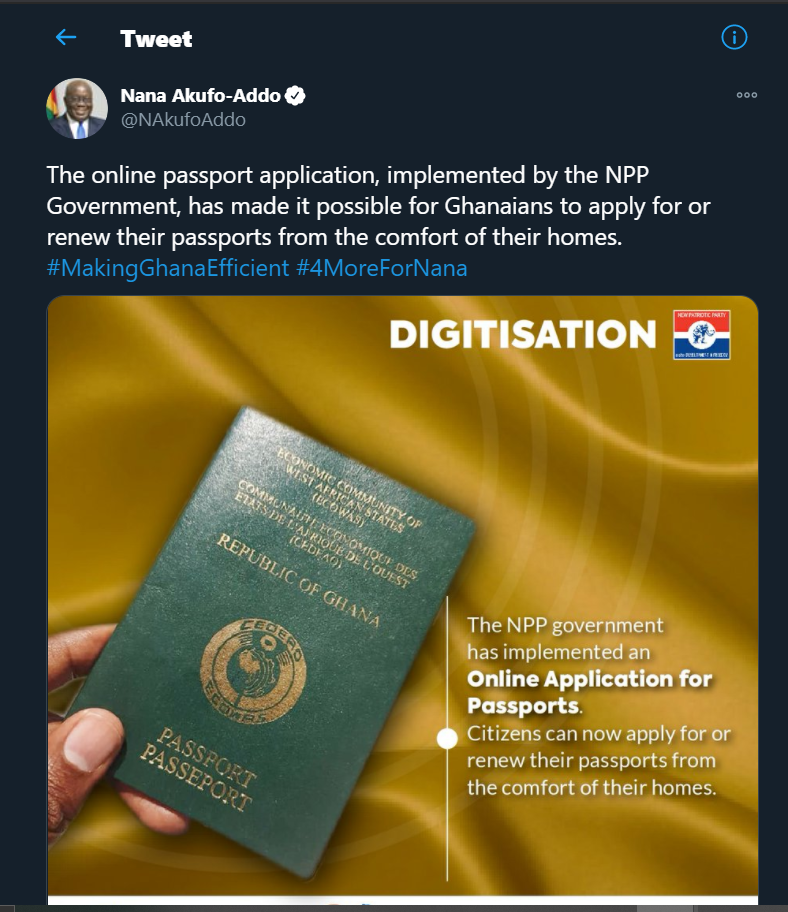
    The New Patriotic Party, in a Twitter post from the President’s verified account, posted that their administration was responsible for implementing the online passport application in the country. 

    Image source: Twitter.com

    The post has been retweeted 2.8K times since it was posted yesterday, October 19th, 2020. 

    A well known Ghanaian celebrity, Sarkodie, has also retweeted the post, indicating appreciation and congratulations to the ruling government. 

    “…was looking forward to this…About time. Anything towards the right direction we support though there’s a lot to b fixed”, the tweet stated. 

    Sarkodie’s retweet on its own has also generated 1.4K retweets and 8.3K likes since yesterday.

    Image source: Twitter.com

    The initial post and the supported retweet has led to extensive discussion on the twitter social media platform. Some users have countered the claim made with posts that suggest that the former government, led by John Dramani Mahama, was actually the one to implement the online passport application process. 

    Twitter users, @CitizenSawaJnr, @YayraKoku and many others have outrightly called out the President on the post, claiming that the information being passed on is wrong. 

    They further indicate that the post is a blatant lie on the part of the ruling government.

    On the other hand, some, like @ChristallAndre1 and @enkaddison have commended the government for being efficient and competent and have also “thrown shade” at those making any contrary comments on the matter.

    Verification:

    Dubawa set out to clarify the issue of who did what regarding the online passport application and renewal process.

    Passport Application in Ghana.

    Until December, 2016, all applications for new Ghanian passports and renewal of already existing ones needed to be processed manually. The process involved buying the form from designated banks or the passport office and sending duly completed form to the passport office for processing. 

    Between 2014 and 2015, during the Mahama led administration from July 2012 to December 2016, the online passport application project was introduced through the National Information Technology Agency’s (NITA) pilot project which was later taken over by the Ministry of Foreign Affairs and Regional Integration.

    The system was tested successfully and launched in December, 2016 by the Minister, Hannah Tetteh.

    The move to convert to an online system for the passport application process was fueled by complaints about the long queues and the “Goro boy system” which for years frustrated citizens. 

    Present state of Passport Application In Ghana

    After phasing out the manual passport application since its launch in 2016, the online application which is now in full force came into effect on March 1st, 2020. This was announced in a press statement signed by the current Minister of Foreign Affairs and Regional Integration, Sherry Ayorkor Botchway.

    What this means is that by March 1st 2020, there can be no manual processes for acquiring or renewing passports in the country.

    Image source: Ministry of Foreign Affairs, Ghana.

    The process now involves buying an online form by selecting from a range of payment options, completing and submitting the form online and finally, selecting preferred dates for the capture of the individuals bio-data at any of the Passport Application Centers (PACs) across the country. This is done through the Ministry of information portal: passport.mfa.gov.gh.

    The online passport application system has been in effect since its launch in December 2016. But since March this year, the manual system has been completely scrapped off for the online system to take full effect.

    Conclusion:

    It can then be concluded that the online passport application process was indeed   implemented during the ruling NPP administration after the NDC lost power in 2016. 

  • False! John Mahama did not ‘spray’ cash to supporters in Berekum

    Social media users claim Former President John Mahama shared cash to party supporters during a campaign tour in Berekum. 

    While one of the videos used as the basis for the claim is a 2016 campaign video, the others showed him sharing an item that is black with white straps and a white towel but not money. 

    Full text

    Many social media users claim that Ghana’s former president and flagbearer of the National Democratic Congress (NDC) in the 2020 elections, John Dramani Mahama, has been captured on video distributing cash to some party supporters during a campaign tour in Berekum in the Bono region. 

    The claims have been made on pro-government Facebook pages including NPP projects bureau and on Twitter. The posts have gained more than 8,000 views. 

    The claims are accompanied by a video that shows the former president standing out of a vehicle’s sunroof while the vehicle and others in the convoy are mobbed by several individuals clad in colours of the NDC; red, white, green and black. 

    Some news portals such as GhPage also indicated that the presidential candidate distributed money to supporters: “The NDC Presidential candidate John Dramani Mahama in the course of his campaign tour has visited Berekum in the Bono Region today 28th September 2020. John Mahama in the middle of his street cavalcade pulled wads of cash from his car and gave it to some of the crowded party adherents on the streets.” 

    The official Twitter page of the NDC has, through a statement signed by James Agyenim-Boateng, the party’s campaign spokesperson, denied the claims of John Mahama distributing money. 

    “The said reports are untrue and completely borne out of the desperate and fertile imaginations of the author(s)… As it has become typical of Mr. Mahama on his campaign tour of the regions, he shares JOHN MAHAMA 2020 branded nose masks to people…,” the NDC’s statement indicated. 

    We investigated the claims. 

    Verification

    We have seen two different videos making the rounds on social media, all making the claim that the NDC flagbearer was sharing money to party supporters during his campaign tour. 

    We fact-checked each of the videos below: 

    Video 1, shared on the NPP Projects Bureau Facebook page on 28th September 2020 with the caption “This is video of John Mahama sharing Money in Berekum, where the Nose Masks, Apron and T-shirts they claimed to be sharing not money? December 7 will expose you!!” 

    A reverse image search conducted on some frames of the video showed that it is an old video of Mahama on a campaign. The results matched a similar video uploaded by Joy News to their YouTube channel on September 21, 2016. 

    In both videos, John Mahama is seen in a black polo shirt and a white baseball cap. The background visuals were the same. 

    A google search on the subject showed news reports pointing to the video being taken at Abossey Okai in Accra in 2016.

    Given the evidence above, we find the NPP Projects Bureau’s claim that Video 1 was evidence of John Mahama sharing money in Berekum in 2020 to be false.  

    Video 2

    Shared by a twitter user who is prone to sharing Pro-NPP content on his timeline, the second video shows John Mahama on his recent Berekum visit. The video is accompanied with the text; “John Mahama sharing money on his campaign tour in Berekum, Bono Region. Is Government Official One that desperate? Votes buying come inside? #RejectConMahama”.

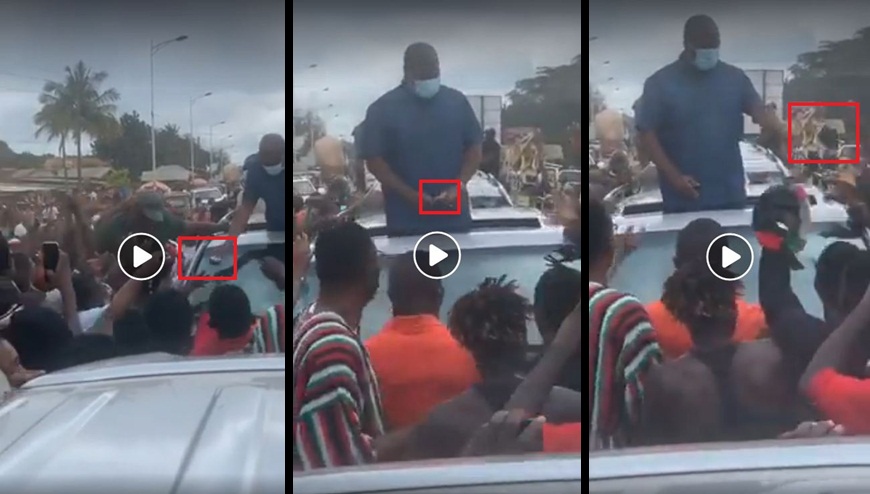
    The NDC presidential candidate is seen standing out of the sunroof of his vehicle in a deep blue shirt and with many of his followers surrounding the vehicle. Although the video is dark and not very clear, it is noticeable that he does at a point hand out something to some people. 

    At exactly 16 seconds into the 42-second video, John Mahama is seen taking and handing out the item to someone around the front-side of the vehicle and later tossing another into the crown on his left.

    We were able to find a fuller version of the same video shared by a Facebook user, Enoch Kofi Nyarkoh with the caption: “John Mahama sharing money on his campaign tour in Berekum..Asem no aye kese oooo.” That video has been watched more than 9,000 times. 

    Analyzing the video in slow motion and in reverse motion between 19 seconds and 25 seconds, we found that the items handed out to the supporters were black with a touch of white. 

    The first frame showed the NDC flagbearer slide the item down the vehicle windscreen. The second frame shows him holding the black item while the third frame gives a better view of the item after he tossed it into the crowd. 

    The nature of the item and how it was tossed does not prove to be money. 

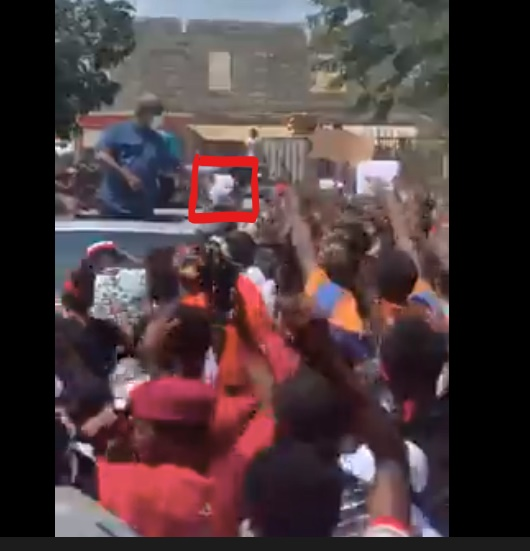
    A further online search of videos on Mahama’s Berekum tour revealed another video originally shared from a live video taken by NDC’s Campaign Spokesperson, James Agyenim Boateng’s on the Berekum tour.

    At the 10 seconds mark of the video, the white piece of cloth which looked like a little towel was tossed into the crowd by the NDC flagbearer. 

    The object seen in no way appears to be money as claimed. 

    Conclusion

    Based on the evidence above, we conclude that the item John Mahama gave to party supporters on his tour of Berekum is not money as claimed.

    The reporter, Jonas Nyabor, produced this fact-check under the auspices of the Dubawa 2020 Fellowship in partnership with Citinewsroom to facilitate the ethos of “truth” in journalism and to enhance media literacy in the country.

  • Alhaji and Alhaji: Did Akufo-Addo Promise to Build 350 Schools?

    In the recently aired Alhaji and Alhaji political show on 12 September 2020,  two invited panellists on the show, Kojo Twum Boafo and Kamal-Deen Abdulai, were heard debating a claim. 

    Boafo, who is the former CEO of Free Zones Authority and affiliated with the National Democratic Congress (NDC), was heard asserting that President Akufo-Addo promised to build 350 schools when he was a presidential candidate. Boafo was supported by another panellist, Gabriella Tetteh, a member of the NDC Communication Team, who was also heard claiming that this promise was stated in the New Patriotic Party’s (NPP) 2016 Manifesto.

    However, both claims by Boafo and Tetteh were contested by Abdulai, the Deputy Director of Communications of the NPP, who indicated that Akufo-Addo made no such promises. 

    A transcription of the trilogue is captured below:

    Boafo: “The president when he was a candidate said ‘Mahama said he’s built 200, I will build 350’ (translated from Twi) and today when you ask them where the 350 are, they tell you they painted classrooms”

    Abdulai: “Kojo! Where?”

    Tetteh: “Your 2016 manifesto said you were going to build 350 schools… You’ve forgotten?” 

    Abdulai: “Oh no no no no!”

    Claim: Akufo-Addo, as a presidential candidate, said he will build 350 schools

    Verdict: In 2012, Akufo-Addo, as the NPP presidential candidate, said in an address to UDS tertiary students association of the party in Navrongo that the first 18 months of the next NPP government would involve the building of 350 new Senior High Schools from scratch. 

    A 2-minute 23-second video news report published by the Ghana Broadcasting Corporation (GBC) on 4 December 2012 confirms Boafo’s assertion as true. 

    In the video, Akufo-Addo, who was the NPP 2012 presidential candidate was heard making commitments of building a new society of job creation in his address to the NPP tertiary students association of the University for Development Studies (UDS) Navrongo campus.  

    “We plan a rapid and vigorous development of educational infrastructure in the first 18 months of the next NPP government. This would involve the building of 350 new senior high schools from scratch while rehabilitating and expanding existing ones,” Akufo-Addo said.

    Again in 2016, a news report by JoyFM on 7 March 2016 shows that the former NPP Communications Director, Nana Akomea, mentioned that the NPP had a strategy to make this promise a reality.

    “This whole idea of John Mahama saying I will build 200 schools was in reaction to Nana Addo’s plan to build 350-day schools as part of the free SHS agenda. So John Mahama also brought this thing that I am also going to build schools, it wasn’t part of their initial plan,” Nana Akomea said.

    Claim: Akufo-Addo’s promise of building 350 schools is stated in the NPP 2016 manifesto

    Verdict: There is no promise of the building of 350 new schools in the NPP 2016 manifesto nor in the NPP 2012 manifesto.

    Contrary to Gabriella Tetteh’s claim that Akufo-Addo and the NPP’s promise of building new schools is stated in the NPP 2016 manifesto, there is no evidence of such promises by the NPP in the entire NPP 2016 Manifesto. There are no such promises found either under the infrastructure nor under education policies in the manifesto. 

    Furthermore, since Akufo-Addo mentioned this promise in 2012 in his address at UDS, one would assume that perhaps it might be stated in the NPP 2012 Manifesto; however, there is also no such promise stated in the entire  NPP 2012 Manifesto

    Conclusion

    The claim by both Boafo and Tetteh that Akufo-Addo promised to build 350 schools is true. Akufo Addo said this in 2012 as the NPP flagbearer while addressing the NPP tertiary students association at the UDS Navrongo campus. But there is no such promise stated in the 2016 NPP manifesto as Tetteh has claimed. It is also not found in the 2012 NPP manifesto. 

  • Did the NDC government issue a ‘dumsor’ timetable in 2016?

    A leading member of the New Patriotic Party (NPP), Gabby Otchere-Darko, claims that Ghana experienced major power outages, ‘dumsor’ in 2016 and that the National Democratic Congress (NDC) government published a power rationing schedule to that effect.

    There were major power outages in Ghana in 2016 but we found no evidence to suggest that a load-shedding schedule was published that year as suggested by Mr Otchere-Darko. The photo attached to the tweet was denied by the Electricity Company of Ghana as originating from them when it surfaced in 2016.

    Full text: 

    Ghana’s recent history includes battling serious energy crisis that saw intermittent power cuts popularly known as ‘dumsor.’

    Ghana, during the National Democratic Congress’ (NDC) Mahama administration, saw publications of power outage schedules to indicate rationing of power in the country. 

    The development has remained a major area of controversy between the opposition NDC and the governing New Patriotic Party (NPP). 

    A leading member of the NPP, Mr  Otchere-Darko via his Twitter page on Sunday, August 2, 2020, made a post in which he claimed that power outages during the Mahama era extended from 2011 when he was Vice President to 2016 when the former president was voted out of power. 

    Mr Otchere-Darko accompanied his post with a photo of one of the purported publications on power rationing schedule [for August 1, 2016, to August 14, 2016] to prove that the power rationing extended to 2016. 

    C:\Users\Jonas\Desktop\Gabby.jpg

    The post has so far received over 1,000 reactions on Twitter.

    A Deputy Minister for Power during Mahama’s administration, John Jinapor, in a counterclaim, challenged Mr Otchere-Darko’s position in a statement where he said: “there was no load shedding schedule published in the whole of 2016.”

    Dubawa looked into the claims.

    Verification: 

    Gabby Otchere-Darko’s ‘dumsor’ schedule

    In verifying the image shared by Mr Otchere-Darko as the supposed power rationing schedule published by the government in 2016, we conducted a reverse image search whose results showed a variation of the image tweeted by Mr Otchere-Darko. 

    The variant image, which is of much better quality, had the exact information (except the dates) and its text positioned in the same way as those in the photo tweeted by Mr Otchere-Darko. 

    The variant was seen on document-archiving site VDocuments on October 16. 2015. That image bears the date of a load-shedding exercise that was planned for March 17, 2014, to March 30, 2014. 

    Graphic Online also published that same schedule on its website on March 19, 2014.  

    See the difference below:

    C:\Users\Jonas\Desktop\Eebzc_jX0AULaN0 (1)-horz.jpg
    Image A: Supposed government-issued 2016 load-shedding schedule (Shared by Gabby)
    Image B: Government-issued load-shedding scheduled for March 2014 (Published on VDocuments)

    Our further checks revealed that the Electricity Company of Ghana in a statement on July 23, 2016, indicated that the supposed load-shedding schedule for August 1 to August 14 that had been widely circulated at the time was fake. 

    The statement was also shared on ECG’s official twitter handle

    The same disclaimer was published by Yen.com.gh

    We, therefore, conclude that the supposed 2016 load-shedding schedule tweeted by Mr. Otchere-Darko is fake and false. 

    ‘Dumsor’ In 2016?

    A series of Google searches conducted revealed that there were a number of extensive power outages experienced in the country in 2016 with areas such as Dansoman, Awoshie, Achimota, Taifa, and Kasoa mentioned as some of the areas most affected. 

    According to Daily Graphic, President John Mahama at a meeting with the Council of Christian Churches in Kumasi on Thursday, June 30, 2016, admitted that the country was having a power challenge. 

    “He said the crisis appeared to have been prolonged by the non-supply of gas from neighbouring Nigeria to feed thermal plants as a result of sabotage which led to the shutdown of the Asogli power plant…. President Mahama who was on his final leg accounting to the people’s tour of the Ashanti region expressed the hope that there would be more rains to increase the water levels of the Akosombo dam to improve hydro power to augment thermal production. Currently, Akosombo was operating below its minimum capacity of 240 feet but President Mahama was optimistic the situation will improve.” — Excerpts of Graphic’s report read. 

    A publication on Peacefmonline sourced from Classfmonline in July 2016 also revealed how there were calls on the government and the Public Utilities and Regulatory Commission (PURC) by the Africa Centre for Energy Policy (ACEP) to publish a load-shedding schedule to help residents plan their activities accordingly.

    The then opposition party, the New Patriotic Party (NPP), also issued a statement demanding a load-shedding schedule from the government but the Head of Public Affairs at the PURC, Nana Yaa Juantuah, in a response captured in a Citi FM report said the Electricity Company of Ghana (ECG) could not release a load shedding timetable because the erratic power supply  at the time was only a temporary problem.

    Three weeks earlier on Wednesday, July 6, 2016, President Mahama, while delivering an address at that year’s Eid Celebrations at the Independence Square in Accra, said he would not declare a load-shedding because he was confident things would normalize soon. 

    “We are not declaring load shedding; I believe things will normalize but we are taking steps every day to ensure that Ghana has security when it comes to power…Because of sabotage in Nigeria on the terminals, crude oil that we ordered last month has not arrived and so it has created some generational problems for us,” he was quoted to have said. 

    The Deputy Minister for Power at the time, Mr Jinapor, in an interview on the Joy Super Morning Show on October 26, 2016, admitted that the country was having power challenges, confessing that “money has been one of the challenges” in fixing the issue. 

    Conclusion

    Based on the evidence above, we find that although there was a major power issue in 2016, the government did not formally declare it as a power crisis and was hesitant in releasing a power rationing schedule. 

    Indeed, there is no evidence of any official power rationing schedule. The ECG denied photo which was shared by Mr Otchere-Darko when it surfaced in the public domain.

    The reporter produced this fact-check under the auspices of the Dubawa 2020 Fellowship in partnership with Citinewsroom to facilitate the ethos of “truth” in journalism and to enhance media literacy in the country.  

  • Did Ghana Rank last in the 2013 PISA Test?

    Yaw Buaben Asamoa, Communications Director of the NPP, claimed Ghana ranked last in the PISA 2013 test. 

    Ghana has neither participated in nor been ranked in PISA since the programme started. PISA is triennial and is released every three years since the first one in 2000. There was no PISA test for 2013 and therefore Ghana could not have ranked last in a report that does not exist.  

    Full Text

    On Monday, July 6, the National Executive Committee of the largest opposition, the National Democratic Congress (NDC), unanimously approved Prof. Naana Jane Opoku-Agyemang as the running mate for NDC flag bearer, John Mahama, for the 2020 presidential election. 

    On that same day, hours after the official announcement, Communications Director of the governing New Patriotic Party (NPP), Yaw Buaben Asamoa, addressed a press conference at the NPP campaign office at Kokomlemle where he put out the party’s reaction to the selection of the NDC running mate. Among the commentary he made, Buaben Asamoa claimed that Ghana placed last in the 2013 Programme for International Student Assessment (PISA)

    “In 2013 when Ghana was ranked last in PISA, she run away from the competition where Ghana could have taken the opportunity to roll out robust reforms in dealing with our educational challenges as a nation, yet she preferred not to be ranked at all”- Yaw Buaben Asamoa, of the NPP said.

    About PISA

    PISA is a programme developed by the Organization for Economic Co-operation and Development (OECD) for assessment of students. PISA is an acronym that stands for “Programme for International Student Assessment”. According to OECD, PISA measures 15-year-olds’ ability to use their reading, mathematics and science knowledge and skills to meet real-life challenges

    PISA is “not only the world’s most comprehensive and reliable indicator of students’ capabilities, it is also a powerful tool that countries and economies can use to fine-tune their education policies…to share evidence of the best policies and practices, and to offer timely and targeted support to help countries provide the best education possible” (Angel Gurría, OECD Secretary-General in PISA 2018; Insights and interpretations).

    Countries volunteer to participate in PISA and once the PISA board approves the country, individual schools are chosen based on stringent criteria to represent all 15-year-old students in that country. The students are randomly chosen from among all 15-year-olds enrolled in grade seven or higher.

    Verification

    A thorough website search conducted showed that Ghana is not listed as one of the over 90 countries and economies that have participated in PISA tests since the year 2000

    On the official website, the OECD states that PISA is a triennial test that is taken once every three years. The programme began in 2000 and every three years since, results have been announced. This means that since the year 2000, there have been seven PISA tests taken in 2000, 2003, 2006, 2009, 2012, 2015, and 2018. 

    From this, it is clear that there was no PISA test for 2013. Ghana could therefore not have been ranked first of all, let alone be ranked last in a test that was never conducted.

    Verifying further, we did a Google search to identify online portals which published the news item about the claim in question. The search yielded no result pertaining to Ghana ranking last in the PISA 2013 test. None of the state publications and websites of the mainstream media in the country published a story to that effect. There is no documented evidence that points to the claim that Ghana ranked last in PISA 2013.

    However, the Google search produced results of publications relating to another ranking done by the OECD. 

    The Global School Ranking, touted as the biggest ever of such rankings, was released in May 2015 and was based on test scores in 76 countries. It showed the link between education and economic growth. OECD’s education director, Andreas Schleicher, is quoted to have said while commenting on the report in 2015 that the ranking was the “first time we have a truly global scale of the quality of education” and that the idea is to “give more countries, rich and poor, access to comparing themselves against the world’s education leaders, to discover their relative strengths and weaknesses, and to see what the long-term economic gains from improved quality in schooling could be for them” 

    Asia’s Singapore came tops in the ranking while Ghana ranked last in the 76th position.

    In spite of the fact that the Global School Ranking was done by the OECD, the analysis provided a much wider global map of education standards than the PISA tests, which focused on more affluent industrialized countries. According to the BBC, the rankings “were based on an amalgamation of international assessments, including the OECD’s PISA tests, the TIMSS tests run by US-based academics, and TERCE tests in Latin America” 

    Then Education Minister Prof. Naana Jane Opoku Agyeman reacted to the ranking by saying that the data used to determine Ghana’s position in the Global School Ranking were from the 2011 Trends in International Mathematics and Science Study (TIMSS), noting that the ranking raised “ a number of concerns”. 

    Conclusion

    The claim by Communications Director of the governing NPP, Yaw Buaben Asamoa, that Ghana ranked last in PISA 2013 is not true. There was no PISA test done that year and according to the OECD website, Ghana has not participated in any PISA test since its inception. The country is not included in the list of countries and economies that have been involved in PISA.  Indeed, Ghana came last in a ranking done by the OECD but that ranking was the Global School Ranking and was done in 2015 and not 2013. 

  • Profile of Vice President Mahamudu Bawumia

    Alhaji Dr Mahamudu Bawumia is the Vice President of Ghana and the running mate of the flagbearer of incumbent President Nana Akufo-Addo for the December 2020 elections. 

    Dr Bawumia’s foray into politics started when he was selected by then flagbearer of the New Patriotic Party (NPP), Mr Akufo-Addo to be his running mate for the 2008 elections. For the 2008 elections, Dr Bawumia is noted to have increased the NPP votes from the 2004 elections, particularly in three regions in northern Ghana, albeit the NPP lost in that election. However, in the 2016 elections, the NPP won and Dr Bawumia was sworn in as the Vice President of the Republic of Ghana, on 7 January 2017.

    Before his political career, Dr Bawumia served as a trained economist and banker. He is currently an Associate of the Chartered Institute of Bankers (U.K) (ACIB) and a Fellow of the Chartered Institute of Bankers (FCIB), Ghana. He also has several publications to his name including articles in journals and two books on Monetary Policy and Economic Development.

    Dr Bawumia’s career as an economist and banker started as a lecturer for Monetary Economics and International Finance at the Emile Woolf College of Accountancy in London, England, between 1988 and 1990. He also worked as an economist at the Research Department of the International Monetary Fund in Washington DC, USA. From 1996 to 2000, Dr. Bawumia served as an Assistant Professor of Economics at Hankamer School of Business, Baylor University in Texas, USA. There, he was awarded the Young Researcher Award in 1998. 

    He returned to Ghana in 2000 and served as a senior economist at the Bank of Ghana. While at the Bank of Ghana, Dr Bawumia held positions such as the Head of Monetary Policy and Financial Stability, Special Assistant to the Governor, Capital Market Committee Chairman, Monetary Policy Committee Member, and in June 2006, he was appointed Deputy Governor of the Bank by former President J.A. Kufuor where he served till 2009.

    Dr Bawumia was also a Consultant for the Economic Commission of Africa from February to March 2009.  In October 2009, he was appointed a Fellow of the International Growth Centre (IGC), where he served as an IGC Team Member for Sierra Leone.  He then served as an Advisor to the Central Bank of Sierra Leone on the redesigning of the organisational structure of the Bank and its monetary policy framework. In January 2010, Dr Bawumia was appointed a Resident Representative of the African Development Bank for Zimbabwe by the African Development Bank and served in that capacity until he was re-nominated as the Vice Presidential Candidate to Mr Akufo-Addo of the NPP ahead of the 2012 Presidential Election. 

    Dr Bawumia has also served on some academic boards as a visiting scholar at the University of British Columbia Liu Centre for Global Studies, in Canada and the UBC Fisheries Centre from April to October 2009; a Senior Associate Member of St. Anthony’s College at the University of Oxford; and a visiting professor of economic governance at Ghana’s Central University, between 2013 and 2015.

    Dr Bawumia had his primary education at Sakasaka Primary School in Tamale and his secondary education at Tamale Secondary School. In secondary school, he was President of the Ghana United Nations Students’ Association (GUNSA) in 1981 and graduated the following year in 1982. 

    He later had his tertiary education in the United Kingdom where he studied banking and obtained the Chartered Institute of Bankers Diploma (ACIB) at the Emile Woolf College of Accountancy, London in 1984. He also studied Economics at Buckingham University in 1987 where he obtained a First Class Honours Degree. He further obtained a master’s degree in Economics at Lincoln College, Oxford, and a PhD in Economics at the Simon Fraser University, Vancouver, British Columbia, Canada in 1995. Dr Bawumia specialises in the fields of Macroeconomics, International Economics, Development Economics and Monetary Policy.

    Dr Bawumia was born in Tamale, on October 7, 1963, to the late former Chairman of the Council of State, and Mamprugu Royal and Paramount Chief, Mumuni Bawumia, and to Mariama Bawumia. He is the twelfth of 18 children of his father, and the second of five children of his mother.

    Dr Bawumia is married to Samira Ramadan Bawumia, whose father was the former People’s National Convention (PNC) National Chairman, Ahmed Ramadan. They have four children together.

Back to top button