Claim: Temperature and enclosed spaces affect the transmission of coronavirus.
Mostly True. Although some literature supports the claim that temperature can affect the reduction or increase in coronavirus transmission, a lot is still yet to be proven in this regard.
Full Text
As the coronavirus began working its way through countries, many myths and theories were spread about the virus. Some of these claimed that eating garlic could kill the virus; that consuming hot peppery soups could prevent the virus, and a host of others. Most of these claims were later found to be false.
A very prominent theory that circulated and had some countries at ease when the pandemic started was that the Covid-19 virus could not survive or spread in a hot or sunny climate.
“So last year, who ankasa come lie we say covid-19 no go catch Africans cos here hot.”
The post has since generated many comments on the platform.
A video of a former deputy Health Minister, Dr. Okoe Boye during an interview, stating some hypothesis on how temperature can affect the spread and intensity of Covid-19, was shown as evidence to support the claim.
But does temperature really affect the spread of the Covid-19?
Video Transcript
“There are two main things and remember we are still studying the virus so most of the claims are hypothetical not empirical from established studies. But there are two observations that have been made strongly that facilitates spread and even intensity of disease.
The first one being the temperature, cold climate. That is why in most countries they predicted that they might have a second wave in the winter.”
Verification
The comments on Twitter seemed to give the impression that the video in question was from last year. Although similar claims were made last year, the video showing of Dr Boye is recent.
A longer version of the video showed that the excerpt came from CitiTV’s The Big Issue which aired on January 17th, 2021.
The discussion that brought out Okoe Boye’s statement was in line with the reopening of schools and risks associated with it.
Transcript
Interviewer:
“You made a point about concentration of particles in enclosed spaces. Fortunately, a lot of our schools are not under trees. Perhaps these are one of the instances where we can be happy about schools under trees but fortunately or unfortunately we don’t have instances where we have schools under trees. A lot of the schools, a huge majority are enclosed. What is the government’s plan? What are the measures put in place by the government to ensure that should any of the kids or students have it; I mean be it asymptomatic or not, given that they are in an enclosed space, this will not degenerate, the infection rate will not go up or that person will not infect a lot of their colleges.”
Okoe Boye:
“There are two main things and remember we are still studying the virus so most of the claims are hypothetical not empirical from established studies. But there are two observations that have been made strongly that facilitates spread and even intensity of disease.
The first one being the temperature, cold climate. That is why in most countries they predicted that they might have a second wave in the winter. The second one is an enclosed, If the structure of your community enclosed type, the rate of transmission is higher. And what do i mean by the closed type? If you go to Europe, most markets, if you want to go and buy, it’s not an open market like Agbogbloshi or makola where… you go to an enclosed space… Luckily, how many schools”
Two claims were deduced from Dr Boye’s response:
Enclosed spaces promote the spread of Covid-19
Temperature affects spread and intensity of disease
Are there existing hypothetical studies to support Okoe Boye’s claims?
Yes.
A study by Peng Shi, Yinqiao Dong, Huanchang Yan, Xiaoyang Li, Chenkai Zhao, Wei Liu, Miao He, Shixing Tang and Shuhua Xi titled, The impact of temperature and absolute humidity on the coronavirus disease 2019 (COVID-19) outbreak – evidence from China, investigated the impact of temperature and absolute humidity on the Covid-19 outbreak in 31 provincial-level regions in mainland China. Data was gathered between January 20th and February 29th, 2020. Findings revealed that the lowest daily incidence of the coronavirus was at -10 °C and highest at 10 °C. COVID-19 incidence changed with temperature as daily incidence decreased when the temperature rose. Also, a modified susceptible-exposed-infectious-recovered (M-SEIR) model confirmed that transmission rate decreased with the increase of temperature, leading to further decrease of infection rate and outbreak scale.
However, the World Health Organization(WHO), has stated firmly that there is currently no conclusive evidence that either weather or climate have a strong impact on transmission of the virus. This is proven in the fact that the disease has been transmitted in all regions of the world, from dry, cold, hot or humid climates.
With regards to enclosed spaces increasing risk of infection, studies also exist to support this.
Bhagat et al in their 2020 study, Effects of ventilation on the indoor spread of COVID-19, found that existing data indicates that indoor transmission of the virus far exceeds outdoor transmission. This, the study indicates may be due to longer exposure times and the decreased turbulence levels (and therefore dispersion) found indoors. This suggests that indoor or enclosed spaces do have the tendency to increase transmission of the coronavirus.
This is supported in another study that suggests that it is very critical to prevent overcrowding and to also allow adequate ventilation and filtration of circulating air in buildings to mitigate the transmission of the coronavirus. This suggestion is made in the study, Understanding of Aerosol Transmission of COVID 19 in Indoor Environments, by Barro et al (2020).
Additionally, respiratory droplets from coughs and sneezes and person-to-person close contact are some of the main modes of transmission identified. This could account for enclosed spaces being sources of infection in some way.
The case of Ghana
Ghana has recorded a relatively high number of Covid-19 cases regardless of the high temperatures experienced here. But has the temperature supported the moderately better record of deaths and confirmed cases in comparison to countries with colder temperatures?
According to endcoronavirus.org, some of the countries that are beating coronavirus are Australia, the Bahamas, Brunei, Djibouti, Iceland among others while Burkina Faso, Chile and Canada are at the other end of the stick. These countries range from hot to cold climates on both sides of the coin. Canada for instance is currently -11°C while Burkina Faso is at 37°C and yet, both countries are considered countries not doing well in battling the Covid-19 pandemic. Same can be said for Iceland which presently records a temperature of -3°C and Djibouti with its 29°C and yet both are tagged as countries beating the coronavirus.
It is, therefore, clear that there is more to the spread of the virus as rightly stated by the WHO and many other health organisations and studies.
Conclusion
Okoe Boye is not off in his claims regarding temperature and enclosed spaces as the preceding studies suggest. Boye also provided a caveat in his statement that suggests that he may be wrong as the claims he made are based on theoretical studies, making the claim to merit a mostly true status.
Claim:Melting polythene in hot oil before frying sliced plantain in it will make plantain chips crispy.
There is no empirical evidence to back this claim which dates back to many years ago. Scientists suggest that the result would rather leave a layer around the chips which will make it unsafe for eating.
Full text
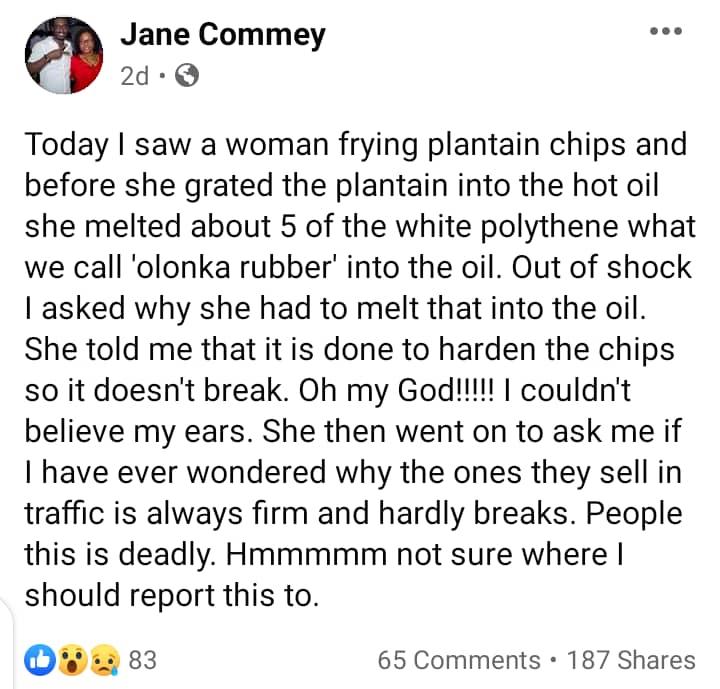
A social media user on Wednesday, January 14, 2021, claimed that she saw a plantain chips seller melting rubber in hot oil before frying the sliced plantain in it. According to her, the seller said doing so will make the chips crispy.
The post has gone viral and its text shared in various social media groups including on WhatsApp with a warning to persons who buy the product.
The claimant was not available to provide additional details but is it true that adding rubber to hot oil before frying sliced plantain in the oil will make the chips crispy?
Verification
Our checks reveal that this claim has been made several times already in the past and dates back to around 2014, as confirmed by a number of social media posts such as this, this and this.
In 2014 when the claim came up, there was again no evidence to back it.
“Apparently some plantain chips producers melt polythene into the cooking oil used in frying the chips to keep them crispy & ensure longevity,” a claimant said.
The Principal Regulatory Officer of the Food and Drugs Authority (FDA), Kofi Essel, in reaction to the claim on TV Africa in 2014 discounted it, arguing that scientifically it is not possible for the plastic material to completely dissolve in the oil to supposedly make plantain chips crispy. [40 secs. – 4 mins.]
“If you [try to] dissolve [rubber] in the oil, it stays in the oil as a gummy material…The plastic is only changing from one state to another physical state as a result of the heating conditions… If anything at all, you may be suspecting leaching,” he said in that interview.
Worldwide claim
A Google search on the subject shows that similar claims have been made on different online forums such as Tercharp and Rojakpot in the past.
In the article on Rojapot, several arguments were made to counter the claim, amongst them being the fact that it was suspicious that despite how widely that claim has circulated, there was not a single piece of evidence, either photo or video, to back it except for viral text messages on social media in which the persons who post it, usually claim they saw it themselves.
Also, the argument was made that any plantain chips that will be fried in such oil will be inedible because the gummy rubber will form a layer on the sliced plantain.
A video below was used to demonstrate what will happen when a plastic material is melted in hot oil.
To get further clarification on the subject, we contacted the co-founder of GhScientific, a science-based NGO focused on promoting Science, Technology, Engineering and Mathematics (STEM) education, Dr Thomas Tagoe. He said there is no certainty that melting rubber in hot oil before frying sliced plantain will make it crispy; however, a thin layer of rubber will most likely form on the chips which could make it firmer.
“Most polythenes that are used are said to be thermoplastic, meaning that when they melt they can be reformed and solidify upon cooling. So theoretically, it is possible that by melting the plastic in oil and frying with it, a thin layer of the plastic could form on the chips and this will give it a firmer, maybe stretchy texture,” Dr Tagoe, who is also a lecturer at the Physiology Department of the University of Ghana said.
On the possible risks associated with consuming any food fried in oil in which plastic has been melted it, Dr Tagoe said: “there is definitely a health risk.”
“Some plastics can leak chemicals which are dangerous within the body and have been linked to cancers and weakened immune systems. Then there are Microplastics, which are plastics too small to be seen with the naked eye (less than 5mm) have been linked to a number of health challenges that affect reproduction and childhood development,” he added.
A Ghanaian food researcher in France, Priscilla Ashie-Nikoi, also indicated that it is impossible for plantain chips to be made crispy by melting plastic in the oil used to fry it.
“Plastic cannot dissolve in oil, it can only melt, and it will stay in oil in the melted state, so it doesn’t contribute at all to the crispiness of plantain chips,” she said.
She adds that any food cooked in such oil would have an unpleasant smell; hence, it would be unlikely that anyone will eat such a product without one noticing.
She, however, suggested among other things that drying sliced plantain before frying it could make it crispy.
Conclusion
There is no definite science to back the claim that melting rubber in oil before frying plantain chips will make it crispy. Rather, evidence shows that the rubber will only change into a gummy state and will form a layer around the sliced plantain.
One of the most common forms misinformation or disinformation come is in images.
Over the years, fact-checkers have observed how misinformation and disinformation in this form can get complex but thanks to digital tools, most of these are easily unmasked.
In this guide, I share, based on my experiences, some of the tips and tools that can help to fact-check claims that are premised on images.
Note, the nature of the claim determines the approach used in the fact-checking process.
Is the claim suggesting a phone was taken somewhere other than where you suspect it to be? Is the claim suggesting that a photo was taken at a time of the day you find questionable? Do you suspect a photo being used to make the claim is from an unrelated event? or do you think the photo has been doctored to create a false impression?
You can arrive at a strong conclusion by making use of some digital tools relevant for fact-checking images.
Images from unrelated events
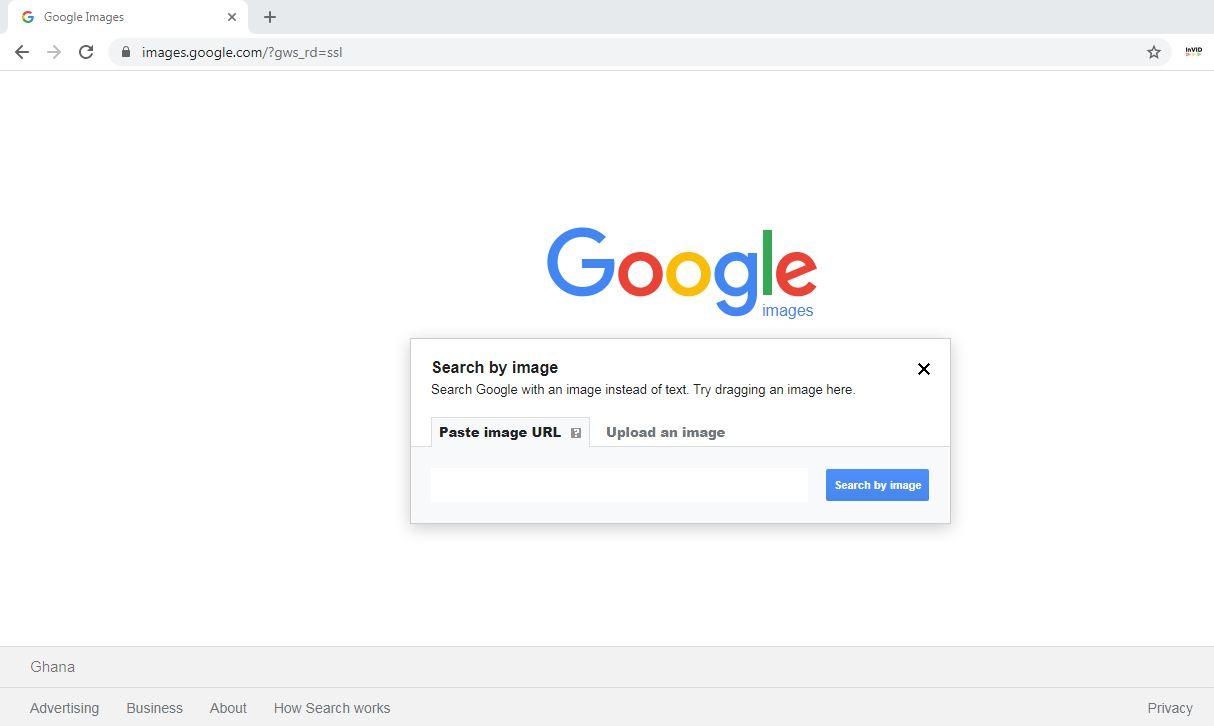
Reverse image search is a common fact-checking activity that is mostly used to ascertain whether an image has ever been shared elsewhere online and what it was earlier used to depict.
Google, Yandex, TinEye all offer reverse image search services. When you upload the image in contention on any of these platforms, they scan the internet and pull out the same or very similar versions on the internet to enable you to conduct further analysis, whether the image was uploaded a year or two earlier, or the week earlier in relation to a different event.
Snapshot of Google Images
In some instances, the results of a reverse image search cannot form the basis for a conclusive fact-checking, but it provides relevant information for further analysis.
The platforms mentioned above offer a wide range of settings that allows you to tailor your search or carryout more advanced search online.
Doctored images
Dealing with doctored images in fact-checking can be very simple yet complex especially without the right digital tools.
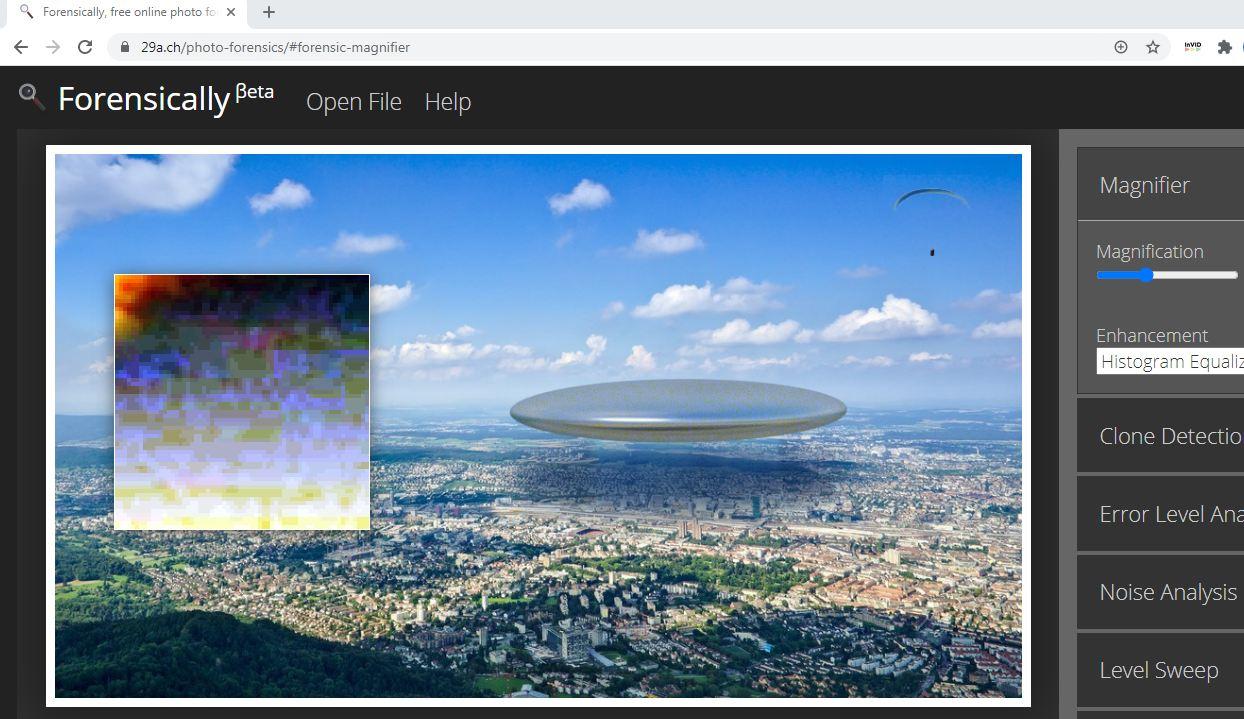
Although conducting reverse image search can also help bust doctored images, there are instances that require advanced use of available digital tools such as Forensically and Invid Image Verification.
Snapshot of Forensically
These tools have many features to help to analyse images and photos to ascertain their authenticity.
These tools, when applied correctly, can easily resolve some very complex claims hinged on doctored images.
Disputed time
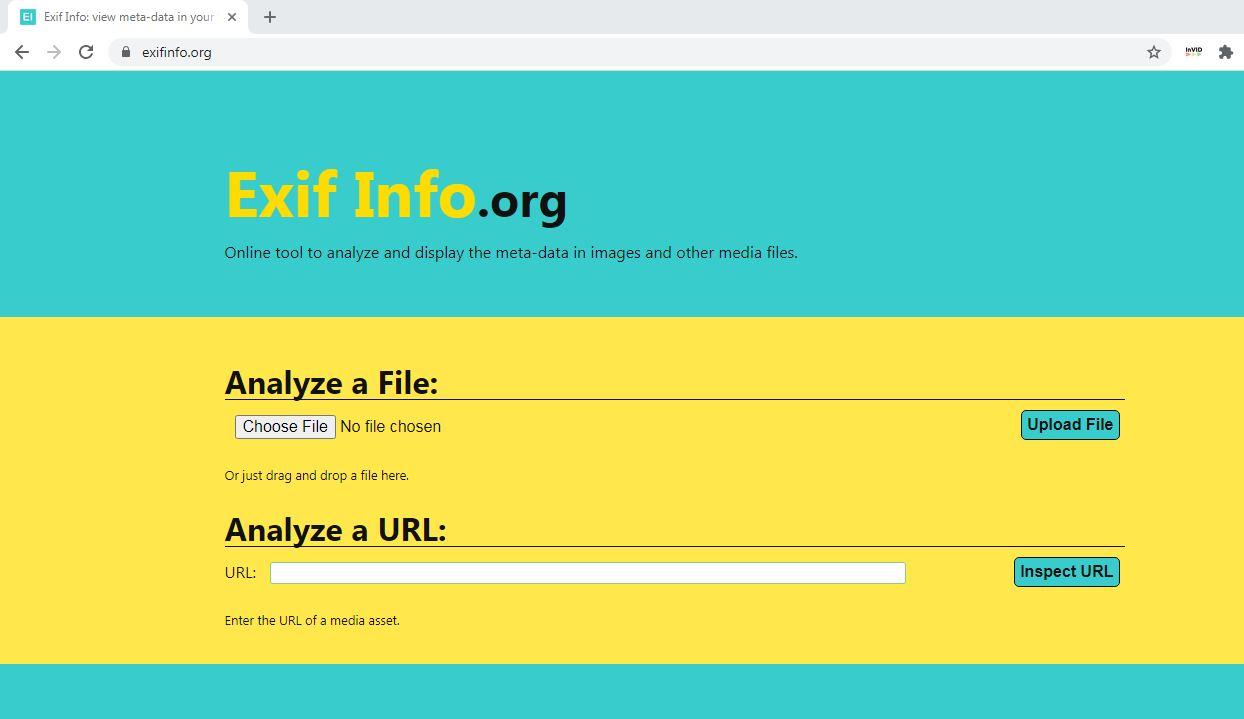
You can know the time of the day an image was taken if you have access to the image’s metadata or EXIF data. An image’s metadata has almost every detail you need to know about a photo; date, time, the camera used, image dimension, location and so on.
You can retrieve this information using any of the many metadata extraction tools available online including MetaPicz and Exifinfo.
Once you upload the image, the tool will present the image metadata in less than a minute.
Snapshot of Exif Info
Unfortunately, most images uploaded to social media have their metadata stripped off, hence complicating extracting their metadata.
There are alternative ways of ascertaining the time a photo was taken and this includes studying the position of the shadow of the subject in the image if available. In some cases, juxtaposing the weather in the photo with available local weather data can give relevant clues.
With new technologies coming up often, there surely will be more resources to be added to this article that can help to clarify fact-check’s contentious images.
The reporter, Jonas Nyabor, produced this report under the auspices of the Dubawa 2020 Fellowship in partnership with Citinewsroom to facilitate the ethos of “truth” in journalism and to enhance media literacy in the country.
The preponderant influx of misinformation on social media and its injurious effects on audiences have been a prominent drive for fact-checkers in the campaign against fake news and misinformation. Consequently, leading social media organisations such as Facebook and Twitter are growing in an awareness of the need for swift strategies to counter the surging flanks of fake news on their platforms.
It is in light of this that Twitter has recently launched what it names ‘Birdwatch’ – a community driven tool that relies on the social network of users to provide context to tweets that appear misinforming or lacks details.
“Birdwatch allows people to identify information in Tweets they believe is misleading and write notes that provide informative context. We believe this approach has the potential to respond quickly when misleading information spreads, adding context that people trust and find valuable. Eventually, we aim to make notes visible directly on Tweets for the global Twitter audience, when there is consensus from a broad and diverse set of contributors. In this first phase of the pilot, notes will only be visible on a separate Birdwatch site. On this site, pilot participants can also rate the helpfulness of notes added by other contributors. These notes are being intentionally kept separate from Twitter for now, while we build Birdwatch and gain confidence that it produces context people find helpful and appropriate. Additionally, notes will not have an effect on the way people see Tweets or our system recommendations.”
The evolving nature of Twitter’s policies
Although there is a novelty associated with the Birdwatch feature, this is not the first time Twitter is deliberately stepping up its efforts to combat misinformation on their platform. In the third quarter of 2020, the social media company announced its intentions to thwart election-related misinformation by banning or tagging complicating content about ballot tampering, election rigging, election results and other similar issues. Twitter’s action, which follows a similar initiative announced by Facebook in almost the same period, establishes the thread for a rising battle between the social media companies and misinformants who have been sharing misleading information and false claims about voting and other diverse topics.
Having witnessed previous efforts by Twitter in countering misinformation, Birdwatch will however be marked as Twitter’s first initiative of stepping down from the hem of deciding which tweets are misinforming, to allowing its users through crowdsourcing make judgements and identify what content is misleading by providing context to tweets that appear suspicious. Noticeably, this is almost contrary to Twitter’s initial policy of having the autonomy in deciding what tweet is misinforming or misleading, exemplified in the case of former U. S president, Donald Trump when the social media company suspended him from their platform for spreading what they considered as an effect of fake news. A statement that announced their decision, and the company’s judgement reads as follows:
“After close review of recent Tweets from the @realDonaldTrump account and the context around them — specifically how they are being received and interpreted on and off Twitter — we have permanently suspended the account due to the risk of further incitement of violence.”
Consequently, we find that Birdwatch is a potential attempt to disenfranchise Twitter’s autonomy to give more room for users to partake in decision making.
Birdwatching: for general users not fact checkers
As Twitter outlined, Birdwatch will enable users to identify information in tweets that they recognize to be misleading or false, and write notes or notations to those tweets in a way they feel is providing “informative context.” However, these individuals are not professional fact-checkers but must only be a user. According to Twitter, the company is “not doing a fact check” with Birdwatch and also “not a true-or-false tool,” but instead, a way to “add context.”
Though Birdwatch is only in its pilot phase and accessible to a restricted number of users, Twitter welcomes all users to apply to be part of the pilot, but only 1,000 users will be chosen to participate only within the United States.
According to Keith Coleman, Vice President, Twitter “We want to invite anyone to sign up and participate in this program, and know that the broader and more diverse the group, the better Birdwatch will be at effectively addressing misinformation,” Coleman said. “People valued notes being in the community’s voice (rather than that of Twitter or a central authority) and appreciated that notes provided useful context to help them better understand and evaluate a tweet (rather than focusing on labeling content as ‘true’ or false’),” Coleman added..
Evidently, Twitter’s aim is to construct Birdwatch in the open and have it fashioned by the Twitter community, but also said it is taking significant steps to make Birdwatch transparent, by making the data contributing to Birdwatch publicly available and downloadable. Birdwatch is clear of professional judgments or fact-checking verdicts however, Coleman explains that: “As we develop algorithms that power Birdwatch such as reputation and consensus systems we aim to publish that code publicly in the Birdwatch Guide,” we also hope this will enable experts, researchers, and the public to analyze or audit Birdwatch, identifying opportunities or flaws that can help us more quickly build an effective community-driven solution.”
The effect and impact of misinformation is already very evident in the world and Twitter is in the war against it, even this time carrying along it’s users. As regards this reality, Twitter’s Senior Director of Public Policy Strategy and Development, Nick Pickles explained that “Twitter began applying labels and removing certain misleading content in a way that has made people pause. We recognize these solutions don’t solve the challenges of fact-checking, but Birdwatch is reflective of this approach.”
Pickles added that “there is a desire for people on Twitter to move quickly and provide more context to potentially misleading information. People want to be part of the conversation on what sources are credible to give people more context. We’re excited about it.
A case for Fact-checkers fact-checking Birdwatchers
It is obvious that Twitter doesn’t want to stop at the limitations of their policies as they are willing to give more users a voice in the process of deciding what’s misleading with the opportunity to add context. Even though Twitter hopes a community-based approach to misinformation is projected to compliment fact-checking institutions and tech companies, some users appear to hold different opinions -projecting a situation where birdwatching itself calls for fact-checking or transforms into a catalyst for propagating misinformation.
“The plural of anecdote is not fact. Having a preponderance of people confirming or denying a claim is not the same as addressing misinformation. Twitter needs designated subject matter experts that can intervene to stop a false claim. And pay them for their time and service.”
“So basically a group of ideologically aligned people can get on here I am basically take down anything they don’t agree with.”
As regards the basic usage of Birdwatch amongst Twitter users, Seaguard (@SeaguardXIV) while replying to @TwitterSupport and @birdwatchprobed that:
“Fundamentally, how is this any different from reporting? It seems like the only difference is that instead of hiring content moderators to go through reports, you want that responsibility to be done by the users themselves. Just hire more CMs and let them *do their jobs*better.”
“That’s a really interesting approach to misleading information, however a lot of people believing something doesn’t make it a fact, which might be hard to end up controlling since it’ll be handled by the community. I guess we’ll see how it ends up like with this test.”
Conclusion
Notwithstanding the discourses and arguments associated with Twitter’s Birdwatch, the effectiveness of the tool will soon prove itself since it’s only at the pilot level of testing. Also, as traditional fact checkers may continue to doubt if open source is a best way to counter misinformation; the goal to combat misleading information is still on sight since social media giants are now actively participating in it.
The concerted efforts by scientists and medical experts across the world in rolling out vaccines for COVID-19 has been met with skeptical attacks. Conspiracy theories, misinformation and public apprehensions are among the skepticism restraining undiscerning audiences from getting vaccinated, given the adverse consequences purported to be associated with COVID-19 vaccines. And yet again, fact-checkers are having to war against the verbal missiles threatening the possible end of the pandemic – vaccine infomedic – that have plagued both social and traditional media spaces across the world. The vaccine misinformation has circulated in varied forms and upon access to them Dubawa has verified them accordingly.
At the onset of the pandemic, there seemed to be widespread and welcoming news of the discovery of purported vaccines, which however all turned out to be false. The alleged discovery of vaccines was found to be so welcoming that political figures were associated with the claims, perhaps to give the claims more weight. This was evidenced in a claim made against former American president, Donald Trump, alleged to have announced a new vaccine, which was found to be false.
It was not until the actual recent discovery of vaccines by some pharmaceutical companies that the false narrative of side effects and medium of administering the vaccines started being pushed strongly across media spaces, all of which were again, found to be false. Oblivious to what the obsession and association with penis-related COVID-19 discussion was, Dubawa found penis enlargement and injection of the vaccine through the penis to be the false side effects and medium of administering the vaccine, respectively, being circulated.
While concerns and apprehensions about COVID-19 vaccines are valid and well expected for a new virus, it is no justification to incite public unrest by misinforming others with one’s perceived knowledge and uncertainties. When unsure, one is expected to simply verify from authorised sources before sharing.
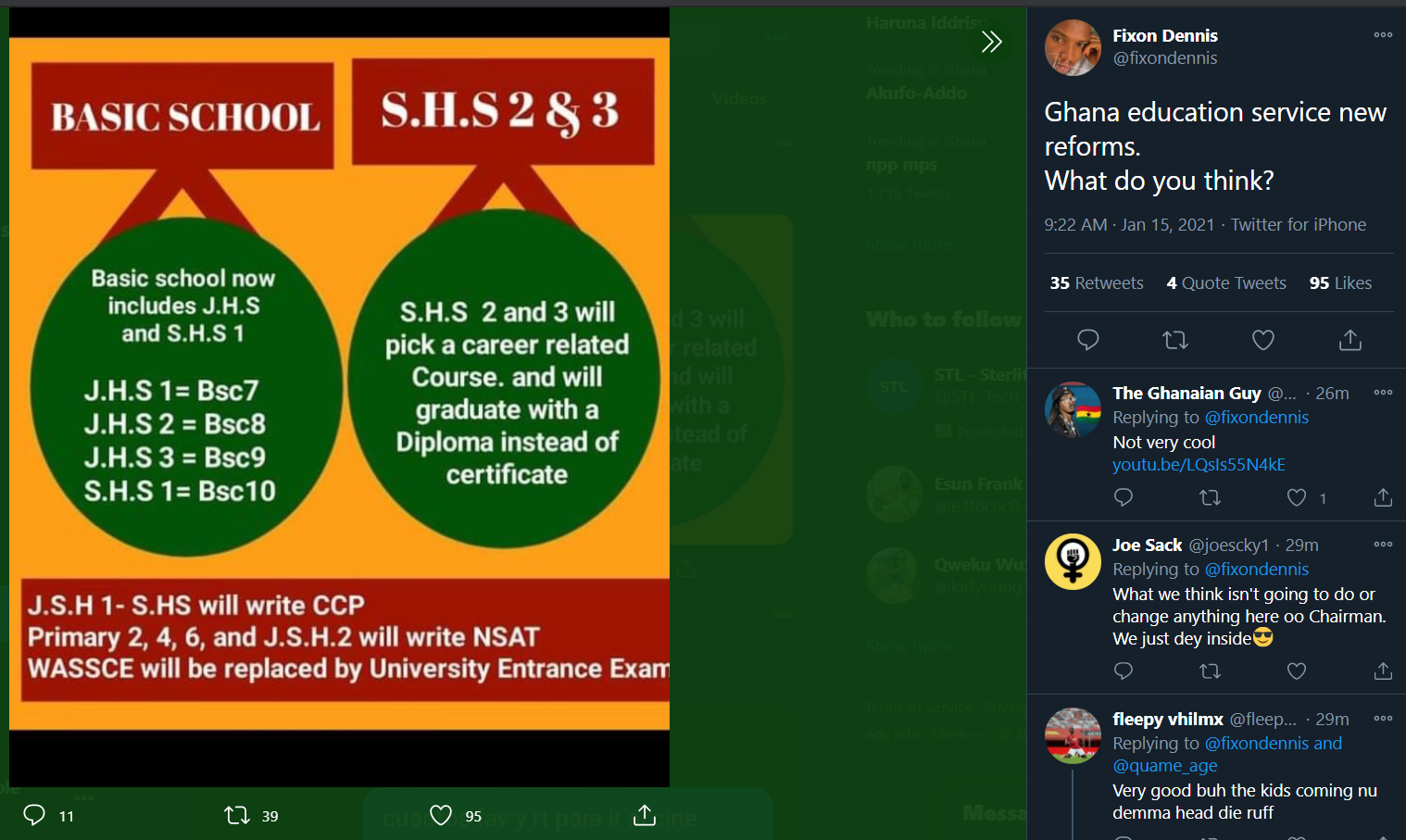
Social media users suggest that a new educational reform has been rolled out by the Ghana Education Service (GES) which includes some changes in the state of the Basic Education system and other aspects of the system as is being run currently in the country. An image, which contains the claims, has been in circulation on social media applications like Twitter and has generated some conversation on the medium with some users indicating excitement at the change and others being indifferent and skeptical about the implementation processes to be involved.
Image source: Twitter
Dubawa set out to find out what truths exist or otherwise in the image and posts being circulated.
Claim 1: Basic schools in Ghana now include JHS and SHS 1.
True. However, the basic school system does not end at SHS 1 but rather at SHS 3.
Verification: According to the National Council for Curriculum and Assessment (NaCCA), basic education has been redefined as a concept to include Senior High School as opposed to just Kindergarten to Junior High School 3 as had previously existed. The system has further been divided into five key phases:
Key Phase 1: Foundation level which comprises Kindergarten 1 and 2
Key Phase 2: Lower Primary level which comprises basic/class 1 to 3
Key Phase 3: Upper Primary level which comprises basic/class 4 to 5
Key Phase 4: Junior High School level 1 to 3
Key Phase 5: Senior High School level 1 to 3
Claim 2: SHS 2 and 3 will pick a career related course and will graduate with a Diploma instead of certificate.
False. Decisions have not been taken on the type of examinations that will be written at the end of the Senior High School Year yet.
Verification: According to Mr John Mensah Anang, acting Director General of NaCCA, there are two pathways from which students will choose– career pathway and academic pathway. The academic pathway encompasses the sciences and the humanities while the career pathway will be the vocational and the technical courses.
“The type of exams they will write, the decision has not been taken so there is nothing like Diploma or certificate. That thing was somebody’s suggestion when we were meeting stakeholders. A series of suggestions have been made but we are not yet there because the students who will write or enter into those places are currently in JHS 1 so it will take four years before they will get there. By that time, we might have discussed thoroughly and convincingly and as a nation, come out with what type of exams they should write at the ending point of Senior High. So as at now, no decision has been made,” Mr. Anang said.
This was also confirmed by Cassandra Twum Ampofo, Public Relations Officer at the Ghana Education Service, who stated that after being taken through the Common Core Programme from JHS to SHS 1, students will be allowed to choose their electives which will be specific and help chart their career paths.
Claim 3: JHS 1 to SHS will write Common Core Programme (CCP).
False. The CCP is a four year programme designed to lead students to choose a pathway in their second year in Senior high school. It is not some form of exam to be written.
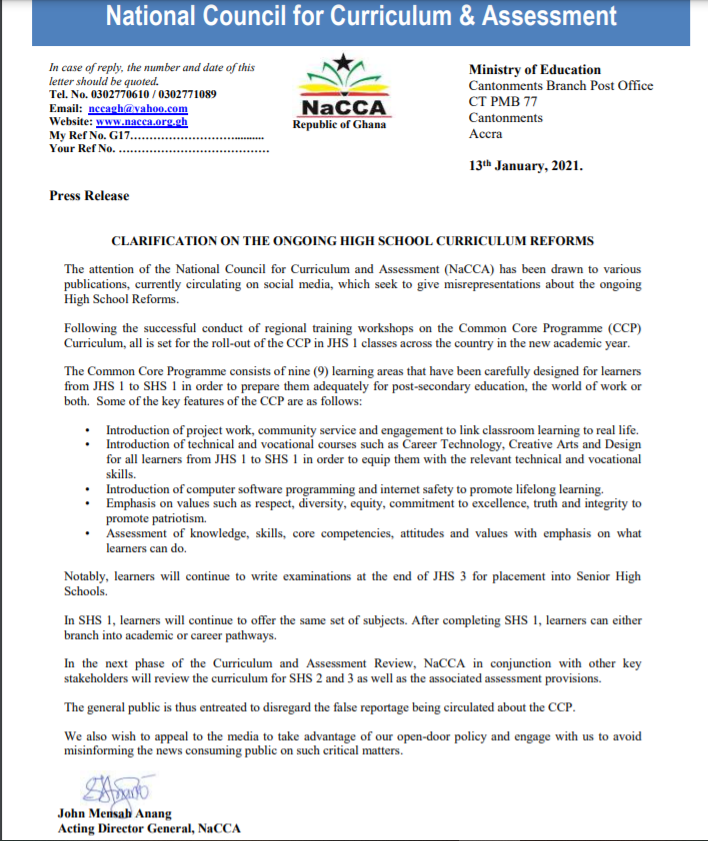
Verification: From JHS 1 to SHS1, GES is rolling out a course called Common Core Programme (CCP).
“This just means that the subjects that are done in JHS 1 will be done till SHS 1 and this is what is supposed to predispose the learner into the two pathways– the career pathway and the academic pathway. So it is a four year program,” Mr. Anang, Acting Director General of the NaCCA clarified.
The CCP will comprise nine subjects —Mathematics, Languages, Science, Religious and Moral Education, Physical and Health Education, Career Technology, Social Studies, Computing, Creative Arts and Design.6.
The press release above, issued by the Acting Director General of NaCCA, John Mensah Anang, provides more detail on the Core Curriculum Programme.
Claim 4:Primary 2, 4, 6 and JHS 2 will write NSAT.
True. However, SHS 2 was left out of the stages that the NSAT will be written.
Verification: The National Standard Assessment Test( NSAT) will be written in Primary 2, 4, 6, JHS 2 and SHS 2, according to Mr. Anang.
“This is supposed to be conducted by NaCCA at all these levels to assess the quality of teaching and the quality of learning that has gone on. Then the interventions that will be needed where the gaps that are identified will be instituted at the next level to help the child,” he added.
By testing the students at all these levels, there is an expectation that shortcomings will be identified and also the progress and achievement of each learner can and will be tracked in order to know which interventions to put in place to help the child adjust.
According to the PRO of GES, Cassandra Twum Ampofo, the implementation started in September 2019 where the Service announced that there would be a national assessment to ascertain the core competence that learners have acquired.
Claim 5:WASSCE will be replaced by University Entrance Exams.
False. WASSCE will not be replaced by the University Entrance Examination.
Verification: According to Mr. Anang, this was someone’s suggestion during the Covid-19 period when SHS 3 students were unable to go to school and write their exams. The suggestion was however rejected for various reasons of which he mentioned two.
First, Mr. Anang stated that doing so would rob people who cannot further their education of certificates which they could use to apply for jobs that may accept Senior High School Certificates for employment.
Secondly, he stated that the Universities cannot take on all SHS leavers.
“This is a figment of someone’s imagination. It is not true”, Mr Anang stated.
About Ghana Education Service
The Ghana Education Service (GES) was established, as part of the Public Service of Ghana, in 1974. The GES is tasked with the duty to create an enabling environment in all educational institutions and also manage the positions that facilitate effective teaching, learning and efficiency in the management for the attainment of the service’s goals. The GES also has the responsibility of ensuring that all Ghanaian children of school-going age are provided with inclusive and equitable quality formal education and training through effective and efficient management of resources.
The GES is also responsible for the implementation of approved national pre-tertiary educational policies and programs to ensure that all Ghanaian children of school-going age are provided with inclusive, equitable and quality formal education.
There are four (4) main programmes under the GES:
Pre-tertiary education management including Headquarters Divisions, Regional and District directorates
Basic Education, comprising Kindergarten, Primary and Junior High Schools
Secondary Education comprising Senior high School (SHS) and Technical and Vocational Education Training (TVET)
Special and Inclusive Education
About the National Council for Curriculum and Assessment(NaCCA)
The NaCCA was established as an Advisory Board to the Curriculum Research and Development Division of the Ghana Education Service. The goal was to manage and implement the Curriculum Policy of the Ministry of Education towards the attainment of educational objectives and educational goals in Ghana. NaCCA had its first set of council members inaugurated in 2011. It is presently governed by a 21-member Governing Council which is made up of representatives from different institutions.
Conclusion:
The claims being circulated about a new educational reform in Ghana constitute a mix of half-baked truths and untruths.
Ghana’s fourth Republic plods on, jerkily, but the nation that first ushered Africa into independence and democratic rule came to some recent reckoning as the world’s attention was fixed on the country ahead of its 2020 general elections. The challenge, going into the elections, was a simple one: Will this beacon of hope in the sub-region be able to consolidate its democratic gains and continue to inspire a continent characterised by political instability?
Not only has it done that, it has left for generations to come many historical moments – and events – hopefully, to learn from and to further strengthen its democracy.
A Historical Election
The December 2020 general election was historic on many fronts: it was the first to have been conducted in the country during a pandemic – Covid-19; the first to feature a sitting president, Nana Addo Dankwa Akufo-Addo, and a former president, John Dramani Mahama, from the two major political parties – the National Democratic Congress (NDC) and the New Patriotic Party (NPP); and the first since 1993 to feature a female running mate from one of the major political parties..
Legitimising disenfranchisement
Significantly, for the first time in its fourth republic history, a group of people were disenfranchised. Electorates in the yet-to-be created Guan District Assembly which constituted by the Santrokofi, Akpafu and Lolobi (SALL) areas in the Oti Region, were, in accordance with an Electoral Commission (EC) press statement, deprived of their right to elect a Member of Parliament. They were served notice of this on the eve of elections – December 6.
“As a result of the creation of the Guan District Local Government (Guan District Assembly) Instrument, 2020 and pending the creation of the Guan Constituency, eligible voters in the Guan District will vote only in the Presidential Election but not in the Parliamentary Election in the Buem Constituency,” the EC statement read.
As it turns out, the ‘firsts’ will not only be limited to the pre-elections period but events after as well. The Chairperson of the Electoral Commission (EC), Jean Mensa, announced the elections’ verdict on December 9, 2020 (after being unable to deliver on the promise of declaring results within 24 hours) without results from one constituency – Techiman South. According to Mensa, results from the constituency would have no effect on what had been received and collated from 274 of the 275 constituencies.
The presidential election outcome as declared and amended by the commission has since been challenged by the NDC candidate, John Dramani Mahama, with a petition filed at Ghana’s Supreme Court. This is not the first time a candidate is seeking redress in the apex court after an election. Precedence was set after the 2012 presidential candidate of the New Patriotic Party, Nana Addo Dankwa Akufo-Addo, prayed the Supreme Court to overturn election results which declared NDC’s candidate, John Dramani Mahama, winner. The petition was dismissed after eight months of legal tussle.
A Hung Parliament
Again for the first time, none of the political parties which contested the elections won a clear majority in Parliament. According to the EC, out of 275 constituencies, the NPP and the NDC won 137 seats apiece and an independent candidate, Andrew Amoako Asiamah, a seat. Asiamah, was the Member of Parliament for Fomena Constituency in the Ashanti Region on the NPP ticket. He was expelled from the party a few weeks after the elections over disagreements with constituency executives and his seat subsequently declared vacant by the Speaker of the Seventh Parliament, Prof Mike Aaron Ocquaye.
The number – 137 apiece for the two sides – remains the same in spite of judicial contestations by both the NDC and the NPP to overturn parliamentary results in some constituencies. As such, a hung Parliament is what is currently in place.
Soldiers in parliament
The drama around the election extended to Parliament House on January 6 and 7 when Members of Parliament convened to elect a Speaker and subsequently to be sworn-in as elected representatives. The ceremony which was expected to last two hours from midnight of January 6, ended after 10 a.m January 7.
The contest between former speaker of Parliament, Prof Mike Aaron Ocquaye, nominated by the NPP caucus, and former first deputy speaker of the seventh Parliament, Alban Sumana Bagbin, nominated by the NDC side, supposed to be by secret balloting as stipulated by the constitution 104 (4) of the 1992 Constitution and Standing Order 9 (1) of Parliament, was interrupted about three times after the NDC caucus insisted MP-elects from the NPP side must not display their ballot papers to their party leadership. Altercations, including the exchange of abusive words, kicking of ballot booths ensued during proceedings.
A major highlight of the night was what many call the ‘invasion’ by armed military officials into the house to ostensibly settle the confusion. Their presence attracted commotion from the NDC side who sang the national anthem and revolution songs in their bid to stand up to what they term ‘oppressor’s rule’.
However, the crowning moment of what many Ghanaians have called disgraceful conduct from the ‘honourables’ or Parliament, was the snatching of yet- to be counted ballot papers by an MP-elect, Carlos Ahenkorah. He was subjected to beatings – meant to force out the papers he had attempted to chew, according to a member of the NDC, – after his plot was foiled.
Ahenkorah was a Deputy Minister for Trade and Industry but was forced to resign in 2020 when he visited election registration centres in spite of testing positive for Covid-19. His apology explaining his action, has not gone down well with many.
The riotous and acrimonious proceedings notwithstanding, Alban Suman Bagbin was elected Speaker of the eighth Parliament.
What Do these events Mean for Ghana’s Democracy?
Ghana’s institutions and democracy are not perfect. Indeed, there is no perfect democracy or anywhere in the world – As events of last week from the United States of America where supporters of President Donald Trump stormed Capitol Hill have shown, no democracy or country is immune from unexpected tussles. Therefore, although some of the events preceding the 2020 elections and afterwards should be a concern for Ghanaians, they present us with opportunities to fix our institutions and work on our democracy. But are our leaders willing to deny themselves of the benefit of the status quo for an equal and democratic society where institutions work for the common good?
The outcome of the elections, especially massive loss of the governing party, NPP, from holding a majority in Parliament with a total of 167 seats in 2016 to the current 137, in spite of the much-touted free Senior High School, is an indication of the growing sophistication of electorates. It is a wake-up call for politicians that the Ghanaian electorate is discerning and cannot be bought off with occasional ‘goodies’, propaganda and populist policies. With this massive blow, politicians will be disabused of the perception that electorates will accept whatever is thrown at them.
With the nature of the current Parliament, the success or otherwise of governance and government business will hinge on consensus building and collaboration between the two caucuses and government. Considering the history of ‘the minority can have its say but the majority will have its way’ in previous Parliaments, how will the current Legislature work? Can the Executive, which has been accused of disregarding input from civil society, citizens and opposition political parties, work effectively with the hung parliament presided over by a speaker from the opposition party?
Again, for a Legislature which has since the inception of the fourth republic been considered a ‘rubber stamp’ doing the bidding of the Executive, often because the President has always come from the majority in Parliament, a hung parliament with a speaker from the opposition is expected to be much more critical of the government and ensure against executive excesses.
Ghanaians, and indeed the world, wait to see how this will pan out.
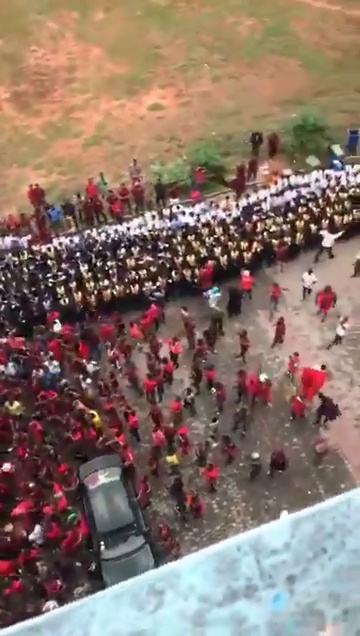
Photos and videos purport a demonstration happened on Friday 8 January 2021 on Legon campus by University of Ghana students against a double-track system and academic modular system.
Photos and videos making claims of an ongoing demonstration on Legon campus are dated. There was no demonstration held on the proposed date due to a low turn out of protesters.
Full text
Ghana Twitter was buzzing with the trending hashtag #LegonDemonstration on Friday 8 January, 2021, where several users suggested in videos and photos that there was an ongoing demonstration happening on the University of Ghana, Legon campus. The alleged story of an ongoing demonstration has also been featured on some sites including GhanaTalksRadio.
Even though the demonstration was truly organised by a group, ‘Concerned Students of the University of Ghana,’ to be held on the said date to protest against the double track system and academic modular for students suggested by the Management of the University, some Twitter users have debunked the claims of the demonstration being held, stating the all such videos and photos pushing the narrative are false.
Verification
Dubawa subjected the video and photo purporting that a demonstration was ongoing on Friday 8th January 2021 on the University of Ghana Legon campus to investigation, and found both cases of the video and photo to be dated.
Context of video
The 30-second video shows a group of people predominantly in red ‘charging’.
Charging is a ritual of clapping, dancing, singing, drumming, and firing of arms mostly by male residents of Commonwealth Hall in the University of Ghana, who accessorise with red, performed either in the hall or as a procession on the streets of the campus. In this video, it appears to have been performed at the parking lot of Legon Hall’s Annex B building which overlooks the Sarbah field.
Analysis of video
Firstly, the angle of the shooting of the video suggests that it was taken at a time school was in session. The recorder of the video, whose voice is identified to be female, was positioned on a high floor in the hall making comments with others around her, while looking on down at the ‘charging’ happening at the car park. This raises doubts of the video being associated with the alleged demonstration since school had not yet resumed then.
Additionally, using the InVid Image Magnifier on key frames in the video, there is evidence of a group of people in graduating gowns and white shirts accompanying the alleged group of protesters.
This is corroborated with comments in the thread of the post, debunking the video as old and revealing that it was on an occasion of a matriculation in 2018 where the charging was performed by Commonwealth residents as an initiation for their fresh year students.
Dubawa further ran the photo which suggests that the demonstration was ongoing and was found to be dated.
A Google Reverse Image Search shows that the photo has been on the Internet for at least two years. In a RadioUnivers report published in 2019, the photo was accompanied with the story of ‘students’ agitation over the possible privatization of four halls of residence’ at the time and was not associated with an alleged ongoing demonstration exercise on Friday 8 January, 2021.
Dubawa also contacted a reporter at the University of Ghana-based radio station, RadioUnivers, to confirm details of the alleged demonstration. The reporter, Jeffrey Nyabor, told Dubawa that there was no demonstration held on Friday 8th of January 2021.
“They planned to demonstrate but it didn’t come off because people didn’t show up. Some of the protestors came around, about eight or so- just a handful- but there was no demonstration. One of the leaders told us it would have to be rescheduled,” Nyabor said.
Also, neither mainstream media nor RadioUnivers has reported on an alleged demonstration held at Legon on the said date. Rather, it was reported that a meeting involving student leaders and the University management scheduled on the same date to discuss the modular for the academic year, which was one of the reasons for the planned demonstration, has consequently been extended.
Conclusion:
The video and photo circulating on Twitter suggesting that a demonstration at Legon campus was ongoing on Friday 8 January, 2021 is false. The multimedia formats are dated content that happened on different occasions on the University campus, and not associated with the planned #LegonDemonstration. The demonstration could not be held at all on the said date owing to a low turnout of protesters.
Ahead of Ghana’s 2020 elections, concerns of spiraling rise of fake news and its osmotic penetration into public discourse was feared to become the conduit for character assassination, falsehood peddling and publication of dated information already debunked as false. As anticipated, fake news and malicious information were kneaded into the information ecosystem, thus staining and denting information the general public is exposed to on legacy and new media platforms.
Given that elections are about the struggle for power, information shared by political parties are meant, largely, to influence the decision of the electorate to vote in a particular way. Though there are divergent schools of thought on the potential impact of fake news on the behavior of voters (Cantarella, Fraccaroli & Volpe, 2019; Wang, 2020; & Lee, 2020), what is not in doubt is that fake news is perceived by some individuals as a true reflection of reality and they will not bog down to accept views contrary to what they have heard, seen, or read from platforms with which they share similar beliefs and ideologies (Nguyen, 2020). Verification of information by media audiences is often not given priority, thus exposing consumers of information to well-crafted messages intended to distort reality and ultimately misinform a target community. While verification has become somewhat a challenging task for many, fake information continues to fester; feeding on the vulnerability and gullibility of individuals.
Media platforms, particularly social media, have been singled out as the breeding ground for fake news. According Mavridis (2018), fake news about current social or political issues is regularly circulated on social media with tremendous speed and these fake stories are created to misinform or deceive audiences, influence people’s views, push a political agenda or cause confusion and can often be a profitable business for online publishers
In an era where media audiences are not merely observers and readers of information but have become active contributors, content generators and publishers in the news feed (Bell, 2014), there is the expectation, however, that the practice of information verification will be adhered to. This, often, goes awol, giving a window for fake information to sneak in and eventually populate media platforms. The gatekeeping role played in traditional newsroom set-ups has contributed immensely in double-checking of information before media audiences are exposed to it. Editors and proofreaders have and continue to perform that verification role aimed at ensuring that news presented is devoid of misinformation (Born & Edgington, 2017).
Beyond the opportunity presented by online spaces to media users to create and share their own content to their audiences, the fundamental right of individuals to free speech is also bolstered by a medium that seeks to provide the platform for many to express their opinions and contribute to socio-political discussions on national issues. In Ghana, the constitution grants the right to all persons to freely express their opinion (Endert, Moore, & Suuk, 2019) and this right is consistent with other international protocols on freedom of expression (O’Flaherty, 2012) that Ghana has signed on to. In the wake of widespread fake news, majorly on online platforms where media users post, share and re-share information they have, often not verifying its authenticity, many observers are beginning to shudder on the potential implications of fake news on a fledgling democracy like Ghana. How much effort and measures can be put in place to either control or exterminate fake news in this young democracy remains a daunting task for policy makers, especially when such a step may potentially lead to some sort of censorship or an outright blackout of persons or group of persons from exercising their right to free speech?
While it is expected that the exercise of one’s right to free speech is consciously carried out without abuse, much of the evidence (Anderson & Rainie, 2017; Fletcher et al, 2018)) observed on online platforms points to a situation where media users have found social media as an extension of their voices to propagate, intentionally or unintentionally, misleading information that has the propensity to arouse anxiety, create fear and panic and doubts in the minds of the citizenry.
Fake News as a News Industry
Business organisations have products and services they market, primarily, to rake in income and make profit. For media organisations, the product marketed is information. That information must be newsworthy and must have the element of currency, relevance, oddity, prominence, timeliness, proximity, and sometimes accompanied by controversy. The news media, until recently, was basically newspapers, radio and television. Often, the underpinning motivation behind news publication is to inform, educate and entertain (Le Jeune, 2009). These canons have been a guide for all media houses and media professionals who ply their trade in the media terrain.
However, in recent years, the emergence of fake news disguising itself as factual information has challenged and continues to challenge the status quo of what mainstream news is expected to achieve. Fake news as we see today circulating on all media platforms do not inform, rather they are either intentionally or inadvertently published to misinform (Dentith, 2017).. Gradually, fake news is gaining roots in information dissemination and has taken a niche within the spectrum of the information ecosystem.
The unrestricted access to media use coupled with the difficulty in regulating content especially on online spaces have made it extremely challenging for many policymakers and other stakeholders to find a solution to this festering canker. The danger, however, is that this growing phenomenon has raced into public conversations on key developmental issues. Creators and perpetrators of fake news though may have failed in upholding the principal canons of journalism, the level of attention given to it by those exposed to it makes the fight to exterminate it an arduous one.
Bearing the semblance of a news organisation, the fake news industry is fast becoming an institution on its own where it has creators of information, its audiences and platforms for dissemination of the created information. Given the negative impact that fake news could have on individuals, it is expected that perpetrators of such forms of news would act responsibly, bearing in mind not to sacrifice their right to free speech on the altar of sensationalism and mischief.
Touted as the fourth estate of the realm that holds government and policymakers accountable, the need therefore for information coming from the media to be factually accurate should be a sacred totem that bears on the work of any individual who takes up the responsibility to share information to the general public. However, any effort that deviates from this ideal position is either undermining the work of media professionals or somewhat, staining and blotting the intended impact news information is supposed to have in building strong democracies.
Fake News as a Business Enterprise
As a business enterprise, creators of fake information in the form of click bates, memes, and satires have successfully managed to direct traffic to their web pages in a bid to attract advertisement and attention to their web platforms. These phenomena portray a picture of fake news as a deliberate economic venture (Parsons, 2020) that capitalizes on the curious tendencies of humanity. As a bait, the news item lures readers to a web page to read stories often created by online users to serve as a deviation from the facts of information.
The flip side of the argument, however, is that fake news is occasionally used by competitors in a capitalist market to tarnish the brands of other competitors in the same market. The overarching goal is to cause disaffection for a product or service in favour of a demand for the other in the same market space. Thus, fake news has become the conduit for trade wars and competition for clients in the business arena.
One of the underpinning tenets of democracies is a free market economy where individuals with resources can engage in legal businesses with the aim of making profit. Taxes from such private businesses in most cases have been the financial mainstay used to bankroll developmental activities across the length and breadth of a country. As a cardinal principle, democratic governments encourage private businesses to operate in a free and conducive environment and, by and large, their operation is expected to have a positive impact on the country’s economy, therewith, reducing unemployment and creating wealth at the same time.
Thus, fake news is not restricted to the inky fraternity but spreads its tentacles to the world of business. While media audiences continue to scratch their heads over how to overcome this menace, the business environment is not spared the agony that fake news brings along. As a constituent of democracy, businesses truly need the air to survive and flourish and given the prowling impact of fake news on business survival, the clarion call for perpetrators of fake news to halt their activities has become louder than before.
Like the media front, exposure to fake information about a product or service offering of a company spreads so fast that even when the information is fact-checked and turned out to be untrue, fewer numbers get to know the truth of the false story first circulated. Ironically, in many instances, the true originators of the stories are unknown yet online users share information without a prompt about verifying the source.
Fake News as a Political Strategy
The politics of fake news is perhaps the most common in most democracies. For example, in the United States of America, fake news gained momentum prior to the coming into office of President Donald Trump in 2016. He often branded news organisations as perpetrating fake news and branded some news information about him as fake. Indeed, in the 2020 US presidential race, the issue of fake news resurfaced and was used by both the Republican Party and the Democrats as well.
In Ghana, the use of fake news as a political weapon to run down competing opponents in either a presidential or a parliamentary race is common. Political opponents crisscrossing the length and breadth of the country get closer to the electorate and make promises in an attempt to win their confidence for votes. Some of the campaign messages come along with statements that when verified, turn out to be outright falsehoods. Political parties, especially the two main contending parties in the just-ended presidential elections in Ghana, the New Patriotic Party (NPP) and the National Democratic Congress (NDC) had groups online that propagated messages about one another that turned out to be untrue when subjected to the litmus test of verification. A viral video of Ghana’s President Akuffo-Addo, purporting that he was taking a bribe was found to be a doctored material when the content of the video was subjected to thorough examination by Dubawa, a leading fact-checking organisation in Ghana.
To the extent that political race is ultimately aimed at getting control over power and resources, these fake news in public discourses are often targeted at opponents to tarnish a projected reputation. The democratic system of governance in Ghana allows for the exchange of ideas in any public place of opinion. However, like all the other challenges associated with fake news, the factual basis of disseminated information is often missing, rather, a forceful attempt is made by the peddlers of such misleading information to present the information as true and sacrosanct (Dentith, 2017).
With perhaps no interest to verify information or perhaps, totally naïve about fact-checking, the electorate is likely to be exposed to and further embrace misleading stories in public space or on media platforms. Such fake stories are eventually disseminated to an even more vulnerable population who do not have the resources and the know-how to either do an independent verification or seek assistance from professional bodies to fact-check information. This lacuna created by the limited number of fact-checking organisations in Ghana has, in many ways, given the grounds for fake news to outpace fact-checked information on media platforms.
Fake News as a Social Media Phenomenon
Without a doubt, fake news has become synonymous with online spaces. The creation of echo chambers online has given the wheels to the spread of fake news in almost all facets of the socio-cultural aspect of human life. Digital media platforms have become a megaphone for online users who wish to share one information or the other whether factual or laden with factual inaccuracies.
A major characteristic feature with these online users and by extension the echo chambers is that they believe in information shared in the groups they belong to online and no amount of dissenting views they are exposed to will change their already held beliefs (Rhodes, 2019). Indeed, some scholars have argued that the major reason why misinformation continues to thrive is that fake news shared in online groups tends to reinforce an already held biases of the members of the group and no amount of an alternative to their “truth” will ever change their position on an issue.
While successive governments in a country make efforts to entrench democratic ideals, it is expected that journalists and media users share information that is factually accurate and purposefully truthful. A deviation from this norm is indicative of an abuse of the right to free speech that the constitution of the republic grants citizens.
Implications of Fake News on Democratic Governance
The various pillars of democracy are ultimately aimed at promoting development and empowering the masses to be actively involved in the decision making processes at the grassroots to the national level of public discourse. The right to free speech is expected to be respected by countries like Ghana that have signed on to related international protocols. In recent years, however, the attending challenges that have come with the right of individuals to freely express their opinion on social media platforms has triggered debates among policymakers as to how best to ensure that information shared on media platforms are devoid of untruths.
Three main areas often appear hardly hit by the spread of fake news in most democratic societies where free speech is often a trump card and a hallmark of the country – lack of public trust in information, threat to human lives and lack of public and community support for government initiatives.
Lack of trust in information
Fake news blurs the lines between the facts and falsehood and often it takes painstaking verification to ascertain the truth in an information one is exposed to. As fake news grows in leaps and bounds, the effect has been a certain lack of interest in information shared on media platforms. This occurrence has a rippling effect on several areas of society including casting doubt on information shared by government sources and other relevant bodies in the country.
The danger in it is simply that where the citizenry is needed to adhere to one information or the other, they may dismiss it; tainting it with doubts. This of course has the effect of stonewalling the efforts in promoting the good ideals of democratic principles in countries such as Ghana.
Threat on lives
Another challenge from the effect of fake news on the populace is the reluctance to participate in national activities. If fake news succeeds in discrediting a source of information, it equally goes to put doubt on the message coming from the same source.
One area that perpetrators of fake news have often targeted is the health and wellness sector. In the past few months, the entire globe has been brought to its knees by the rampaging impact of the coronavirus pandemic. Many theories have been advanced about what the cause of the disease may have been and medicines that could cure the disease. Many of the so-called antidotes to the coronavirus infection have proven to be untrue.
With a recent announcement of a vaccine found to help combat the disease, some conspiracy theories have suddenly flung through the roof with a warning to many to resist taking the vaccines. As governments in many countries make the effort to acquire and immunize their citizens, a potential face-off is likely to emerge where many who have been exposed to information about the toxin nature of the vaccines are likely to abstain and this may derail the effort of many countries to safeguard the lives of its citizens.
Lack of Public and Community Support for Government Initiatives
With information discredited, getting the support of the citizenry to support a government initiative will often come with challenges. Fake news targeting government policies can cause disaffection for the government and its officials and this could translate in lack of support for a successful implementation of one project or programme or the other.
Democracy, as has been famously defined, is a government of the people, by the people and for the people. It stands to reason that any form of governance without the input of the masses is likely to suffer hitches and eventually cause dissatisfaction for a government in power. Given such circumstances, governments almost always make the effort to rally the citizens along with any form of policy initiative. The danger, however, is that, when fake news and falsehood are targeted at running down such initiatives the tendency for it to hit a snag is high because of lack of support from the populace. Propaganda has often been used within political circles to achieve this agenda. The end effect, however, is that intended developmental projects will lag.
Conclusion
Information and exchange of ideas have always been at the heart of building strong democracies. The upsurge in fake news has obviously muddied the information ecosystem and these concerns have triggered attention to find an antidote to confront the growing menace. Fact-checking institutions have come in handy in an effort to ensure sanity in the dissemination of messages on media platforms. Arguably, with many of these institutions available, citizens will have assurances of messages they are exposed to on media platforms and the resultant effect will be tacit support for government projects and programmes and trust in government information will be high.
Reference
Anderson, J & Rainie, L (2017). The Future of Truth and Misinformation Online. Pew
ResearchCenter. Retrieved from http://www.elon.edu/docs/e-web/imagining/surveys/2017_survey/Future_of_Info_Environment_Elon_University_Pew_10-18-17.pdf
Bell, I. (2014). Creators, Audiences, and New Media: Creativity in an Interactive
Cantarella, M., Fraccaroli, N., & Volpe, (2019). Does fake news affect voting
behaviour? DEMB Working Paper Series (146). Retrieved from http://merlino.unimo.it/campusone/web_dep/wpdemb/0146.pdf
Dentith, X. R. M. (2017). The Problem of Fake News. Public Reason 8 (1-2): 65-79. Retrieved from https://philpapers.org/archive/dentpo-31.pdf
Fletcher, R., Cornia, A., Graves, L & Nielsen, K. R. (2018). Measuring the reach of “fake
news” and online disinformation in Europe. Factsheet, Reuters Institute. Retrieved from https://www.press.is/static/files/frettamyndir/reuterfake.pdf
Le Jeune, M. (2009). To inform, educate and entertain? British broadcasting in the twenty-first century. Centre for Policy Studies. Retrieved from https://www.cps.org.uk/files/reports/original/111027112808-20090324PublicServicesToInformEducateAndEntertain.pdf
O’Flaherty, M (2012). Freedom of Expression: Article 19 of the International Covenant on
Civil and Political Rights and the Human Rights Committee’s General Comment No 34. Human Rights Law Review 12 (4), Oxford University Press. Retrieved from https://www.corteidh.or.cr/tablas/r29946.pdf
Parsons, D. D. (2020). The Impact of Fake News on Company Value: Evidence from Tesla and Galena Biopharma. Tennessee Research and Creative Exchange. Retrieved from https://trace.tennessee.edu/cgi/viewcontent.cgi?article=3363&context=utk_chanhonoproj
Rhodes, C. S. (2019). Echo Chambers and Misinformation: How Social Media Use Conditions Individuals to Believe Fake News. A dissertation submitted in partial fulfillment of the requirements for the degree of Doctor of Philosophy Washington State University School of Politics, Philosophy, and Public Affairs. Retrieved from https://research.libraries.wsu.edu/xmlui/bitstream/handle/2376/16815/Rhodes_wsu_0251E_12799.pdf?sequence=1&isAllowed=y
Wang, T-L. (2020) Does Fake News Matter to Election Outcomes?: The Case Study of
CLAIM: A photo circulating and rumours making rounds suggest the COVID-19 vaccine leads to penis pnlargement.
FALSE. Whilst there have been notable side-effects associated with the dose of the COVID-19 Vaccine, none of those side-effects has proven or led to any case of penis enlargement as claimed in the photo that is circulating on social media.
Full Text
The photo purporting to be breaking news from a news agency reads, “COVID-19 Vaccine enlarges Penis.” This has drawn attention from mostly young men, and the author of this article was privy to one of the discussions and had access to the photo following the conversation he heard amongst young men at a public event. The discussion attracted the attention of many and most of them confirmed to have seen the photo circulating on social media especially WhatsApp.
This photo with the flamboyant claim is just one of the many backlashes to have emerged from the announcement of a clinically trusted COVID-19 vaccine in a much shorter time than anticipated. The Pfizer Covid Vaccine has already been applied to the most vulnerable group of people to the pandemic – frontline health workers in the United Kingdom and the United States.
Verification
The Pfizer BioNTech vaccine has gone through the required clinical trial that was presented to over 44,000 participants and scored over 95% in effectiveness and safety. This did not, however, clear the vaccine of potential side effects, particularly that the first dosage on British health workers did come with reactionary side-effects. The side effects triggered by histories of allergic reactions were reported in this New York Times article. But of all the side reactions to the vaccine so far, nothing like penis enlargement has been reported.
The Pfizer BioNTech Vaccine, like any other vaccine, is delivered as a shot in the arm and notable side effects have been headaches, fatigue, chills and muscle pain. The penis enlargement claim, from all indications, has proven to be baseless for lack of medical or scientific backing.
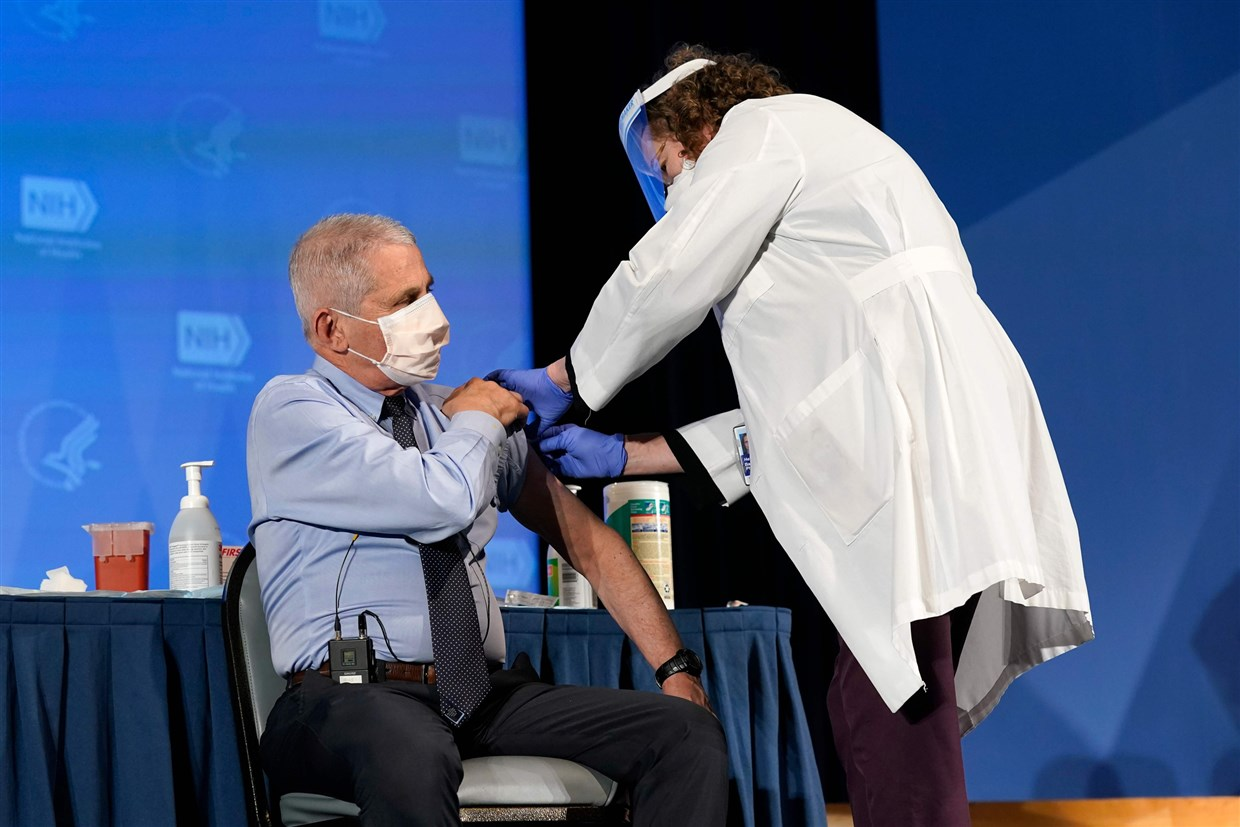
For further clarifications, Dubawa checked the other COVID-19 Vaccine, Moderna vaccine, which has very recently received emergency approval. Its clinical test has shown its effectiveness to be almost as high as that of the Pfizer vaccine. It was first delivered to top health officials like Dr Fauci on the 22 December 2020 and so far, no such claim has been associated with it.
Patrick Semansky / AFP – Getty Images
Secondly, the photo circulating has no inscription or logo of any particular brand that raises red flags. It further claimed a 23% increase in penis size relating it to a study which was never explained in detail as to who or what organization conducted the study and how they reached such a conclusion on a vaccine that is less than a month old. These misconceptions and red-flags question the veracity of such claims and expose its groundlessness.
Conclusion
The claim of penis enlargement related to the COVID-19 vaccine is unfounded and therefore misleading. No major side effect has been identified, apart from cases of patients with histories of allergic reactions and none of such effects is related to penis enlargement.