Featured

  • Online shopping during the festive season: separating the real from the fake

    In recent times, online shopping has gained prominence with many physical shops moving to get online presence to take advantage of this internet-powered sales boom, especially amidst the COVID-19 pandemic. 

    The process involved in making sales or purchases online is what is generally captured as e-commerce.

    Whether it is a business website, a business page on Facebook, Twitter, Instagram or WhatsApp, many individuals and businesses establish their presence online to make sales.

    Unfortunately, this development, like any other, comes with its own challenges.

    Our experience in fact-checking popular claims in Ghana over the past many months has taught us that some persons are taking advantage of the e-commerce boom to perpetrate scams. 

    With the festive season being characterized by several sales and purchases, it is anticipated that disinformation peddlers and scammers will heighten their activities to try and defraud unsuspecting buyers.

    A common observation has been the proliferation of fake pages cloned after genuine business pages and purporting to be offering Christmas deals.

    Identifying the real from fake pages could be a daunting task but here are some basic tips that can help you. 

    1. Page verification: It is best to do business with pages that are verified. Verified pages have a blue tick like this next to their names. It is true that many small businesses on social media have not been verified, in these cases, always ensure you run a search to see if the original page will emerge or if you are already engaging with the original one. 

    Most times, the original pages have more followers than the cloned pages. 

    Also looking out for the date the page was created is crucial. The older the page, the most trustworthy is, usually. 

    2. Deals too good to be true: This is a widely known red flag but always very tempting to shoppers. If it is too good to be true then it is probably not true. There are countless stories about people who have been defrauded by business pages online when they tried to take advantage of very ridiculous product offers. 

    It would be helpful to browse other online stores to know the average cost of a product, before making your final purchase with one whose offer you find to be unreasonable. Ridiculously low prices could be a bait to defraud. 

    3. Suspicious reviews: Most web-based platforms give room for reviews from customers. Going through the reviews could give you clues on whether or not you are dealing with the right page. Being very thorough here is important because so many praise-singing or positive reviews could be a red flag. Too many negative reviews could also give relevant information. Having reviews or comments that look like they were ‘Bot-generated’ is also a red flag. 

    A 2019 news feature examines some experiences of victims of e-commerce scams. 

    These experiences and the trends observed by fact-checkers show that ignoring red flags on online pages you intend to do business with could mean seeing you giving up your hard-earned cash in return for nothing. 

    You can read some of our fact-checks relating to e-commerce scams here, here and here

    Have a Merry Christmas and the Happy New Year.

  • False: NDC has not placed an injunction on the investiture of Nana Akuffo-Addo

    Claim: The legal team of the  National Democratic Congress (NDC), led by Mr. Tsatsu Tsikata, has placed an injunction on the yet to be witnessed investiture of the president-elect and has petitioned the ICC on the matter.

    The NDC legal team has denied any knowledge of the said claim and has stated emphatically that the party has not filed any case in court yet, neither has it petitioned the ICC. Therefore, the claim is false.

    Full Text

    The controversy over the results of the 2020 Presidential and Parliamentary elections rages on as members of the NDC continue their protest over the disputed results.

    The minority in parliament took the protest to the office of the Electoral Commission (EC) to present a petition to the election management body.

    Officials of the EC were, however, not available to receive the petition, an act which further worsened the already sullied relationship between the two bodies.

    The EC later in a press release explained that the commission was not given prior notification of the minority’s action.

    The party took their challenge of the parliamentary election results, particularly in the Techiman South constituency a notch higher when it publicly collated the results of all the 266 polling stations in the constituency.

    The NDC accused the EC of rigging the election in favour of the NPP candidate, Martin Adjei Mensah Korsah who was officially declared Member of Parliament elect.

    The party has also rejected the results of the presidential election which saw the incumbent president, Nana Addo Dankwa Akuffo-Addo, declared president-elect.

    As the controversy rages, lots of claims are being circulated on social and traditional media platforms about the elections.

    One such claim is a screenshot of a piece of information that suggests that the NDC’s legal team has placed an injunction on the investiture of President Nana Akuffo-Addo.

    The claim has gone viral on several social media platforms, including Facebook and WhatsApp.

    Verification

    To ascertain the veracity or otherwise of the claim, Dubawa contacted a member of the NDC legal team, Abraham Amaliba on phone.

    Mr. Amaliba denied knowledge of the claim and said the NDC had not yet filed any case in court over the disputed results.

    “No, we don’t have any of that happening. We have not filed anything yet. ICC, no. I don’t know if another group has done that, but as a party, no. I can confirm to you,” Mr. Amaliba stated.

    Conclusion

    The NDC legal team has denied any knowledge of the said claim and has stated emphatically that the party has not filed any case in court yet, nor has it petitioned the ICC. Therefore, the claim is false.

  • NDC, NPP win an equal number of parliamentary seats; what are the implications of a hung parliament?

    The 2020 elections will go down in history as one of the most keenly contested elections in the fourth republic.

    The 2008 elections in Ghana remains the most keenly contested elections in the history of the fourth republic, with the then opposition National Democratic Congress (NDC) narrowly beating the then incumbent New Patriotic Party (NPP) by just a little over 40,000 votes in the second round of that election.

    But even in the 2008 elections, the NDC had a clear majority of seats in parliament – 116 seats as against the NPP’s 107 seats. There were four independent Members of Parliament, two People’s National Convention (PNC) MPs, and one Convention People’s Party (CPP) MP.

    In the 2020 general elections, even though the incumbent president, Nana Addo Dankwa Akuffo-Addo, per the official results declared by the Electoral Commission, won by a margin of over 500,000 votes, he was unable to secure a majority in parliament.

    Both the NPP and the NDC won 137 seats each with one independent MP.

    The independent MP was a member of the NPP before his expulsion from the party prior to the elections.

    Andrews Amoako Asiama, who secured the mandate of the people of the Fomena constituency as an independent MP, has since expressed his desire to support the NPP side in parliament.

    Article 97 of the 1992 constitution of Ghana, however, bars him from rejoining the NPP.

    “An MP shall vacate his seat in parliament if he was elected a Member of Parliament as an independent and joins a political party,” the constitution states.

    This means the number of seats for the NPP cannot increase even if the Fomena MP decides to side with the NPP side.

    He would be able to vote or debate in favour of the NPP side in parliament but cannot join to give them a majority.

    This, therefore, means that Ghana is in for a hung parliament if the number of seats won by the two parties remains the same after the resolution of the disputes in some of the constituencies.

    Any implications of a hung parliament on parliamentary business?

    1.      Construction of the leadership of parliament?

    Article 95 (1) of the 1992 constitution provides for the election of a speaker of parliament.

    It states: “There shall be a speaker of Parliament who shall be elected by the members of parliament from among persons who are members of Parliament or who are qualified to be elected as members of parliament.”

    Article 96 (1) also provides for the election of two deputy speakers of Parliament. Paragraph (b) of Article 96 states that the two deputy speakers of Parliament shall not be members of the same political party.

    A private legal practitioner, Lawyer Terrence Ningneng told Dubawa in a telephone interview both sides can present candidates to be elected as speaker and deputy speakers, and the candidates who win simple majority become the speaker and deputy speaker.

    The side which fails to secure the first deputy speaker position automatically takes the second deputy speaker position.

     “The speaker, normally both sides will nominate but it’s just natural that all the time the majority always gets their way because if you nominate and you are on the minority side, there is no way because it’s a simple majority,” he explained.

     From this explanation, the candidates the NPP side presents are likely to win the speaker and first deputy speaker positions if the independent MP decides to vote in their favour.

     This may apply to other elected offices among the MPs in parliament.

     2.      Composition of committees of parliament

    A private legal practitioner, John Ndebugri who spoke to Dubawa in a telephone conversation believes the composition of the various committees will be one of the major challenges the 8th parliament will battle with.

    He explains how the committee members are constituted based on which party is the majority in the house.

    Using the current parliament and the number of MPs the NPP (169) and the NDC (106) have, he said the number of MPs on the NPP side (169), for example, is divided by the total number of MPs (275) and multiplied by 100 to get a percentage that will inform the percentage of Majority MPs who would be on a particular committee.

    The chairmen of the committees, with the exception of the Subsidiary Legislation and Public Accounts Committees, are appointed from the majority side.

    However, with the current situation where there is no majority side, the committees will have an equal number of representatives from both sides of the house.

    “It is going to be difficult to determine the leadership of these committees unless the two parties decide to compromise. One way of compromising is for the NPP to cede grounds and allow the NDC to also control some, if not all of the committees,” he suggested.

    He contends that there is bound to be serious problems relating to the passage of, especially controversial bills and agreements.

    Implications on government business

    Lawyer Ndebugri said if the situation remains as it is, the NDC can decide to make matters very difficult for the government by simply refusing to cooperate at the committee level.

    Article 78 (1) of the constitution stipulates that the president shall appoint the majority of ministers from among members of parliament.

    This, Lawyer Ndebugri believes, will have an effect since the ministers who are at the same time MPs may not always be available for committee meetings.

    “If the NDC wants to paralyze government business it’s just the matter of voting out every matter that comes before the committees,” he said.

    How will the government get the cooperation of the opposition?

    Lawyer Ndebugri said if the dispute over the election results is resolved and the status quo, the president-elect, Nana Addo Dankwa Akuffo-Addo must extend the olive branch to the opposition.

    He also advised activists of the NPP to desist from using violent language against the opposition NDC and its candidate.

    “I think that if we are going to make some progress, people must pipe down and try extending the olive branch. There have to be compromises. Beyond compromises I don’t see that we can make much progress,” he stated.

    The reporter produced this article under the auspices of the Dubawa 2020 Fellowship in partnership with The Finder Newspaper to facilitate the ethos of “truth” in journalism and to enhance media literacy in the country.

  • True! EC published Essikado-Ketan parliamentary results featuring 6 candidates instead of 3

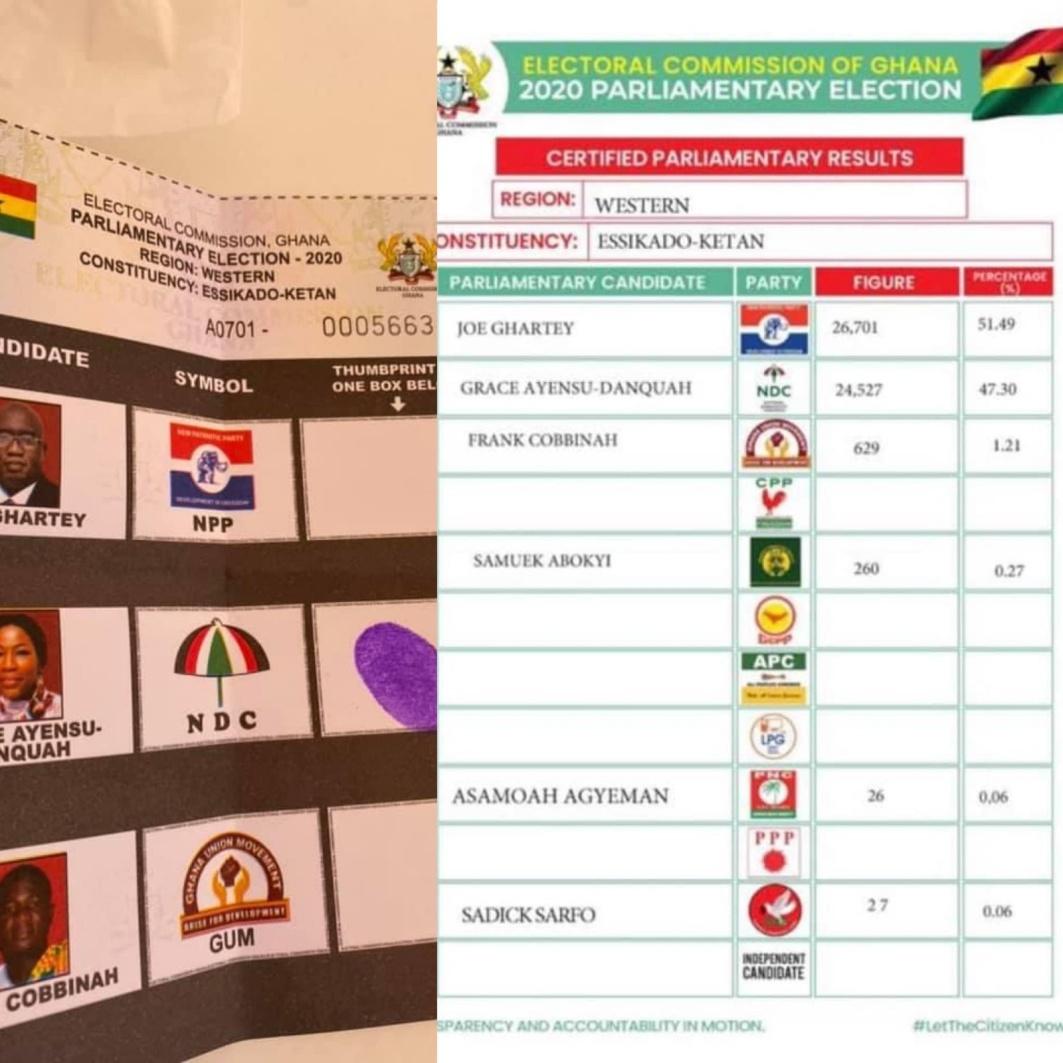
    Pro-NDC groups claim only three persons contested for the Essikado-Ketan parliamentary elections but the Electoral Commission announced results for six candidates. 

    Although three persons contested in the elections, the EC published an artwork on its website with the result of six candidates. It, however, deleted it later and uploaded a different one.  

    Full text

    The Electoral Commission (EC) has come under criticism from a section of the public following official declaration of the 2020 election results. 

    Most of the criticisms have been about how the Commission has not been able to effectively undertake its clerical functions for the purposes of updating the public. 

    There is record of the Commission revising earlier election result announcements

    The most recent one has been about the release of an artwork announcing the result of the Essikado-Ketan parliamentary elections. 

    Many pro-opposition Facebook groups including NDC TV and some commentators are sharing images to claim that the Commission published results for six parliamentary candidates for the Essikado-Ketan seat when in fact, only three people contested for the seat. 

    Their claim is to make the case that the Commission’s data or declared results cannot be trusted.

    C:\Users\Jonas\Desktop\227bf0aa-825e-4900-8cdb-d68d067173b6.jpg

    Verification 

    A notice of poll, sourced from the Essikado-Ketan constituency in the Western Region, confirmed that the only three candidates contested in the elections. 

    The candidates were; 

    CANDIDATESPOLITICAL PARTY
    Joe GharteyNPP
    Dr. Grace Ayensu DanquahNDC
    Frank CobbinahGUM
    C:\Users\Jonas\Desktop\a5cd11bb-79c6-4a93-afee-a380e96c0f14.jpg

    Media reports such as one reported by Citi News also accounted for only three candidates in that election. 

    Further checks, using the serial number A0701 on the sample ballot paper shared by the claimants to make their case confirms that, the ballot paper shown is the actual ballot paper used on the day of voting in the Essikado-Ketan constituency. 

    Did the EC make any publication of six candidates?

    Scanning through the Electoral Commission’s website, we found that it had uploaded several of the parliamentary results on Thursday, December 11, 2020. 

    The results included Essikado-Ketan. However, unlike the image being shared on social media by the claimants, the document featured the actual three candidates who contested for that seat. 

    Did the claimants ‘photoshop’ their copy of the results sheet? 

    With the possibility that the EC uploaded and later deleted the document being shared by the claimants, we conducted a search in the webpage’s source code and discovered that within the chain of other results uploaded on Thursday, one file had been removed after it was uploaded. 

    C:\Users\Jonas\Desktop\Capture1.JPG

    That file is the one being shared by the claimants, confirming that indeed, the Electoral Commission uploaded that copy as parliamentary results for Essikado-Ketan but later deleted it. 

    Conclusion

    The Electoral Commission indeed shared an Essikado-Ketan parliamentary results document with results for six supposed candidates although only three people contested in that election. It, however, deleted it later and replaced it. 

  • ANALYSIS: Ghana’s presidential election results declared with significant errors

    Following what some international and local election observers say was a successful holding of Ghana’s 2020 presidential and parliamentary elections, the Electoral Commission declared the official presidential results on Wednesday, December 9, 2020, at its headquarters in Accra. The verdict was declared without results from the Techiman South Constituency which Mensa explained was under contention.

    Chairperson of the Commission, Jean Mensa, declared Nana Addo Dankwa Akufo-Addo, the incumbent president, as the winner of the keenly contested polls.

    His closest contender and former president, John Mahama, who contested on the ticket of the National Democratic Congress (NDC) came second. 

    “At the end of a transparent, fair, orderly and timely and peaceful presidential election, the total number of valid votes cast was 13,434,574, representing 79 per cent of the total registered voters. Permit me to present the result in the order of appearance on the 2020 presidential ballot.” 

    “At the end of the polls, Nana Addo Dankwa Akufo-Addo of the New Patriotic Party obtained 6,730,413 votes, being 51.595% of the total valid votes cast. John Dramani Mahama of the National Democratic Congress obtained 6,214,889 votes being 47.366 of the total valid votes cast,” she said. 

    A document from the EC shared with journalists who covered the declaration however stated different figures for votes won by each candidate. 

    C:\Users\Jonas\Desktop\dc537a76-ab4c-48ec-ab68-bf7a860e491e.jpg

    Data twist? 

    Following that declaration, however, we found some discrepancies that have been highlighted below:

    1. Madam Jean Mensa’s spoken declaration stated 13,434,574 as the total valid votes cast while the one captured on the EC’s official document was 13,121,111

    2. Madam Jean Mensa declared that Akufo-Addo got 51.595% of the total valid votes cast while the official EC document captured 51.295%

    3. The EC’s official artwork shared on its Facebook page to announce Akufo-Addo’s victory also stated 51.295%

    C:\Users\Jonas\Desktop\EC artwork.jpg

    This caught our attention because the 0.30% difference carries a significant number of votes, over 39,400

    What percentage exactly did Akufo-Addo get?

    Calculating for the actual percentage won involves dividing the total number of valid votes cast in favour of Akufo-Addo by the total number of valid votes cast and multiplying the result by 100.

    Votes in favour of Akufo-Addo/ Total number of valid votes       × 100%

    With two different “official” number of valid votes cast in the 2020 polls; these are the percentage votes Akufo-Addo would have won.

    CandidateUsing 13,434,574Using 13,121,111
    Nana Akufo-Addo50.0977%51.2945%
    John Mahama46.260%47.3655%

    More Data Twist?

    The Electoral Commission on Thursday, December 10, 2020, released a press statement in which it revised the total number of valid votes cast from the 13,434,574 “inadvertently used” to 13,119,460.

    “The Chairperson of the Electoral Commission inadvertently used 13,433,573 as the valid votes cast. The total valid votes cast is 13,119,460,” the statement said.  

    C:\Users\Jonas\Desktop\Eo3IYpiXUAILVyU.jpg
    Source: Electoral Commission of Ghana

    The statement also came with reviewed actual figures for the number of votes obtained by each candidate. 

    Below are the major differences we’ve seen.

    Table 1: Results Declared By EC Chairperson on December 9 VS Results on EC Document Given to Journalists After Result Declaration

    CandidateResults declared by Jean Mensa(Valid votes- 13,434,574)Percentage (%)Results captured on EC’s document(Valid votes 13,121,111)Percentage (%)
    Nana Akufo-Addo6,730,41350.09776,730,41351.2945
    John Mahama6,214,88946.26046,214,88947.3656
    Christian Kwabena Andrews105,5650.78577105,5650.80454
    Ivor Greenstreet12,2150.0909212,2150.09309
    Akua Donkor5,5750.04155,5750.04249
    Henry Herbert Lartey3,5740.02663,5740.02724
    Hassan Ayariga7,1400.053157,1400.05442
    Kofi Akpaloo7,6900.057247,6900.05861
    David Apasera10,8870.0810410,8870.08297
    Brigitte Dzogbenuku68480.0509768480.05219
    Nana Konadu Agyeman Rawlings6,6120.049226,6120.05039
    Asiedu Walker9,7030.072229,7030.07395
    13,434,57413,121,111

    Table 2: Difference Between Reviewed Results Provided In EC Press Release on Thursday, December 10, 2020, And EC Document To Journalists After Wednesday’s Declaration

    CandidateReviewed results (Valid votes 13,119,460)  Percentage (%)Difference between earlier results and reviewed results (Votes)
    Nana Akufo-Addo6,730,58751.30232+174
    John Mahama6,213,18247.35852-1707
    Christian Kwabena Andrews105,5480.804515-17
    Ivor Greenstreet12,2000.092992-15
    Akua Donkor5,5740.042487-1
    Henry Herbert Lartey3,5640.027166-10
    Hassan Ayariga7,1380.054408-2
    Kofi Akpaloo7,6830.058562-7
    David Apasera10,8820.082945-5
    Brigitte Dzogbenuku6,8490.052205+1
    Nana Konadu Agyeman Rawlings6,5490.049918-63
    Asiedu Walker9,7040.073966+1
    13,119,460-1651

    Based on the above information, we find that the EC provided three different pieces of information on Ghana’s presidential election results. 

    The last official information from the EC on the results of Ghana’s presidential elections is Thursday’s press release which said President Akufo-Addo obtained 6,730,587, constituting 51.30232 per cent and John Mahama, 6,213,182, representing 47.35852 per cent of 13,119,460 valid votes cast.

    The results declared by Madam Jean Mensa has already been widely reported in both local and international media including France24, DW and Aljazeera although the EC has announced a revision. 

    Besides the fact that widely publicized erroneous data would mislead the public, it is concerning that such errors will riddle a major election result declaration such as Ghana’s. 

    The Vice President of IMANI Africa, Bright Simons believes that the situation is worrying. 

    He says most of the challenges observed with the country’s elections have been as a result of poor execution of documentation and administrative tasks on the part of the independent election management body. 

    “The problem is quite simply that over the past 10 years the country has spent roughly $200 million in biometric and allied technologies, systems and their maintenance. All this shiny gear does only one thing: stop impersonation. But this is hardly the biggest problem in our elections. As we saw in the 2013 petition and are seeing in the current slew of controversy, the real mess in the elections has always been clerical,” he said. 

    He adds that based on how the EC conducts its administrative work, it is not surprising to him that the EC’s official results have changed a few times. 

    “Apart from the seminal decision to give copies of pink sheets and other tally sheets to parties as a matter of right, we have done little to improve on that whole administrative and logistical process since 1992. It is thus not surprising that tallies for the same polling stations have differed across the political parties, the EC, the media and the observer missions… There certainly are concerns when even the Electoral Commission itself start flip-flopping on basic numbers. Hopefully, we shall not go to sleep on these issues like we did after the last petition.”

  • Election 2020: NDC Rejects Presidential Results

    The National Democratic Congress (NDC) has rejected the results of the 2020 presidential polls, describing the elections as flawed.

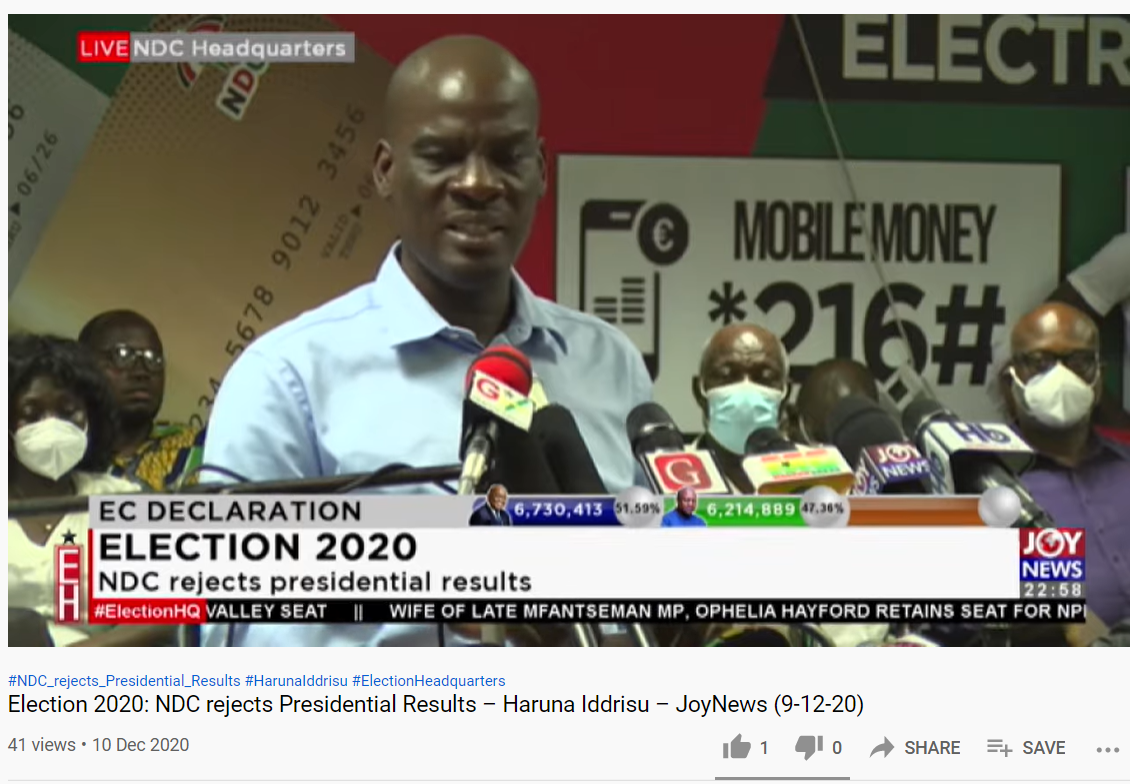
    Haruna Iddrisu, a leading member of the NDC and Member of Parliament for Tamale South constituency, in a press conference held shortly after the declaration of the presidential results by the Electoral Commission, said the party has overwhelming evidence that the presidential election was won by John Dramani Mahama.

    This image has an empty alt attribute; its file name is Qcn0gcF1P5f-CR6qEM4JNvRc1t4RBD6ZBVfI2TdjMcD4oSEiGSbQtDqbT4EKXEiyw2-eer8sMh7WSFEl1PluM7EF-gnusV5GAEZrZ0ELFEmKh8YiPl33JttGV-FH-i0liQG5QW9p
    Image source: Joynews(YouTube)

    “We have come to only one irresistible conclusion, that it is a fraud, discredited election and therefore we reject the presidential result without any reservation,” Iddrisu said.

    He added the party obtained Parliamentary majority and will therefore resist a contrary result.

    “We want to say that it’s a flawed election and therefore we reject it without any reservation, we reject the presidential elections as announced by the Chairperson of the Electoral Commission [Jean Mensa]. And we also want to serve notice that the blatant effort to deny us a parliamentary majority will be fiercely resisted. We know that the good people of Ghana gave us a mandate and that mandate includes a parliamentary majority… Overwhelming evidence available to us makes it difficult for us to accept these results,” he said.

  • EC declares Akufo-Addo as winner of 2020 Ghana presidential elections

    Some 48 hours after polls closed on Monday 7 December 2020, the Chairperson of the Electoral Commission (EC), Jean Mensa, has announced the results of the 2020 presidential elections on Wednesday 9 December 2020. 

    The presidential candidate of the New Patriotic Party (NPP), Nana Addo Dankwa Akuffo-Addo, who garnered 6,730,413 votes representing 51.595%, is president-elect of the Republic of Ghana.

    He was followed closely by the presidential candidate of the National Democratic Congress (NDC), John Dramani Mahama, who had 6,214,889 votes representing 47.366%. 

    Mensa explained results announced did not include results from the Techiman South constituency because they are being contested. She added that the addition of those results would not make a difference in who emerges winner than is currently declared, as the total voter population in the constituency is 128,018.

    Source: MyJoyOnline

  • EC Has Not Yet called the Presidential Elections

    Claim: Social media users and online portals claim their preferred candidates, John Mahama or Nana Akufo-Addo, have been declared winner of the  2020 presidential election.

    False. The country is still waiting for the results of the presidential elections. The Electoral Commission has not declared John Mahama, Nana Akufo-Addo or any other candidate winner of the just concluded election in Ghana. 

    Full Text

    Electorates, following the casting of ballots on December 7th, are awaiting the declaration of the winner of the presidential election. 

    Some online news portals and social media users have declared John Mahama of the NDC as the while others have stated that Nana Akufo Addo has won ahead of the EC’s announcement.

    Verification 

    The institution mandated to call the election, the Electoral Commission (EC), has not declared the presidential results.

    The chairperson of the EC, Mrs. Jean Mensa, gave an update regarding the collation of the 2020 presidential election results citing rain and travel challenges at some polling stations as one of the reasons for the delay. 

  • Mahama has Not Conceded Defeat

    Viral social media messages suggest that John Mahama has conceded to the ruling NPP.

    During an emergency press conference held last night, John Mahama, flagbearer of the opposition National Democratic Congress (NDC) indicated that he has not conceded defeat.

    Full Text 

    As Ghanaians await the Returning Officer Jean Mensah to announce the final result of the presidential elections, social messages claim John Mahama has conceded defeat.

    Verification

    Mahama has denied the rumours. During a press conference held last night, Mahama said:

    “…I want to state categorically and firmly that I have not congratulated any person, and no attempt should be made to steal this election,” Mahama said.

  • False: CNN has not declared NDC winners of the just ended 2020 Ghana Elections

    A Facebook page claims CNN has announced Ghana’s opposition leader winner of the national elections.

    Our checks reveal the full-length video on CNN which was from the 2016 elections and not the just-ended 2020 elections.

    Full Text

    Social media users claim a CNN report indicates the leader of the opposition political party has been declared winners of the just-concluded elections in Ghana.  

    The claim has been shared on Facebook and other platforms

    Source: Facebook

    The picture was again shared by NDC WEB on Facebook claiming yet again that the opposition NDC had been declared the winner. 

    Image source: CrowdTangle (Facebook)

    When trying to access this particular link, it appears as unavailable as seen below.

    Image source: Facebook

    Both posts were flagged by CrowdTangle as overperforming posts, suggesting that there was a huge push of the narrative on the Facebook platform.

    The National Democratic Congress (NDC) is the main opposition political party in the country; its flag bearer is former President John Dramani Mahama.

    Verification

    Dubawa ran a check on the CNN website and found that the video was from the 2016 general elections in Ghana and not the just concluded elections. Watch the full length of the video on CNN

    The claimant used the photo deceptively to announce a premature win for the opposition NDC.

    In 2016, the NPP was in opposition with the NDC serving as the ruling party. The video from CNN was to show that the then opposition NPP had been declared winners in the 2016 general elections.

    The current state of the elections in Ghana

    The Electoral Commission (EC), the mandated institution to call the elections, has not yet declared a winner of the presidential elections. It had announced before the general elections that a winner would be declared within 24 hours of elections. This timeline could however not be met by the EC.

    Source: Twitter(EC)

    Conclusion

    The claim is false. The Electoral Commission has not declared a winner for the just-ended presidential election.

Back to top button