Featured

  • BOG Declined An Invitation to Assist Parliament’s Probe Into the Revocation of Banking Licenses. Here’s what experts have to Say

    The Bank of Ghana, in June this year, made headlines after it announced that it will not honour an invitation from Parliament to assist with investigations into the revocation of the banking licences of Unibank and UT Bank.

    Owners of the two banks had petitioned Parliament to probe the Bank of Ghana and the Ghana Stock Exchange on the revocation of the license of their respective financial institutions during the banking sector clean-up which commenced in 2017.

    The two petitioners are Dr. Kwameba Duffuor, founder of now-defunct UniBank and Mr. Prince Kofi Amoabeng, the former Chief Executive Officer of now-collapsed UT Bank.

    In their separate petitions, they asked Parliament to direct the Bank of Ghana to restore their banking licenses and “the remedying of the harms done to the shareholders’ property rights as a result of the conduct of the Bank of Ghana.”

    Following the petition, the Speaker of Parliament directed the constitution of a seven-member parliament committee to look into the matter.

    This committee is chaired by the First Deputy Speaker and Member of Parliament for Bekwai, Joseph Osei Owusu.

    The remaining six are: Alexander Afenyo- Markin (MP, Effutu), Joe Ghartey (MP, Essikando-Ketan), Patrick Yaw Boamah (MP, Okaikwei Central), Samuel Atta-Akyea (MP, Abuakwa South), James Klutse Avedzi (MP, Ketu North), Hon. Cassiel Ato Forson (MP, Ajumako Enyan Esiam), Isaac Adongo (MP, Bolagtanga Central) and Elizabeth Ofosu-Adjare (MP, Techiman North).

    Subsequently, the apex bank was invited to assist with investigation into the matter.

    But the Central Bank, in responding through its lawyers, Bentsi-Enchill Letsa and Ankomah, said that the actions of the two former bank owners were contrary to some sections of the Bank of Ghana Act, 2002.

    Regulation of the Banking Sector

    There are two legislation that regulate banking and other related financial activities in the country.

    These are:

    1. Bank of Ghana Act, 2002 (Act 612) as amended by Bank of Ghana (Amendment) Act, 2016 (Act 918) – providing the powers and role of the Bank of Ghana

    2. Banks and Specialized Deposit-Taking Institutions Act, 2016 (Act 930) – the primary legislation for banking and other specialized deposit-taking business

    The bank on Ghana, per its letter, referred to some provisions in two of out of the five Acts; Banks and Specialised Deposit-Taking Institutions Act, 2016 (Act 930) and the Bank of Ghana Act, 2002 (Act 612)

    It questioned the petitioners’ decision to use the legislative arm to resolve their grievances whilst the BSDTI Act had prescribed what should be done in cases of conflicts.

    “The BSDTI Act provides how persons who are aggrieved with such decisions may seek redress for their grievances, and the prescribed resolution mechanisms do not include recourse to Parliament,” part of the statement from the apex bank reads.

    Sections 140, 141, and 142 of the Banks and Specialized Deposit-Taking Institutions Act, 2016 (Act 930) prescribes the actions that one can take when it wants the apex bank to review a decision.

    Source: BSDTI Act

    What does Section 140,141,142 of the BSDI 2016, Act 930 say

    Source: BSDTI Act

    The Bank of Ghana also said that petitioners, in seeking to get parliament to influence its decision, were acting in contravention of Section 3(2) and section 4(1A) of the Bank of Ghana Act, 2002.

     Section 3 and Section 4 of the Bank of Ghana Act, 2002, deals with the “objects of the Central Bank” and the “Functions of the Central Bank” respectively.

    Section 3(2) 

    Source: Bank of Ghana Act, 2002 (Act 612)

    Section 4(1A)

    Perspectives On BOG’s Response to Parliament

    The response from the Central Bank has triggered public discussion on whether or not the Central Bank was right in its decision.

    Banking Consultant, Dr. Richmond Atuahene, in an interview on Accra-based Joy FM, asserted that the Bank of Ghana was right in its decision.

    He said that it was also wrong on the part of Parliament to summon the central bank on a matter that was already before court.

    Economist, Dr. John Gatsi does not agree with this. 

    He said in an interview with the Ghana New Agency that the Bank of Ghana was accountable to Ghanaians through parliament since it was set up and bound by the constitution. 

    Senior Vice President of IMANI Africa, a policy think-tank, Kofi Bentil, has also criticized the Bank of Ghana’s (BoG) refusal to submit to Parliament’s investigations into the circumstances leading to the revocation of the licenses of uniBank and UT Bank.

    Can this be pursued in court?

    Law lecturer at the University Of Ghana School Of Law, Mr. Kenneth N.O. Ghartey also helps with the question on whether the Bank of Ghana is justified in refusing to honour parliament’s invitation and if it can be pursued in court.

     “As to whether parliament has power to invite the Bank of Ghana, from the nature of the constitutional creation of the Bank of Ghana, I do not see how the Bank of Ghana thinks that parliament cannot invite it to appear before a committee if it so requires. There are even other responsibilities under the constitution in which the Bank of Ghana is required to appear before parliament,” he told Dubawa Ghana.

    “It’s a tricky matter. It has come up for the first time and the position is not clear as to what the law will really take but personally, there is nothing within the constitution that prevents parliament from calling upon the Bank of Ghana to answer questions on public interest,” he added.

    Mr. Ghartey said that the Central Bank “is subject to the laws of Ghana and parliament has wide oversight responsibility over the arms of the executive including the Bank of Ghana which is effectively controlled by the executive”

    When asked whether the matter could be pursued in court for clarity, he said that parliament should rather be the first point of call as they gave the Bank of Ghana their framework within which it should operate.

    “I don’t know if it’s important that we go to the court to clarify this matter. Parliament itself in 2016 passed an amendment act, the Bank of Ghana (Amendment) 2016, Act 918, and within that amendment act, parliament says that except as provided by the constitution, the Bank of Ghana is not subject to the directive or control of anyone…so effectively, I don’t think that a court is needed to clarify this matter,” he said.

    “It is parliament that gave the Bank of Ghana that power,” he insists.

    “Within the constitution itself, it does not appear that Bank of Ghana has a broad constitutional independence but it is parliament that has given it that power so perhaps a court might then be able to weigh it out but for me, it seems to say that the only way to remove this position that Bank of Ghana has set for itself is for parliament to amend its own law and the power it gave to the Bank of Ghana,” he adds.

    “The Bank of Ghana is provided constitutional responsibility under Article 183 to be “the Central Bank of Ghana” with responsibility to “issue the currency of Ghana,” Mr. Ghartey concluded.

    Parliament, at the time of this report, had only acknowledged the receipt of the response from the Bank of Ghana and said that it will consider it.

    Conclusion

    The matter is indeed delicate. Bank of Ghana’s refusal to appear before a parliamentary committee to assist in investigations is based on legislation that regulates banking and other related financial activities in the country. While some may be unsatisfied with the Central Bank’s position, there may be a need for Parliament to amend these Acts that the Bank of Ghana is basing its stance on.

    This report was produced under the Dubawa Student Fact-checking Project aimed at offering students in tertiary schools aspiring to take up roles in the profession the opportunity to acquire real-world experience through verification and fact-checking

  • Fact Sheet: The June 24 flooding in Kumasi: Deaths, Destruction And Displacement

    The torrential downpour witnessed in Kumasi and other parts of the Ashanti Region, last Thursday, June 24, 2021, resulted in massive flooding of some areas of the city displacing many residents.

    The development, a perennial occurrence, has so far also led to the deaths of a total of six people including an infant, according to the Ashanti Regional office of the National Disaster Management Organisation (NADMO).

    The deceased persons include three young girls, according to myjoyonline.com. Two of the girls, who were siblings aged 8 and 2 years, were swept away by floodwaters at Asuoyeboa, a suburb of Kumasi, after River Abonsua, which had overflowed its banks, entered their residence, it was reported.

    Meanwhile properties worth millions of Ghana cedis including buildings, roads, market wears, household items were also destroyed due to the heavy rainfall.

    Chief Executive of KMA inspecting some of the dame caused by the flooding in one of the communities

    Some Key Facts To Note

    1. Wednesday, June 23 

    Rainfall amount recorded: 55.9 mm

    Duration of the rainfall: 5 hours 

    2.  Thursday, June 24

    Rainfall amount recorded: 108.38 mm

    Duration of the rainfall: 3 hours 6 minutes  

    3.         Total Number of deaths reported so far is 6

    4.          Assessment by NADMO still ongoing

    5           Ghana National Fire Service has desilted major drainage around the new Kejetia Market

    6.           Housing Minister orders 300 structures on watercourses to be pulled down

    What Caused The Flood?

    Data provided by the Ghana Meteorological Service Department in Kumasi shows that the three hours and six minutes downpour measured up to 108.38 millimetres. This amount of rainfall recorded has been described as unprecedented within the last 10 years in the region. 

    The District Meteorological Officer, Kwame Ofori-Agyemeng, explained that before the widespread flooding on Thursday, a rainfall amount of 55.9 millimetres was recorded the previous day, Wednesday, June 23. This is one of the two key factors that led to the flooding. 

    According to him, June is the peak of the rainy season and during this time the water table in the earth crust rises due to predominant rains. 

    A newly constructed bridge partly washed away

    As a result of that, any significant amount of rainfall that the earth soaks will be saturated enough for the earth to gradually assimilate or drain before the rain on the surface can settle.  

    However, it is important to highlight that the amount of rainfall recorded on the day the flooding occurred was very huge, and has not been recorded for the past 15 years according to data available for Kumasi rainfall. 

    The intensity of the rainfall within that short period of time is quite notable. 

    “So, from the previous day’s rainfall which shows that  the earth surface had already soaked some significant amount of rainwater, there was a likelihood of flood, as was the case,” said Ofori-Agyemeng.

    Ofori-Agyemeng was clear that anthropogenic activities (human activities) further aggravated the flooding. The indiscriminate disposal of refuse, particularly plastics, building in waterways among others affected the ability of the rain water to find its way to join water bodies.

    He proposed the construction of storm drains as well as properly structured bridges, where necessary, to significantly address the annual floods witnessed in the country.

    The Aftermath of the Flood: Response of government and other agencies

    According to NADMO, assessment of the flooding incident is still ongoing but they confirmed that a total of six people have died as a result of the flooding last Thursday.

    The Deputy Ashanti Regional Deputy Director of NADMO, Ernest Yaw Amoah, disclosed that most parts of the region were affected while attributing one the possible causes of the flooding to building in waterways.

    Meanwhile, the Ghana National Fire Service who intervened in several near-fatal situations during the floods have worked to desilt major drainage around the newly developed Kejetia Market which also flooded.

    Personnel from the Fire Service with the assistance of some persons removed tree storms from the main drainage system of the market. According to the Daily Graphic, some city authorities pointed to the tree storms as the cause of the flooding of the Kejetia Market.

    A bridge in one of the communities choked with plastics after the flooding

    The Kumasi Metropolitan Assembly (KMA) has, however, said they are waiting for a report from NADMO and the Town and Country Planning Department of the Assembly to inform their next line of action.

    The Public Relations Officer of KMA, Henrietta Afia Konadu, however, noted that initial assessment of the flooding situation pointed to human causes. However, she maintained that it will require collaborative work between the affected Metropolitan, Municipal and District Assemblies (MMDA’s) to effectively tackle the annual flooding witnessed in the Region.

    KMA fears the current situation is likely to affect revenue collection but the loss could only be realised at the end of the financial year. 

    The Minister of Works and Housing, Mr Francis Asenso-Boakye, has asked city authorities to pull down over 300 structures which are identified to be on watercourses.

    It is believed that this would help avert further flooding in the future, with the onset of the rainy season.

    “Mr Asenso-Boakye gave the advice last Monday when he visited some areas in Kumasi that were affected by the heavy rains recorded last week and which left two people dead in the metropolis and rendered many others homeless.”

    According to Mr Asenso-Boakye, managing flood was not the responsibility of only the Ministry but also the MMDAs, as well as their chief executives, who had been mandated to manage flood at the local level and help solve the perennial floods across the country.

    City officials inspecting some of the damage caused by the flooding

    The researcher produced this article per the Dubawa 2021 Kwame KariKari Fellowship partnership with ThebftOnline Tribune to facilitate the ethos of “truth” in journalism and enhance media literacy in the country.

  • No, ‘Breast Sucking’ Does NOT Cause Cancer!

    Claim: According to a 2017 report in The Chronicle Newspaper which has resurfaced on social media, sucking a woman’s breast can cause breast cancer.

    According to health experts, there is no known cause of breast cancer; therefore sucking a woman’s breasts cannot be linked to the development of cancer. 

    Full Text

    A 2017 publication by The Chronicle newspaper has resurfaced and is making rounds on social media suggesting that a woman can get breast cancer if her partner sucks it.

    Image source: WhatsApp

    The image was also shared  on Twitter in November 2017 and recently by Johnnie Hughes, broadcast Journalist at TV3, on May 15th 2021.

    Verification

    According to the report which was published by the Chronicle newspaper in 2017, the claim that breast sucking causes cancer was made by Madam Adwoa Afriyie Benuako, the Head of Education at Breast Care International. 

    “The breast is a delicate part of the woman’s body, which must be treated and handled with care and caution. It is so fragile that when sucked and pressed, it endangers the organ,” Benuako is quoted by the newspaper to have said.

    The report continues, without quoting Benuako, “…argued that most of the breast cancer diseases worldwide, according to available research, are attributable to the sucking of the victims breasts by their husbands and fiances.”

    Source: The Chronicle Newspaper

    However, Benuako told Dubawa she did not make the claim as reported by the newspaper. 

    “He interviewed me alright and I gave him an audience but he reported what he wanted to report. So that is why we are saying that not all information being put out is true. This information they have tagged my name on is false….Because of this, the paper was sold like it was an essential commodity, ” Benuako said. 

    She added that it is not true that breast sucking can cause cancer.

    “As of now, we can’t point to anything as a cause of breast cancer and researchers are still working on it and to point out that breast sucking is a cause of breast cancer, it’s not true. People are just making up their own stories,” Benuako said.

    Dubawa also contacted Dr. Bismark Dwobeng, a Radiation Oncologist at Komfo Anokye Teaching Hospital to find out more on the matter. According to Dr. Dwobeng, sucking a woman’s breast will not result in breast cancer.

    “It’s not true. In the first place, it’s impossible to talk about a cause for any cancer.”

    Dubawa probed further to find out if any type of nipple play, rough or otherwise which may involve biting or intense sucking, could result in cancer but the answer was a firm ‘no’. 

    The Connecticut Department of Health in their “Breast Health, Breast Cancer Risk Factors and Symptoms, Breast Cancer Screening, and Resources” report have similarly stated that “bumping, bruising, pinching, or touching the breast does not cause breast cancer.”

    Additionally, it states that medical experts do not know exactly what causes breast cancer but have however identified age, family history, personal history of cancer, race and ethnicity, not having children and hormone replacement therapy as risk factors for breast cancer development in women.

    Conclusion

    Sucking or playing with a woman’s breast will not cause breast cancer.

  • False; COVID-19 jabs not causing magnetic effects in the arm

    Claim: Social media posts suggest magnets are sticking to the jab area on peoples arms because there are magnetic elements in the Covid-19 vaccines.

    Senior medical officials have dispelled these assertions.

    Full Text

    Videos and photos circulating on various social media platforms are suggesting that magnets and metals have been found to stick to the arm, particularly at the area the Covid-19 jab is administered, after taking a dose of the coronavirus vaccine.

    The videos and photos claiming this has been posted across various social media platforms including Twitter, Facebook, TikTok, and Instagram.

    Social media users are using the hashtag, #MagnetChallenge as tags on these posts.

    A Ghanaian has also joined in making these claims. 

    In a video, the man, appearing in a police uniform, made an exhibition to back the claims.

    Image: The unidentified Ghanaian man claiming that he could stick a phone to the arm after taking the jab.

    Verification

    For there to be a magnetic attraction, there must be magnetic elements in the area where there is the attraction.

    Since these persons linked the supposed magnetic attraction to the Covid-19 jab, we checked the composition of some of the vaccines, including Sputnik V and Astrazeneca, which are being administered in Ghana, to ascertain if they have magnetic properties.

    Composition of Pfizer

    Producers of the Pfizer-Biontech Covid-19 vaccine have listed MRNA, lipids, potassium chloride, monobasic potassium phosphate, sodium chloride, dibasic sodium phosphate dihydrate, and sucrose as its ingredients.

    Composition of Sputnik V

    The ingredients in this vaccine include Tris-(hydroxymethyl)-aminomethane, Sodium chloride, Sucrose, Magnesium chloride hexahydrate, Disodium EDTA dihydrate, Polysorbate 80, Ethanol, and Water.

    Composition of Astrazeneca

    The Astrazeneca Vaccine is made from a modified adenovirus which causes the common cold in chimpanzees. This virus has been modified so that it cannot cause an infection. It is used to deliver the genetic code for the coronavirus spike protein. The vaccine also contains inactive ingredients such as polysorbate 80, an emulsifier, and a very small amount of alcohol (0.002mg per dose). The vaccine also contains traces of magnesium (3 to 20 parts per million).

    Investigation in the composition of these elements show that they do not contain metals that could, in any way, be magnetic.

    Furthermore, Eric C. Palmer of the National High Magnetic Field Laboratory, Florida State University, says that no significant quantity of magnet to cause a magnetic effect can be injected into the arm considering the size of the needle used in the vaccination. 

    “The vaccine needles are extremely small, a fraction of a millimetre in size. So even if you inject an extremely magnetic particle, it would be so small in size that there wouldn’t be enough force on it to actually keep a magnet stuck to your skin,” he told the BBC in an interview.

    Ghana’s Presidential advisor on health, Dr. Anthony Nsiah-Asare, says that these claims are being peddled by persons of the anti-vaccine movement and has urged the public to ignore such claims.

    He stressed that the vaccines that are being administered are safe for the public.

    “There is no iota of truth in what they are saying. It is a complete hoax. There is nothing that you can have a metal attached to your hand unless you have implanted a magnet inside there. The bone, muscle, blood vessels, skin and subskin do not have magnetic properties so it beats my imagination,” he told Dubawa Ghana.  

    The Director of the West Africa Centre for Cell Biology of Infectious Pathogens (WACCBIP) at the University of Ghana, Gordon A. Awandare has described these claims as a hoax.

    He says that people making such assertions are doing so with the motive of discouraging others from taking the jab.

    “These are pranks that people are playing. There is nothing like that. I have taken the vaccine and there is nothing wrong. People should ignore these videos and shouldn’t even give them the attention they are getting. This is a total hoax, there is nothing like that. These are people who are anti-vaccine people and they just do propaganda to discourage people from taking the vaccine so you should not even tolerate this kind of mischief,” he said in an interview with Dubawa Ghana.

    Conclusion

    It is not true that the coronavirus jab is causing magnetic effects in the arm. It has not been proven scientifically that a medical condition can cause such an effect, unless there is a magnetic implantation in that part of the body.

    This report was produced under the Dubawa Student Fact-checking Project aimed at offering students in tertiary schools aspiring to take up roles in the profession the opportunity to acquire real-world experience through verification and fact-checking. 

  • Dubawa Ghana’s recent fact-checking engagements

    It has been well over a month since we last let our readers in on our engagements, but we are back to give you a peek into some projects we were involved with while we were away. As duty demands, we have persisted with the fight against misinformation and have increased our capacity and reach – extending this duty to potential and current journalists in Ghana and across the West-African sub-region, by providing them with hands-on training on fact-checking, and equipping them with the necessary skills and tools for it. 

    In the past month, Dubawa Ghana has facilitated two major fact-checking projects – the Campus fact-checking project and the Kwame Karikari fact-checking and research fellowship – and both projects are underway.

    The maiden Campus fact-checking project launched with a three-day training workshop for 20 journalism and liberal arts students across seven tertiary institutions in Ghana. The project is inspired by the need to address some of the ethical lapses identified in journalism practice by offering students in tertiary schools aspiring to take up roles in the ecosystem the opportunity to acquire real-world experience in the journalism profession through verification and fact-checking.

    As they readily demonstrated during the training, the students have an unflinching committedness and enthusiasm to counter misinformation and amplify truth and are deliberating on other ways to promote the culture of fact-checking on their campuses. 

    Dubawa Ghana team and the maiden cohort of the Campus Fact-Checking project

    Similarly, the 2021 Kwame Karikari Fact-checking and Research fellowship has commenced with 26 fact-checking fellows and 17 researchers and post-doctoral fellows from Nigeria, Ghana, Sierra Leone, the Gambia and Liberia after a two-week long in-person and virtual training programme

    Named after Professor Kwame Karikari, redoubtable media freedom advocate and founder and former executive director of the Media Foundation for West Africa (MFWA), the Fellowship is also inspired by the need to tackle and curb the rapid spread of mis- and dis-information and further expand the art and reach of verified and accurate information to rural and urban societies, to institutionalize a culture of fact-checking across the globe, and to build knowledge around the menace of information disorder in Africa.

    The Dubawa team and some fact-checking fellows 

    Latest Fact-checks

    President Akufo Addo fact-checked on Ghana’s corruption ranking claim

    Ghana’s president, Akufo-Addo in an interview with CNN’s Zain Asher, stated that since his party took over government, Ghana’s corruption ranking in the world has, in his words  “gone up several notches”. However, according to the Corruption Perception Index (the world’s most trusted metric for assessing perceived levels of public sector corruption) report published between 2012 and 2020, Ghana has not risen significantly in terms of perceptions of lower corruption. 

    This viral image is not of 100km Ghana/Burkina Faso railway line

    A viral image of a railway line has circulated on Facebook with captions purporting that it is the 100km railway project linking Ghana to Burkina Faso, which the Government of Ghana through the Ministry of Railway Development announced in 2019 to have secured a loan to construct. However, this claim was found to be false. 

    Fact-check: Ghana is not the second largest producer of cassava in Africa

    News reports, which have since been updated, stated that “Ghana is the second largest producer of cassava in Africa – a claim made by Banda Abdallah Khalifah, the Head of Trade in Services and Manufactures at the Ghana Export Promotion Authority, during a conference on financial and technological support for processing cassava in Kumasi in May 2021.  However, Dubawa found that instead, Ghana is currently the third largest producer not the second. This was confirmed by the claimant in our conversation with him as he further clarified that the claim was based on data from 2017 and 2018. 

    Viral image purported to be Accra-Kumasi highway false

    A Facebook user has claimed that the construction and completion of the Accra-Kumasi highway by the Akufo-Addo government. However, findings reveal that the photo making the claim showing the completed roadwork is a highway in Brazil, not Ghana.

    More fact-checks here

    1. Did the president of the World Bank tell the Akufo-Addo government to stop borrowing and fix the country? 
    2. Viral video suggesting kidnapped Ghanaian children have been found in Benin is false 
    3. Fact-check: Accra has not recorded a cholera case since 2017
    4. Fact-check: Yet to be completed Volivo bridge project not a Mahama-legacy
    5. False, celebrities have not endorsed a money investing scheme suggesting 100 return in 15 minutes
    6. The Epic 99:1 India-Ghana football match that never was
    7. Chicago teen did not sleep with bullies mothers to assert dominance
    8. A John Mahama or Akufo Addo legacy: The facts about the Tema-Akosombo railway line project
    9. False: R Kelly has not been released from prison
    10. Ayarigas claims on Akufo Addo receiving malaria-vaccination instead of Covid-19 vaccination & others false
    11. All you need to know about Ho-Fume road project
    12. False, Ghana did not place 6th in the 2021 most corrupt countries ranking
    13. Insufficient evidence to back viral video of Burkinabes illegally migrating to Ghana
    14. Doctor of Medical Laboratory Science (ML.S.D)  programme offered at the UDS is accredited by the National Accreditation Board

    Explainers and Media Literacy Articles 

    1. World Malaria Day: Nearly 750 children under age 5 die of malaria daily 
    2. Covid-19: Thinking of getting vaccinated? Here are a few things to know 
    3. Pokuase Interchange: Settling the Akufo-Addo-John Mahama legacy confusion
    4. How many trucks did President Akufo-Addo really unveil?
    5. Covid-19 Vaccination: Timing, number of doses required for full protection  
    6. World Day against Child Labour: Progress against child labour stalls for the first time in two decades
    7. Five key facts you need to know about the right to information law in Ghana
    8. Is the IGP’s directive to the Association of Bankers to provide fortified armoured vehicles for carting currencies by the close of June 2021 feasible

    Tip of The Week

    Join us! Send Us Claims. 

    Share our fact-checks. 

    Help people access quality information.

    Get In Touch

    Engage with us and our work. For feedback, suggestions, and claims you want fact-checked, feel free to contact us. 

    Website: ghana.dubawa.org

    Twitter: @dubawaGH

    Facebook: Dubawa

    Whatsapp: +233 542 818 189

    Instagram: @Dubawa_Official

    YouTube: Dubawa

  • Viral image purported to be Accra-Kumasi highway false

    Claim: A Facebook user claims a highway in a photo is the Accra – Kumasi highway in Ghana.

    Findings reveal that it is not the Accra- Kumasi highway but a highway in Brazil.

    Full Story

    The Akufo-Addo administration in its quest to address the poor road networks in major parts of the country declared this year as the Year of Roads.

    As such, there has been high anticipation and look out for road constructions the government is undertaking. 

    But a Facebook user, John Kwadwo Stephens, has shared a post that purportedly shows the construction and the completed stage of a highway as a part of the fleet of roads constructed by the government. 

    In the post, he said “Kumasi-Accra road! Akufo Addo is doing well, I know the enemies of progress will come and be ranting here”

    Image source: Facebook

    Many Facebook users have questioned whether the supposed photograph is that of the Accra-Kumasi highway.

    The photo has been used by pressreader.com and rhodesiatimes.com where it was said to be a highway in Zambia. Other extensive discussions on the road’s origin being Zambia was also held on the Facebook page, Patriotic Front Zambia where users claimed it was the Lusaka-Ndola dual carriage highway.

    Dubawa therefore set out to determine the veracity and origin of the image. 

    Verification

    After conducting a Google reverse image search, Dubawa traced the origin of the photo to Flickr, an American image and video hosting online community where the image taken on February 28, 2015, was credited to a Brazilian, Edson Lopes Jnr, a photo and videographer.

    Dubawa also found a licensed version of the photo under Wikimedia Commons. This copy of the image provided a clearer view, which enabled us to establish that the image in question was taken in South America. 

    The signage seen on the right side of the photo reads “retorno”, and we found that retorno is a municipality and town of El Retorno in the Guaviare Department of Colombia.

    Additionally, our search revealed that the photo was taken during the announcement of works done on the Rodovia Cezário José de Castilho highway (SP-321) in the São Paulo state of the Baura region in Brazil.

    More evidently, prior to the announcement we found a news report dated 2013 by Globo, a Brazilian online news portal where commuters staged a protest calling on the authorities to expand the one lane highway due to the enormous road accidents it has recorded. 

    Other organizations including Brazilian fact checking website Lupa and Comprova have verified the photo and affirmed the highway is that of Rodovia Cezário José de Castilho (SP-321) highway in Brazil.

    According to the sites, the photo of the road still under construction can be found in the Tineye reverse search tool, which records that this image was present on the São Paulo government website in September 2014. But it no longer appears on the website .

    Furthermore, the number plates seen in the photo are clear indications that this image was not taken in Ghana.

    Checks from the Ministry of Roads and Highways website did not affirm the picture as purported in the claim. In addition, no major news organization has reported on the commissioning of this claimed highway.

    A basic online search for pictures of the Accra to Kumasi highway did not also confirm the picture. 

    Conclusion

    The findings reveal that the alleged image of a highway is not the Accra- Kumasi highway in Ghana. 

  • Is the IGP’s directive to the Association of Bankers to provide fortified armoured vehicles for carting currencies by the close of June 2021 feasible?

    On 14th June 2021, some unidentified armed men attacked and robbed a bullion van at Adedenkpo, a suburb of James Town in Accra. The gang shot and killed a policeman, General Constable Emmanuel Osei, aboard the van as well as a 35-year-old woman, Efua Badu, who is alleged to have tried raising an alarm on seeing the men in action. The driver of the van was also shot but survived.

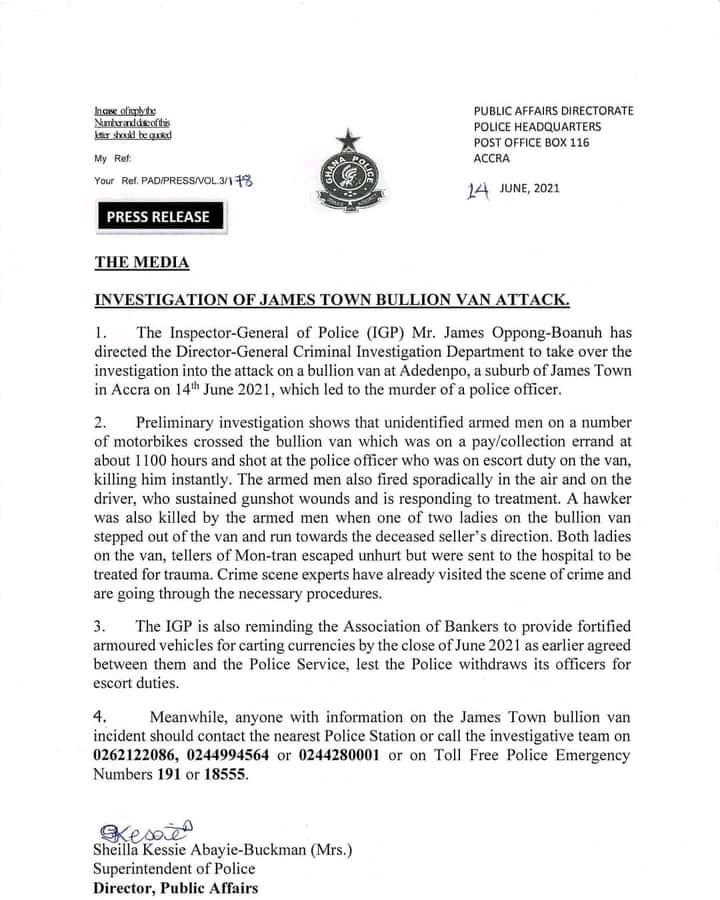
    Following the incident, the Inspector-General of Police (IGP), Mr James Oppong-Boanuh, directed the Director-General of the Criminal Investigation Department to take over the investigations into the attack. Per a statement signed by the Director of Public Affairs of the Ghana Police Service, Superintendent Sheilla Kessie Abayie-Buckman (Mrs), on 14th June, 2021, the IGP equally reminded “the Association of Bankers to provide fortified armoured vehicles for carting currencies by the close of June 2021 as earlier agreed between them and the Police Service, lest, the Police Service withdraws its officers for escort duties”.

    IMG-20210616-WA0079.jpg
    Figure 1 Police Statement giving ultimatum to Association of Bankers

    2020 BoG Directive

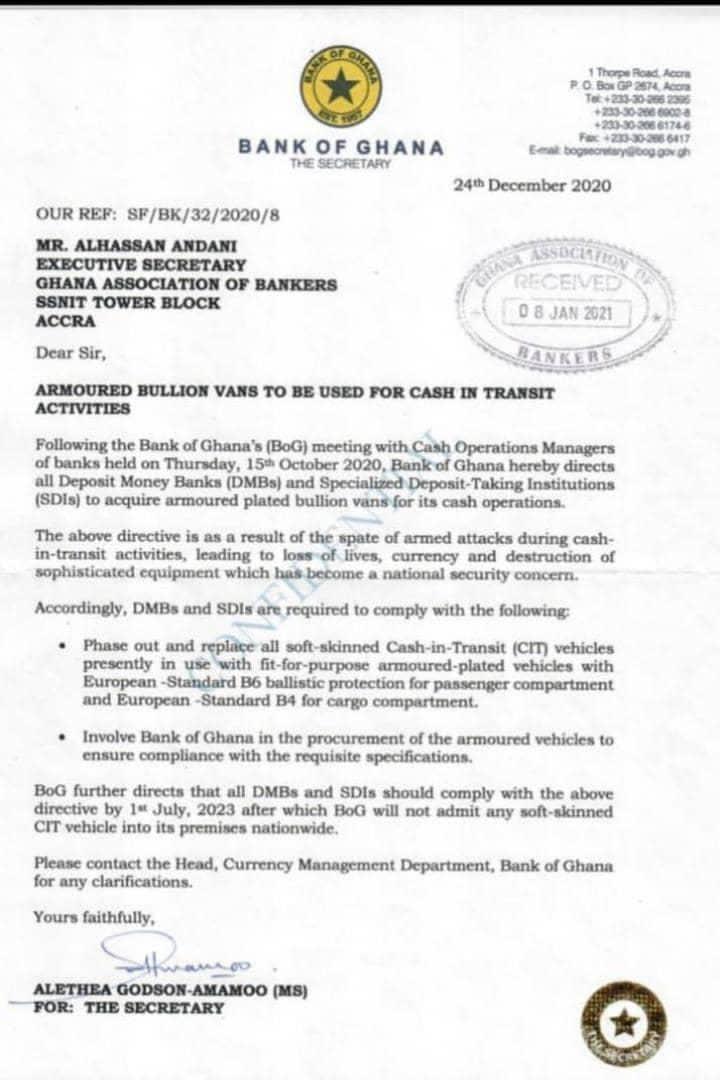
    Meanwhile, the Bank of Ghana (BoG) on 24th December, 2020, had written to the Executive Secretary of Association of Bankers (Alhassan Andani) giving a directive on the need for “armoured bullion vans to be used for cash in transit activities”.

    In that correspondence, the BoG recalled a meeting it held with Cash Operations Managers of banks on Thursday, 15th October 2020, and directed that all Deposit Money Banks (DMBs) and Specialized Deposit-Taking Institutions (SDIs) to procure  armoured plated bullion vans for its [their]cash operations. 

    The Central Bank (BoG) was clear that its directive was occasioned by the spate of armed attacks during cash-in-transit (CIT) activities, leading to loss of lives, currency and destruction of sophisticated equipment which had become a national security concern.

    Specifications

    The DMBs and SDIs (banks) were instructed to acquire fit-for-purpose armoured plated vehicles with European-Standard B6 ballistic protection for passenger compartment and European-Standard B4 for cargo compartment. BoG directed that it should be involved in the procurement of the vehicles to ensure compliance in relation to Specifications.

    BoG Ultimatum

    The Central Bank instructed that DMBs and SDIs should acquire the Armoured Bullion Vans by 1st July, 2023. The BoG warned that after the deadline, it will not admit or allow any soft-skinned [non-armoured] Cash in Transit (CIT) vehicle into its premises across Ghana.

    IMG-20210615-WA0032.jpg
    Figure 2 Bank of Ghana’s letter armoured bullion vans

    Duration of armouring

    According to ARMORMAX, which describes itself as ‘a World leader in the manufacturing and design of armoured passenger vehicles’, customers can bring their vehicles into one of its facilities or it can assist a customer to buy his or her vehicle for armoured fortification. 

    The armouring process, depending on the package selected by a client, can take anywhere from 30 – 45 working days on a majority of vehicle models. The International Armoring Corporation is able to accomplish this due to the volume of vehicles being armoured and by keeping in stock armour components for most of the popular luxury vehicles.

    It further stated that, depending on the package and level of protection, it starts at about 200 hours [8.33 days] and can go well over 1,000 hours [41.66 days] based on the complexity of the build. 

    From the perspective of Texas Armoring Corporation (TAC), “An honest timeframe for having a vehicle armored is approximately 90-150 days”. 

    A former Managing Director of Bank of Africa, Menson Torkornoo has asked the Inspector-General of Police (IGP) to review the deadline for banks to procure fortified armoured vehicles. Mr. Torkornoo is of the view that the directive is unrealistic, saying that banks will face challenges in connection with the acquisition of the armoured bullion vans by the end of June.   

    Conclusion

    IGP’s  directive is not feasible within the next two weeks. Available data from the amouring industry show that it will be practically difficult if not impossible for all Deposit Money Banks (DMBs) and Specialized Deposit-Taking Institutions (SDIs) to acquire armoured bullion vans within 16 days [by end of June, 2021] as directed by the IGP. 

    It is recommended however that a triumvirate committee comprising the security services, the Association of Bankers and BoG should be formed to see to it all Deposit Money Banks (DMBs) and Specialized Deposit-Taking Institutions (SDIs) procure armoured plated bullion vans for their cash operations in keeping with BoG’s directive which ends by 1st July, 2023.  

    The Researcher produced this piece per the 2021 Kwame Karikari Fact-checking Fellowship with GBC Radio Upper West to facilitate the ethos of truth in journalism and enhance media literacy in the country.  

  • Doctor of Medical Laboratory Science (ML.S.D) Programme offered at the UDS is accredited by the National Accreditation Board

    Claim: The Doctor of Medical Laboratory Science (ML.S.D) programme in UDS has not been accredited by the National Accreditation Board (NAB)  ̶ Professor Agyeman Badu Akosa.

    Findings indicate that the Doctor of Laboratory Science program offered in UDS has been accredited by the National Accreditation Board. 

     Full Text

    On the 26th of May edition of Citi TV’s ‘’The Point of View”  program,  Prof Agyeman Badu Akosa said the Doctor of Medical Laboratory Science programme offered at the University for Development Studie (UDS) has not been accredited by the National Accreditation Board (NAB).

    ‘’I wrote to the National Accreditation Board – National Accreditation Board wrote back to me to say they had not accredited that programme so why is UDS still even running that programme,” Prof. Akosa said on the show ( between the 44th and 45th minute).

    He was challenged by Dr. Gyasi, Public Relations Officer of the Ghana Association of Medical Laboratory Scientists who joined  the discussion via zoom. Dr Gyasi insisted that the programme is registered and is available on the website of the National Accreditation Board.

    Image: Picture of Prof. Akosa on the show

    This claim and counterclaim were during a discussion with Bernard Avle on the topic “Lap Scientists strike, justified or not?” following the indefinite strike announced by the Laboratory Scientist in the Country on the 26th May, 2021.

    This strike was in solidarity with their members in the Komfo Anokye Teaching Hospital ( KATH) who has began a one- week sit-down strike in protest of the appointment of two medical officers to the Laboratory service Directorate of the hospital which they say is an affront on the practice of medical science in Ghana.

    The video is available on https://youtu.be/pEH-orfkJO

     Verification

    Checks by Dubawa on the website of the Ghana Tertiary Education Commission (GTEC), now merged with the National Council for Tertiary Education (NCTE) and the National Accreditation Board (NAB) under the new Education Regulatory Bodies Act, 2020 (Act 1023), revealed that the Doctor of Medical Laboratory Science programme programme offered in UDS has been accredited.

    Image source: gtec.edu.gh

    Dubawa checks on the website of the Ghana Tertiary Education commission shows that the said programme was accredited as of 1st September, 2017. 

    Further checks also revealed that the school has responded to Prof Badu Akosa’s claim in a letter dated June 1, 2021 of which paragraph 2, 3 and 4 reads as follows;

    “The University regrets that Professor Akosa chose to  make such a false statement when he could have easily cross-checked facts with NAB (Ghana Tertiary Education Commission). The university wishes to state clearly that: ’

    “The ML.S.D was developed and ratified by the West African Health Organization (WAFO) for the training of Medical Laboratory Scientists by Universities in the sub-region, and UDS happens to be the first University to implement the programme in Ghana”.

    “The ML.S.D programme is fully accredited by the Ghana Tertiary Education Commission and this information is verifiable on the Commission’s website.”

    Image: The letter of response from UDS

    Dubawa contacted the Public Relations Officer of the school, Mr Ibrahim Ayuba, via phone call. He said the claim by Prof Badu Akosa is simply untrue.

    According to him, the programme is fully accredited and can simply be verified on the Ghana Tertiary Education commission website which is not hidden.

    “l don’t know if Prof Akosa is not having knowledge of the existence of the programme in question to have made this untrue statement, is verifiable on the  commission’s website and the public should disregard his claim,” Mr. Ayuba said.

    We reached out to Prof Akosa in the quest of  fact- checking this claim he made and this is what he said.

    “The National Accreditation Board is the statutory body responsible for accrediting programmes and if your checks in their website shows that the said programme has been accredited then that’s fine.” 

    He continued: 

    “l wrote to them and l know what their response was but if your checks shows otherwise then thus it, I was even questioning the faculty members who were teaching at that level”

    Dubawa quizzed further to know when he wrote to them and he said;

    “I am in my village and l don’t have my documents with me to cross check the date but am okay if your checks shows the programme has been accredited”

    Conclusion

    The six year Doctor of Medical Laboratory Science programme offered in UDS is accredited by the Ghana Tertiary Education Commission.

     This report was produced under the Dubawa Student Fact-checking Project aimed at offering students in tertiary schools aspiring to take up roles in the profession the opportunity to acquire real-world experience through verification and fact-checking.

  • Five Key Facts You Need to Know About the Right To Information Law in Ghana

    Context

    Ghana’s President Nana Addo Dankwa Akufo-Addo on Tuesday, May 21, 2019, signed into law the Right To Information, RTI, Act. This came about two months after the parliament passed it after several years of delay.

    The Act is primarily meant to allow citizens access to information by public offices as a means to holding the government accountable.

    The president in an address said he was happy that the feat had been achieved under his watch and congratulated the parliament for their commitment to the bill.

     “I want to thank the seventh parliament for its courage, sense of responsibility, and commitment to good governance in passing this significant piece of legislation,” he said.

    “The purposes of the act as set out in its preamble is to provide for the implementation of the constitutional right to information held by any public institution and to foster a culture of transparency and accountability in public affairs,” the president stressed.

        President Akufo – Addo assents RTI ACT 

    The Journey

    The right to information is enshrined in Ghana’s 1992 Constitution but, for many years, the country had struggled to pass the RTI law. The Institute of Economic Affairs (IEA) drafted an RTI Bill for Ghana as far back as 1999.

    Despite this early start, Ghana was unable to adopt an RTI Law until recently. In March 2018, the Right to Information Bill, 2018 (2018 Bill or Bill) was placed before Parliament. 

    Prior to this, it had been the subject of a series of protests, especially from the media and civil society groups. They accused lawmakers of deliberately delaying the passage of the law because of their own selfish interests.

    On their part, the lawmakers had argued that the bill needed fine-tuning in areas bordering on national security.

    Journalists in Ghana largely believe that the passage of the bill into law will make their work easier, especially in the area of accessing official government data.

    RTI and Misinformation

    The spread of misinformation is globally widespread. The effect of social media has broadened the sources of information.  Therefore, in recent years, fact-checking has become more prevalent in journalism. This is reflected in the increasing number of fact-checking organizations being established both locally and internationally, such as  Dubawa, Africa Check, and other members of the International Fact-Checking Network.

    In order to effectively fact-check claims and verify information, journalists in Ghana will sometimes have to rely on the new RTI law to look for information to support their facts. It is, therefore, imperative for them to be familiar with the law.

    Here are Five Key Facts You Need to Know About Your Right to Information, under the RTI Law in Ghana.

    1. Know your Right to Access Information

    It is the responsibility of the government to make available general information on governance and any person applying for information may do so without giving a reason, according to the 1992 Constitution of the Republic of Ghana. A person is at liberty to apply for information without giving a reason for the application. There are, however, exceptions to this.

    “Where an applicant requests that the application be treated as urgent, the applicant shall state the reason for the urgency,” reads Act 1 subsection 4 of the RTI Law.

    1. Know Who to Contact within the Organisation

    Before requesting information from a department or ministry, it helps to know exactly who you must consult to receive the information you request. For many institutions, the data you need will come from an information officer. When applying, request for the information officer’s name, position, and contact information indicating “the form and manner of access required and state the capacity of the applicant to the satisfaction of the information officer to whom the application is made.” reads Section 19 clause 1 (c) and (d) of the RTI Law

    1. Know the Time Limits

    An information officer has 14 days to determine the status of your application. If your request has been denied, you are entitled to appeal the decision under sections 31-39 of the RTI Law. The information officer’s immediate supervisor will review the appeal, known as an “internal review.” If access to the information is still denied, you are legally entitled to request for an RTI Commission, a body that will be established to promote, monitor, protect and enforce your right to information.

    1. Know What You Do Not Have Access to

    The following information is exempt from public access:

    • Information submitted or prepared for submission to the President or the Vice President
    • Information submitted or prepared for submission to Cabinet
    • Information whose disclosure can reasonably disrupt, endanger, impede, or interfere with law enforcement and public safety
    • Information whose disclosure can reasonably affect the security of the state
    • Information whose disclosure can reasonably affect international relations
    • Economic information and any other interests prior to official publication
    • Economic information of third parties
    • Information whose disclosure can reasonably infringe on Parliamentary privilege, prejudice fair trial, and constitute contempt of court
    •  Privileged information
    • Information on personal matters/Personal Information
    1. Know When to Pay – and When Not to Pay

    Any applicant requesting information must pay a fee approved by Parliament in accordance with the Fees and Charges Act of 2009. If the information needed is in another language, another fee can be imposed. No fees or charges should be payable for the following:

    • Reproduction of personal information of the applicant;
    • Reproduction of personal information of a person on whose behalf an application is made;
    • Reproduction of information that is in the public interest;
    • Information that should have been provided within the stipulated time under this Act;
    •   Information to an applicant who is indigent;
    •   Information to a person with a disability;
    •   Time spent by an information officer or information reviewing
    •   Officer in charge of reviewing the information requested;
    •  Time spent by an information officer or information reviewing officer in examining whether the information requested is exempt information
    • Time or preparing the information for which access is to be provided.

    Resources

    Right to Information access for the Ministry of Aviation is available here: Ministry of Aviation Right-to-information. The Ministry of Finance and Economic Planning RTI request form is available here MoFEP RTI form as well as RTI- Ghana PDF.

    Conclusion

    It is recognizably important for journalists and fact-checkers to familiarize themselves with the RTI law to be able to use it effectively to enhance fact-checking.

    The Researcher produced this Media Literacy Article per the 2021 Kwame Karikari Fact-checking Fellowship in partnership with ADARS FM to facilitate the ethos of truth in journalism and enhance media literacy in the country.

  • Is COVID-19 causing a permanent swelling of the tongue?

    According to some news portals, some Covid-19 patients are developing a condition that causes their tongue to permanently expand so much that they can not speak or eat. 

    Image source: Peacefmonline.com

    Information available suggests although there are some indications of COVID-19 causing some rare cases of macroglossia (a medical term for an unusually large tongue which causes difficulty in eating, speaking, swallowing and even sleeping) not much is known as to why yet. Furthermore, unlike the claim that these cases are permanent, they are actually treatable with surgery.

    The case of the massive enlargement of the tongue

    In Houston, doctors have recorded some cases of massively enlarged tongues in patients who had been hospitalized due to COVID-19. According to news reports on the matter, the condition is called macroglossia, which presents with an unusually large tongue which causes difficulty in eating, speaking, swallowing and even sleeping.

    Recorded cases

    According to Dr. James Melville, associate professor in the Bernard and Gloria Pepper Katz Department of Oral and Maxillofacial Surgery at UTHealth School of Dentistry,  who is a specialist in dealing with macroglossia, about nine cases of macroglossia had been reported in the United States. 

    Dr. Melville and other colleagues had published a study in 2018 publication titled “Unusual Case of a Massive Macroglossia Secondary to Myxedema: A Case Report and Literature Review.  The date of the publication indicates that those cases within the publication were before the onset of COVID-19, however, as the issue at hand was the same, Melville and his team were able to help. 

    In macroglossia’s relation to COVID-19,  Melville is of the view that these cases may have to do with “where the virus attaches itself and the body’s immune response to it”.

    It was further suggested that patients who survived the virus had inflammatory cells in their tongue tissue which suggests that there is something about the virus that makes certain individuals prone to the rare condition.

    Breakdown of the cases recorded so far

    Of the nine cases recorded, eight of the patients were of black descent. Two of them had suffered from strokes and seven of them had been hospitalized with COVID-19 prior to developing macroglossia. 

    Can it be treated?

    Yes! Unlike the claim in question suggests, the condition is not permanent as it can be corrected through a 45 minute surgery. Melville is conducting a study to find what links there may be between recovered COVID-19 patients and macroglossia.

Back to top button